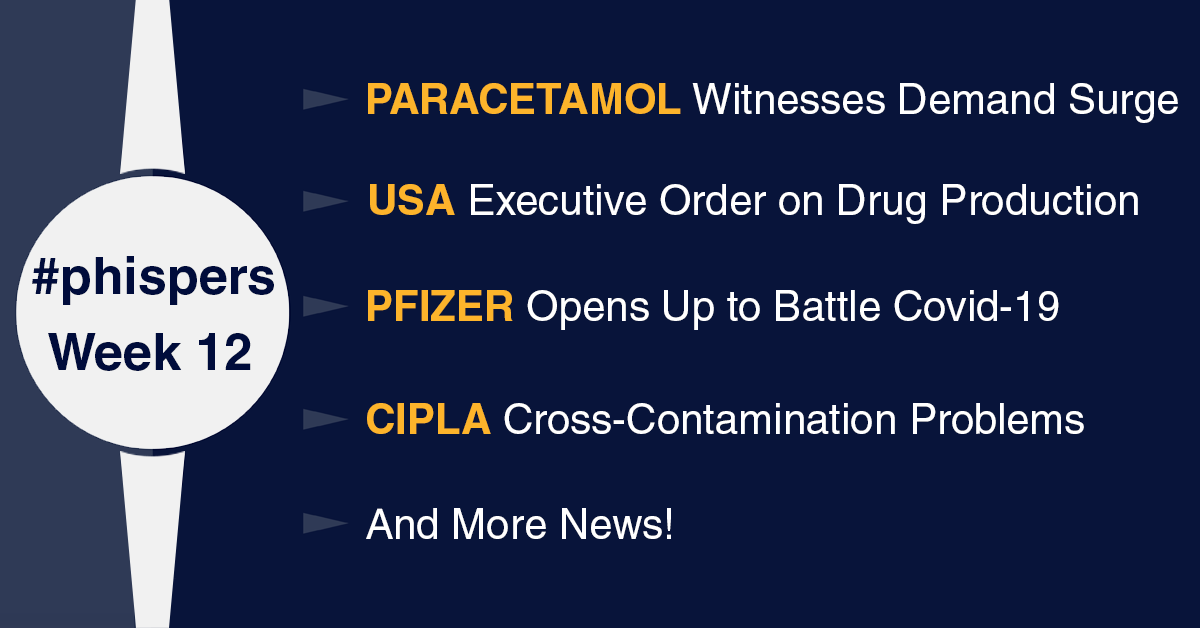
This week, Phispers has more updates on Covid-19.
The US is preparing an executive order that will reduce the country’s drug dependence on China and India.
German biotech CureVac was in news for not just its experimental coronavirus vaccine, but also for being lured by US President Donald Trump to move its research to the US.
Germany and the EU are pledging financial support to scuttle Trump’s plans.
The US Health and Human Services (HHS) department suffered a cyber-attack on its computer system over the weekend.
Tech players like Google and Microsoft launched websites to help out people during the pandemic.
J&J saw a surge in demand of its paracetamol tablet. EMA said there is no scientific evidence that ibuprofen harms Covid-19 patients.
In the US, licensed pharmacist and physicians were allowed to create batches of hand sanitizers to scale over the supply shortfall.
And Pfizer issued a five-point plan calling on the
biopharmaceutical industry to join the company in committing to unprecedented
collaboration to combat Covid-19. In the only non-Covid-19 news, Indian drug
maker Cipla was issued a warning letter by the FDA for serious
cross-contamination problems.
White House
prepares executive order to bring drug manufacturing back to US
White House
advisor Peter Navarro has said he is preparing an executive
order that would reduce America’s drug dependency on other countries.
Navarro said the executive order, he hopes to finish this week, would help relocate medical supply chains from overseas to the US.
“Most Americans
don’t know (that) 97 percent of antibiotics come to this country from China (and) 80 percent of the active ingredients in pharmaceuticals come from China and India,” Navarro said.
As part of the
order, the Trump administration is considering offering companies “100 percent expensing” to move their operations back to the United States from China, White House economic adviser Larry Kudlow said.
Navarro also said
Trump’s push for a payroll tax cut would
provide enough stimulus to help Americans through the coronavirus crisis.
Navarro has been championing a payroll tax cut as part of the fiscal response
to the coronavirus, arguing that it would serve as a US$ 800 billion economic
stimulus.
J&J’s paracetamol demand surges, France limits purchases; ‘no evidence of ibuprofen harming Covid-19 patients’
Last week, India — the world’s main supplier of generic drugs — restricted the export of some ingredients as well as medicines including paracetamol, which is also sold under the brand Tylenol in the United States. As a result, fears
around shortages of some drugs wreaked havoc on supply chains.
Johnson
& Johnson is seeing a spike
in demand for Tylenol (an over the counter painkiller) and other self-care
products, as people are stocking up essentials due to the Covid-19 scare.
J&J said it was shipping its stock in a “controlled manner” and that its manufacturing sites had ramped up production to ensure supply.
J&J
said it did not anticipate a shortage of Tylenol (paracetamol) even though the
drug “may have temporarily run out of stock at one location”.
However, France’s health agency ANSM issued a statement this
week to limit sales of paracetamol-based drugs to prevent people from
unnecessarily buying large stocks of the drug.
Taking
ibuprofen for Covid-19: Reckitt Benckiser has sought to quash warnings
against taking Nurofen, saying it was not aware of any evidence
that the ibuprofen adversely impacted patients suffering
from Covid-19.
Reckitt Benckiser’s statement followed a warning by France's health minister last week that people should not use anti-inflammatory drugs such as ibuprofen if they have coronavirus-like symptoms.
Olivier Véran, France’s health minister who is
also a qualified doctor, said in a tweet on Saturday: “The
taking of anti-inflammatories [ibuprofen, cortisone … ] could be a factor in aggravating the infection. In case of fever, take paracetamol. If you are already taking
anti-inflammatory drugs, ask your doctor’s advice.”
Meanwhile,
the European Medicines Agency (EMA) has said that there is currently no scientific
evidence establishing a link between ibuprofen and worsening of Covid‑19. EMA is monitoring
the situation closely and will review any new information that becomes
available on this issue in the context of the pandemic.
Pharmacists
to make sanitizers: In the US, stores have run out of hand sanitizer and the
FDA is worried home-made concoctions aren’t as safe to use.
Therefore, the agency is encouraging licensed pharmacists
and physicians to create batches of hand sanitizer to cut back on shortages due
to the Covid-19 pandemic.
The
FDA has said it won’t
take any enforcement action against certain facilities or licensed
professionals who make hand sanitizer for consumer use as long as they use high
quality ingredients and follow a recipe laid out by the agency. That recipe
includes suggested volumes of alcohol, glycerol, hydrogen peroxide, and sterile water.
Serious cross-contamination problems at Cipla; data-integrity issues at Windlas
Two
months after Indian drugmaker Cipla informed the bourses that its finished pharmaceuticals
manufacturing facility in Goa had been classified as Official Action Indicated (OAI) by the US Food and Drug
Administration (FDA), the warning letter issued to the facility was posted on the FDA website.
The site was inspected in September 2019, following which the
FDA investigators had issued a 38-page Form 483.
The warning letter highlights severe cross
contamination concerns at the Goa site. It follows both the inspection as well
as a review of Cipla’s responses.
During the inspection, FDA
investigators observed residue on manufacturing equipment which when tested by
Cipla confirmed the presence of multiple active ingredients. After the
inspection, Cipla also tested reserve samples of selected batches to assess the
potential for cross contamination and the testing confirmed the presence of
active ingredients from a previous product in batches of the next product.
In its warning letter, the FDA also states that there is no assurance that the scope of Cipla’s evaluation into this cross-contamination problem was comprehensive.
Following the inspection, Cipla also informed the FDA of its decision to suspend production in its sterile units where the FDA had raised concerns over atypical High Efficiency Particulate Air (HEPA) filter failures and the firm’s failure to perform adequate smoke studies to evaluate whether unidirectional flow existed in Cipla’s aseptic operations.
At the time of the inspection, Cipla’s Goa unit generated 25 to 30 percent of its US business.
This week, the FDA also shared the warning letter issued to another Indian finished
formulation manufacturer Windlas Healthcare, which
was placed on an import alert by the FDA on January 21, 2020.
An August 2019 inspection of the firm revealed several
data-integrity violations. When the FDA investigators arrived at Windlas just
30 minutes after announcing their inspection, they observed numerous employees
in the process of moving off-site cartloads of trash bags containing shredded
and torn documents and binders. Upon closer examination, the investigators
discovered batch reconciliation forms, cleaning and dispensing logs, training
assessments, and scale balance printouts. The inspection also revealed that
failing API batches had been used to manufacture and ship drug products to the
United States.
Cyberattack hits HHS in US amid Covid-19 crisis; Google, Microsoft launch websites
In
the US, the Health and Human Services Department suffered a cyber-attack
on its computer system on Sunday, March 15. The HHS is a key part of the
federal response to the fast-spreading coronavirus outbreak.
While
the cyberattack is being seen as a campaign of disruption and disinformation
that was aimed at undermining the response to the coronavirus pandemic, the HHS
Secretary Alex Azar said there was “no data breach.”
National
Security Council spokesman John Ullyot said HHS networks “are functioning normally at this time” and that officials are investigating the matter.
According
to reports, the attack, which involved overloading the HHS servers with
millions of hits over several hours, didn’t succeed in slowing the
agency’s
systems significantly.
“We had no penetration into our networks, we had no degradation of the functioning of our networks,” Azar said at a White House briefing on the coronavirus on Monday afternoon.
Covid-19
websites: Microsoft
has launched a new interactive Bing map to provide
information on the spread of Covid-19. The map shows the amount of cases on a
per country basis, broken down by the number of currently active cases,
recovered cases, and fatal cases.
Microsoft
says the tool is pulling data from a collection of sources including the World
Health Organization (WHO), the US Centers for Disease Control and Prevention
(CDC), the European Centre for Disease Prevention and Control (ECDC), and
Wikipedia.
Although
the number of cases the tool is pulling are consistent with those published by
the WHO, Microsoft’s
Covid-19 tracker appears to be having trouble surfacing relevant news stories.
Microsoft isn’t the only tech company providing tools on the pandemic. Verily – a sister company to Google under the corporate umbrella of Alphabet – launched a website
on Sunday allowing residents of two northern California counties to enter
symptoms and, if eligible, make an appointment for coronavirus testing.
However,
the rollout of this website has been marred by
confusion and limitations. Privacy concerns are also circling the
service.
By
Monday morning, the website had reached capacity, and users were informed that
no more testing appointments were available.
US
President Donald Trump had announced last week that Google had 1,700 engineers
working on a website that would “be very quickly done, unlike websites of the past, to determine whether a test is warranted and to facilitate testing at a nearby convenient location”.
Pfizer opens up
tools and capabilities to battle Covid-19
US-headquartered
drug behemoth Pfizer has issued a five-point
plan calling on the biopharmaceutical industry to join the company in
committing to unprecedented collaboration to combat COVID-19.
“In this troubling time, Pfizer is committed to doing all we can to respond to the COVID-19 pandemic,” Dr. Albert Bourla, Chairman and CEO, said in a statement.
Pfizer said it is
openly sharing its drug development talents, tools and expertise
with any company working on promising anti-Covid-19 candidates. It is also
calling on the entire biopharma industry to do the same.
“Pfizer is working to advance our own potential antiviral therapies and is engaged with BioNTech on a potential mRNA coronavirus vaccine,” Bourla said.
Pfizer
is making five promises that will help scientists more rapidly bring forward therapies and vaccines to protect humankind from this escalating pandemic. One of its promises includes offering its manufacturing capabilities. “Once a therapy or vaccine is approved it will need to be rapidly scaled and deployed around the world to put an end to this pandemic. As one of the largest manufacturers of vaccines and therapeutics, Pfizer is committed to using any excess manufacturing capacity and to potentially shifting production to support others in rapidly getting these life-saving breakthroughs into the hands of patients as quickly as possible,” a Pfizer statement said.
Pfizer is also reaching out to federal agencies to
build a cross-industry rapid response team of scientists, clinicians and
technicians able to move into action immediately when future epidemics surface.
Germany, EU try
to stop US from luring away vaccine firm CureVac
German biotech CureVac AG has been developing a Covid-19 vaccine. Florian von der Muelbe, CureVac’s chief production officer and co-founder, had told Reuters last week the company had started with a multitude of
coronavirus vaccine candidates and was now selecting the two best to go into
clinical trials. CureVac hopes to have an experimental vaccine ready by June or
July to then seek the go-ahead from regulators for testing on humans.
Alongside, there
was news that US President Donald Trump had offered funds to lure CureVac to
the United States, and the German government was making counter-offers to tempt
it to stay back.
Reports by Welt am
Sonntag and Reuters had alleged that Trump had met CureVac’s then-CEO
Daniel Menichella earlier this month (who has since left CureVac), and had
tried to lure the company over to the US to continue working on its Covid-19 mRNA
vaccine, albeit for use only
in the US.
Reports say that
Berlin is trying to stop
Washington from persuading CureVac to move
its research to the United States, prompting German politicians to insist no
country should have a monopoly on any future vaccine.
A German Health
Ministry spokeswoman said: “The German government is very interested in ensuring that vaccines and active substances against the new coronavirus are also developed in Germany and Europe.”
“In this regard, the government is in intensive exchange with the company CureVac,” she added.
Meanwhile, in a call
to CureVac this week, European Commission president Ursula von der Leyen, EU
Research Commissioner Mariya Gabriel and European Investment Bank
vice-president of innovation Ambroise Fayolle, pledged financial support “to scale up development and production of a vaccine against the coronavirus in Europe.”

















 Share
Share