Please Wait
Applying Filters...
Menu
Xls

Digital Content read-more

Create Content with PharmaCompass, ask us

DATA COMPILATION #PharmaFlow

read-more
read-more
DMF filings rise 4.5% in Q3 2025; China holds lead, India records 20% growth in submissions
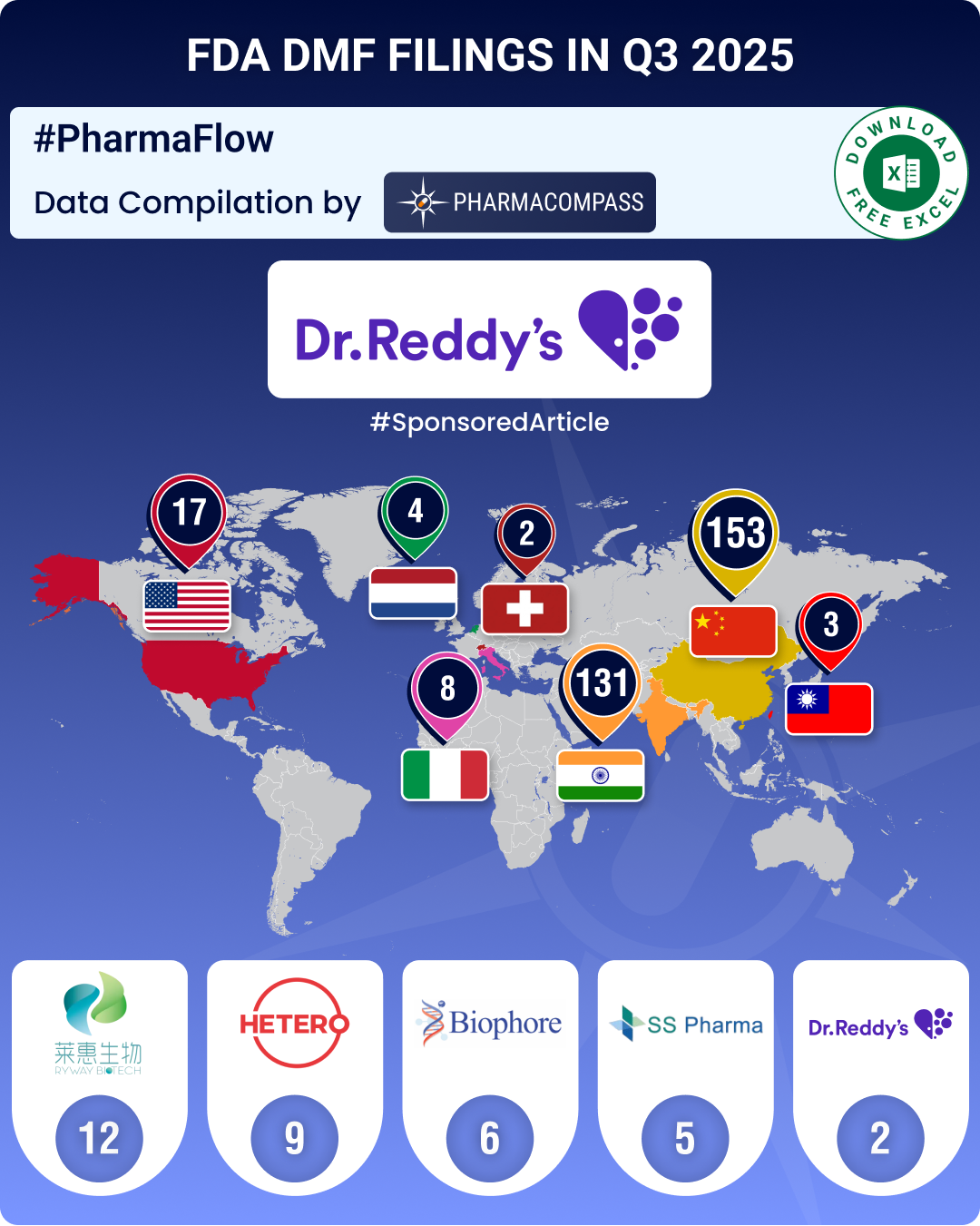
The third quarter (Q3) of 2025 witnessed a steady rise in Drug Master File (DMF) submissions to the US Food and Drug Administration (FDA). DMFs are used to provide confidential, detailed information about facilities, processes, or articles used in the manufacturing, processing, packaging, and storing of human drug productsA total of 323 Type II DMFs were submitted during this period, as opposed to 309 submissions in Q3 2024, marking an increase of 4.53 percent. This is the second highest number since 2018. In Q1 2025, 339 Type II filings were recorded.Across all DMF types (II, III, IV, and V), 479 DMFs were filed in Q3 2025, compared to 394 in Q3 2024, representing a 21.57 percent increase. Out of the 323 Type II DMFs submitted in Q3 2025, 40 had completed their review by the end of Q3, reflecting a processing lag between submission and review completion. View FDA DMF Filings in Q3 2025 (Power BI Dashboard, Free Excel Available)China maintains its lead while India posts double-digit growth in DMF submissions China and India continued to dominate DMF submissions in Q3 2025. China retained the top spot with 153 Type II DMFs, matching its submission count from Q3 2024. India recorded 131 DMFs, marking a 20.18 percent increase over 109 filings during the corresponding period last year.The United States stood a distant third with 17 filings, compared to 13 in Q3 2024. Among European nations, Italy recorded eight DMFs, doubling its 2024 tally. The Netherlands filed four, up from three. Spain submitted only one DMF, as against seven submitted in Q3 2024. Taiwan made three filings, up from one submitted in Q3 2024. Together, India, China and Taiwan accounted for about 88.9 percent of all Type II DMFs filed during the quarter. View FDA DMF Filings in Q3 2025 (Power BI Dashboard, Free Excel Available) China’s Suzhou Ryway Biotech tops corporate tally; India’s Hetero, Biophore followChina’s Suzhou Ryway Biotech led the company-wise tally with 12 DMF submissions in Q3 2025. The company had not filed any DMFs in Q3 2024.India’s Hetero Group followed with nine DMFs, maintaining the same number of filings as Q3 2024. Biophore India Pharmaceuticals ranked third with six DMFs, doubling its count from three last year.Other notable contributors include Sai Sreyas Pharmaceuticals (India) and Shanghai Haoyuan Chemexpress (China), with five DMFs each. Companies such as SNJ Group, Lunan Pharmaceutical, Allsino Pharmaceutical, Shankus Pharma, Jiangxi Xinganjiang Pharmaceutical, Sunpure Extracts, Lee Pharma, Umedica Laboratories, Linhai Tianyu Pharmaceutical and Maithri Drugs filed four DMFs each. View FDA DMF Filings in Q3 2025 (Power BI Dashboard, Free Excel Available) Olaparib, semaglutide lead molecular filings; Dr. Reddy’s files DMF for edoxaban & tucatinibDr. Reddy’s Laboratories also featured among key DMF filers in Q3 2025, submitting two DMFs — for edoxaban tosylate monohydrate and tucatinib copovidone. Edoxaban tosylate monohydrate (marketed as Savaysa by Daiichi Sankyo) is a prescription anticoagulant used to reduce the risk of stroke and to treat deep vein thrombosis and pulmonary embolism. Patent exclusivity for Savaysa extends until October 2026 in the United States, with no generic currently available.In terms of molecules, the highest number of DMFs were filed for olaparib, semaglutide, ruxolitinib phosphate, ferric carboxymaltose, and vismodegib, with three DMFs each in Q3 2025.Olaparib, sold by AstraZeneca under the brand name Lynparza, saw DMFs being filed by BDR Lifesciences and Intas Pharmaceuticals from India, and by ScinoPharm Taiwan during the quarter.Semaglutide, a glucagon-like peptide-1 (GLP-1) receptor agonist developed by Novo Nordisk, continued to draw strong interest from API manufacturers. DMFs for semaglutide were filed by three Chinese companies: Yangzhou Aurisco Pharmaceutical, Zhejiang Peptites Biotech, and Fujian Genohope Biotech.Ruxolitinib phosphate, marketed by Incyte as Jakafi, saw three DMFs. Three Indian companies — Alembic Pharmaceuticals, Valary Labs, and Devi Pharmatech — filed DMFs for this API in Q3 2025. Other molecules that received multiple DMF submissions include ferric carboxymaltose (used to treat iron-deficiency anemia) and vismodegib (an oral therapy for basal-cell carcinoma). View FDA DMF Filings in Q3 2025 (Power BI Dashboard, Free Excel Available) First-time DMF filings span 17 companies; India leads with nine first-time DMFs The quarter saw first-time DMF filings from 17 companies. India took a lead here with nine first-time DMF filings, followed by China (six), and the US (two).The DMF filings in this quarter included inclisiran sodium (filed by Aurisco Pharmaceutical of China), pacritinib citrate (by TAPI Nl B.V. of the Netherlands), and vosoritide (by Apicore LLC of the US).Out of the 19 first-time DMFs filed in Q3 2025, four completed their Generic Drug User Fee Amendments (GDUFA) review process during the quarter. View FDA DMF Filings in Q3 2025 (Power BI Dashboard, Free Excel Available) GDUFA fee for FY 2026: The FDA Generic Drug User Fee Amendments (GDUFA) is a law designed to speed access to safe and effective generic drugs to the public and reduce costs to the industry.Fee rates for fiscal year 2026 were published on July 30, 2025. FDA has revised fees under GDUFA III across all categories. While there is a slight increase in the DMF fee from US$ 95,084 in 2025 to US$ 102,584 in 2026, the ANDA fee has seen a sharp rise: from US$ 321,920 in 2025 to US$ 358,247 in 2026.FY 2025 and FY 2026 User Fee Rates Generic drug fee category Fees rates for FY 2025 Fees rates for FY 2026 Applications:     Abbreviated New Drug Application (ANDA) US$ 3,21,920 US$ 3,58,247 Drug Master File (DMF) US$ 95,084 US$ 1,02,584 Facilities:     Active Pharmaceutical Ingredient (API)—Domestic US$ 41,580 US$ 43,549 API—Foreign US$ 56,580 US$ 58,549 Finished Dosage Form (FDF)—Domestic US$ 2,31,952 US$ 2,38,943 FDF—Foreign US$ 2,46,952 US$ 2,53,943 Contract Manufacturing Organization (CMO)—Domestic US$ 55,668 US$ 57,346 CMO—Foreign US$ 70,668 US$ 72,346 GDUFA Program:     Large size operation generic drug applicant US$ 18,91,664 US$ 19,18,377 Medium size operation generic drug applicant US$ 7,56,666 US$ 7,67,351 Small business generic drug applicant US$ 1,89,166 US$ 1,91,838 Our viewFor several years prior to the pandemic, India had a lead in Type II DMF submissions. In recent years, China has surpassed India in DMF filings. But Q3 2025 numbers indicate that Indian drugmakers are fast catching up. Since DMFs establish trust in APIs from across the world, we feel this healthy competition between drugmakers from the two countries is good for the global pharmaceutical industry. 

Impressions: 4845

https://www.pharmacompass.com/radio-compass-blog/dmf-filings-rise-4-5-in-q3-2025-china-holds-lead-india-records-20-growth-in-submissions

#PharmaFlow by PHARMACOMPASS
13 Nov 2025

STOCK RECAP #PipelineProspector

read-more
read-more
Pipeline Prospector 2024 highlights: Rise in new breed of biotechs with maiden approvals; GLP-1 meds show promise beyond obesity
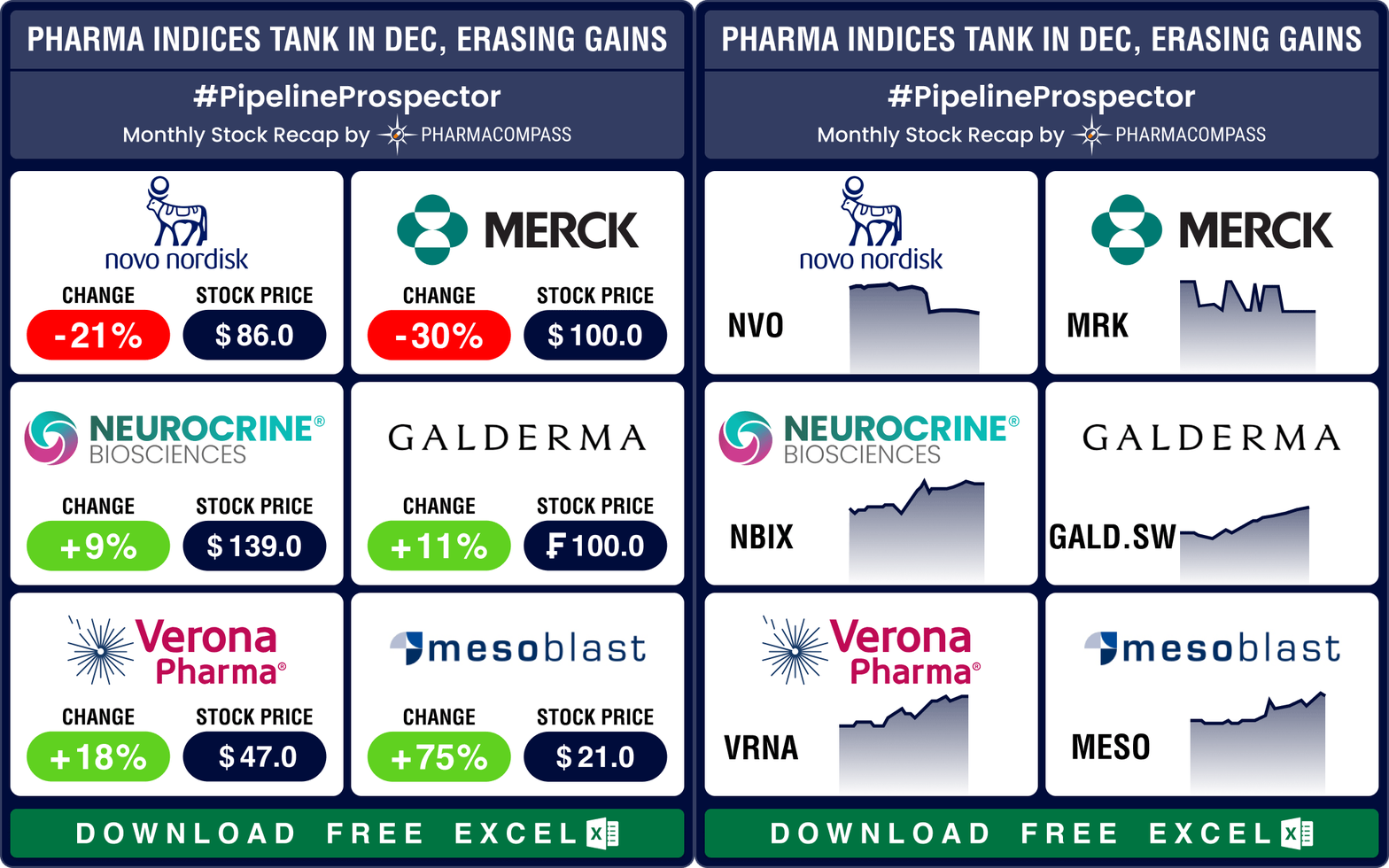
December proved to be one of the most bearish months of 2024 for the biopharma sector. The Nasdaq Biotechnology Index (NBI) sank 7.2 percent from 4,638.6 to 4,310.6. The SPDR S&P Biotech ETF (XBI) plummeted 9.6 percent (from 99.29 to 90.06) and the S&P Biotechnology Select Industry Index (SPSIBI) plunged 9.5 percent (from 7,763.7 to 7,023). This downturn in indices at the fag-end of 2024 effectively erased the gains they had made during the year. NBI was lower by 0.68 percent at the end of 2024, as opposed to 2023. XBI and SPSIBI posted modest gains of 1.84 percent and approximately 1 percent, respectively. The sector’s tepid performance stands in stark contrast to the broader market, which closed 2024 at near-record highs.  Access the Pipeline Prospector Dashboard for December 2024 Newsmakers (Free Excel) GLP-1 drugs show promise beyond obesity, diabetes; Novo Holdings completes US$ 16.5 bn Catalent buyout Glucagon-like peptide-1 (GLP-1) agonists created much news in 2024, for not just their demand and concomitant shortages, but also for their health benefits beyond weight-loss and diabetes.  December saw Lilly’s Zepbound break new ground as the first FDA-approved treatment for obstructive sleep apnea (OSA) in adults with obesity. OSA affects around 1 billion people globally. In March 2023, Novo’s Wegovy became the first obesity drug cleared by the FDA to lower the risk of cardiovascular death, heart attack, and stroke. In the same month, Novo’s blockbuster Ozempic also slashed the risk of kidney disease progression in a late-stage trial. The biggest investments in December came from Novo Nordisk and Eli Lilly — the two early entrants into the potential US$ 150 billion obesity market. Throughout 2024, the two companies kept injecting billions to boost production in order to meet the burgeoning demand. Just last month, Lilly invested US$ 3 billion to expand its recently acquired injectables plant in Wisconsin, US, to meet the soaring demand for GLP-1 drugs. And Novo invested US$ 1.2 billion to establish a new rare disease drugs plant in Odense, Denmark. After much ado, Novo Holdings completed its US$ 16.5 billion acquisition of Catalent in December, having won the greenlight from both the US Federal Trade Commission and European Commission. This was the biggest pharma deal of 2024 (announced in February). Interestingly, Lilly turned out to be the best performing pharma stock of the year (its market cap increased by a whopping US$ 163 billion in 2024) while Novo’s stock ended the year 17 percent lower than 2023. It crashed 21 percent in December after disappointing results from a late stage trial of its eagerly awaited experimental next-generation obesity drug CagriSema.  Access the Pipeline Prospector Dashboard for December 2024 Newsmakers (Free Excel)  Rise of ‘buyout-hesitant’ biotechs that bagged maiden approvals; Novartis snaps up PTC’s Huntington’s disease program Novartis has been investing in early-stage science. The Swiss drugmaker inked over 20 deals in 2024, paying over US$ 5.5 billion upfront and promising over US$ 25 billion in biobucks. In December, Novartis snapped up PTC’s Huntington’s disease program in a US$ 2.9 billion deal, including US$ 1 billion upfront. Barring the Novo-Catalent buyout, all other deals in the biopharma space last year were in the sub-US$ 5 billion range. The other major deals were Vertex’s US$ 4.9 billion acquisition of Alpine Immune, Gilead’s US$ 4.3 billion buyout of CymaBay and Lilly’s US$ 3.2 billion acquisition of Morphic Holding. The most striking trend was the emergence of a new breed of ‘buyout hesitant' biotech firms that preferred to commercialize their products independently instead of seeking Big Pharma partnerships. This shift in strategy proved successful for many, as numerous companies completed the transition from clinical-stage to commercial-stage operations. December saw several such notable commercial debuts. Ionis Pharmaceuticals secured approval of Tryngolza, the first-ever treatment for familial chylomicronemia syndrome (FCS), a rare genetic disorder. Mesoblast’s cell therapy Ryoncil gained US approval for treating post-transplant complications (graft-versus-host disease), offering a novel approach to managing immune-related adverse events. Mesoblast’s stock grew 950 percent in 2024. Similarly, Checkpoint Therapeutics (stock up 50 percent in 2024) secured FDA approval for Unloxcyt, targeting cutaneous squamous cell carcinoma in patients with locally advanced or metastatic disease where surgery and radiation are not viable options. Merus’ Bizengri brought new options to patients with hard-to-treat cancers, adding to the growing arsenal of precision oncology treatments. Merus’ stock ballooned 48 percent last year. Though the trend caught momentum in December, even the preceding months of 2024 saw significant debuts. For instance, in March, Madrigal’s Rezdiffra became the first drug approved in the US for the common fatty liver disease known as metabolic dysfunction-associated steatohepatitis (MASH). Madrigal’s stock grew 35 percent last year. Similarly, Verona brought to market Ohtuvayre (approved in June), the first new mechanism of action in over two decades for the treatment of chronic obstructive pulmonary disease. Verona’s stock soared 147 percent in 2024. And in May, PTC’s Kebilidi, a treatment for enzyme deficiency disorder, became the first FDA-approved gene therapy directly administered to the brain. PTC’s stock rose 68 percent in 2024.  Access the Pipeline Prospector Dashboard for December 2024 Newsmakers (Free Excel)  Drug approvals gain momentum in December; Vertex, Neurocrine, Astra score wins The year 2024 saw some landmark drug approvals. And as the year drew to a close, FDA began approving drugs at a feverish pace. Novo won approval for Alhemo, a once-daily subcutaneous injection that significantly reduces bleeding episodes in hemophilia patients, marking a shift from more burdensome treatment regimens.  Vertex Pharmaceuticals expanded treatment options for cystic fibrosis patients with its triple combination therapy that targets specific genetic variants of the disease. Dermatology saw two advancements with the approvals of Organon’s Vtama cream and Galderma’s Nemluvio injection, both targeting atopic dermatitis through distinct mechanisms. FDA also approved Neurocrine Biosciences’ Crenessity — the first new treatment in 70 years for classic congenital adrenal hyperplasia, a rare hormonal disorder. The oncology landscape saw Bristol Myers-Squibb enhance patient convenience with Opdivo Qvantig, an injectable formulation of its blockbuster cancer drug. And FDA expanded the approval of AstraZeneca’s Imfinzi to treat adults with limited-stage small cell lung cancer.  Access the Pipeline Prospector Dashboard for December 2024 Newsmakers (Free Excel)  Our view The industry dynamics witnessed a marked shift in 2024. The absence of mega-mergers, coupled with Novartis’ approach to buy smaller companies, suggests a more measured approach to deal-making. The emergence of companies like Madrigal, Verona, and Ionis signals a maturing biotech sector, less dependent on Big Pharma partnerships. Looking ahead, this evolution could herald a more diverse and resilient industry landscape. Access the Pipeline Prospector Dashboard for December 2024 Newsmakers (Free Excel) 

Impressions: 14630

https://www.pharmacompass.com/pipeline-prospector-blog/pipeline-prospector-2024-highlights-rise-in-new-breed-of-biotechs-with-maiden-approvals-glp-1-meds-show-promise-beyond-obesity

#PharmaFlow by PHARMACOMPASS
09 Jan 2025

WEEKLY NEWS RECAP #Phispers

read-more
read-more
Novo invests US$ 1.2 bn in new rare disease plant in Denmark; FDA approves two drugs for atopic dermatitis

As the year draws to a close, the US Food and Drug Administration (FDA) has been approving drugs at a feverish pace. It approved two significant treatments for atopic dermatitis — Organon’s Vtama cream and Galderma’s Nemluvio injection. It also approved Mesoblast’s cell therapy — Ryoncil — that treats a complication that can occur after a cell transplant.Neurocrine Biosciences achieved a historic milestone with the approval of Crenessity, the first new med in seven decades to treat classic congenital adrenal hyperplasia (CAH), a rare disorder affecting the production of hormones. Checkpoint Therapeutics marked its transition to a commercial-stage company with the FDA approval of Unloxcyt, the first PD-L1 inhibitor for treating advanced cutaneous squamous cell carcinoma.Among drugmakers, Novo Nordisk made much news. First, it announced plans to establish a US$ 1.2 billion production facility in Odense, Denmark, focused on manufacturing rare disease drugs including hemophilia treatments. Second, its parent company, Novo Holdings, cleared a significant hurdle in its US$ 16.5 billion acquisition of Catalent, with the US Federal Trade Commission (FTC) okaying the deal. And third, its popular diabetes drug Ozempic came under scrutiny when two studies suggested that it can more than double the risk of a rare eye condition that can cause sudden vision loss. The European Medicines Agency (EMA) is reviewing the two studies.Meanwhile, Merck entered the race for weight loss drugs by signing a global licensing deal worth up to US$ 2 billion with Chinese biotech Hansoh Pharma. Novo Nordisk invests US$ 1.2 bn to build new rare disease drugs plant in DenmarkNovo Nordisk is investing US$ 1.2 billion to establish a new production facility in Odense, Denmark. This facility will focus on manufacturing drugs for rare diseases, including treatments for hemophilia. The new plant, spanning 40,000 square meters, is expected to create 400 permanent jobs upon its completion in 2027. This investment marks the Danish drugmaker’s first new factory in the country this century.Ozempic linked to sudden vision loss: Novo’s Ozempic (semaglutide) has come under scrutiny due to potential links to a rare eye condition known as non-arteritic anterior ischemic optic neuropathy (NAION). This condition can cause sudden and irreversible vision loss. Two studies conducted by the University of Southern Denmark found that Ozempic more than doubles the risk of developing NAION in type 2 diabetes patients. The European Medicines Agency has said it will review the two Danish studies. The agency has said that to this point, evidence has not supported a connection between the GLP-1 and NAION.After intense scrutiny, FTC okays Novo Holdings’ US$ 16.5 bn buyout of CatalentNovo Holdings is set to finalize its US$ 16.5 billion acquisition of Catalent after getting the FTC greenlight. This deal, which has been under intense scrutiny, also includes Novo Nordisk's plan to purchase three of Catalent’s fill-finish sites for US$ 11 billion, which will bolster its production capacity for injectable drugs like Wegovy (semaglutide).Last week, the buyout also received the go-ahead from EU regulators. The deal has faced criticism from lawmakers and consumer groups concerned about potential anti-competitive effects, particularly in the GLP-1 drug market, where Novo Nordisk and Eli Lilly are major players.Merck enters race for obesity drugs via US$ 2 bn licensing deal with Chinese biotechMerck has signed a global licensing deal worth up to US$ 2 billion with Chinese biotech Hansoh Pharma for its experimental oral drug to treat obesity. Merck will develop, manufacture and potentially sell the drug — HS-10535 — which is an investigational preclinical oral small molecule GLP-1 receptor agonist.Merck is a late entrant in the GLP-1 space, as several players (including Amgen and Pfizer) are already testing their candidates. Merck will pay Hansoh US$ 112 million upfront, and US$ 1.9 billion in various milestone payments. Hansoh will also be eligible for royalties on net sales.Meanwhile, Merck is discontinuing the development of two cancer candidates, vibostolimab and favezelimab, after receiving underwhelming data from phase 3 trials.FDA okays Organon’s Vtama cream, Galderma’s Nemluvio shot for atopic dermatitisFDA has approved two treatments for atopic dermatitis (AD), one a cream and the other an injection. Organon’s Vtama (tapinarof) cream was approved for the treatment of AD in adults and children as young as two years. This approval came months ahead of its adjusted PDUFA date of March 12, 2025.The nod came three months after New Jersey-based Organon acquired the product in a US$ 1.2 billion takeover of Dermavant. This could help spark stagnant sales of Vtama, which has not lived up to analyst expectations as a novel, steroid-free treatment.Galderma’s Nemluvio (nemolizumab-ilto), a subcutaneous injection, was approved for patients aged 12 years and older with moderate-to-severe AD. Nemluvio is designed to be used alongside topical corticosteroids and/or calcineurin inhibitors. It is the first humanized IgG2 monoclonal antibody that targets the IL-31 receptor. It achieved significant improvements in skin clearance, itch relief, and reduced sleep disturbances compared to placebo in a phase 3 trial of over 1,700 patients. Galderma anticipates Nemluvio to achieve blockbuster status by the end of 2027 with peak sales exceeding US$ 2 billion.Mesoblast’s cell therapy okayed: FDA has approved Mesoblast’s cell therapy — Ryoncil — that treats graft-versus-host disease (GVHD), a complication that can occur after a cell transplant, where the donated stem cells attack the recipient’s cells, viewing them as an unfamiliar threat. Ryoncil is the first such therapy approved to treat pediatric patients aged two months and older whose GVHD symptoms have not responded to standard steroid therapy. FDA approves Neurocrine’s Crenessity — first med for CAH in seven decadesFDA has approved Neurocrine Biosciences’ new drug, Crenessity (crinecerfont), calling it an “important advance” for treating classic congenital adrenal hyperplasia (CAH) in both children and adults. CAH is a rare genetic disorder that affects the adrenal glands, leading to an overproduction of androgens and a deficiency in cortisol. This can lead to symptoms such as dehydration, vomiting, and in extreme cases, life-threatening salt loss. Crenessity is the first new treatment for CAH in seven decades.Checkpoint’s skin cancer drug bags FDA nod: FDA has approved Checkpoint Therapeutics’ Unloxcyt (cosibelimab-ipdl) for treating cutaneous squamous cell carcinoma (cSCC), a type of cancer that affects the outer layer of the skin. This approval is for cases where the cancer is locally advanced or has spread to other parts of the body, making surgery and radiation unviable.

Impressions: 1015

https://www.pharmacompass.com/radio-compass-phisper/novo-invests-us-1-2-bn-in-new-rare-disease-plant-in-denmark-fda-approves-two-drugs-for-atopic-dermatitis

#Phispers by PHARMACOMPASS
19 Dec 2024

NEWS #PharmaBuzz

read-more
read-more

https://www.businesswire.com/news/home/20260415800059/en/Organons-VTAMA-tapinarof-cream-1-Granted-Strong-Recommendation-in-the-2026-American-Academy-of-Dermatology-Guidelines-for-Pediatric-Atopic-Dermatitis

BUSINESSWIRE
15 Apr 2026

https://www.businesswire.com/news/home/20260327556082/en/Organon-Debuts-New-Analysis-of-VTAMA-tapinarof-cream-1-Phase-3-Pooled-Data-Demonstrating-Early-and-Consistent-Skin-Clearance-and-Itch-Improvement-in-Atopic-Dermatitis-Patients-Down-to-2-Years-of-Age

BUSINESSWIRE
27 Mar 2026

https://www.globenewswire.com/news-release/2026/03/26/3263002/0/en/CDT-Equity-Expands-Tapinarof-Intellectual-Property-Portfolio-with-Two-New-Patent-Filings.html

GLOBENEWSWIRE
26 Mar 2026

https://www.businesswire.com/news/home/20260227912195/en/New-Analysis-of-Organons-VTAMA-tapinarof-cream-1-Phase-3-Data-Showed-Early-and-Consistent-Improvement-in-Patient-Reported-Sleep-Subdomains-in-Pediatric-Patients-Down-to-2-Years-of-Age-with-Atopic-Dermatitis

BUSINESSWIRE
27 Feb 2026

https://www.businesswire.com/news/home/20251108738421/en/New-Data-Show-Early-and-Consistent-Response-to-VTAMA-tapinarof-Cream-1-in-Children-Aged-2-with-Atopic-Dermatitis-Including-Those-With-Associated-Comorbidities

BUSINESSWIRE
08 Nov 2025

https://www.businesswire.com/news/home/20250707974353/en/Organons-VTAMA-tapinarof-cream-1-Granted-Strong-Recommendation-in-the-American-Academy-of-Dermatology-Updated-2025-Guidelines-for-Adult-Atopic-Dermatitis

BUSINESSWIRE
07 Jul 2025