Please Wait
Applying Filters...
Menu
Xls

Digital Content read-more

Create Content with PharmaCompass, ask us

DATA COMPILATION #PharmaFlow

read-more
read-more
DMF filings rise 4.5% in Q3 2025; China holds lead, India records 20% growth in submissions
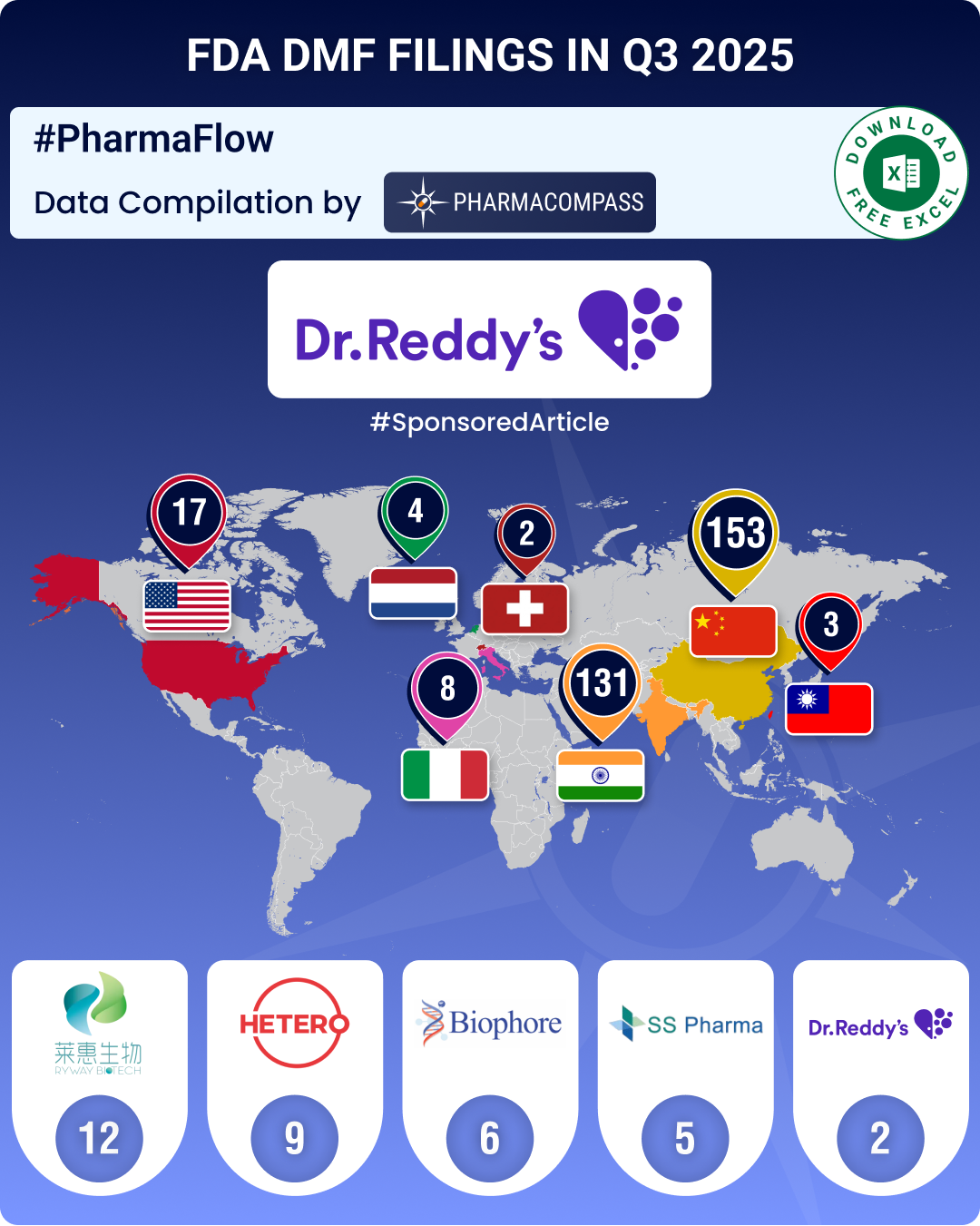
The third quarter (Q3) of 2025 witnessed a steady rise in Drug Master File (DMF) submissions to the US Food and Drug Administration (FDA). DMFs are used to provide confidential, detailed information about facilities, processes, or articles used in the manufacturing, processing, packaging, and storing of human drug productsA total of 323 Type II DMFs were submitted during this period, as opposed to 309 submissions in Q3 2024, marking an increase of 4.53 percent. This is the second highest number since 2018. In Q1 2025, 339 Type II filings were recorded.Across all DMF types (II, III, IV, and V), 479 DMFs were filed in Q3 2025, compared to 394 in Q3 2024, representing a 21.57 percent increase. Out of the 323 Type II DMFs submitted in Q3 2025, 40 had completed their review by the end of Q3, reflecting a processing lag between submission and review completion. View FDA DMF Filings in Q3 2025 (Power BI Dashboard, Free Excel Available)China maintains its lead while India posts double-digit growth in DMF submissions China and India continued to dominate DMF submissions in Q3 2025. China retained the top spot with 153 Type II DMFs, matching its submission count from Q3 2024. India recorded 131 DMFs, marking a 20.18 percent increase over 109 filings during the corresponding period last year.The United States stood a distant third with 17 filings, compared to 13 in Q3 2024. Among European nations, Italy recorded eight DMFs, doubling its 2024 tally. The Netherlands filed four, up from three. Spain submitted only one DMF, as against seven submitted in Q3 2024. Taiwan made three filings, up from one submitted in Q3 2024. Together, India, China and Taiwan accounted for about 88.9 percent of all Type II DMFs filed during the quarter. View FDA DMF Filings in Q3 2025 (Power BI Dashboard, Free Excel Available) China’s Suzhou Ryway Biotech tops corporate tally; India’s Hetero, Biophore followChina’s Suzhou Ryway Biotech led the company-wise tally with 12 DMF submissions in Q3 2025. The company had not filed any DMFs in Q3 2024.India’s Hetero Group followed with nine DMFs, maintaining the same number of filings as Q3 2024. Biophore India Pharmaceuticals ranked third with six DMFs, doubling its count from three last year.Other notable contributors include Sai Sreyas Pharmaceuticals (India) and Shanghai Haoyuan Chemexpress (China), with five DMFs each. Companies such as SNJ Group, Lunan Pharmaceutical, Allsino Pharmaceutical, Shankus Pharma, Jiangxi Xinganjiang Pharmaceutical, Sunpure Extracts, Lee Pharma, Umedica Laboratories, Linhai Tianyu Pharmaceutical and Maithri Drugs filed four DMFs each. View FDA DMF Filings in Q3 2025 (Power BI Dashboard, Free Excel Available) Olaparib, semaglutide lead molecular filings; Dr. Reddy’s files DMF for edoxaban & tucatinibDr. Reddy’s Laboratories also featured among key DMF filers in Q3 2025, submitting two DMFs — for edoxaban tosylate monohydrate and tucatinib copovidone. Edoxaban tosylate monohydrate (marketed as Savaysa by Daiichi Sankyo) is a prescription anticoagulant used to reduce the risk of stroke and to treat deep vein thrombosis and pulmonary embolism. Patent exclusivity for Savaysa extends until October 2026 in the United States, with no generic currently available.In terms of molecules, the highest number of DMFs were filed for olaparib, semaglutide, ruxolitinib phosphate, ferric carboxymaltose, and vismodegib, with three DMFs each in Q3 2025.Olaparib, sold by AstraZeneca under the brand name Lynparza, saw DMFs being filed by BDR Lifesciences and Intas Pharmaceuticals from India, and by ScinoPharm Taiwan during the quarter.Semaglutide, a glucagon-like peptide-1 (GLP-1) receptor agonist developed by Novo Nordisk, continued to draw strong interest from API manufacturers. DMFs for semaglutide were filed by three Chinese companies: Yangzhou Aurisco Pharmaceutical, Zhejiang Peptites Biotech, and Fujian Genohope Biotech.Ruxolitinib phosphate, marketed by Incyte as Jakafi, saw three DMFs. Three Indian companies — Alembic Pharmaceuticals, Valary Labs, and Devi Pharmatech — filed DMFs for this API in Q3 2025. Other molecules that received multiple DMF submissions include ferric carboxymaltose (used to treat iron-deficiency anemia) and vismodegib (an oral therapy for basal-cell carcinoma). View FDA DMF Filings in Q3 2025 (Power BI Dashboard, Free Excel Available) First-time DMF filings span 17 companies; India leads with nine first-time DMFs The quarter saw first-time DMF filings from 17 companies. India took a lead here with nine first-time DMF filings, followed by China (six), and the US (two).The DMF filings in this quarter included inclisiran sodium (filed by Aurisco Pharmaceutical of China), pacritinib citrate (by TAPI Nl B.V. of the Netherlands), and vosoritide (by Apicore LLC of the US).Out of the 19 first-time DMFs filed in Q3 2025, four completed their Generic Drug User Fee Amendments (GDUFA) review process during the quarter. View FDA DMF Filings in Q3 2025 (Power BI Dashboard, Free Excel Available) GDUFA fee for FY 2026: The FDA Generic Drug User Fee Amendments (GDUFA) is a law designed to speed access to safe and effective generic drugs to the public and reduce costs to the industry.Fee rates for fiscal year 2026 were published on July 30, 2025. FDA has revised fees under GDUFA III across all categories. While there is a slight increase in the DMF fee from US$ 95,084 in 2025 to US$ 102,584 in 2026, the ANDA fee has seen a sharp rise: from US$ 321,920 in 2025 to US$ 358,247 in 2026.FY 2025 and FY 2026 User Fee Rates Generic drug fee category Fees rates for FY 2025 Fees rates for FY 2026 Applications:     Abbreviated New Drug Application (ANDA) US$ 3,21,920 US$ 3,58,247 Drug Master File (DMF) US$ 95,084 US$ 1,02,584 Facilities:     Active Pharmaceutical Ingredient (API)—Domestic US$ 41,580 US$ 43,549 API—Foreign US$ 56,580 US$ 58,549 Finished Dosage Form (FDF)—Domestic US$ 2,31,952 US$ 2,38,943 FDF—Foreign US$ 2,46,952 US$ 2,53,943 Contract Manufacturing Organization (CMO)—Domestic US$ 55,668 US$ 57,346 CMO—Foreign US$ 70,668 US$ 72,346 GDUFA Program:     Large size operation generic drug applicant US$ 18,91,664 US$ 19,18,377 Medium size operation generic drug applicant US$ 7,56,666 US$ 7,67,351 Small business generic drug applicant US$ 1,89,166 US$ 1,91,838 Our viewFor several years prior to the pandemic, India had a lead in Type II DMF submissions. In recent years, China has surpassed India in DMF filings. But Q3 2025 numbers indicate that Indian drugmakers are fast catching up. Since DMFs establish trust in APIs from across the world, we feel this healthy competition between drugmakers from the two countries is good for the global pharmaceutical industry. 

Impressions: 4802

https://www.pharmacompass.com/radio-compass-blog/dmf-filings-rise-4-5-in-q3-2025-china-holds-lead-india-records-20-growth-in-submissions

#PharmaFlow by PHARMACOMPASS
13 Nov 2025

WEEKLY NEWS RECAP #Phispers

read-more
read-more
Insys founder Kapoor convicted in opioid scandal; FDA rules changing due to new technologies
This week, Phispers brings you news about John Kapoor, the founder of Insys who was found guilty of engaging in a bribery scheme to get doctors to prescribe a highly potent and addictive opioid. FDA granted approval to Pfizer’s rare and fatal heart disease drug — tafamidis. Sanofi’s controversial dengue vaccine also bagged the FDA nod, albeit with several caveats. Lundbeck bought Abide Therapeutics for US$ 250 million, a company that has been working on a cannabinoid platform for new drugs to treat brain diseases. Meanwhile Ned Sharpless, the acting commissioner of the FDA, said he will take the agency in the same direction as Gottlieb. In biosimilars, Biocon said it is looking at the potential option of raising money through an IPO by spinning off its biologics business as a separate entity. And Torrent Pharma’s API facility in India received an FDA Form 483, wherein the agency has raised concerns over its investigations and process validations. Billionaire John Kapoor found guilty in bribery scheme to drive opioid sales   Indian-American billionaire John Kapoor, who founded Insys Therapeutics, and four of his senior colleagues have been found guilty of engaging in a bribery scheme to get doctors to prescribe its potent and addictive opioid painkiller — Subsys. A federal jury in Boston has also charged them with duping insurers into paying for the drug. Each defendant — Kapoor; former vice-president of managed markets Michael Gurry; former national director of sales Richard Simon; and former regional sales directors Sunrise Lee and Joseph Rowan — faces up to 20 years in jail. Kapoor is the first CEO of an opioid maker to be convicted in a trial. The historic criminal conviction takes aim at the powerful pharmaceutical executives behind a marketing ploy designed to put profit ahead of patients. All five of them have denied any wrongdoing on their part, and have also signaled their plans to appeal against the judgement. Kapoor created Insys in 1990. In 2012, the company’s fentanyl spray — Subsys — was approved by the FDA for breakthrough cancer pain. Fentanyl is a man-made opioid 50 times more potent than heroin and 100 times more potent than morphine.  Three years later, in a damning report, Roddy Boyd of the Southern Investigative Reporting Foundation brought to light the deadly impact of Subsys (when prescribed indiscriminately), triggered by Insys’ questionable marketing practices. In 2017, Kapoor was charged with criminal conspiracy, on the same day as the US President Donald Trump declared the US opioid crisis a public health emergency. FDA’s inspection at Torrent raises concerns over investigations into OOS results   An eight-day FDA inspection at Torrent Pharmaceuticals’ finished dosage form and active ingredient facility in India revealed concerns over investigations and process validations. The Form 483 posted on the FDA website following the April 2019 inspection highlighted that over the past three years Torrent’s investigations into out of specification (OOS) results for finished products had concluded that almost 73 percent of them were invalid. The FDA investigation mentions almost a dozen examples where the original failing results were invalidated without a scientifically-sound and justifiable root cause. In addition, “review of process validation documents revealed that manufacturing batches run under a process validation protocol failed to meet requirements and quality attributes.” However, the process validation was deemed acceptable and counted towards successful manufacturing process validation. Torrent Pharmaceuticals has been besieged with drug recalls in the United States as its ‘sartan’ products have been found to contain cancerous nitrosamine impurities, which were found to be above the acceptable daily intake limits released by the FDA. Sharpless calls for nimble FDA; Gottlieb had sought changing FDA rules due to new technologies   In his first speech to an outside group since taking charge as the acting commissioner of the US Food and Drug Administration (FDA), Ned Sharpless has revealed that he will keep the agency headed in the same direction as his predecessor Scott Gottlieb. Last month, Sharpless took over the reins of the FDA from Gottlieb, who resigned from the post after two years on the job in order to spend more time with family. “If we want to harness the full potential of therapies to transform care, we need to become more efficient, more collaborative, and more data-driven so that we can learn from every patient’s journey,” Sharpless said. “It is crucial that FDA be nimble, flexible, and adaptable as we continue to advance regulatory frameworks, products, and interventions,” he added. Known for his deep understanding of oncology and big data, Sharpless, said he has a commitment to science-based decision-making and will prioritize the FDA’s efforts to benefit public health. Sharpless spoke at the Food and Drug Law Institute’s (FDLI) annual conference in Washington, DC, and at the Reagan Udall Foundation’s annual public meeting at Pew Charitable Trusts. Meanwhile, the US Congress passed a new law that gave the FDA the authority to impose Risk Evaluation and Mitigation Strategies (REMS) and Elements to Assure Safe Use (ETASU). These measures were meant for certain drugs that had serious safety concerns associated with their use. The agency’s aim was to help ensure that the benefits of drugs with known safety issues would outweigh their risks. The agency also pursued, and acquired, the authority to require drugmakers to conduct post-market studies to minutely evaluate emerging safety concerns. These new capabilities represent a fundamental modernization in the FDA’s review process. Former FDA commissioner Gottlieb had talked about changes the agency maybe undertaking due to the new therapies and technologies that have come in the market. According to industry sources, old rules of the FDA do not apply to new technologies such as artificial intelligence and gene therapy. Moreover, safety issues will be more challenging to identify in clinical trial settings due to these new technologies. According to sources, FDA may issue new guidelines for cell therapy in a year’s time. Moreover, as phenotype, genotype and other targeted and innovative medicines emerge, pre-market testing will become more challenging. The agency is adopting a standard dynamic template for submissions. It will eliminate paper from the submission process. Moreover, the agency is also working on Medicare Part B reimbursements since Medicare has a difficult time adjusting payments for new medicines such as CAR-T or chimeric antigen receptor T-cell therapy, a relatively new immunotherapy for cancer.    Biosimilars on a roll: Biocon’s potential IPO; new launches by Fresenius, Pfizer   There was a lot of news from the world of biosimilars. First, Fresenius Kabi announced it is launching its first biosimilar medicine in Germany — Idacio. The drug is a biosimilar of the world’s best-selling drug Humira and is available in the following administration options: pre-filled syringe, pre-filled pen and vial. The launch follows marketing authorization granted by the European Commission (EC) to Idacio for all indications of Humira in the areas of rheumatology, gastroenterology and dermatology. “The launch of Idacio in Germany is an important milestone for our company and for all patients who will now have an additional option for access to high-quality treatment,” Michael Schönhofen, President Pharmaceuticals and Devices Division of Fresenius Kabi, said. Second, Pfizer is preparing for three biosimilar launches this year in the field of cancer-care — trastuzumab, rituximab and bevacizumab. “Trastuzumab was already launched in the EU in the first quarter, and we look forward to the launch of trastuzumab in Japan in the third quarter,” Pfizer’s group president of biopharmaceuticals, Angela Hwang, told investors. “Rituximab will also be launched in Japan, and that will be in the fourth quarter.” “Bevacizumab will be launched in both the US and Japan in the fourth quarter,” she revealed. “We’ve seen some nice uptake in the supportive oncology portfolio that we launched late last year and we look forward to the oncology biosimilar portfolio contributing to our growth,” Hwang stated. Since the start of this year, Pfizer has already boosted its oncology biosimilars portfolio by obtaining an authorization in the EU for Zirabev, a biosimilar to Avastin (bevacizumab) for treating multiple forms of advanced or metastatic cancer. And in the US, the FDA had approved Pfizer’s Trazimera (trastuzumab-qyyp) biosimilar to Herceptin in March as a treatment for certain forms of breast and gastric cancer.  “Revenues from our biosimilars portfolio grew 7 percent operationally in the quarter,” CEO Albert Bourla said.  Biocon Biologics IPO: Indian drugmaker Biocon Limited continued to show strong results in the fourth quarter, buoyed by momentum in its biologics business and robust growth in its research services segment. Chairperson and managing director Kiran Mazumdar-Shaw has said Biocon could spin-out its biologics division to raise funds for further biosimilar development. During an investor call, Biocon said it is looking at consolidating its biosimilars business under Biocon Biologics India Limited. “And one of the potential options for our money raising is the IPO, and we can consider raising IPO at this entity level,” the company said. Biocon’s biologics business grew 87 percent to US$ 64.6 million (INR 4.51 billion) in the fourth quarter of the financial year that ended in March 2019. Mazumdar-Shaw termed the year as a “landmark” year for the segment, as the revenues crossed US$ 200 million.  “Our biosimilar strategy has begun to deliver with the start of monetization of our biosimilars pipeline in the developed markets of the US and EU. The launch of biosimilar pegfilgrastim (marketed as Fulphila by Biocon’s partner Mylan NV) in the US and the ramp-up of sales of our biosimilar trastuzumab in emerging markets were the main contributors to this growth,” Mazumdar-Shaw said. Pfizer’s rare disease drug, Sanofi’s dengue vaccine bag FDA nod; Lundbeck buys Abide   Sanofi’s controversial dengue vaccine — Dengvaxia, which took two decades to develop, has bagged the approval of the US Food and Drug Administration (FDA), albeit with a raft of caveats. Last week, the US regulator sanctioned the use of Dengvaxia as the first-ever product to prevent the mosquito-borne disease in individuals who have previously contracted dengue and who live in areas rife with the disease. Originally, Sanofi had sought approval for people aged 9 to 45. But the FDA has only recommended its use in individuals aged 9 to 16 who have had laboratory-confirmed previous dengue infection and live in areas where the disease is endemic, such as Puerto Rico, the US Virgin Islands and American Samoa. The FDA said Dengvaxia — which is administered as three separate injections — was found to be roughly 76 percent effective in preventing symptomatic dengue disease in individuals aged 9 to 16 who previously had laboratory-confirmed dengue disease. However, according to Sanofi, the FDA hasn’t cleared any tests in the United States to determine a previous dengue infection. Meanwhile, the US FDA has approved Pfizer Inc’s oral drug, tafamidis to treat a rare and fatal heart disease, known as transthyretin amyloid cardiomyopathy. Tafamidis had earlier been rejected by the FDA. But now, it is ready to disrupt a rare-disease field only recently tapped by Alnylam and Ionis. Pfizer’s tafamidis, to be sold under brand name Vyndaqel, comes at a list price of US$ 225,000 a year for the medicine. According to analysts, its annual sales are forecast to exceed US$ 1 billion in 2024. Tafamidis is the first approved medicine for the disease in the United States. Pfizer believes there are about 100,000 people in the United States with the condition, the vast majority undiagnosed. Only about 2,000 to 5,000 patients are currently diagnosed with the progressive heart disease globally. The company has been in talks with insurers and is confident the drug will be reimbursed at the US$ 225,000 list price, he said. Lundbeck buys into cannabinoid platform: New Lundbeck CEO Deborah Dunsire is turning to M&As to build the company’s drug pipeline. Dunsire had agreed to pay US$ 250 million cash to buy San Diego-based Abide Therapeutics, where researchers have been working on a cannabinoid platform for new drugs to treat brain diseases. In addition to the cash, Lundbeck is keeping aside up to US$ 150 million for milestones. And the drugmaker will be retaining the San Diego base, designating it as a discovery center for Lundbeck.  

Impressions: 3741

https://www.pharmacompass.com/radio-compass-phisper/insys-founder-kapoor-convicted-in-opioid-scandal-fda-rules-changing-due-to-new-technologies

#Phispers by PHARMACOMPASS
09 May 2019

NEWS #PharmaBuzz

read-more
read-more

https://www.biospace.com/drug-development/bridgebio-stands-up-to-pfizer-in-attr-cm-as-late-stage-data-hint-at-better-survival

BIOSPACE
12 May 2026

https://www.globenewswire.com/news-release/2026/05/11/3291995/0/en/acoramidis-continues-to-demonstrate-disease-modifying-effects-in-attr-cm-reducing-sttr-variability-and-outpatient-worsening-heart-failure.html

GLOBENEWSWIRE
11 May 2026

https://www.businesswire.com/news/home/20260428954117/en/Pfizer-Reaches-Three-Settlement-Agreements-for-VYNDAMAX

BUSINESSWIRE
28 Apr 2026

https://endpoints.news/pfizer-delays-patent-cliff-for-blockbuster-vyndamax/

ENDPOINTS
28 Apr 2026

https://firstwordpharma.com/story/7232259

FIRSTWORD PHARMA
28 Apr 2026

https://www.fiercepharma.com/pharma/bridgebio-shares-slide-amid-pfizer-reported-decision-withdraw-vyndamax-eu-patent

FIERCE PHARMA
06 Feb 2026