This week, Phispers brings you updates on Covid vaccines,
news on regulatory actions, legal battles involving drugmakers and deals that
may involve scrutiny by the Federal Trade Commission (FTC) in the US.
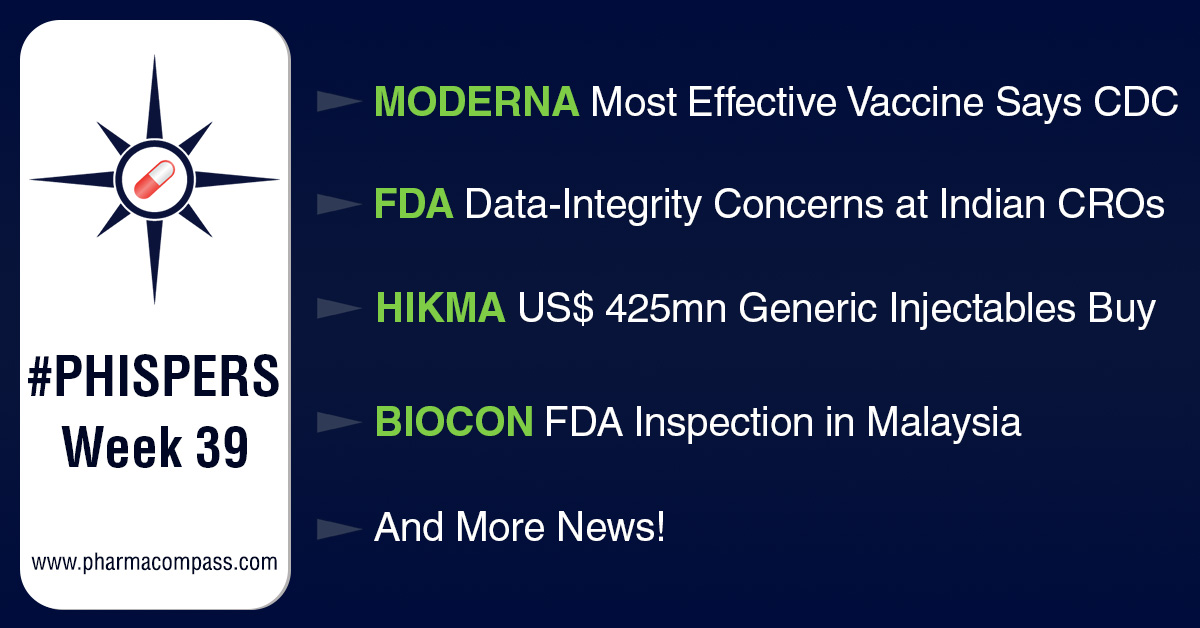
In Covid news, America’s Centers for Disease Control and Prevention (CDC) had commissioned a study on the three authorized vaccines from Pfizer, Moderna and J&J that has found Moderna to be the most effective vaccine for Covid-19. Sanofi has decided to halt development of its unmodified mRNA Covid-19 vaccine and Pfizer-BioNtech
submitted data on trials on five to 11 year old children.
In regulatory news, Indian biotech major Biocon received FDA’s Form 483 with six observations after an inspection of its manufacturing facility in Malaysia. And two Indian CROs came under FDA’s lens over data integrity concerns.
There were two pay-for-delay
lawsuits in the US. While two American pharmacy chains slapped a case against
Gilead, BMS and Teva for engaging in a “multifaceted scheme to suppress and delay” generic rivals of Gilead’s HIV medicines, two insurance companies
slapped lawsuits on Merck, accusing it of deploying similar tactics for its
cholesterol drugs Vytorin and Zetia.
Companies also settled disputes. While Pfizer and Merck resolved their
patent fight over their next-gen pneumococcal vaccines, Novo Nordisk settled its insulin pricing lawsuit for
US$ 100 million.
Under President Joe Biden, the Democrat-led FTC has argued that large pharma mergers can lead to high drug prices and embolden tactics that hurt competition. As a result, Hikma’s acquisition of Custopharm and Merck’s possible acquisition of Acceleron are likely to face FTC scrutiny.
Covid updates: CDC study finds Moderna to be most effective, with 98% efficacy against severe disease
Results from a study suggest that Moderna may be the most effective vaccine for Covid-19. In the US, the Centers for Disease Control and Prevention (CDC) had conducted a nationwide study of all the three authorized Covid-19 vaccines — from Pfizer-BioNTech,
Moderna and Johnson & Johnson.
It involved 3,689 adults hospitalized for Covid-19 between March 11 and August
21, 2021.
The CDC-commissioned head-to-head study found the Moderna vaccine to be slightly more effective than Pfizer’s in real-life use in keeping people out of the hospital. While Pfizer’s vaccine provided 88 percent protection against hospitalization, Moderna’s was 93 percent effective. J&J’s Janssen vaccine came
third, providing 71 percent protection.
The study also says Moderna’s vaccine continues to prevent Covid-19 and severe cases even after five months (or more) of taking the second shot.
In the case of the Pfizer-BioNTech, the efficacy began to decline at about four months after people were fully vaccinated. “Vaccine effectiveness for the Pfizer-BioNTech vaccine was 91 percent at 14 -120 days after receipt of the second vaccine dose but declined significantly to 77 percent at more than 120 days,” the CDC study said.
“Differences in vaccine effectiveness between the Moderna and Pfizer-BioNTech vaccine might be due to higher mRNA content in the Moderna vaccine, differences in timing between doses (three weeks for Pfizer-BioNTech versus four weeks for Moderna), or possible differences between groups that received each vaccine that were not accounted for in the analysis,” the CDC study said.
Meanwhile, Pfizer CEO and chairman Albert Bourla
said: “Within a year I think we will be able to come back to normal life.” However, we may need annual Covid vaccine shots, he added.
Sanofi calls it quits on mRNA Covid-19 shots: Despite positive
phase 1/2 results, Sanofi
has said it will halt development on its unmodified mRNA Covid-19 vaccine. The
reason why Sanofi said it is stopping the Covid-19 mRNA program is because the
market is too crowded. The mRNA program has been developed in partnership with
Translate Bio, a company it acquired last month for US$ 3.2 billion.
Pfizer-BioNTech submit data on five to 11 year olds: Pfizer-BioNTech have submitted data to the US Food and Drug Administration (FDA) from the phase 2/3 trial of their Covid-19 vaccine in children between the age of five to 11 years. The trial included 2,268 participants in that age group, and the vaccine demonstrated a favorable safety profile and elicited robust neutralizing antibody responses using a two-dose regimen of 10 μg doses. Pfizer-BioNTech are expected to submit a request for emergency use authorization (EUA) of their vaccine in this age group in the coming weeks. However, America’s top infectious disease official Anthony Fauci has said a decision on
whether to approve the Pfizer for
this age group may spill over to November, if needed.
AstraZeneca’s vaccine shows 74% efficacy: The much-awaited results from
a clinical trial of the AstraZeneca
Covid-19 vaccine were finally published this week. The vaccine demonstrated 74 percent efficacy at preventing symptomatic disease. In people aged 65 and older, efficacy increased to 83.5 percent. The overall efficacy of 74 percent was lower than the interim 79 percent figure reported by AstraZeneca in March, which the British drugmaker revised to 76 percent after a few days, drawing sharp public rebuke from health officials that the figure was based on “outdated information.” The data looked at over 26,000 volunteers in the United States, Chile and Peru, who received two doses of the vaccine spaced about a month apart.
Two Indian CROs under lens as FDA raises data integrity issues
The US Food and Drug Administration (FDA) has asked several pharmaceutical companies to repeat the studies conducted at two Indian contract research organizations (CROs) — Synchron Research Services and Panexcell Clinical Lab — over data integrity concerns.
The agency’s action follows inspections at the facilities of Synchron and Panexcell, as well as its own analyses of study data generated at these CROs and submitted in several applications.
The inspections and data analyses revealed “significant instances of misconduct and violations of federal regulations, which resulted in the submission of invalid study data to the FDA,” the agency said. The
FDA has also put out a Q&A regarding the violations at the
two Indian CROs.
In October last year, the WHO had issued
a notice of concern over the implementation status of good clinical practices
(GCP) standards at Panexcell. It had raised
concerns over the CRO’s
quality management system and corresponding reliability in how the company
carried out its bio-equivalence studies.
Biocon hit by FDA Form 483 with six observations at Malaysian plant
The US Food and Drug Administration (FDA) has
issued a Form 483 with six observations after inspecting the manufacturing facility of Biocon’s Malaysian subsidiary — Biocon Sdn Bhd.
In a statement, Biocon said the FDA conducted an on-site pre-approval inspection of the company’s Malaysian subsidiary’s manufacturing facility for insulin aspart
between September 13 and September 24,
“At the conclusion of the inspection, the agency has issued a Form 483 with a total of six observations across drug substance, drug product and devices facilities,” it added.
The company said it is confident of addressing these
observations through procedural enhancements and an appropriate Corrective and
Preventive Action Plan (CAPA), which will be submitted to the FDA in the
stipulated time.
Pay-for-delay lawsuits: Pharmacy chains slap case against,
Gilead, BMS, Teva; insurance firms sue Merck
Earlier this month, we had covered a pay-for-delay case pertaining to
Bausch Health Companies, formerly known as Valeant, and its diabetes drug Glumetza. This week, there is news of two other pay-for-delay lawsuits. In the first such lawsuit, filed in the district court of San Francisco, two of America’s largest pharmacy chains—CVS and Ride Aid — have accused Gilead, Bristol Myers Squibb (BMS) and Teva
of engaging in a “multifaceted scheme to suppress and delay” generic rivals of Gilead’s HIV medicines.
The pharmacy chains allege the drugmakers engaged in unlawful reverse-payment deals for a number of Gilead’s HIV drugs,
including Viread, Truvada, Atripla, Descovy and Vemlidy. Those deals resulted in buyers overpaying for those drugs
by “hundreds of millions of dollars,” CVS and Rite Aid claim.
Similarly, Merck is facing lawsuits from two major insurance companies—Centene and Humana—who blame the company of deploying similar tactics for its cholesterol drugs — Vytorin and Zetia. Generic makers Glenmark Pharmaceuticals and Merck’s Schering-Plough are also listed as defendants in both the
lawsuits.
Merck incorrectly listed its patents and
delayed generic rivals by entering into a “pay-for-delay” deal with Glenmark, which resulted in the insurers overpaying by “hundreds of millions of dollars” for the two drugs, the lawsuits claim. According to the lawsuits, Zetia “quickly became a steady source of enormous profits for Merck,” reaping sales of about US$ 1 billion in 2010 and US$ 1.6 billion in 2016.
Pfizer, Merck resolve
patent fight over next-gen pneumococcal vaccines
The FDA
had approved pneumococcal conjugate vaccines from Pfizer and Merck in June and July
this year. Pfizer’s shot, a follow-up to the massively successful Prevnar 13, helps protect against 20 different pneumococcal serotypes. Merck’s vaccine targets 15 serotypes.
But six months prior to the FDA approvals, Merck had filed a lawsuit in pursuit of a declaratory judgment stating that its new vaccine, Vaxneuvance, doesn’t infringe Pfizer patents on its Prevnar portfolio. In fact, the two companies have been embroiled in legal battles for years over vaccine patents in several countries.
This week,
in a settlement in the US federal court in Delaware, Merck and Pfizer
agreed to dismiss patent claims against one another. Under the deal, Merck will
pay Pfizer 7.25 percent of its net sales from pneumococcal conjugate shots
worldwide through the end of 2026. After that, Merck will owe a 2.5 percent
royalty to Pfizer until 2035-end.
Novo Nordisk settles insulin pricing lawsuit for US$ 100
million: Novo Nordisk has agreed to pay US$ 100 million to settle a
2017 investor lawsuit that alleges the company failed to disclose it was under
the same pricing pressures as its competitors.
In a statement issued last week, Novo Nordisk said the
settlement was reached after a voluntary mediation process and resolves claims
brought on by investors for alleged violations of US securities laws. The
company said the settlement contains no admission of liability, wrongdoing or
responsibility by any of the defendants.
Hikma’s buyout of Custopharm, Merck’s possible acquisition of Acceleron may face FTC scrutiny
Generics giant Hikma is buying US generic injectable player Custopharm for US$ 375 million upfront and another US$ 50 million in
milestone payments. This way, Hikma is boosting
its injectables business to nearly 130 products in the US.
With the acquisition, Hikma looks to gain 13
FDA-approved products, including four first-to-market generics, plus several
pipeline programs. Hikma expects the Custopharm portfolio to generate revenues
of over US$ 80 million in 2021.
However, before the deal wraps up, the
transaction is up for antitrust review with the US Federal Trade Commission
(FTC). The now Democrat-led FTC has argued that large pharma mergers
can lead to high drug prices that hurt competition. FTC officials have
also suggested that it may take a pharma company’s track
record on anticompetitive practices into consideration while reviewing
deals.
Similarly, Merck has emerged as a finalist to
acquire Acceleron for around US$ 11 billion, but overlapping businesses
between the two drugmakers could attract antitrust scrutiny.
If successful, the deal would give Merck the
FDA-approved anemia drug Reblozyl, which Acceleron markets with partner Bristol Myers Squibb. But Merck’s real focus is on sotatercept, an experimental drug for pulmonary arterial
hypertension (PAH). However, this is the drug that could spell trouble for the
deal with regulators, SVB Leerink analysts Daina Graybosch and Geoffrey Porges
said in separate notes.

















 Share
Share