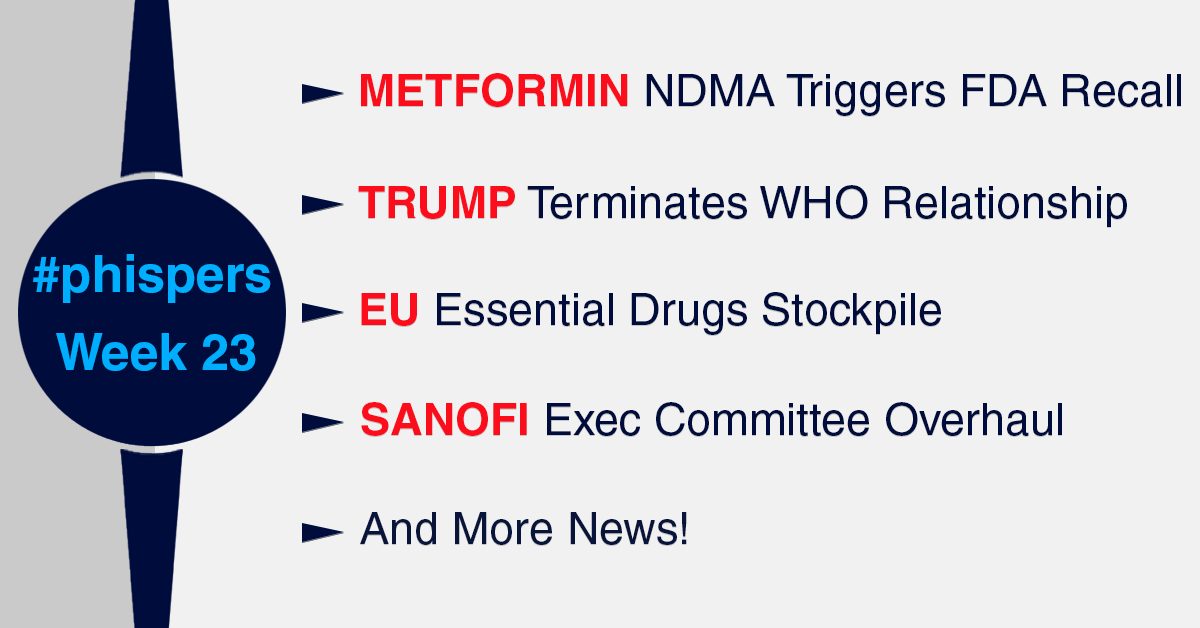
This week, Phispers brings news on various developments across the world as a result of the Covid-19 pandemic.
While US President Donald Trump ended America’s association with the WHO and thereby its US$ 400 million annual funding to the agency, Europe launched a global fundraising campaign to finance
testing, vaccines and treatments against Covid-19.
The WHO and 37 other nations appealed for common ownership of vaccines, medicines and diagnostic tools to tackle the pandemic.
After the US, EU also announced a plan to stockpile essential drugs in the wake of the pandemic, even
as India relaxed its export restrictions on paracetamol APIs.
And Pfizer tied up with vial manufacturer Corning Inc, in anticipation of unprecedented demand for its experimental vaccine.
In non-Covid news, Sanofi overhauled its executive committee and hired new leaders, even as its vaccines chief quit the company to head Ipsen. After claiming that metformin does not carry NDMA impurity risk in February, the US Food and Drug Administration recalled the diabetes drug as unacceptable levels of the impurity were found in the drug’s extended release tablets. And crab blood continues to remain the standard for endotoxin tests
as US Pharmacopeia abandons proposal to use a synthetic substitute.
Trump terminates relationship with WHO; 37 nations join alliance to share Covid tools
After
threatening to pull out of the World Health Organization (WHO) for weeks, US
President Donald Trump finally terminated America's relationship with the agency last week.
The
move to quit the Geneva-based body has come amid growing tensions between
Washington and Beijing over the Covid-19 pandemic, which first emerged in China’s Wuhan city.
Trump
accused the WHO of protecting China as the pandemic took off.
Speaking
in the White House Rose Garden, Trump said Chinese officials “ignored their reporting obligations” to the WHO about the virus and pressured the agency to “mislead the world.”
An
exposé by Associated Press strengthened Trump’s allegations against the agency. The AP investigation said the WHO publicly praised China for what it called a speedy response to the new coronavirus and thanked the Chinese government for sharing the genetic map of the virus “immediately.” In reality, Chinese officials sat on releasing the genome of the deadly virus for over a week, the report said.
The WHO is
funded by fees from its 194 member states,
as well as by voluntary contributions that comprise three-quarters of the
agency’s financing. The US has been
the agency’s top benefactor, accounting
for more than 14 percent of WHO’s
financing at around US$ 400 million a year.
It
is unclear whether Trump can fully withdraw US funding for the WHO without an
act of Congress, which controls all federal government spending. Democrats have
argued that doing so would be illegal, with House Speaker Nancy Pelosi
threatening last month that such a move would be “swiftly challenged.”
The
announcement has alarmed health experts. “Certainly there needs to be a good, hard look at mistakes the World Health Organization might have made in connection with coronavirus, but the time to do that is after the crisis has been dealt with, not in the middle of it,” said Senator Lamar Alexander. However, experts are also of the view that
if the US leaves the WHO, the influence of China on the agency will only grow.
Covid-19 Technology Access Pool: The WHO and 37 countries have
appealed for common ownership of vaccines, medicines and diagnostic tools to
tackle the pandemic. The initiative is led mostly by developing nations, and
takes aim at patent laws they fear could become a barrier to sharing crucial
supplies.
Known
as the Covid-19 Technology Access Pool, the initiative
won praise from groups including humanitarian NGOs like Doctors Without
Borders.
Expectedly,
the drug industry is opposed to such a move. Albert Bourla, CEO of Pfizer, termed the move as “dangerous”. Similarly, AstraZeneca CEO Pascal
Soriot said intellectual property is “a fundamental part” of the drug industry. If IP is not protected, then essentially, there is no incentive for anybody to innovate.
Europe launches global fundraising campaign: As US and China
favor national initiatives, the EU is pushing for global
cooperation.
The
EU has launched a new global fundraising campaign — “Global Goal: Unite For Our Future” — to finance the development and worldwide distribution of testing, vaccines and treatments against Covid-19.
“No one is safe until we are all safe,” EU Commission president Ursula von der Leyen said while launching this
initiative, which will end with a pledging summit on June 27.
This
new initiative seeks to raise tens of billions of dollars
with private and public donations, and follows another EU-led global campaign with
the same goal. In less than a month, the previous campaign raised nearly US$ 11
billion, with more than half of it coming from EU nations and institutions.
Of
the nearly US$ 11 billion donated so far by governments, only US$ 50 million
came from China, while the US shunned the initiative altogether, EU officials
said.
Sanofi
overhauls executive committee; its vaccines chief quits to head Ipsen
At
a crucial time when Sanofi is working on two vaccine projects to protect against Covid-19, the French drugmaker’s head of vaccines David Loew quit the company to
join as CEO of Ipsen from July 1.
There
was a management vacuum at Ipsen which has been struggling
to find a new CEO since the departure of David Meek in December. Loew will finally fill that space.
Ipsen
is working to get back on track with its
rare bone disease drug palovarotene, acquired through its US$ 1.3 billion Clementia buyout that misfired. The company is
also looking to strengthen its portfolio to offset the long-term generic threat
to its top-selling cancer treatment, Somatuline.
Meanwhile, Sanofi has named four new leaders to its executive committee. “These appointments now complete the announced changes in February to further simplify the Company’s executive leadership team,” a company statement said. The
company also said that Alan Main, the head
of their consumer healthcare unit, is out.
Three
of the four new executives joining Sanofi are coming from outside of the
pharmaceutical industry. Natalie Bickford is joining Sanofi from
Merlin Entertainments as the chief people officer. Arnaud Robert, who is currently working with Viking Cruises, will join Sanofi
as its chief digital officer. And Julie Van Ongevalle will replace
Alan Main as the head of consumer healthcare. She is currently the global brand
president of Origins, a division of the Estée Lauder
Companies, based in New York City. And Thomas Triomphe, who currently
serves as head of franchises and product strategy at Sanofi Pasteur, will be
promoted as the head of Sanofi Pasteur, replacing David Loew from June
15.
These
moves were expected when Sanofi hired a new CEO, Paul Hudson, in September last
year.
“We need leaders who come to Sanofi with a fresh perspective as well as leaders who have grown up within the company,” Hudson said.
After US, EU announces stockpile plan for essential drugs; India relaxes paracetamol export ban
A
fortnight back, we had reported on how the Trump Administration
was preparing an executive order that would require certain essential drugs and
medical treatments for a variety of conditions to be made in the US. Trump
Administration had also roped in a startup — Phlow Corp — to build the nation’s first stockpile of key drug ingredients.
This week, we bring you news that the European Commission is doing quite the same — it wants to set up a permanent
reserve of essential drugs and medical equipment to address shortages that have
plagued EU for years. Like the US, EU also plans to build drug manufacturing
capacities.
In a
speech, European Commission President Ursula Gertrud von der Leyen said: “We will also create for the first time a new Strategic Investment Facility. This will help invest in key value chains crucial for our future resilience and strategic autonomy, such as the pharmaceutical sector. Europe must be able to produce critical medicines itself.”
The
stockpile would be funded through a new health budget of around US$ 10.3
billion (Euro 9.4 billion) which the EU executive commission proposed last
week.
The
reserve would complement a US$ 427 million (Euro 380 million) emergency
stockpile created at the onset of the pandemic after many EU countries faced
acute shortages of face masks, testing kits, ventilators, intensive care drugs
and other vital items.
The
EU is seeking to stockpile disinfectants, testing and diagnostic reagents,
protective gear and essential medicines, according to an EU document.
The
extra funding would also be used to acquire vaccines. The Commission also said
it wants to offer incentives to drug companies to develop and produce vaccines
in Europe, and relocate manufacturing capacity of medicines and their chemical
ingredients which are, at present, being imported largely from India and China.
India ends restrictions on export of paracetamol API: While the US
and Europe were busy devising plans to manufacture essential drugs in their own
countries, India ended restrictions on export of
active pharmaceutical ingredients (API) of paracetamol.
In March, the Indian government had restricted exports of several drugs, including paracetamol, to secure supplies for its people after the pandemic disrupted the industry’s supply chain globally.
FDA
recalls metformin due to unacceptable levels of NDMA impurity
Back
in early February, we had carried news that type 2 diabetes drug metformin doesn’t carry any N-Nitrosodimethylamine (NDMA) risk. This had been announced by
the US Food and Drug Administration (FDA) after it tested samples of the drug
for unacceptable levels of NDMA impurity and found that no FDA-tested sample
exceeded the acceptable intake limit.
But last week, the FDA recalled some
extended-release (ER) formulations of the diabetes drug as it had unacceptable
levels of the NDMA impurity. The acceptable limit for NDMA, set by the FDA, is
96 nanograms per day for drugs. The substance can raise the risk of cancer with
long-term elevated exposure of NDMA.
Currently, the FDA has notified five drug companies that have
detected NDMA in their metformin preparations in quantities that are above the acceptable intake limit. Only two drugmakers — Apotex Corp
and Amneal Pharmaceuticals — are named on the FDA website currently. The agency is in contact
with five firms to recommend they voluntarily recall their products.
In December, the agency had started an investigation into
metformin. Online pharmacy Valisure had said in March that its independent tests had shown
high levels of NDMA in metformin made by 11 companies, including Amneal
Pharmaceuticals Inc and Aurobindo Pharma Ltd.
Crab
blood remains standard for endotoxin tests as USP drops synthetic substitute
plan
Horse-shoe crabs’ copper-rich blood clots in the presence of bacterial endotoxins have long been used in tests to detect contamination in shots and infusions. More recently, we have seen man-made versions — known as recombinant Factor C (rFC) — from manufacturers like Swiss drugmaker Lonza and France’s bioMerieux.
However, an industry battle had been brewing in the US. Charles River Laboratories
had criticized the synthetic option on safety grounds. Maryland-based US Pharmacopeia (USP) had initially
proposed adding rFC to the existing chapter governing international endotoxin
testing standards. But last week, USP announced it has abandoned that proposal, opting instead
to put rFC in a new stand-alone chapter. USP is a nonprofit scientific
organization that develops and disseminates public compendial quality standards
for medicines and other articles
Therefore, for now, the crabs’ blood will
remain the drug industry’s standard for safety tests.
“Given the importance of endotoxin testing in protecting patients ...the committee ultimately decided more real-world data” was needed, USP said in a statement.
Wildlife groups have been urging drugmakers to curb the use of crab blood. Post USP’s announcement, the National Audubon Society, Defenders of Wildlife and other groups called for greater use of rFC in a statement released by their umbrella organization, the Horseshoe Crab Recovery Coalition. Fishermen catch hundreds of thousands of crabs off the US East Coast and Asia every year for using their blood in medical safety tests.
Glass vial shortage stares at Covid vaccine aspirants; Pfizer ties up with Corning
It seems like the Covid-19 vaccine isn’t the only Holy Grail in humanity’s fight against the pandemic. The world will likely need billions of doses of any vaccine that proves to be safe and effective. And to hold those doses,
the industry needs glass vials. This
need is creating another supply-chain challenge for drugmakers to address as
they work overtime to complete the phased clinical trials of their vaccine
candidates.
“The challenge is not so much to make the vaccine itself, it’s to fill vials,” Pascal Soriot, CEO of AstraZeneca, said last week. “There’s not enough vials in the world.”
AstraZeneca, along with Pfizer, Johnson & Johnson and Sanofi, are working to quickly produce hundreds of millions of doses of its
vaccine candidate even before studies prove their safety and efficacy. In an
effort to conserve limited supplies, AstraZeneca, J&J and Pfizer are all
exploring whether they could safely fit five or 10 doses of vaccine into one
vial.
“Typically, we are producing vaccines in single-dose vials,” said Pfizer CEO Albert Bourla. Pfizer has signed a long-term agreement with Corning Inc to procure vials for storing drugs.
“We’re also exploring with the governments right now if it would be more convenient if there are five- or 10-dose vials,” Bourla added.

















 Share
Share