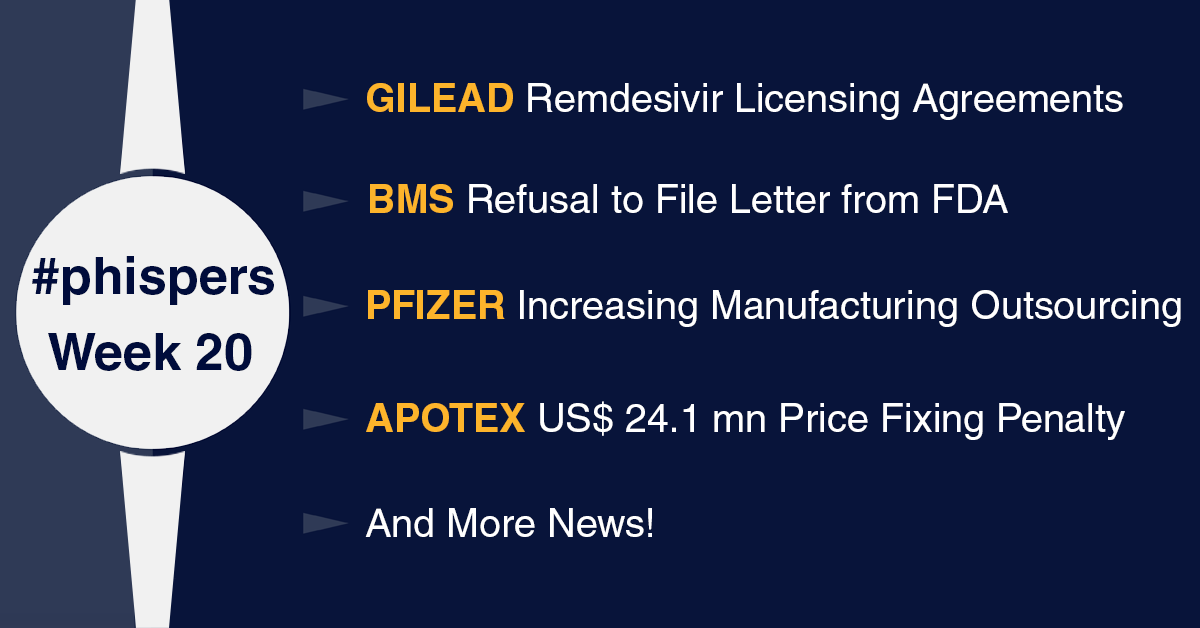
This week, Phispers brings you news on how Covid-19 is pushing drugmakers to outsource manufacturing of drugs.
While Gilead signed non-exclusive voluntary licensing agreements with five generic drugmakers based in India and Pakistan to increase the supply of remdesivir, an investigational drug being authorized to treat Covid-19, Pfizer decided to shift more of its drug production to contractors.
This way, Pfizer will be able to focus on large-scale production of an experimental coronavirus vaccine.
There was more bad news on hydroxychloroquine (HCQ).
An observational study found that HCQ neither lessened the need for Covid patients requiring breathing assistance nor the risk of death.
Meanwhile, Bristol Myers Squibb and bluebird bio Inc announced they have received a Refusal to File letter from the US Food and Drug Administration (FDA) regarding the Biologics License Application (BLA) for idecabtagene vicleucel for patients with heavily pre-treated relapsed and refractory multiple myeloma.
And Apotex admitted to price fixing and signed a US$ 24.1
million deal with the US department of justice.
Gilead signs licensing agreements with
five generic drugmakers for remdesivir
Gilead Sciences Inc has signed non-exclusive voluntary licensing agreements with five
generic drug manufacturers based in India and Pakistan to increase the supply
of remdesivir, an
investigational antiviral drug that received the US Food and Drug Administration’s Emergency Use Authorization for Covid-19 earlier this month.
The five generic drugmakers are Cipla Limited, Ferozsons Laboratories, Hetero Labs Limited, Jubilant Lifesciences and Mylan. These
drugmakers would manufacture remdesivir, a potential therapy for Covid-19, for
distribution in 127 countries.
The countries consist of nearly all low-income
and lower-middle income countries, as well as several upper-middle- and
high-income countries that face significant obstacles to healthcare access.
Under the licensing agreements, Gilead will share its manufacturing know-how with the five companies
to help them increase remdesivir production. Each company will be allowed to
set the price for its own generic version of the drug.
Moreover, the five licensed drugmakers won’t pay royalties to Gilead until the World Health Organization (WHO) calls off the novel coronavirus public health emergency or until another therapy for Covid-19 is approved, Gilead said in a statement.
In September 2014, Gilead had signed similar non-exclusive licensing agreements with
seven India-based generic pharmaceutical manufacturers to expand access to its
chronic hepatitis C medicines in developing countries. The agreements had
allowed the companies to manufacture sofosbuvir and the investigational single
tablet regimen of ledipasvir/sofosbuvir for
distribution in 91 developing countries.
Apotex admits to price
fixing; to pay US$ 24.1 million in criminal penalty
In the US, the Department of
Justice took up a years-old generics price-fixing investigation in the midst of
the pandemic. The federal authorities have now inked a deal with Apotex Corp. Under the deal, Apotex will pay a US$ 24.1 million criminal penalty, admit to price-fixing and
enter a deferred prosecution agreement (DPA).
Apotex Corp is a generic drugmaker headquartered in Florida and is the U.S. subsidiary of Apotex Inc., the largest Canadian-owned pharmaceutical company. It was charged with fixing the price of the generic drug pravastatin, a generic cholesterol medication. Apotex admitted to working with other generic companies to artificially inflate the drug’s price.
“Apotex and other generic drug companies agreed
to increase and maintain the price of pravastatin, a commonly prescribed cholesterol medication that lowers the risk of heart disease and stroke. The conspiracy began in May 2013 and continued through December 2015,” a DOJ statement said.
Under the DPA, Apotex has
agreed to cooperate fully with the Antitrust Division’s ongoing criminal investigation. As part of the agreement, the
parties will file a joint motion, which is subject to approval by the court, to
defer for the term of the DPA any prosecution and trial of the charges filed
against the defendant. Apotex also agreed to “cooperate fully” with the DOJ’s ongoing probe.
After Moderna-Lonza deal, Pfizer to outsource manufacturing to focus on vaccine
In order to prepare itself for
large-scale production of an experimental Covid-19 vaccine, drug behemoth Pfizer Inc has decided to shift more of its
medicine production to outside contractors.
Mike McDermott, president of
global supply at Pfizer said the US drugmaker is tapping its network of around
200 outside contractors, which includes Catalent Inc, Lonza Group AG and Thermo Fisher Scientific Inc, to play a bigger role in
producing some of its existing medicines.
Such a move will help Pfizer
shift a portion of production at four of its vaccine manufacturing facilities,
including one of its largest plants in the US, toward the coronavirus vaccine
while preventing disruptions in supply of its other products, he said.
However, Pfizer did not specify
which companies within its network it is in active discussions with about
shifting production.
Earlier this month, Moderna and Swiss contract drugmaker Lonza Group had signed a 10-year collaboration agreement to accelerate the manufacturing of Moderna’s potential coronavirus vaccine — mRNA-1273 — which is being tested in early-stage trial by the US National Institutes of Health.
Meanwhile, Pfizer and German
partner BioNTech SE said they have begun delivering doses of their coronavirus
vaccine candidates for initial human testing in the US. Trials in Germany had
already begun.
If successful, Pfizer said it
hopes to receive emergency use authorization from the FDA by October. It could
distribute up to 20 million doses by the end of 2020, and potentially hundreds
of millions next year, it said.
The shift to outside production
of other medicines will affect vaccines and intravenous drugs. Pfizer currently
produces around 1.5 billion doses of intravenously injected vaccines and drugs
each year. McDermott said Pfizer will also add additional shifts to its own
factories, hire more workers to take advantage of its unused production
capacity, and stockpile current products in order to prepare the company for
the shift to production of the vaccine.
Earlier this week, Pfizer had said it was preparing four of its manufacturing sites — three in the US and one in Belgium — to produce the vaccine, even before clinical trials shows which, if any, of the four potential candidates being tested demonstrates efficacy in preventing infection with the novel coronavirus. It will cost Pfizer at least US$ 150 million to gear up its facilities for the new vaccine, McDermott said.
Like Moderna’s vaccine, Pfizer and BioNTech’s vaccine candidates also relies on the messenger RNA (mRNA) technology,
which instructs cells in the body to make specific coronavirus proteins that
then produce an immune response.
Meanwhile, Tedros Adhanom Ghebreyesus, Director-General of the World Health Organization has said there are
around seven or eight “top” candidates for a vaccine to combat the novel coronavirus and work on them is being accelerated. He said an accelerated effort is under way, helped by US$ 8 billion (Euro 7.4 billion) pledged by
leaders from 40 countries, organizations and banks for research, treatment and
testing.
New hydroxychloroquine
observational study fails to demonstrate efficacy
There is more bad news on hydroxychloroquine (HCQ), the malaria treatment touted by US President Donald Trump as a “game changer” in the fight against Covid-19.
According to a new observational study
published last week in the New England Journal of Medicine, HCQ neither lessened the
need for patients requiring breathing assistance nor the risk of death. The
study said randomized, controlled trials of HCQ
in patients with Covid-19 are needed.
The study, funded by the
National Institutes of Health and conducted by researchers at New
York-Presbyterian Hospital and Columbia University Irving Medical Center,
looked at 1,376 consecutive patients who showed up at the emergency room with
symptoms of Covid-19.
Nearly 60 percent, or 811 of
the patients, received the drug within 48 hours and were found, on average, to
be more severely ill than those who didn’t receive the drug, the researchers said.
“We didn’t see any association between getting this medicine and the chance of dying or being intubated,” lead researcher Dr. Neil Schluger said. “The patients who got the drug didn’t seem to do any better.”
Among patients given HCQ, 32.3
percent ended up needing a ventilator or dying, compared with 14.9 percent of
patients who were not given the drug.
HCQ also showed no benefit when
combined with the antibiotic azithromycin, Schluger’s team reported.
Azithromycin alone also showed no benefit.
The new findings come two weeks
after the FDA issued a
warning against the use of chloroquine
and HCQ to treat Covid-19 outside of a hospital or a formal
clinical trial setting due to the risk of heart rhythm problems.
Bristol Myers receives
refusal to file letter from FDA over multiple myeloma drug
Bristol Myers Squibb and bluebird bio, Inc announced they have received a Refusal to
File letter from the US Food and Drug Administration (FDA) regarding the
Biologics License Application (BLA) for idecabtagene vicleucel (ide-cel) for
patients with heavily pre-treated relapsed and refractory multiple myeloma,
which was submitted in March 2020.
Ide-cel belongs to a complex
class of treatments named CAR-T therapy that involves taking immune cells from
a patient, engineering them to attack tumor cells and infusing them back into
the patient.
Upon preliminary review, the
FDA determined that the Chemistry, Manufacturing and Control (CMC) module of
the BLA requires further detail to complete the review. No additional clinical
or non-clinical data have been requested or are required.
Bristol Myers Squibb is
planning to resubmit the BLA by
July-end. A Reuters report said Bristol Myers and bluebird bio will
present updated positive results from its pivotal Karmma study of ide-cel at ASCO20.
“Cell therapies are a bit more complicated and that is why there is a lot of questions and answers that we go back and forth with the health authorities,” Bristol Myers’ Chief Medical Officer
Samit Hirawat said. Bristol Myers gained ide-cel through its US$ 74 billion acquisition of Celgene in January 2019. The transaction was completed in
November 2019.
Incidentally, back in February
2018, Celgene had received a Refusal to File letter from the FDA for its new drug application for
its multiple sclerosis treatment ozanimod. Last month, the FDA approved Zeposia (ozanimod). However, the launch of the drug would be delayed due to the
coronavirus outbreak.















 Share
Share