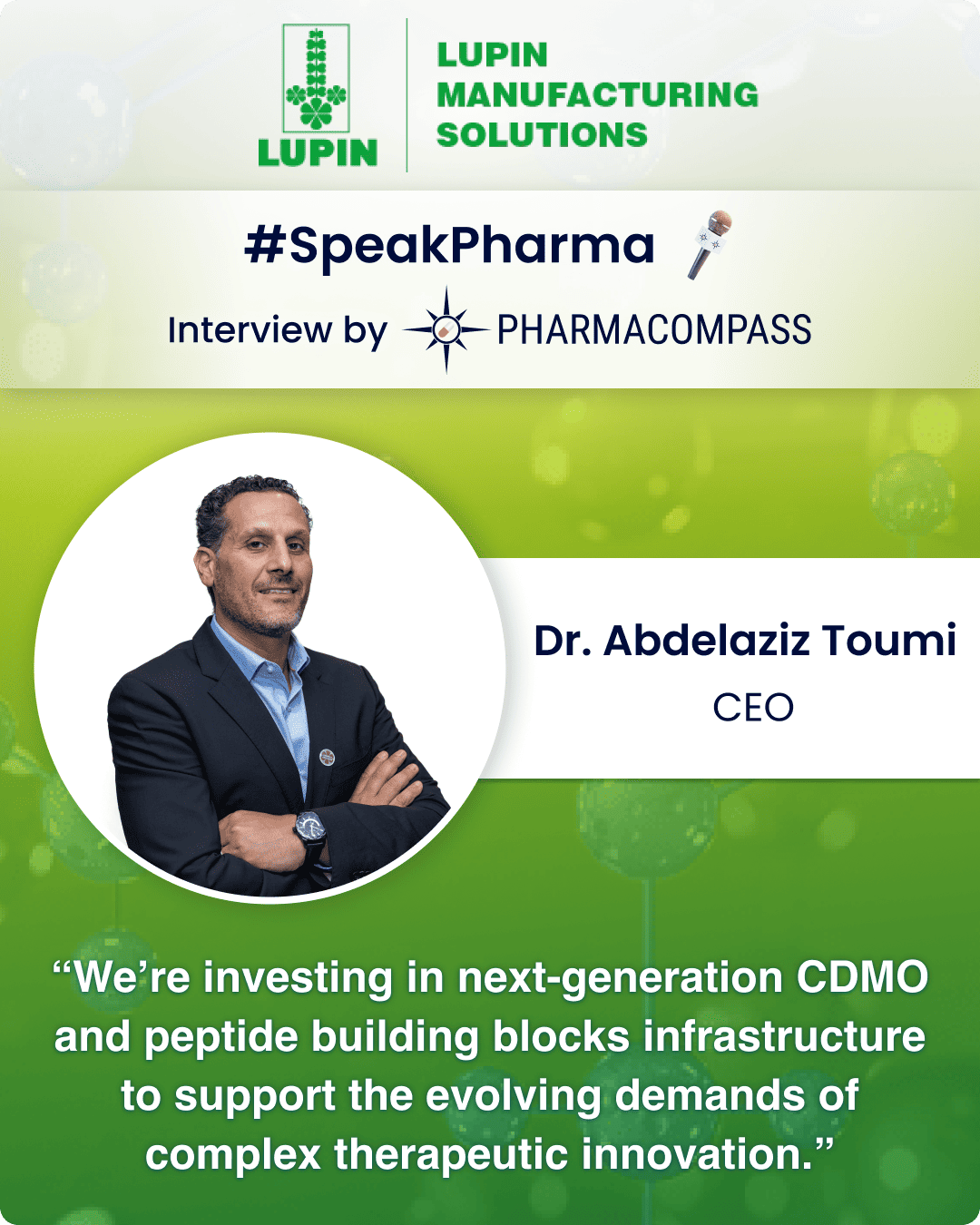
This week, SpeakPharma interviews Dr. Abdelaziz Toumi, Chief Executive Officer of Lupin Manufacturing Solutions (LMS). In this exclusive interview with PharmaCompass, Dr. Toumi discusses the evolving CDMO landscape, the shift toward complex therapies and growing peptide ecosystems along with LMS’s recent strategic investments in integrated CDMO and peptide building blocks infrastructure. As the industry convenes at DCAT Week, he highlights how LMS is positioning itself as a capability-driven CDMO partner for next-gen complex therapies.Dr. Toumi, The US has been taking several steps to reduce dependence on overseas pharmaceutical supply chains. How is Lupin Manufacturing Solutions (LMS) navigating these shifts?The framing of this debate as globalization versus reshoring misses what is actually happening. What we are seeing is a deliberate recalibration, a move from networks built purely for cost efficiency toward architectures that distribute risk more intelligently. That is a fundamentally different objective, and it changes what pharmaceutical companies expect from their manufacturing partners. What policymakers are pushing for, whether through the BIOSECURE Act or broader reshoring incentives, is a strategic allocation of manufacturing risk, and that is entirely rational.For LMS, this environment plays to our strengths. We have never positioned ourselves as a low-cost volume provider. Our competitive case is built on technical capability, regulatory reliability, and the ability to manage genuinely complex chemistry programs. Those attributes matter most to customers re-evaluating their supply relationships. Our investments in HPAPI containment, peptide building blocks, and integrated CDMO infrastructure reflect a deliberate commitment to being relevant precisely where complexity is highest. That is where we see sustained and growing demand, irrespective of how supply chain policy continues to evolve.How do you see the pharmaceutical landscape evolving over the next five years? How is LMS positioning itself to stay ahead of these changes?Five years from now, the defining feature of this industry will be the sheer scientific complexity embedded in pharmaceutical pipelines. Peptides, targeted oncology compounds, radiopharmaceuticals, these are not molecules you manufacture through conventional means. They demand deep process chemistry, specialized infrastructure, and partners who can genuinely co-develop solutions rather than simply execute a manufacturing order.That shift is changing how innovation-driven companies select their CDMO partners. Technical depth, regulatory track record, and the ability to navigate development risk have moved to the top of the evaluation criteria. At LMS, everything we are building right from our integrated CDMO block at Dabhasa to our HPAPI infrastructure at Vizag is calibrated to this reality. We are positioning to be a partner of choice and not just a transactional service provider.Could you provide an update on LMS’ oncology (HPAPI) manufacturing block in Visakhapatnam? How is it contributing to your CDMO strategy?Oncology manufacturing is one of the most technically exciting segments in the industry, and that complexity is only intensifying. As targeted therapies and antibody drug conjugates advance through pipelines, the demand for high-potency API capability delivered reliably, at global safety standards continues to grow.Our Vizag facility has been designed with that reality in mind, and that goes beyond containment engineering. It incorporates the process discipline, safety culture, and quality systems that high-potency manufacturing demands at every level of the organization. You cannot retrofit this kind of capability; it has to be purpose-built. What we have put in place is a platform that supports programs from early clinical development through commercial supply offering customers the continuity they need without transferring between sites as their programs mature. That continuity is a genuine competitive advantage.In December, LMS signed a strategic alliance with PolyPeptide Group AG to scale the global peptide supply chain. How will this collaboration strengthen your CDMO capabilities in the fast-growing peptide therapeutics segment?The rapid growth of peptide therapeutics, especially GLP1s, has fundamentally changed how the industry thinks about scale, reliability, and supply security. What was once a niche capability has become a core requirement, and customers are now looking for partners who can support the peptide value chain end-to-end, at a global scale.LMS’s strategy is built around serving the entire peptide market and establishing a globally competitive platform over the next three to five years, rooted in India, positioning itself as a credible partner amidst the China+1 strategy, capable of supporting both innovators and large pharmaceutical companies. The strategic alliance with PolyPeptide Group fits naturally within this vision allowing us to complement our own capabilities with additional synthesis depth and geographic flexibility, particularly for customers seeking resilient, diversified supply chains.LMS brings deep process chemistry expertise, a growing peptide intermediates and building blocks platform at Dabhasa, and strong regulatory execution. Importantly, as part of the Lupin group, we are also able to offer downstream drug product manufacturing capabilities spanning oral formulations as well as sterile injectables, including vials and drug-device delivery systems, which are increasingly critical as peptide programs move rapidly from development to commercial scale.Together, this integrated approach allows us to support customers across the full lifecycle, from peptide intermediates and APIs through to finished dosage forms. In a market defined by speed, scale, and supply assurance, this breadth of capability positions LMS to emerge as one of the leading global players in peptide CDMO services.As the industry convenes at DCAT Week, what is LMS bringing to the table this year?This year is about laying the foundations for LMS’s next phase of growth, particularly in complex and high value modalities. Strategically, our focus is on building the capabilities required to support emerging oncology and peptide adjacent platforms, while preparing for commercial scale-up over the next 18-24 months.On the technology side, LMS already has strong R&D capabilities across peptides, payloads and linkers, bioconjugation, and high potent compounds. These capabilities allow us to engage with customers early in development, solve complex chemistry challenges, and support rapid transition from discovery into development programs. Building on this base, we are progressing plans to establish commercial-scale GMP capacities in payload-linker synthesis and bioconjugation, including the development of a dedicated GMP facility in Vizag. This is a critical step for us as more antibody drug conjugates and related platforms move toward late-stage development and commercialization.Equally important is how we engage with customers. Alongside traditional CDMO models, we are increasingly offering alternative business models such as dedicated facilities, long-term capacity commitments, and guaranteed supply arrangements designed to address customers’ growing concerns around security, scalability, and speed to market. Overall, the year ahead is about execution including strengthening our R&D engine, advancing commercial-scale infrastructure, and deepening customer partnerships so that LMS is well positioned to support complex programs as they move into clinical and commercial reality.LMS has articulated its ambition to emerge as a trusted global CDMO partner with next-generation manufacturing capabilities and scientific agility. How would you assess your progress toward that goal?Trusted partnerships are earned over time, and I am clear-eyed about that. What I can say with confidence is that the strategic choices we have made over the past year have been the right ones, and the investment portfolio we have assembled aligns with direction the industry is heading.The development of our integrated CDMO block at Dabhasa, the scaling of peptide building blocks capabilities, the Vizag HPAPI facility, the PolyPeptide alliance, these reflect a coherent long-term strategy. What continues to occupy my attention most is execution. Infrastructure sets the stage, but it is our science, our quality systems, and our people that customers will ultimately judge us by. That work is ongoing, and it is where I spend most of my time.Could you update us on LMS’ green manufacturing initiatives? How is sustainability being integrated into your operations and facilities?Sustainability has shifted from a compliance requirement to a genuine competitive dimension, and I think that shift is permanent. Customers, investors, and regulators are asking harder questions, and organizations treating it just as a reporting exercise will find themselves at a disadvantage.Our approach remains grounded in the belief that durable environmental improvement comes from process intelligence. When you optimize synthesis routes for atom economy, reduce solvent intensity, and engineer waste out at the design stage, you improve sustainability and manufacturing economics simultaneously. These are not competing priorities. We are embedding green chemistry principles across our development workflows and investing in solvent recovery and waste management infrastructure. Our parent organization Lupin Limited was recently recognized among the top 1% of companies worldwide in the S&P Global Corporate Sustainability Assessment (CSA) attaining an overall score of 91 out of 100 establishing itself as the leading pharmaceutical company globally, and the leader across all sectors in India, surpassing both Indian and international peers which underscores our commitment.











 Share
Share