Please Wait
Applying Filters...
Menu
$ API Ref.Price (USD/KG) : 32,318Xls

Digital Content read-more

Create Content with PharmaCompass, ask us

DATA COMPILATION #PharmaFlow

read-more
read-more
Molecular glue degraders: Lilly, AbbVie sign billion-dollar deals; BMS leads with three late-stage drugs
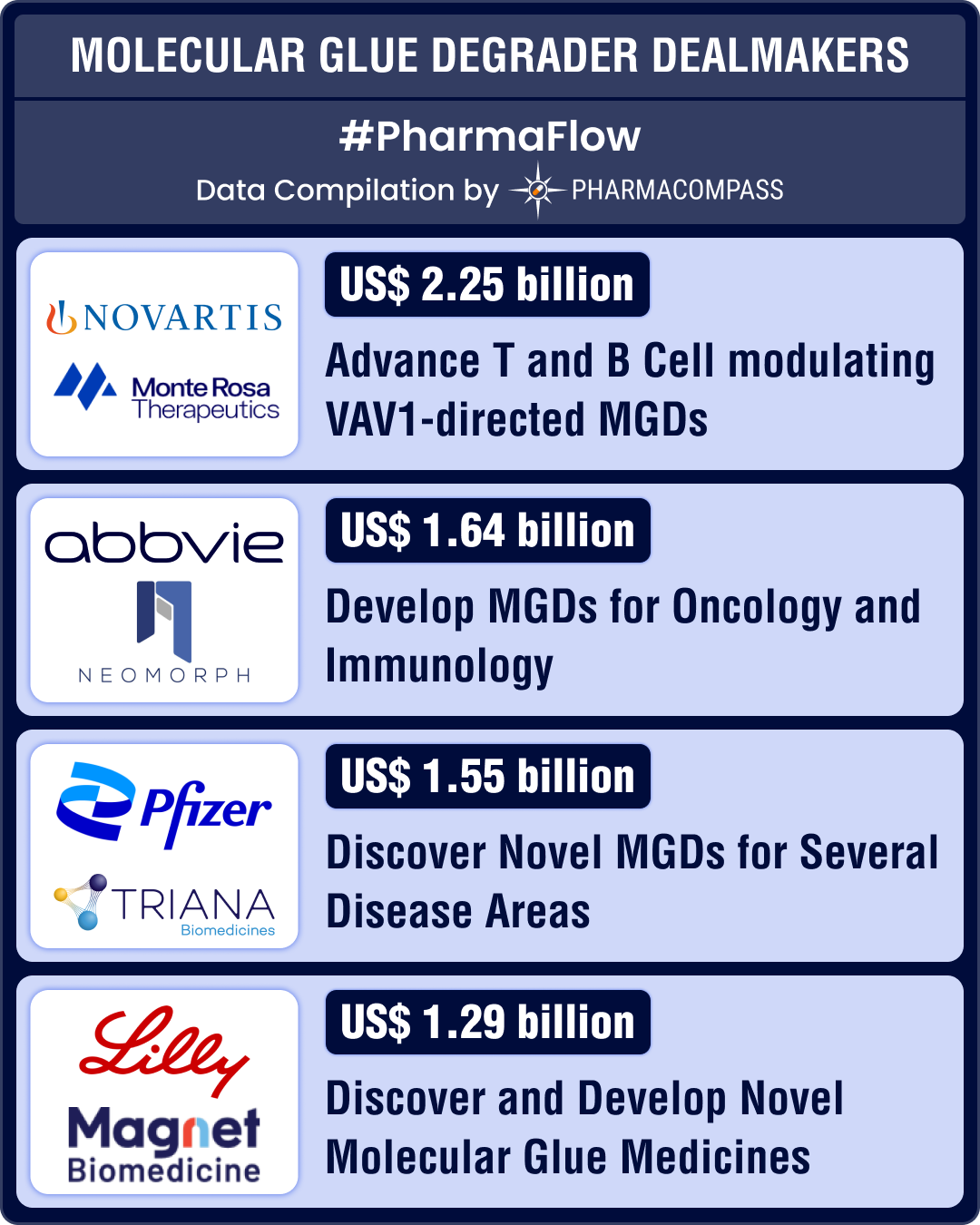
This week, we delve into molecular glue degraders (MGDs), one of the most promising frontiers in drug development. MGDs address a vast number of previously “undruggable” disease-causing proteins.Unlike traditional small molecule drugs that require specific binding pockets, MGDs function by enhancing protein-protein interactions. MGDs selectively target disease-causing proteins and an enzyme known as E3 ubiquitin ligase. By creating a binding interface between the two, MGDs  destroy the target proteins.Another kind of degraders are proteolysis targeting chimeras (PROTACs) that use a bifunctional approach — one binds the target proteins, and the other binds to an E3 ligases together. These degraders induce the degradation of specific proteins by using the cell’s natural ubiquitin-proteasome system (a process in cells where damaged or unneeded proteins are tagged by a small molecule called ubiquitin and then broken down by a structure called the proteasome so that cells stay healthy and function properly).MGDs constitute a rapidly growing market, where both the targeted protein degradation technologies and investment in research and development are witnessing growth.Currently, the most recognized molecular glues are the immunomodulatory imide drugs (IMiDs), such as thalidomide, lenalidomide and pomalidomide, which have been around for some time. According to GlobalData, lenalidomide generated over US$ 6 billion in sales in 2023, thereby demonstrating the commercial viability of this therapeutic approach.Lilly, AbbVie ink billion-dollar MGD deals; Biogen partners Neomorph; Pfizer, Triana ink collaborationThe MGD space has witnessed extraordinary deal-making activity over the recent months, with major pharmaceutical companies committing billions of dollars to secure access to novel MGD platforms and pipelines. This surge in investment reflects the industry’s growing confidence in the therapeutic potential of MGDs to address previously undruggable targets.This year has already seen two landmark deals. In February, Magnet Biomedicine entered into a collaboration and license agreement with Eli Lilly worth up to US$ 1.29 billion to discover and develop novel MGDs. This partnership leverages Magnet’s TrueGlue discovery platform and approach with Lilly’s expertise in the development of small molecule therapeutics. In January, AbbVie crafted a US$ 1.64 billion deal with molecular glue biotech Neomorph, combining AbbVie’s oncology and immunology drug development capabilities with Neomorph's leading molecular glue discovery platform.While oncology remains the primary focus, these collaborations are increasingly expanding into neurodegenerative diseases, immunological disorders, and other therapeutic areas. For instance, in October, Biogen and Neomorph announced a multi-target research collaboration to discover and develop MGDs for Alzheimer’s, rare neurological, and immunological diseases, potentially worth up to US$ 1.45 billion.October also saw Novartis sign a potential US$ 2.25 billion deal with Monte Rosa Therapeutics. The deal gives Novartis exclusive worldwide rights to develop, manufacture and commercialize multiple MGDs (including MRT-6160) for undruggable targets, including in the areas of immunology and inflammation, metabolism, and genetic diseases.Earlier in October, Triana Biomedicines and Pfizer entered into a research collaboration to discover novel MGDs for multiple targets across several disease areas, including oncology, with a total potential value of up to US$ 1.55 billion.And in August 2024, SEED Therapeutics entered into a strategic research collaboration with Eisai to discover and develop novel MGDs for neurodegenerative and oncological indications, potentially worth up to US$ 1.5 billion.BMS leads with three MGDs in late-stage trials; Monte Rosa’s MRT-2359 targets solid tumorsBristol Myers Squibb has established itself as a leader in the clinical development of MGDs with three products in late-stage development. These include a next-gen MGD mezigdomide (CC-92480), which is currently in phase 3 trials in combination with carfilzomib and dexamethasone for relapsed/refractory multiple myeloma. Another candidate is golcadomide, which is in late-stage clinical trials for high-risk first-line large B-cell lymphoma. And the third MGD in BMS’ portfolio is iberdomide, which has reached phase 3 development for multiple myeloma.Monte Rosa Therapeutics has made significant progress with MRT-2359, an investigational MGD that is currently in phase 1/2 clinical trials for the treatment of patients with MYC-driven solid tumors, including non-small cell lung cancer, small cell lung cancer, and high-grade neuroendocrine cancer. Myelocytomatosis or MYC is a gene which causes various solid tumors when overactive.MRT-2359 represents an important advancement in extending the molecular glue approach beyond hematological malignancies to solid tumors, which have historically proven more challenging to address with protein degradation strategies.Other significant early-stage candidates are Nested Therapeutics’ NST-628 and Plexium's PLX-4545. NST-628 relies on a novel mechanism of action in its category of RAS-MAPK inhibitors, and overcomes some traditional limitations in the treatment of cancers.PLX-4545 is Plexium’s first small molecule degrader program to enter clinical development. This potent and selective MGD of a classically undruggable transcription factor, also known as Helios (IKZF2), explores treating solid tumors. Transcription factors are proteins that regulate gene expression by binding to specific DNA sequences.Boehringer’s KRAS degrader advances PROTACs approach; Arvinas tests ARV-102 for neurodegenerative diseasesLike MGDs, PROTACs are also witnessing advancements in both R&D and dealmaking. For instance, BridGene Biosciences recently expanded its strategic collaboration with Galapagos to develop a selective oral SMARCA2 PROTAC in precision oncology. The SMARCA2 gene provides instructions for making one piece (subunit) of a group of similar protein complexes known as SWI/SNF complexes.In the clinical arena, Prelude Therapeutics announced a collaboration with Merck to evaluate PRT3789 in combination with Keytruda (pembrolizumab) in patients with SMARCA4-mutated cancers. PRT3789 is a potent and highly selective, first-in-class SMARCA2 degrader.On the molecular front, ACBI3, a novel pan-KRAS degrader developed through a collaboration between the University of Dundee and Boehringer Ingelheim, addresses a critical gap in cancer therapy by targeting 13 out of 17 prevalent KRAS mutants. KRAS mutation is a change in the KRAS gene, a common gene that can cause cancer. ACBI3’s development is a potential breakthrough for millions of cancer patients with KRAS-driven tumors.Vepdegestrant (ARV-471), a collaborative effort between Arvinas and Pfizer, remains the most advanced PROTAC candidate to date and has met its primary endpoint in a late-stage study in breast cancer patients with estrogen receptor 1 mutations.  Similarly, Arvinas’ ARV-102 became the first PROTAC to be tested in humans for neurodegenerative diseases, marking a significant milestone in addressing brain-related disorders.Our viewMGDs offer a new, and groundbreaking approach to treating cancers and various other diseases, thereby attracting substantial investments by major pharmaceutical companies. As clinical trials show encouraging results, we expect investments in the MGDs space to increase even further. 

Impressions: 5764

https://www.pharmacompass.com/radio-compass-blog/molecular-glue-degraders-lilly-abbvie-sign-billion-dollar-deals-bms-leads-with-three-late-stage-drugs

#Phispers by PHARMACOMPASS
27 Mar 2025

STOCK RECAP #PipelineProspector

read-more
read-more
Pipeline Prospector Jan 2026 highlights: Astra, CSPC sign up to US$ 18.5 bn obesity deal; Wegovy’s pill version debuts in US
The year 2026 began amid heightened geopolitical tensions, particularly over Greenland. The US President Donald Trump threatened 25 percent tariff on several European countries until the US is allowed to purchase Greenland, a semi-autonomous Danish territory. These threats escalated transatlantic tensions and drew strong pushback from European nations and NATO.Despite this, biotech indices grew steadily through the month. The Nasdaq Biotechnology Index (NBI) rose 2.26 percent in January, moving from 5,723.48 to 5,852.67. The SPDR S&P Biotech ETF (XBI) gained 2.03 percent, climbing from 122.27 to 124.75, while the S&P Biotechnology Select Industry Index (SPSIBI) increased 2.29 percent, rising from 9,528.24 to 9,746.25.The month also saw Big Pharma continuing to pledge investments in the US to avert tariffs. January is also the month of JP Morgan healthcare conference. This year, the meet (or JPM26) saw announcements of several important deals, especially in the sphere of obesity drugs and the use of artificial intelligence in drug discovery. Access the Pipeline Prospector Dashboard for January 2026 Newsmakers (Free Excel)Astra, CSPC sign up to US$ 18.5 bn obesity deal; AbbVie to invest US$ 100 bn in USAstraZeneca made a lot of news last month. It signed an up to US$ 18.5 billion licensing deal with China’s CSPC Pharmaceutical Group for its  experimental obesity and weight-related drug candidates. AstraZeneca will pay US$ 1.2 billion upfront and up to US$ 17.3 billion in milestones. The package includes a clinical-ready and three pre-clinical candidates in CSPC’s injectable weight-management portfolio. AstraZeneca will also collaborate with CSPC on four additional new programs using CSPC’s sustained-release delivery platform and AI-driven peptide drug discovery. Besides this deal, AstraZeneca also announced a US$ 15 billion investment in China through 2030 to expand medicines manufacturing and R&D, including capabilities in cell therapy and radio-conjugates.In the US, pharma companies continued to announce investments to avoid import tariffs threatened by Trump. AbbVie pledged US$ 100 billion into its US research, development and manufacturing operations over the next 10 years. This is, by far, the biggest commitment announced by a drugmaker. Coming in at a distant second is Johnson & Johnson, which had announced US$ 55 billion in US-based investments in March.Similarly, Eli Lilly said it will build a US$ 3.5 billion manufacturing plant in Pennsylvania to produce injectable weight-loss medicines, with construction expected to begin in 2026 and operations planned for 2031.Roche’s Genentech also said it will invest nearly US$ 2 billion in a new bio-manufacturing facility in Holly Springs, North Carolina, to manufacture next-generation metabolic treatments, including obesity medicines. Access the Pipeline Prospector Dashboard for January 2026 Newsmakers (Free Excel)AI deals in Jan: Astra buys Modella AI; Sanofi ties up with Earendil; Lilly-Nimbus in obesity research dealArtificial intelligence is taking centerstage in dealmaking. AstraZeneca agreed to acquire Boston-based Modella AI (deal size not disclosed), integrating its foundation models and AI agents into oncology R&D to support clinical development and biomarker discovery.Similarly, Sanofi signed an AI-powered autoimmune and inflammatory disease collaboration worth up to US$ 2.56 billion with Earendil Labs, which will receive up to US$ 160 million in upfront and near-term payments. Sanofi will lead development and commercialization of bispecific candidates from the partnership.Lilly also signed a multi-year AI-driven obesity research and licensing agreement with Nimbus Therapeutics worth up to US$ 1.3 billion. Additionally, Lilly and Nvidia announced an expanded AI partnership, including a US$ 1 billion co‑innovation lab in the Bay Area (US) to integrate advanced computing and biology for drug discovery. This announcement was made at JPM26. Access the Pipeline Prospector Dashboard for January 2026 Newsmakers (Free Excel)Novo’s Wegovy pill makes blockbuster debut in US; Darzalex Faspro quadruplet wins FDA nodIn January, the pill version of Novo Nordisk’s Wegovy (semaglutide) made a stunning debut in the US. It was prescribed more than 18,000 times in the first full week after ‌its launch. Novo’s stock price went up by 14 percent during the month.Johnson & Johnson secured an approval from the US Food and Drug Administration (FDA) for Darzalex Faspro (daratumumab and hyaluronidase) as part of a four-drug regimen for newly diagnosed multiple myeloma patients ineligible for an autologous stem cell transplant. The combination includes Darzalex Faspro with Velcade (bortezomib), Revlimid (lenalidomide) and dexamethasone. The approval marks Darzalex Faspro’s 12th indication overall and its fifth in the newly diagnosed multiple myeloma setting.Darzalex (daratumumab) remains J&J’s largest growth driver, generating US$ 14.4 billion in 2025 sales. J&J (stock up 10 percent) projected its 2026 revenue to be in the range of about US$ 100 billion to US$ 101 billion.FDA also approved Zycubo (copper histidinate) from Fortress Biotech and Sentynl Therapeutics (a US-based biopharma owned by Zydus Lifesciences), to treat Menkes disease, making it the first FDA-approved therapy for the genetic disorder in the US.On the clinical front, Amgen said its experimental obesity drug MariTide (maridebart cafraglutide) helped patients maintain weight loss when administered at a lower dose or less frequently. Access the Pipeline Prospector Dashboard for January 2026 Newsmakers (Free Excel)AbbVie partners China-based RemeGen in US$ 5.6 bn deal; GSK to acquire RAPT TherapeuticsAbbVie partnered China-based RemeGen in a US$ 5.6 billion oncology deal to develop and commercialize RC148, an experimental therapy for multiple advanced solid tumors. AbbVie will gain rights outside Greater China, while RemeGen will receive US$ 650 million upfront and up to US$ 4.95 billion in milestones, along with double-digit royalties. Britain’s GSK said it will acquire US-based RAPT Therapeutics (stock up 69 percent) in a US$ 2.2 billion deal, gaining global rights to the experimental food allergy drug ozureprubart, excluding rights in mainland China, Macau, Taiwan and Hong Kong.Eli Lilly (stock down 3 percent) entered into a US$ 1.93 billion collaboration with US-based Repertoire Immune Medicines to develop tolerizing therapies (treatments that restore the immune system’s ability to recognize self-antigens) for autoimmune disease targets. Repertoire will receive US$ 85 million upfront and up to US$ 1.84 billion in milestones, while Lilly will take over clinical development and commercialization.Novartis added an Alzheimer’s program to its pipeline through a licensing and collaboration deal with SciNeuro Pharmaceuticals, paying US$ 165 million upfront and up to US$ 1.5 billion in milestones. Access the Pipeline Prospector Dashboard for January 2026 Newsmakers (Free Excel)Our viewThis year, several new medications, including treatments for weight loss, hypertension, smoking cessation and plaque psoriasis, are likely to receive FDA approvals. Moreover, existing medications — such as Dupixent (dupilumab) and Wegovy (semaglutide) — could see expanded indications. January has already set a dynamic tone for the year ahead. 

Impressions: 186

https://www.pharmacompass.com/pipeline-prospector-blog/pipeline-prospector-jan-2026-highlights-astra-cspc-sign-up-to-us-18-5-bn-obesity-deal-wegovy-s-pill-version-debuts-in-us

#PharmaFlow by PHARMACOMPASS
05 Feb 2026

NEWS #PharmaBuzz

read-more
read-more

https://www.accessdata.fda.gov/scripts/cder/daf/index.cfm?event=overview.process&ApplNo=213165

FDA
02 Feb 2026

https://www.prnewswire.com/news-releases/darzalex-faspro-based-quadruplet-regimen-approved-in-the-us-for-newly-diagnosed-patients-with-multiple-myeloma-who-are-transplant-ineligible-302671736.html?tc=eml_cleartime

PR NEWSWIRE
28 Jan 2026

https://www.prnewswire.com/news-releases/tecvayli-monotherapy-demonstrates-superior-progression-free-and-overall-survival-versus-standard-of-care-as-early-as-first-relapse-in-patients-with-multiple-myeloma-predominantly-refractory-to-anti-cd38-therapy-and-lenalidomide-302661652.html

PR NEWSWIRE
14 Jan 2026

https://www.businesswire.com/news/home/20260105730167/en/Incyte-Announces-Positive-Topline-Results-from-Pivotal-Study-of-Tafasitamab-MonjuviMinjuvi-as-a-First-line-Treatment-for-Diffuse-Large-B-Cell-Lymphoma

BUSINESSWIRE
05 Jan 2026

https://www.expresspharma.in/icra-affirms-stable-outlook-for-indian-pharma-sector-in-fy2026/

EXPRESSPHARMA
30 Dec 2025

https://www.businesswire.com/news/home/20251221198206/en/Incyte-Japan-Announces-Approval-of-Minjuvi-tafasitamab-in-Combination-with-Rituximab-and-Lenalidomide-for-the-Treatment-of-Relapsed-or-Refractory-Follicular-Lymphoma

BUSINESSWIRE
22 Dec 2025