Please Wait
Applying Filters...
Menu
Xls

Digital Content read-more

Create Content with PharmaCompass, ask us

DATA COMPILATION #PharmaFlow

read-more
read-more
DMF filings hit all-time high in Q3 2024; China tops list with 58% increase in Type II submissions
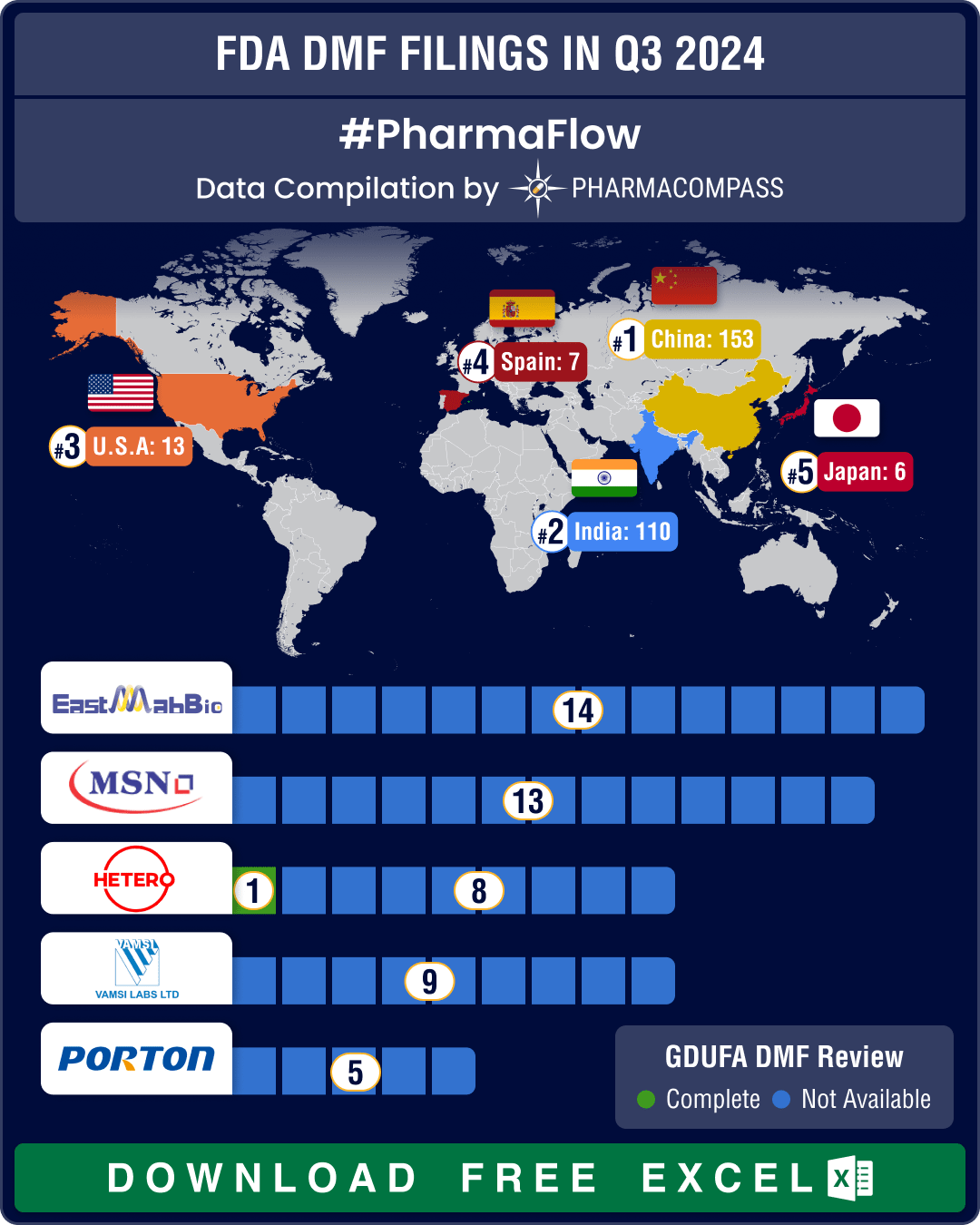
Drug Master Files, or DMFs, are confidential documents that play a crucial role in the pharmaceutical industry. These files, submitted to the US Food and Drug Administration (FDA), contain detailed information about ingredients, manufacturing processes, and packaging of medicines. They help the FDA oversee drug quality. Of the four types, Type II DMFs involve active pharmaceutical ingredients (APIs) for both branded and generic drugs. The third quarter (Q3) of 2024 saw Type II DMF submissions set a new record. A total of 309 Type II DMFs were submitted to the FDA during this period, a substantial 24.6 percent increase over Q3 2023 (with 248 submissions). The second quarter of 2024 too saw a remarkable increase, with 237 Type II DMFs being submitted compared to 178 in Q2 2023. View FDA DMF Filings in Q3 2024 (Power BI Dashboard, Free Excel Available) China witnesses steep rise in DMF submissions, beats India with maximum filings In Q3 2024, China filed 153 DMFs submissions, marking a substantial 57.7 percent increase from the 97 submissions filed in Q3 2023. India maintained its strong position but fell to the number two spot with 110 DMFs, representing a modest 3.8 percent increase from 106 in Q3 2023. The US, which came a distant third, saw a slight decline in DMF submissions, with 13 filed in Q3 2024, as compared to 18 in Q3 2023. For several years, India had a lead in Type II DMFs. Since 2020, which marked the start of the pandemic, we have noticed a gradual increase in DMFs filed by China. This year, China has surpassed India considerably in the first three quarters. During the first nine months of 2024, China submitted 372, while India filed 286 DMFs. If this lead is maintained in Q4, DMFs from China will surpass that of India in 2024.  Amongst European countries, Spain led with seven DMFs, followed by Italy at four, and Germany and the Netherlands at three each. Among other nations, Japan contributed six while Israel submitted four DMFs. In company-wise tally, China’s Jiangsu East-Mab Biomedical Technology topped the list with an impressive 14 DMFs. On its heels were Indian companies — MSN at 13 DMFs, and Vamsi Labs and Hetero Drugs at nine DMFs each. China’s Porton Pharma and Wuxi AppTec filed five, while Shanghai Keze Yongxin Biotechnology, and Qingdao Glycogene Pharmaceutical contributed four submissions each. India's Maithri Drugs also submitted four. Japanese company Santeja filed five. Overall, Asia accounted for nearly 90 percent, with China contributing a dominant 49.5 percent of all DMF submissions. India was at 35.6 percent, the US at 4.2 percent, while Europe contributed 6.5 percent.  View FDA DMF Filings in Q3 2024 (Power BI Dashboard, Free Excel Available) Diabetes, obesity, cancer, women’s health drugs emerge as hot molecules in Q3 2024 In terms of molecules, semaglutide (used for the treatment of type 2 diabetes and weight management) and relugolix (to treat prostate cancer and uterine fibroids) saw six DMF filings each in Q3 2024, indicating significant industry interest in these compounds. Following closely behind were semaglutide’s competitor tirzepatide and overactive bladder therapy vibegron, garnering four DMFs each. Finerenone (a non-steroidal drug for chronic kidney disease associated with type 2 diabetes) and voclosporin (an immunosuppressant for lupus nephritis) saw three DMFs each.  The last quarter also witnessed the introduction of 14 molecules with first-time DMFs. Among them were acetoxy empagliflozin, cabozantinib fumarate, tivozanib hydrochloride monohydrate, diosmetin, trilaciclib, clenbuterol hydrochloride, fenoterol hydrobromide, tapinarof and fezolinetant. Fezolinetant, with a DMF from Spain’s Moehs Iberica, is the active ingredient in Astellas’ Veozah, which is the first non-hormonal treatment for menopausal symptoms approved by the FDA. Tapinarof, filed by India’s Maithri Drugs, is used in Vtama, a novel steroid-free psoriasis cream. Other compounds that made their DMF debut include berotralstat, calcium phosphoryl choline chloride, phloroglucinol dihydrate, belumosudil mesylate and trimethylphloroglucinol. During Q2 2024, there were 19 drugs that saw DMF submissions for the first time, including molecules like triptorelin, sorafenib, pralsetinib, trilaciclib dihydrochloride, resmetirom (hepatology) and teneligliptin hydrochloride hydrate (metabolic disorders).  View FDA DMF Filings in Q3 2024 (Power BI Dashboard, Free Excel Available)    GDUFA fee for FY 2025: The FDA’s Generic Drug User Fee Amendments (GDUFA) is a law designed to speed access to safe and effective generic drugs to the public and reduce costs to the industry. The fiscal year 2025 fee rates were published on July 31, 2024. The FDA has revised fees under GDUFA III for all categories. While there is a slight increase in the DMF fee from US$ 94,682 in 2024 to US$ 95,084 in 2025, the ANDA fee has witnessed a significant jump — from US$ 252,453 in 2024 to US$ 321,920 in 2025. FY 2024 and FY 2025 User Fee Rates Generic drug fee category Fees rates for FY 2024 Fees rates for FY 2025 Applications: Abbreviated New Drug Application (ANDA) US$ 2,52,453   US$ 3,21,920   Drug Master File (DMF) US$ 94,682 US$ 95,084 Facilities: Active Pharmaceutical Ingredient (API)—Domestic US$ 40,464 US$ 41,580 API—Foreign US$ 55,464 US$ 56,580 Finished Dosage Form (FDF)—Domestic US$ 2,20,427   US$ 2,31,952 FDF—Foreign US$ 2,35,427   US$ 2,46,952 Contract Manufacturing Organization (CMO)—Domestic US$ 52,902 US$ 55,668 CMO—Foreign US$ 67,902 US$ 70,668 GDUFA Program: Large size operation generic drug applicant US$ 17,29,629   US$ 18,91,664 Medium size operation generic drug applicant US$ 6,91,852   US$ 7,56,666 Small business generic drug applicant US$ 1,72,963   US$ 1,89,166 Our view The highlight of the last few quarters has been the sharp rise in Type II DMF filings from China. The submission of a DMF is not required by law or any FDA regulation. FDA’s DMF guideline offers guidance on acceptable approaches to meeting regulatory requirements. Moreover, DMFs establish trust in APIs from lesser-known companies. With a growing emphasis on compliance and quality assurance, it appears that Chinese drug companies are eager to demonstrate their commitment to high standards and build trust in the US market. And that’s good news for the pharmaceutical industry.   

Impressions: 10785

https://www.pharmacompass.com/radio-compass-blog/dmf-filings-hit-all-time-high-in-q3-2024-china-tops-list-with-58-increase-in-type-ii-submissions

#PharmaFlow by PHARMACOMPASS
24 Oct 2024

WEEKLY NEWS RECAP #Phispers

read-more
read-more
FDA rejects first MDMA therapy to treat PTSD; Merck, Curon ink up to US$ 1.3 bn deal for next-gen bispecific antibody
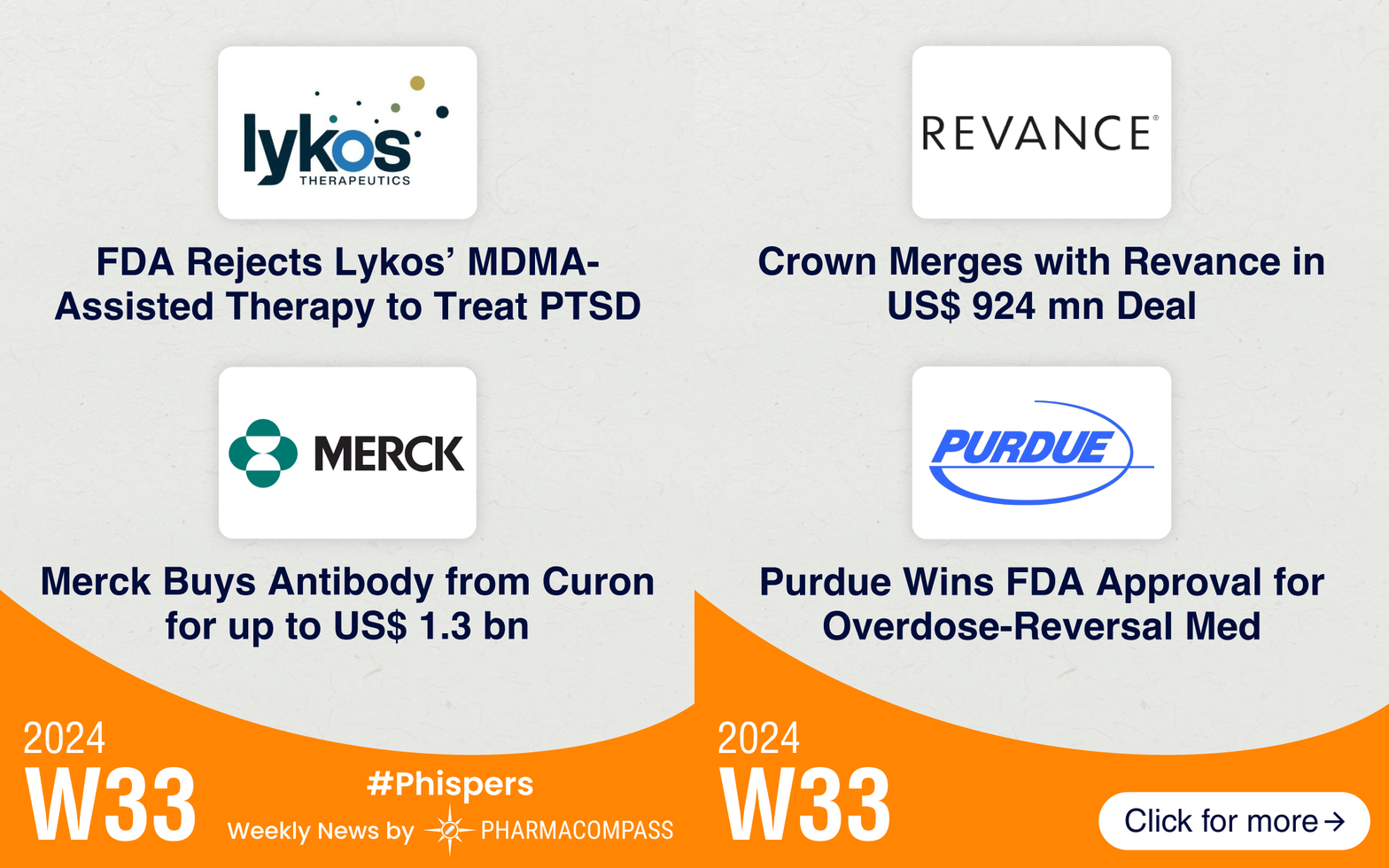
The US Food and Drug Administration (FDA) has declined to approve an MDMA-assisted therapy from Lykos Therapeutics to treat post-traumatic stress disorder (PTSD). Alongside this, the journal Psychopharmacology has retracted three papers on the MDMA-assisted therapy citing “unethical conduct” at one of the study sites.In deals, Merck has signed an up to US$ 1.3 billion deal with China’s Curon Biopharmaceutical for a next-generation bispecific antibody. And skincare company Crown Laboratories is paying US$ 924 million to merge with Botox rival Revance.While FDA rejected Lykos’ MDMA therapy, it approved Purdue Pharma’s auto-injector for the emergency treatment of known or suspected opioid overdose. Purdue Pharma had allegedly fueled the opioid crisis in the US.The agency also greenlit ARS Pharmaceuticals’ Neffy, the first nasal spray alternative to EpiPen approved for severe allergic reactions like anaphylaxis. FDA has also handed Citius Pharmaceuticals its maiden approval for lymphoma, after rejecting the therapy a year back. And Ascendis’ hormone disorder therapy finally got the go-ahead to treat adult patients with hypoparathyroidism.FDA rejects first MDMA-assisted therapy to treat PTSD, issues CRL to LykosDespite intense political pressure, FDA has declined to approve MDMA, commonly known as ecstasy or molly, to treat PTSD, Lykos Therapeutics said after it received a complete response letter (CRL). The agency had previously cited a “striking lack of abuse-related adverse events”, faulty trial design and the need for more evidence. FDA’s expert panel in June had voted 10 against one, saying the benefits of using the party drug to treat PTSD do not outweigh the risks. Last week, 80 members of Congress from both sides of the aisle had urged President Joe Biden and the FDA to consider further studies on the MDMA-assisted therapy.Scientific journal retracts three studies over ‘unethical conduct’: The journal Psychopharmacology has retracted three papers on MDMA-assisted therapy citing “unethical conduct” at one of the study sites. Many of the papers’ authors were affiliated with Lykos. However, the drugmaker said those papers weren’t part of its FDA application. The authors confirmed they were aware of violations at the time of submission, but chose not to disclose it to the journal or remove data generated by this site from their analysis. That includes a widely reported case of sexual assault by an unlicensed therapist on a trial participant.Merck buys next-gen bispecific antibody from Curon in potential US$ 1.3 bn dealBispecific antibodies, or antibodies that can bind to two different antigens at the same time, have been drawing interest as a treatment of cancer. Merck is paying China-based biotech Curon US$ 700 million upfront and an additional US$ 600 million in milestone payments for the rights to CN201, a next generation T cell engager that targets both the CD3 and CD19 proteins. It is currently being evaluated in early-stage trials for the treatment of patients with relapsed or refractory non-Hodgkin’s lymphoma and relapsed or refractory B-cell acute lymphocytic leukemia.Meanwhile, Merck has discontinued a trial on its experimental drug vibostolimab when used in combination with Keytruda in patients with a type of lung cancer after an interim analysis showed the drug was unlikely to succeed.Crown to take Botox rival Revance private in US$ 924 mn deal: Revance Therapeutics has agreed to go private and merge with Crown Laboratories in a deal valued at US$ 924 million. Crown has multiple aesthetics and skincare products. Revance’s Daxxify (daxibotulinumtoxinA) competes with AbbVie’s Botox (onabotulinumtoxinA).Meanwhile, Recursion Pharmaceuticals has agreed to buy its rival Exscientia for US$ 688 million in an all-stock deal. Recursion is a biotech firm that uses artificial intelligence to discover new drug candidates.Lilly opens its center for genetic medicines: Eli Lilly has announced the opening of its 346,000 square foot R&D facility in Boston Seaport. The center will accommodate around 700 Lilly scientists and researchers. It will advance Lilly’s efforts in RNA and DNA-based therapies as well as in discovering new drug targets to create life-changing medicines across several diseases.After allegedly fueling opioid crisis, Purdue wins FDA nod for overdose-reversal medFDA has approved Purdue Pharma’s Zurnai, the first nalmefene hydrochloride auto-injector for the emergency treatment of known or suspected opioid overdose in adults and pediatric patients 12 years of age and older. Purdue is infamous for its misleading marketing of the painkiller OxyContin that allegedly fueled the opioid crisis in America around the late 1990s. Drug overdose persists as a major public health issue in the country, with over 107,000 reported fatal overdoses occurring in 2023, primarily driven by synthetic opioids like illicit fentanyl. According to STAT News, many in the addiction advocacy community don’t look favorably at Purdue’s attempts to address a crisis that it ostensibly helped create.Citius’ immunotherapy for lymphoma bags FDA nod: FDA has okayed Citius Pharmaceuticals’ Lymphir (denileukin diftitox-cxdl) immunotherapy for the treatment of adults with relapsed or refractory cutaneous T-cell lymphoma (r/r CTCL), a group of rare blood cancers that affect the skin. A year back, the agency had rejected this therapy. This renders Lymphir the first novel targeted systemic therapy approved by the agency for r/r CTCL since 2018. Citius had bought Lymphir from India’s Dr Reddy’s Laboratories for US$ 40 million upfront in 2021 and an additional US$ 40 million on FDA approval. This is the first FDA approval for Citius.First nasal spray alternative to EpiPen okayed: FDA has approved ARS Pharmaceuticals’ Neffy, the first nasal spray to treat severe allergic reactions. This makes Neffy the only needle-free emergency option for possibly fatal allergic reactions. Seen as an alternative to EpiPen, Neffy (epinephrine) was greenlit to treat reactions like life-threatening anaphylaxis in adult and pediatric patients who weigh at least 30 kilograms (about 66 pounds). “Some people, particularly children, may delay or avoid treatment due to fear of injections,” FDA said, adding that the important treatment option addresses an unmet need.Ascendis’ hormone disorder therapy gets approved: FDA has approved Ascendis Pharma’s therapy — Yorvipath (palopegteriparatide) — to treat adult patients with the hormone disorder hypoparathyroidism. This makes Yorvipath the only approved treatment for the condition in the US after rival Takeda stops making its Natpara (parathyroid hormone) injection by the end of the year due to supply issues, a Reuters news report said.

Impressions: 1823

https://www.pharmacompass.com/radio-compass-phisper/fda-rejects-first-mdma-therapy-to-treat-ptsd-merck-curon-ink-up-to-us-1-3-bn-deal-for-next-gen-bispecific-antibody

#Phispers by PHARMACOMPASS
15 Aug 2024

NEWS #PharmaBuzz

read-more
read-more

https://www.accessnewswire.com/newsroom/en/biotechnology/tharimmune-reports-pharmacokinetic-simulation-results-for-th104-as-prophylaxis-agains-1062977

ACCESSWIRE
20 Aug 2025

https://www.pharmacompass.com/pdf/news/fda-confirms-para-iv-patent-litigation-for-opvee-spray-49094.pdf

FDA
19 May 2025

https://www.businesswire.com/news/home/20241028862040/en

BUSINESSWIRE
28 Oct 2024

https://www.fda.gov/news-events/press-announcements/fda-approves-first-nalmefene-hydrochloride-auto-injector-reverse-opioid-overdose

FDA
09 Aug 2024

https://www.businesswire.com/news/home/20240807347421/en

BUSINESSWIRE
07 Aug 2024

https://www.businesswire.com/news/home/20240408735407/en

BUSINESSWIRE
08 Apr 2024