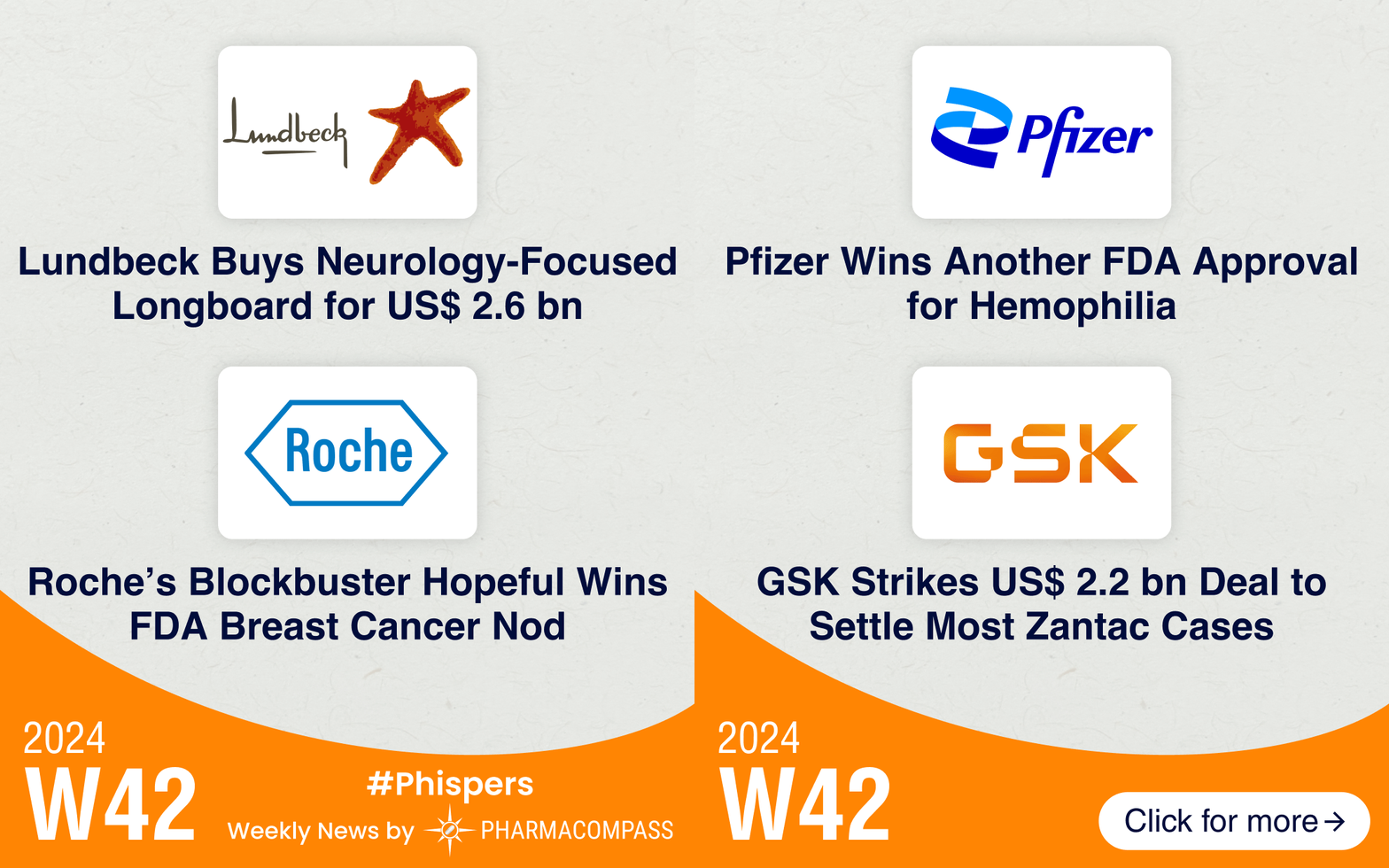
This week’s is a double dose Phispers, as we return from a one-week break due to CPhI Worldwide. The fortnight saw several deals. Denmark’s Lundbeck made its largest acquisition to date as it bought out Longboard Pharmaceuticals for US$ 2.6 billion. Italy’s Recordati struck a deal with Sanofi, acquiring global rights to Enjaymo, a rare immune disorder treatment, for up to US$ 1 billion. Similarly, AstraZeneca and Merck signed biobucks deals. And, there was uproar in France as Sanofi said it is selling a controlling stake in its consumer healthcare business, Opella.Roche secured approval from the US Food and Drug
Administration (FDA) for its breast cancer treatment Itovebi. And Hympavzi
became the second hemophilia med from Pfizer to bag an FDA approval this year.In clinical trials, Johnson & Johnson faced a major setback and had to discontinue a late-stage study on its bladder cancer drug candidate. And GSK agreed to a US$ 2.2 billion settlement to resolve 93 percent of US lawsuits related to its discontinued heartburn medication, Zantac.Denmark’s Lundbeck bets US$ 2.6 bn on epilepsy drug with Longboard buyoutDenmark’s Lundbeck is acquiring
California-based Longboard Pharmaceuticals for US$ 2.6 billion, marking its largest acquisition to date. Longboard focuses
on developing therapies for neurological conditions, with its lead drug
candidate, bexicaserin, showing promise in treating
rare and severe forms of epilepsy, such as Dravet syndrome and Lennox-Gastaut
syndrome. Currently in phase 3 trials, bexicaserin has demonstrated encouraging
anti-seizure effects in early studies. Lundbeck anticipates potential global
peak sales of US$ 1.5 billion to US$ 2 billion from bexicaserin.Italy’s Recordati buys immune disorder drug from Sanofi: Recordati has acquired global rights to Enjaymo, a treatment for cold
agglutinin disease (CAD), a rare autoimmune disorder, from Sanofi for US$ 825 million. This deal
also includes
additional commercial milestone payments of up to US$ 250 million, contingent on the achievement of certain sales thresholds.
Enjaymo (sutimlimab) was approved in the US,
Europe and Japan in 2022 and is the first and only targeted therapy for CAD
patients who suffer from premature destruction of red blood cells.Astra, Merck sign billion-dollar deals for novel treatments; Pfizer partners TrianaAstraZeneca has committed up to
US$ 2 billion in a licensing deal with CSPC Pharmaceutical Group to develop a pre-clinical,
novel, lipid-lowering therapy to treat heart disease. CSPC will receive an
upfront payment of US$ 100 million from Astra, and up to US$
1.92 billion in milestone payments and
royalties.Merck has entered into a potential
US$ 1.9 billion deal with Mestag Therapeutics to explore fibroblast therapies for inflammatory diseases, leveraging Mestag’s innovative platform. Meanwhile, Pfizer has partnered
Triana Biomedicines in a deal potentially worth over US$ 1.5 billion to discover molecular glue degraders for
cancer and other conditions.French govt may pick stake in Sanofi’s Opella to be on its board, as unions fear layoffsLast week, Sanofi had announced that it plans to sell a 50 percent controlling stake
in Opella, its consumer
healthcare business, to US-based investment company Clayton Dubilier & Rice (CD&R).Headquartered in France, Opella employs over 11,000 people and has
a portfolio of 100 leading brands, including Doliprane (paracetamol).Soon after this announcement, there were fears that the stake sale could impact France’s economic sovereignty. Trade unions and opposition leaders had expressed displeasure over Sanofi’s decision.France’s finance minister Antoine Armand has allayed
these concerns by saying that the government is looking at all options,
including picking up a stake in Opella and being on the board of the consumer
healthcare company. Earlier, Armand had said the French government wanted guarantees from Sanofi that the production of
Doliprane would stay in France.Nobel Prize in Medicine goes
to researchers who discovered microRNAThe 2024 Nobel Prize in Physiology or Medicine was awarded to American scientists Victor Ambros and Gary
Ruvkun for their pioneering discovery of microRNA and its role in
post-transcriptional gene regulation. This discovery has fundamentally transformed our
understanding of gene regulation, revealing how tiny RNA molecules, known as
microRNAs, play a crucial role in determining how genes are expressed in
different cell types.The Nobel Prize in Chemistry went to scientists who used artificial intelligence to ‘crack the code’ of almost all proteins. David Baker, Demis Hassabis, and John Jumper won the award for their breakthroughs in computational protein
design and the AI model AlphaFold2 that can predict the shape of proteins and invent new ones. Expected to revolutionize drug and vaccine development, the AI platform acts as a “Google search” for protein structures.Roche’s blockbuster hopeful wins first-line breast cancer nod from FDARoche has strengthened its breast
cancer portfolio with the FDA approval of Itovebi (inavolisib), an oral PI3K inhibitor, for the first-line
treatment of advanced hormone
receptor-positive, HER2-negative breast cancer with a PIK3CA mutation. This approval marks a significant milestone for
Roche, positioning Itovebi as a formidable competitor to Novartis’ Piqray (alpelisib) and AstraZeneca’s Truqap (capivasertib). Roche projects peak sales
for Itovebi to reach CHF 2 billion (US$ 2.3 billion) annually.Pfizer lands second FDA
approval for hemophilia in 6 months: Pfizer’s new hemophilia treatment, Hympavzi (marstacimab-hncq), was approved for routine prophylaxis to prevent or reduce the frequency
of bleeding episodes in adults and adolescents
aged 12 and older with hemophilia A or B, without inhibitors. Hympavzi offers a
convenient once-weekly subcutaneous administration
via a pre-filled auto-injector pen and is the first and only therapy in the US
that works by blocking a specific pathway involved in bleeding for hemophilia A
and B patients. In April, FDA had approved Pfizer’s one-time gene therapy Beqvez (fidanacogene
elaparvovec-dzkt) for adults with hemophilia B.GSK agrees to settle 80,000 Zantac cases in US through US$ 2.2 bn
dealGSK has agreed to pay up to US$ 2.2 billion to settle approximately 80,000
lawsuits in the US related to its
discontinued heartburn medication, Zantac. The lawsuits alleged
that Zantac (ranitidine), which was once the world’s best-selling drug, caused cancer due to the presence of a probable human carcinogen, N-nitrosodimethylamine (NDMA). This settlement resolves 93 percent of the pending cases against GSK.J&J discontinues late-stage study for bladder cancer drug after it flunks reviewJ&J has announced the
discontinuation of its late-stage study on the bladder cancer drug candidate TAR-200. The decision came after an independent interim analysis revealed that TAR-200 did not demonstrate superior benefits compared to the standard chemo-radiation therapy. This phase 3 trial was focused on patients with muscle-invasive bladder cancer who were not undergoing radical cystectomy.
















 Share
Share