This week
Phispers has lots of news from the FDA. While the Trump administration
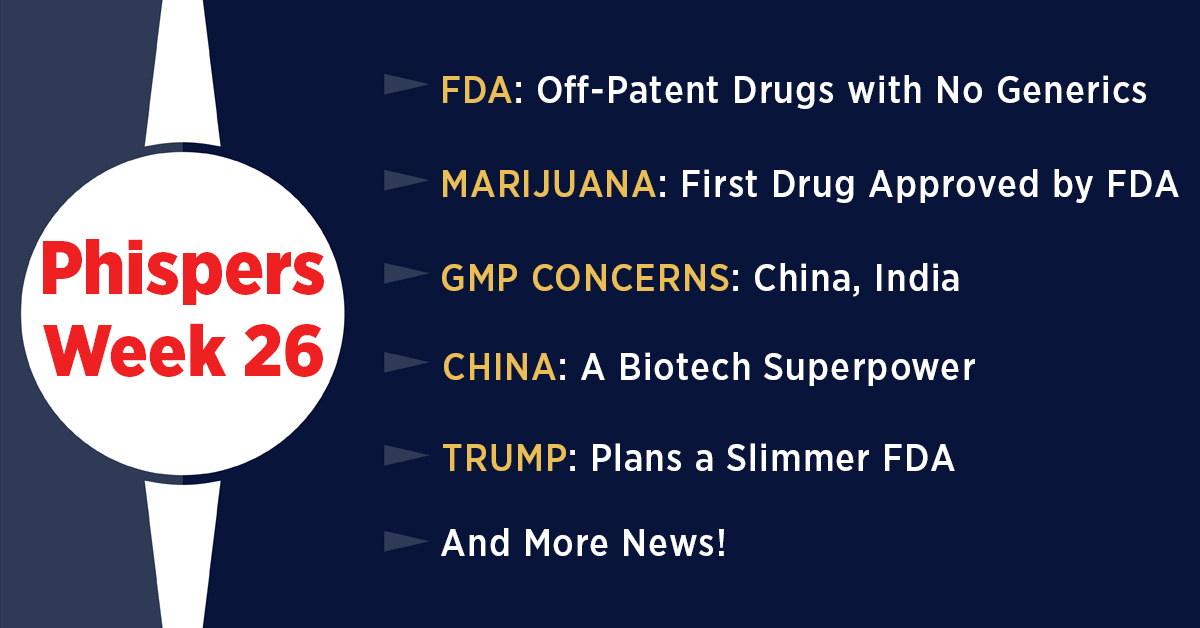
announced its plans to reduce the jurisdiction of the FDA, the agency approved its first marijuana-based drug that treats two severe forms of epilepsy. The FDA also updated its list of off-patent, off-exclusivity drugs without an approved generic for the second time since its release last year. In pivotal clinical trials, Novo Nordisk’s semaglutide proved to be superior to other best-selling type 2 diabetes drugs like Januvia and Victoza. Renowned
surgeon Atul Gawande was chosen CEO of a new company formed by Amazon, JP
Morgan Chase and Warren Buffet-owned Berkshire Hathaway. And China retained the top slot amongst research
centers across the world.
FDA updates its list of off-patent, off-exclusivity drugs without an approved generic
The
FDA has updated its list of Off-Patent, Off-Exclusivity Drugs without an
Approved Generic for the second time since it released the list last year. The
update was undertaken in order to improve transparency and to encourage the
development and submission of abbreviated new drug applications (ANDAs) for
drugs with limited competition.
The document includes two lists — the first list identifies drug products for which FDA could immediately accept an ANDA without prior discussion; the second list identifies drug products for which ANDA development or approval may raise potential legal, regulatory, or scientific issues that should be addressed with the FDA prior to considering submission of an ANDA.
The
document also contains an Appendix which identifies new drug application (NDA)
drug products that were removed from the two lists because one or more ANDAs
referencing, such NDA drug products, have been approved since the publication
of the previous list.
In
the list, the FDA has excluded any NDA drug products that have been approved
within the past year, as it believes it is too soon for an ANDA referencing
such a product to have been approved.
The
FDA also stated that it will update the list every six months.
Click to get your Excel version of FDA’s List of Off-Patent, Off-Exclusivity Drugs without an Approved Generic
Meanwhile,
Health Canada updated its List of Drugs for an Urgent Public Health Need to include Rifapentine to battle an ongoing tuberculosis crisis in Ontario. Rifapentine is classified in Part II of FDA’s list of Off-Patent, Off-Exclusivity Drugs without an Approved Generic.
The notification allows a listed drug to be imported into
Canada and sold in the notifying jurisdiction for a period of one year.
FDA
approves first marijuana-based drug to treat two severe forms of epilepsy
The US Food and
Drug Administration (FDA) has approved Epidiolex (cannabidiol or CBD) oral solution for the treatment
of seizures associated with two rare and severe forms of epilepsy — Lennox-Gastaut syndrome and Dravet syndrome. The drug can be taken by patients aged two years and older.
CBD is a chemical
component of the Cannabis sativa plant, more commonly known as marijuana. And
Epidiolex is the first marijuana-based drug to be approved in the US for epilepsy.
It is produced by GW Pharmaceuticals.
CBD does not cause
intoxication. It is one of the hundreds of molecules found in marijuana and has
been cited by scientists as a potential treatment for mental health issues.
“This approval serves as a reminder that advancing sound development programs that properly evaluate active ingredients contained in marijuana can lead to important medical therapies,” Scott Gottlieb, Commissioner, FDA, said.
However, the launch of Epidiolex depends on how the Drug Enforcement Administration (DEA) evaluates the drug. The DEA categorizes chemicals into five schedules, with Schedule 1 substances — like marijuana and heroin — considered the most deadly and deemed to have no medical benefits. DEA will now have to evaluate Epidiolex by reclassifying CBD as a substance that has medical properties.
Non-compliance alert:
Chinese API
firm, two Indian firms caught in regulatory net
This week, FDA posted the warning letter issued
to Henan Liuha Pharmaceutical in China, a company which produces steroid APIs like hydrocortisone and prednisone. The
warning letter highlights data integrity concerns that landed Henan on FDA’s import alert list in March 2018.
During the inspection, the FDA investigator observed numerous blank batch manufacturing records in an open cabinet in the firm’s manufacturing workshop office.
Among these were multiple blank, product release forms marked with a red quality assurance release stamp stating ‘Permitted to Leave [the] Factory’.
The review of the audit trail of an analytical instrument used to perform stability testing led the FDA to observe that the software was configured to permit continuous use of the “preview run” function and routine overwriting of previous runs.
While only the final “preview run” data in each project folder was retained, FDA’s review of the audit trail demonstrated that multiple distinct runs were performed and that the length of each run was consistent with the time required to perform complete product testing (i.e. blank, sample, and standard).
Meanwhile, two years after receiving a
Statement of Non-Compliance with GMP, Dhanuka Laboratories in
India failed another European inspection.
A March 2018 inspection performed by the French National
Agency for Medicines and Health Products Safety uncovered 24 deficiencies of which one was classified as critical and eight were
considered as major.
The inspection determined that “a recall of products should be considered” and the EDQM should consider withdrawal of the CEPs (certificates of suitability) filed by the company for Cefixime and Cefuroxime axetil as there were “multiple risks of contamination”
This week, the FDA also placed Kopalle Pharma Chemical in India on its Import Alert List.
China’s march towards becoming a biotech superpower
continues unabated
China’s biotech industry has been enjoying high growth rates for quite sometime. Now, there is evidence that China’s research abilities are something other nations need to contend with, confirms a recently assembled annual index of research centers around the world,
prepared by Nature.
According to the report, China held the top slot amongst research centers across the world.
The Chinese
Academy of Sciences made it to the top spot again this year, while China’s Peking University and Tsinghua University scored in the top 15 academic research institutions. Nanjing University and the University of Science and Technology of China have jumped ahead from last year into the top ranks.
In academia, America’s academic institutions retained their top slot. Harvard, Stanford, MIT, and Berkeley dominated the top five. China now has 16 of the top 100 global academic centers on this list, compared to 11 in 2016.
What does this
mean for the Chinese biotech companies? During the first wave, Chinese
biotechs were largely in-licensing approved, late-stage drug makers with US partners. “But as the science gets better and the pipeline sifts through the first wave of drugs, you’ll start to see more original drug development work, which has been missing. Things are changing fast in China biopharma, and not just because of the financing that’s available. More change is straight ahead,” said an article published in Endpoints News.
Once again, India turns focus on reducing dependence on API
imports from China
India imports around 80 percent of APIs from China, despite the fact that the cost of manufacturing APIs in India is nearly the same as China, a study recently released by India’s commerce minister Suresh Prabhu said.
“Cost between India and China is highly competitive with only difference of 3 per cent i.e. in labor cost, rest remains in competition with the Indian market. Though the material, depreciation and indirect personnel cost remains the same as of India, there is an upsurge in the imports (of APIs) from China,” a study titled ‘Enhancing Indian exports of pharmaceutical products to China’ said.
The increase in imports from China is due to the fact that the Chinese companies “have huge capacities built up by the government and are now managed by the private industry,” the study, commissioned by India’s commerce ministry and the Indian embassy at Beijing, said.
“There is also significant bank support in the form of loans at negligible interest rates. They also have freedom, in terms of pollution norms and effluent treatment compared to our units,” it added.
In order to reduce India’s dependence on Chinese APIs, the Indian government is planning to incentivize API manufacturing in India.
While the drug manufacturing sector in India has an average utilization rate of 75 per cent and above, API production facilities have a lower rate. “Most regions show a rate of less than 50 per cent. Lower capacity utilization means low profit levels, and most of the plants in India which cater to local markets run at 30-40 per cent on average,” the study stated.
“China’ s health-care sector continues to grow rapidly with spending projected to grow from US$ 357 billion in 2011 to US$ 1 trillion in 2020,” an Indian government statement said.
Trump
plans a slimmer FDA; to remove food safety from its purview
A sweeping plan
proposed by the Trump administration will fundamentally change
the mission of the FDA. Under the plan, the FDA would transfer most of the
responsibility for regulating food safety to the Department of Agriculture
(USDA). The FDA would then be renamed the ‘Federal Drug Administration’.
This proposal is part of a wide-reaching plan — ‘Delivering Government Solutions in the 21st Century’ — released by the White House last week. The plan includes ideas to reform the Department of Health and Human Services (HHS), which would be renamed the “Department of Health and Public Welfare” and absorb some food assistance programs currently run by the USDA.
The plan to change
the key mission of the FDA comes amid a turf war between the FDA and the USDA.
The two agencies have recently been battling over things like who gets to
regulate lab-grown meat. And in May, FDA Commissioner Scott Gottlieb spoke
about the importance of his agency regulating genetically engineered animals.
At present, both
the FDA and the USDA regulate different parts of the food supply. For example,
the FDA regulates whole eggs while the USDA regulates liquid eggs.
The plan would not only remove food safety from the FDA’s purview, but also wipe out US$ 1.3 billion in resources and 5,000 of the agency’s staff. Further, it would reduce the FDA’s responsibilities to only include drugs, devices, biologics, tobacco, dietary supplements, and cosmetics. However, this widespread reorganization won’t happen overnight as the plan requires ratification by the Congress.
Meanwhile, Gottlieb said the FDA will release a list of surrogate
endpoints used in cancer drug development soon. He also said the industry needs
to modernize drug development to meet the rapid pace of science while ensuring
products remain available at a reasonable cost.
Amazon-JP
Morgan-Berkshire appoint Atul Gawande as CEO of their coalition
Renowned surgeon
and author Atul Gawande, who has criticized medical practices in his recent book ‘Being Mortal: Medicine and what Matters in the End’ will lead the new company
being formed by Amazon.com Inc, Berkshire Hathaway Inc and JP Morgan Chase that
aims to cut US employee healthcare costs. The trio had announced the joint
venture in January this year.
The three
companies are concerned about the rising healthcare costs in the US and plan to
use big-data analysis and other high-tech tools to improve care and reduce
waste.
Gawande practices general and endocrine surgery at Brigham and Women’s Hospital and is a professor at the Harvard T. H. Chan School of Public Health and Harvard Medical School, both located in Boston. The new company will be headquartered in Boston and Gawande will take on the new role on July 9.
According to Forbes, Gawande was selected to fundamentally change how healthcare is structured,
paid for and provided. He was hired to disrupt the industry, to make
traditional health plans obsolete, and to create a bold new future for American
healthcare.
Novo’s semaglutide on track to become US$ 5 billion drug
There is good news
for people with type 2 diabetes. Recently, Novo Nordisk announced the successful completion of a series of pivotal clinical trials of its experimental diabetes drug — oral semaglutide. The drug has proven to be superior to
both Merck’s Januvia (sitagliptin)
and its own best-selling injectable treatment Victoza (liraglutide).
The first trial
compared oral semaglutide to Victoza
(1.8 mg liraglutide) and a
placebo, while the second trial compared oral semaglutide to sitagliptin 100 mg (Januvia). Both the trials were
conducted over 52 weeks.
The result — oral
semaglutide showed
significantly greater reductions in HbA1c (or glycated hemoglobin that
develops when hemoglobin joins with glucose in the blood) and weight compared
to liraglutide and sitagliptin.
Oral semaglutide is a once-daily pill that belongs to a blockbuster class of new GLP-1 treatments that stimulate insulin production, the first of which were derived from the venomous bite of North America’s Gila monster lizard.
“This data is important, as it positions oral-sema as at least as good as the market leading injectable GLP-1,” said Deutsche Bank analysts.
Deutsche Bank
believes oral semaglutide could eventually sell more than US$ 5 billion a year
and allow Novo to grow sales in the high-margin GLP-1 diabetes segment for
years to come. Analysts from Bernstein also said the outcome was stronger than
anticipated.
The latest data on Novo's oral semaglutide will be “critical for commercial positioning,” Evercore ISI
analyst Umer Raffat said.













 Share
Share