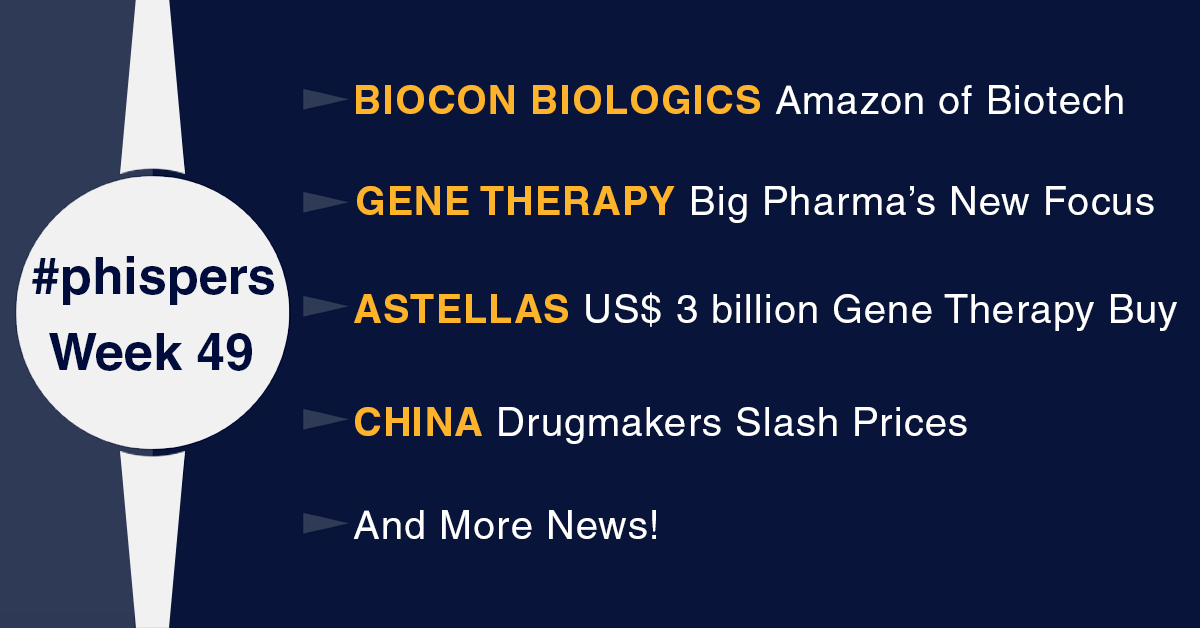
This week, Phispers brings you news on 11 large multinational drugmakers, including Pfizer and Novartis, that have set aside US$ 2 billion to invest in gene therapy manufacturing since 2018 to better control production of these expensive drugs.
In China, multinational drugmakers like AstraZeneca, Gilead, Sanofi and Roche have cut prices of 70 drugs by more than 60 percent on average in return for their inclusion in the Chinese government’s insurance scheme.
After Heritage Pharma in June, Rising Pharma settled a generic drug price fixing case with the US Department of Justice this week.
Meanwhile, Sanofi sold off its surgical products unit Seprafilm to Baxter for US$ 350 million.
Japan’s Astellas Pharma acquired American drugmaker Audentes Therapeutics for about US$ 3 billion in cash.
And Biocon and Mylan launched their Herceptin biosimilar — Ogivri — in the US.
Big pharma plan
major investments in gene therapy manufacturing plants
An analysis
undertaken by Reuters says 11 drugmakers led by Pfizer and Novartis have set aside US$ 2 billion to invest
in gene therapy manufacturing since 2018 in order to better control production
of the world’s priciest medicines.
While Pfizer has allocated US$ 600 million to build
its own gene therapy manufacturing plants, Novartis revealed a US$ 500 million
plan to the news agency.
Drugmakers say
building their own manufacturing plants is a response to the rising costs and
delays associated with relying on third-party contract manufacturers, who are
also expanding to capitalize on demand.
Gene therapies
hold the potential to cure devastating illnesses in a single dose, and are
quite expensive. They aim to correct certain diseases by replacing the missing
or mutated version of a gene found in a patient’s cells with
healthy copies. Such therapies could command prices of well above US$ 1 million
per patient.
Therefore, gene
therapy is one of the hottest areas of drug research and the US Food and Drug
Administration (FDA) is helping speed treatments to market. However, gene
therapy treatments are extremely complex to make, involving the cultivation of
living material, and they continue to pose a risk of carrying serious side
effects.
For drugmakers, it
helps to own their gene therapy facilities as the proprietary production
methods are safeguarded. They can also address any concerns raised by the FDA
more effectivity.
“There’s so little capacity and capability at contract manufacturers for the novel gene therapy processes being developed by companies,” said David Lennon, president of AveXis, Novartis’s gene
therapy division. “We need internal manufacturing capabilities in the long term.”
The FDA has
approved two gene therapies so far, and both have been developed by Novartis — Kymriah
(in August 2017) and Zolgensma (in May 2019). Months after its approval, the US$ 2 million
therapy for a rare muscular disorder had got embroiled in a
data manipulation scandal. And industry executives say the Zolgensma scandal
has highlighted the importance of having a consistent manufacturing process for
gene therapies. In August this
year, the FDA said it is investigating alleged data manipulation by former
executives at Novartis’ AveXis
unit.
There are
currently several hundred gene therapies under development by around 30
drugmakers for conditions such as hemophilia, Duchenne muscular dystrophy and
sickle cell anemia. The FDA expects 40 new gene therapies to reach the US
market by 2022. However, post the Zolgensma scandal, the FDA is also keeping a
close eye on standards.
Meanwhile,
Novartis is setting up a new US$ 90 million cell and gene therapy
factory in northern Switzerland. The unit is on track to begin commercial
production of its cell therapy Kymriah for cancer in 2020.
The new factory,
expected to employ 450 people, will allow Novartis to make its Kymriah
treatment for European patients without first having to fly their immune cells
across the Atlantic. Novartis expects cell and gene therapies to contribute about 15 percent of its revenue.
The Swiss factory,
as well as a separate French site that is also being expanded, are central to
Novartis’s plans to transform Kymriah from a
modest US$ 250 million-per-year seller into a US$ 1 billion blockbuster as
European demand rises.
Drugmakers
slash prices to make it to China’s reimbursement list
In China,
multinational drug companies have agreed to slash the prices of almost 100 drugs as the industry tries to strengthen its
foothold in the world’s
second-largest drug market. These drugs will be added to a nationwide insurance
scheme in China.
AstraZeneca, Gilead, Sanofi and Roche are among the multinationals that have agreed to cut the prices of 70 drugs by more than 60 per cent on average in return for their inclusion in China’s state-run insurance scheme.
These are the
latest among several such price cuts made by MNC drugmakers in order to drive
up sales in China as pressure to lower prices builds in the US.
The cuts will
affect several top-selling medicines, including Adalimumab, an arthritis treatment sold by US
drugmaker AbbVie under the brand Humira. China’s state-run co-payment scheme covers a significant portion of patients’ costs and now applies to 2,700 drugs.
The imported drugs added to the insurance scheme will be sold at the “lowest prices worldwide” as a result of the latest round of negotiations, said Xiong Xianjun, an official at China’s National Healthcare Security Administration.
“Being added to the national medical insurance can be a good thing, but production has to be able to keep up with demand,” said John Lin, an analyst with Ernst & Young.
China has also added a range of
innovative cancer drugs to a list of medicines eligible for reimbursement from
the national insurance system.
Meanwhile, China
said it will use its national drug bulk-buy scheme to
lower the price of drugs currently sold at higher prices compared with other
markets.
The move could
force international drugmakers to cut prices even further and enable copycat
medicines to replace imported off-patent brands at a faster pace.
The bulk-buy
program, which currently covers 25 types of medicines, allows no more than
three successful bidders access to China’s public
hospitals, where most Chinese people buy their drugs.
After Heritage,
Rising Pharma settles generics drug price fixing case with DOJ
In June, we had carried a news on how Heritage Pharmaceuticals Inc had agreed to settle allegations under the US
False Claims Act pertaining to price fixing of several generic medicines by
paying US$ 7.1 million.
Six months on, another pharmaceutical company — Rising Pharmaceuticals — admitted to price fixing and working with a
competitor to rig the market on a hypertension drug, the US Department of
Justice (DOJ)said in a statement this week.
Under
a deferred prosecution agreement, Rising Pharmaceuticals will
cooperate with prosecutors as they look into other players in
the industry, and it further agreed to pay more than US$ 3 million in
criminal penalties, restitution and civil damages.
According to the DOJ statement, “from about April 2014 until at least September 2015, Rising participated in a criminal antitrust conspiracy with a competing manufacturer of generic drugs and its executives to fix prices and allocate customers for Benazepril HCTZ, a medicine used to treat hypertension”.
Top generics
players have been facing the price-fixing heat for years now. This year,
Senator Bernie Sanders and the late Republican Elijah Cummings had urged the
DOJ to get moving. They wrote to Attorney General William Barr that they’re “concerned about the lack of enforcement.”
Recently, there
was news that Teva and other companies have been in talks with the DOJ over the last six months to
resolve a long-running criminal antitrust probe of alleged price-fixing by
these companies. One of the outcomes of such talks could be deferred
prosecution agreements. Such agreements would benefit the government and
generic drugmakers alike, as they would allow the companies and federal
payers to continue to conduct business with each other.
Days before
Sanofi’s strategic revamp announcement, it
strikes US$ 350 million deal
Last week, we had reported on how the new Sanofi CEO Paul Hudson is likely to
announce a new strategy around December 10 when he meets investors for a capital
markets day in Cambridge. There was also news that Hudson is mulling options
for their consumer health division.
This week, we learn that just
days before the big announcement of its new strategy, Hudson lined up a US$ 350
million sale. The French multinational is selling its surgical products unit
Seprafilm to Baxter.
The announcement
was made by Baxter on December 2. The deal gives Baxter's surgery division an
adhesion barrier product meant to reduce incidence and severity of
postoperative scarring in patients undergoing abdominal or pelvic laparotomy
procedures.
Baxter said it
expects the deal to close no later than the first quarter of 2020 and
anticipates the acquired products to generate US$ 100 million in sales in the
following year.
Seprafilm is a
clear film meant to form a barrier between abdominal tissue and organs to
reduce adhesions, or scarring, after surgery. Seprafilm reportedly drew interest from other
healthcare companies and private equity firms.
Sanofi gained Seprafilm in its US$ 20 billion-plus buyout of Genzyme in 2011.
Astellas
announces US$ 3 billion gene therapy push with buyout of Audentes
Japan’s Astellas Pharma Inc is acquiring American drugmaker Audentes Therapeutics Inc for about US$ 3 billion in cash in an over-priced bid to make genetic medicines a key area of growth.
Astellas, which is Japan’s second-largest drugmaker by sales, is offering US$ 60 per share for Audentes, which is a 110 percent premium to its closing price on Monday.
Citi analyst Hidemaru Yamaguchi said that while the deal looked expensive, it was a positive move for Astellas as Audentes had “cutting-edge gene therapy modalities”.
“Recent scientific and technological advances in genetic medicine have advanced the potential to deliver unprecedented and sustained value to patients, and even to curing diseases with a single intervention,” said Kenji Yasukawa, President and CEO, Astellas.
Audentes’ investigational drug, AT132, is being developed to treat a rare genetic neuromuscular disorder which results in extreme muscle weakness, respiratory failure and in some cases early death. Astellas said the companies plan to seek FDA approval for AT312 in mid-2020.
Gene therapies aim to cure diseases by replacing the missing or mutated version of a gene found in a patient’s cells with healthy copies.
“As a result of this acquisition, Astellas will obtain not only Audentes programs but also its proprietary manufacturing knowhow in gene therapy,” Astellas CFO Naoki Okamura said.
The acquisition
marks the second biggest on record for Astellas after its 2010 purchase of OSI
Pharmaceuticals Inc for US$ 3.8 billion, according to Refinitiv data. Astellas
expects the deal, which is subject to regulatory approval including US
antitrust clearance, to close in the first quarter of 2020.
Biocon
launches Herceptin biosimilar in US; says it wants to be Amazon of biotech
Mylan and Biocon have launched their Herceptin biosimilar — Ogivri — in the US. Herceptin is Roche’s blockbuster breast and stomach cancer drug.
Ogivri is the
second biosimilar of Herceptin after Amgen launched copies of both Herceptin and Avastin (a colorectal cancer drug) in July this year.
“With regulatory approval for our biosimilar (Herceptin) in more than 80 countries worldwide, we are bringing vast global biosimilars experience to the US and look forward to continuing our work with all stakeholders in the healthcare system to reduce costs, improve access and advance care," Mylan President Rajiv Malik said in a statement.
Mylan said Ogivri would hit the market at a “competitive discount” to Herceptin. However, it did not disclose the list price for its 420-milligram and 150-milligram vials.
Meanwhile, Biocon’s subsidiary — Biocon Biologics — is focusing on innovative
business models to reduce the cost of human insulin and cancer drugs, as it
looks to build a pipeline of 28 biosimilars across global markets, the company’s chief executive said.
“We want to
be the Amazon of biotech pharma going beyond the product. You don’t have to do ecommerce, but we want to be as innovative and as disruptive as Amazon was. We want to transform healthcare,” Christiane Hamacher, CEO of Biocon Biologics, said.
Biocon Biologics will
chart a path that ensures high volumes and low costs, unlike competitors,
The company plans
to create an ecosystem where patients not only have access to the right
medicine, but also get the right care without always reaching a hospital.
Innovative technology will enable this model. The company is chasing a revenue target of US$ 1 billion in financial year 2021-22. Last fiscal year, it crossed US$ 200 million in revenue.

















 Share
Share