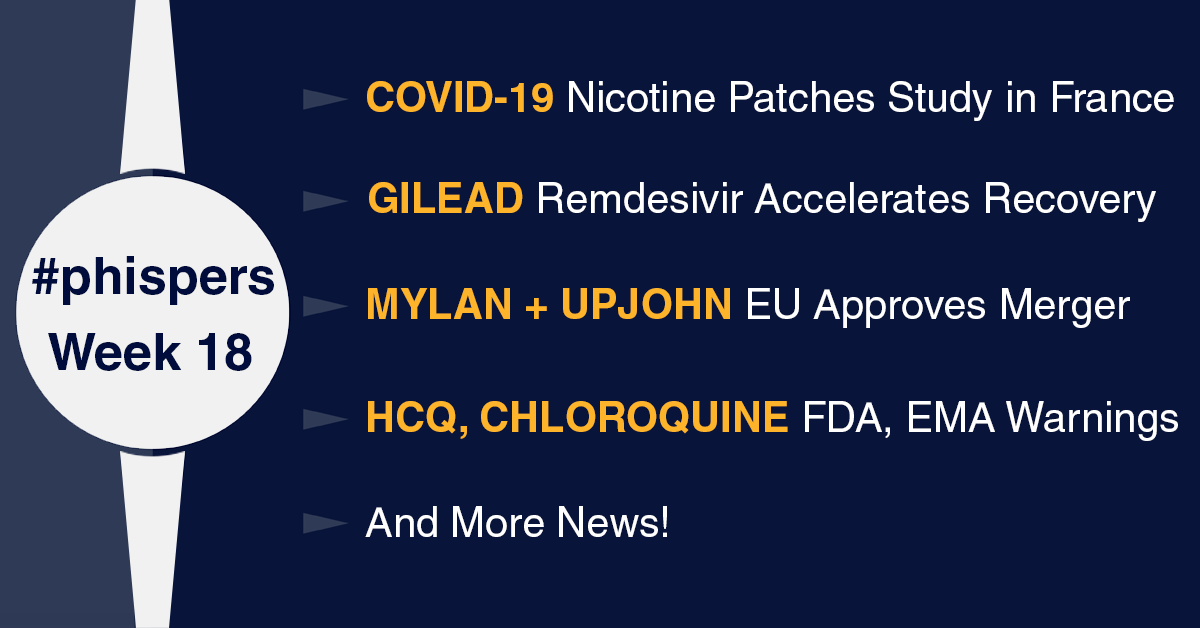
This week, Phispers brings you news that a key study undertaken by the National Institute of Allergy and Infectious Diseases in the US has revealed that Gilead’s remdesivir accelerates recovery against Covid-19.
Japan will approve the drug for treating the disease.
The USFDA and the EMA have issued warnings on the side-effects of HCQ and CQ and have cautioned against the use of these drugs for Covid-19.
FDA’s Janet Woodcock said the agency did its best by approving emergency use of Bayer’s chloroquine, since people with auto immune diseases were having trouble accessing the drug due to its high demand.
A study undertaken by a French hospital has suggested that smokers may be at much less risk of contracting Covid-19.
Human trials on this hypothesis will begin soon.
Another study undertaken in France found tocilizumab to significantly improve clinical outcomes of patients with moderate or severe Covid-19 pneumonia.
And the European Commission approved the proposed merger of Mylan and Upjohn, the Pfizer division that handles off-patent branded and generic drugs, though the approval is subject to conditions.
French researchers to test nicotine patches on
Covid-19 patients after study shows smokers at lower risk
French
researchers are planning to test nicotine patches on Covid-19 patients and frontline health workers after a
study suggested smokers may be much less at risk of contracting the virus. They
are getting ready to launch a human trial to test this hypothesis. The trial will
begin in around three weeks.
The study at the Pitié-Salpêtrière hospital in Paris suggests that nicotine in tobacco may be stopping patients who smoke from catching
Covid-19.
The
trial will involve groups of healthcare workers and patients wearing nicotine patches and other groups wearing placebo patches. They will then be
tested to see if there is a difference in how their bodies respond to the
virus.
However,
the researchers insisted they were not encouraging the population to take up
smoking, which carries other potentially fatal health risks and kills 50
percent of smokers. The researchers also said while nicotine may protect those
from the virus, smokers who have caught it often develop more serious symptoms
because of the toxic effect of tobacco smoke on the lungs.
The team at Pitié-Salpêtrière hospital questioned 480 patients who tested positive for the virus. Out of them, 350 had been hospitalized while the rest with less serious symptoms were at home.
The
median age of those who were admitted to the hospital was 65
years. Out of those, only 4.4 percent were regular/daily smokers. In the French
population, 25.4 percent are daily smokers. Since the proportion of daily
smokers was significantly lower in the 480 patient group who had tested
positive for Covid-19, the authors concluded that daily smokers had a much
lower probability of developing symptomatic or severe SARS-CoV-2 infection as
compared to the general population. However, this hypothesis needs to be tested
clinically. Therefore, researchers are carrying out a trial by making
healthcare workers and patients wear nicotine and placebo patches.
Meanwhile,
France has banned online sale of nicotine substitutes after the release of this study as the
government fears panic buying of nicotine replacement therapies.
The
government said the ban would stop people from rushing out and potentially
over-consuming nicotine substitutes, as well as ensure a steady supply for
patients genuinely being treated for smoking addiction.
Tocilizumab
findings: A study in France found tocilizumab to significantly improve clinical outcomes of patients with moderate or severe Covid-19 pneumonia. A total of 129 patients were randomized: 65 to standard of care + tocilizumab and 64 to standard of care alone.
Patients
were selected on the basis of being hospitalized for Covid-19 moderate or
severe pneumonia not requiring intensive care upon admission. The primary
composite outcome was need for ventilation (non-invasive or mechanical) or
death at day 14.
A
significantly lower proportion of patients reached the primary outcome in the
tocilizumab arm. Results of this study will be submitted for publication in a
peer-reviewed journal.
Tocilizumab
suppresses overreactions of the immune system and helps inhibit a deadly medical condition called a cytokine storm — an overproduction of immune cells that damage healthy tissues — which is also one of the main causes of death for critically ill Covid-19 patients.
Last month, China had approved Swiss drugmaker Roche’s Actemra (tocilizumab) for patients who develop severe complications from Covid-19.
Crucial study shows remdesivir accelerates recovery against Covid-19;
Japan set to approve it
The closely-watched experimental drug to treat Covid-19 — Gilead Sciences’ remdesivir — saw news reports swaying in favor and against the drug over the course of the week. On Wednesday though, a US government-run study of remdesivir showed that the medicine accelerates recovery from advanced Covid-19, the disease caused by the novel coronavirus.
In a statement, Gilead said: “We understand that the trial has met its primary endpoint.”
Time to recovery is a metric often
used in influenza trials and is defined as being well enough for hospital
discharge or returning to normal activity level. Preliminary results indicate
that patients who received remdesivir had a 31 percent faster time (11 days) to
recovery as compared to those who received placebo (15 days). Results also
suggested a survival benefit, with a mortality rate of 8.0 percent for the
group receiving remdesivir versus 11.6 percent for the placebo group.
The study compared remdesivir
to placebo with neither patients nor physicians knowing who got the drug
instead of a placebo. Such a study means unconscious biases will not affect the
conclusions.
Once the data is out, the
findings are likely to represent the first treatment shown to improve outcomes
in Covid-19 patients. A total of 68 sites were involved in the study — 47 in the United States and 21 in countries in Europe and Asia.
Last week, a summary of the results of a clinical trial undertaken in China on remdesivir got inadvertently posted to the website of the World Health Organization (WHO). It suggested that the drug shows no benefit to Covid-19 patients and didn’t prevent them from dying. The summary was taken down soon, though a screenshot of the WHO post was captured by a medical news website.
The news of the China trial came days after the University of Chicago Medicine hospital
reported detailed rapid recovery in fever and respiratory symptoms in some
patients with Covid-19.
Gilead,
however, said the data from the Chinese trial suggests a “potential benefit.” There are multiple phase 3 studies underway to gauge how effective remdesivir is in combating
Covid-19. In addition to carrying two phase 3 studies, Gilead has made the drug
available to studies run by other sponsors, including the one in China, as well
as to more than 1,700 people on a compassionate use basis. The NIAID study was
among the most important and rigorously designed to test remdesivir in
Covid-19.
Meanwhile, Japan’s Prime Minister Shinzo Abe said the country will soon approve remdesivir for the treatment of coronavirus patients. A government
official said the drug will be approved as early as next month to treat
patients with Covid-19.
In Japan, the anti-influenza drug Avigan is also going through clinical tests on Covid-19 patients. A scientific study in China has shown its efficacy in treating the disease.
EU approves merger of Mylan and Pfizer’s Upjohn division, subject to conditions
The
European Commission has approved the proposed merger of Mylan and Upjohn, a business division of Pfizer that operates Pfizer’s off-patent branded and generic established medicines under the EU Merger Regulation. The decision is conditional, depending upon divestment of Mylan’s business for certain generic medicines.
Margrethe Vestager, executive vice-president responsible for competition policy of the European Commission said: “Ensuring that patients and hospitals have access to medicines at fair and competitive prices, as well as ensuring security of supply, is always a key priority which resonates even more strongly in the current challenging context. Our decision ensures that the merger between Mylan and Upjohn does not harm competition, thus preserving competitive access to certain genericised medicines for national health services and European citizens”.
The Commission’s probe focused on the market for generic medicines. Mylan and Upjohn overlap in various therapeutic areas such as cardiovascular, genito-urinary, musculoskeletal, nervous system, and sensory organ treatments.
The investigation found no competition concerns arise for the majority of the products supplied by both Mylan and Upjohn. “The Commission has concluded that the proposed transaction, as modified by the commitments, would no longer raise competition concerns in the EEA. The decision is conditional upon full compliance with the commitment,” a statement said.
FDA, EMA issue warnings on HCQ over side effects; FDA speaks up on Bayer’s CQ
The
US Food and Drug Administration has cautioned against use of hydroxychloroquine (HCQ) or chloroquine (CQ) for Covid-19 outside of the hospital setting or a clinical trial due to risk of heart rhythm problems.
The EMA has also said CQ and HCQ are known to potentially cause heart rhythm
problems.
“Recent studies have reported serious, in some cases fatal, heart rhythm problems with chloroquine or hydroxychloroquine, particularly when taken at high doses or in combination with the antibiotic azithromycin,” EMA said in a statement.
The
two drugs are currently authorized for treating malaria and certain autoimmune
diseases. In addition to side effects affecting the heart, they are known to
potentially cause liver and kidney problems, nerve cell damage that can lead to
seizures (fits) and low blood sugar (hypoglycaemia), the statement added.
“Healthcare professionals are recommended to closely monitor patients with Covid-19 receiving chloroquine or hydroxychloroquine and to take into account pre-existing heart problems that can make patients more prone to heart rhythm issues,” it said.
‘FDA did best by granting EUA to Bayer’s CQ’: In an interview to STAT News, Janet Woodcock, who heads the FDA Center for Drug
Evaluation and Research, said the FDA approved the EUA (Emergency Use
Authorization) for a Bayer drug (chloroquine) that wasn’t approved in the US and a couple of other HCQ drugs during a time when there was
tremendous demand and people with lupus and other autoimmune diseases were
having trouble accessing the drug because of the demand.
“We were clear that an Emergency Use Authorization is not an FDA approval in any shape or form. We simply said it’s possible from the in vitro data this may have a beneficial effect and the benefits may outweigh the risks,” she said.
“Given the circumstances, I would say we did the best we could,” Woodcock added.














 Share
Share