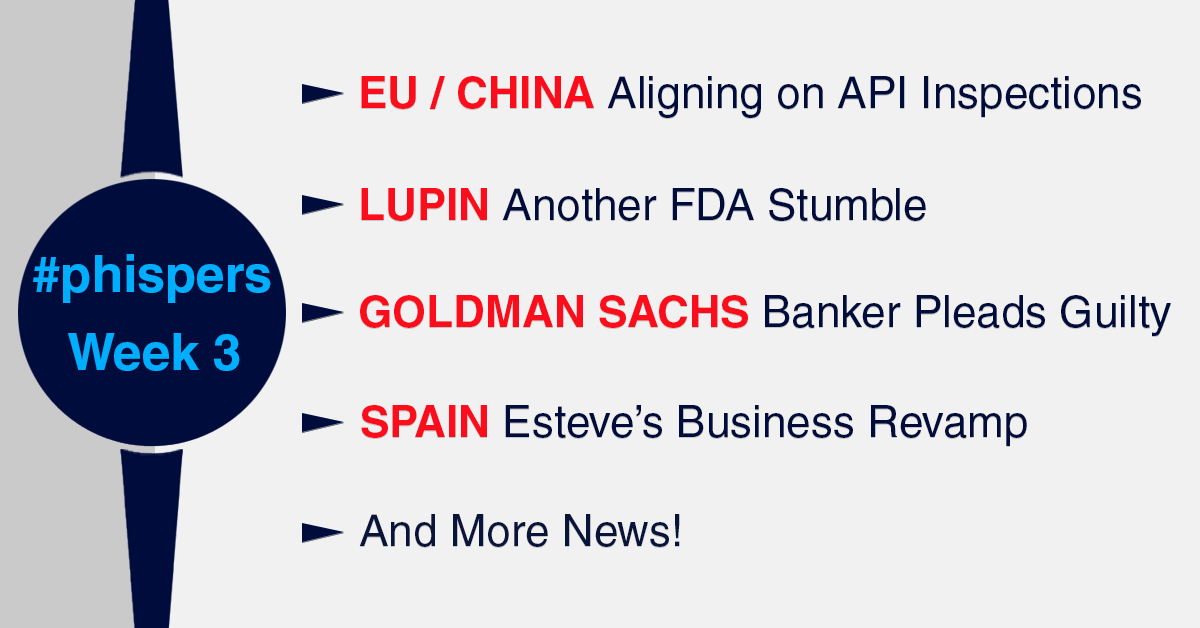
This week, Phispers has news from China, where its drug regulator said it would work with European Commission’s drug regulatory bodies to identify similarities and differences between Chinese and EU regulatory systems for APIs.
In the US, a former Goldman Sachs investment banker pleaded guilty to insider trading in biotechs.
Eli Lilly rang in the new year with the acquisition of California-based Dermira for US$ 1.1 billion.
Spanish drugmaker Esteve announced its decision to buy German drug company, Riemser.
The first fortnight of 2020 also saw several settlements, as Allergan settled its pay-for-delay claims, Celgene resolved claims pertaining to its trade practices and Teva settled a whistleblower lawsuit.
And Indian drugmaker Lupin saw its fifth facility get classified as OAI by the FDA.
EU,
China to work together on aligning API inspection standards
Chinese agency for regulating drugs and medical devices — National Medical Products Administration (NMPA) — has agreed to work with the European Commission’s Director General for Health and Food
Safety (DG Sante), the European
Medicines Agency (EMA) and others to identify similarities and differences between
the Chinese and EU regulatory systems for active pharmaceutical ingredients
(APIs).
The commission
said it has created a budget to conduct a gap analysis, which would be used to
identify Chinese training needs in the API space. EU experts will also conduct
a fact-finding visit to China to assess the regulatory, control and enforcement
system governing the implementation of GMP (good manufacturing practices)
standards.
In a statement, DG Sante said: “The availability of APIs of high quality for manufacturing of medicinal products for the EU market is a growing concern. The manufacturing issues, often related with the API quality, are one of the major reasons of shortages of medicinal products in the EU.”
The Commission is
responsible for carrying out equivalence assessments before and after listing.
Active substances from listed countries such as Australia, Brazil, Israel,
Japan, the Republic of Korea, Switzerland and the US can be imported without a
written confirmation.
However, the
majority of APIs used for manufacturing of medicinal products for the EU market
come from India and China. Neither India nor China are listed. Compliance of
the APIs coming from these countries with the EU GMP relies on the written
confirmations issued by their competent authorities.
“The nitrosamine contamination crisis confirmed the importance of the cooperation on the quality standards for medicines with the Council of Europe,” the Commission said. “DG Sante plans to continue to cooperate with EDQM (European Directorate for the Quality of Medicines and HealHealthCare) for incidents or crisis situations.”
The Commission
also said it contacted the US Food and Drug Administration (FDA) for a project
on a joint training plan for Indian and Chinese inspectors of APIs
manufacturing sites. Japan’s regulators
and the World Health Organization (WHO) also expressed interest, and
information on recent inspection trainings in China and India were requested by
EMA, FDA, Japan and WHO. EMA is also collecting information on scheduled
training events for 2020 through 2022.
Goldman
Sachs banker pleads guilty to insider trading in biotech ahead of M&As
In October last
year, prosecutors in the US had charged six
members of an insider trading ring who worked for firms including the Goldman
Sachs Group, Moelis and Centerview Partners and had allegedly raked in tens of
millions of dollars in illicit profits.
The US Attorney’s Office for the Southern District of New
York had arrested three members of the international ring. According to a Reuters
report from October 2019, the bankers shared the profits from the trades
beginning in at least January 2013. That included profits from buying shares of
biotech firm InterMune Inc ahead of a 2014 announcement of an US$ 8.3 billion
acquisition by Roche Holding AG; profits from shares of Onyx Pharmaceuticals before news reports in June 2013 that it
would be purchased by Amgen for US$ 10.4 billion, and profits off shares of
Pharmacyclics ahead of an announcement it would be purchased by AbbVie Inc for US$ 21 billion in 2015.
The investment
bankers got information about
pending mergers and acquisitions at work, according to the US Department of
Justice and the Securities and Exchange Commission. They then sold the
information to middlemen, who passed it on to traders. The bankers were repaid
with cash, expensive holidays, luxury watches and other benefits, according to
court filings.
Last week, there
was news that a former Goldman Sachs investment banker — Bryan Cohen — has pleaded guilty to insider
trading.
Cohen (33) had been a
vice president in Goldman’s consumer
retail industry group before his arrest in October last year. He pleaded guilty to one
count of conspiracy to commit securities fraud before US Magistrate Judge Debra
Freeman in Manhattan.
Prosecutors said
Cohen, who worked for Goldman in London and New York, gave a securities trader
in Switzerland tips about corporate acquisitions in exchange for cash and other
benefits from 2015 to 2017.
Lilly
announces acquisition of Dermira for US$ 1.1 billion
Eli Lilly rang in
the new year with an announcement that it is acquiring California-based Dermira Inc in an all-cash deal for US$ 1.1
billion. The acquisition will allow Eli Lilly to expand its immunology pipeline with a
late-stage treatment for atopic dermatitis.
The agreement came days ahead of the annual JPMorgan Healthcare Conference in San Francisco (January 13 to 16, 2020) — a platform where drug majors tend to announce significant deals and strategic shifts.
With this buyout,
Lilly will acquire two key Dermira assets — lebrikizumab and Qbrexza (glycopyrronium)
cloth. Lebrikizumab is a novel,
investigational, monoclonal antibody designed to bind IL-13, which is believed
to be a driver of signs and symptoms of atopic dermatitis. It is currently in
two Phase III trials for the treatment of moderate-to-severe atopic dermatitis
in adolescent and adult patients, ages 12 years and older.
Last month, FDA
granted fast-track designation to lebrikizumab, and analysts think the drug could be a challenger to Dupixent, a skin drug made by Regeneron and Sanofi expected to bring in over US$ 11 billion in annual sales.
Qbrexza is a medicated cloth approved by the FDA for
the topical treatment of primary axillary hyperhidrosis (uncontrolled excessive
underarm sweating). The companies said in the statement that they expect the
deal to close by the end of the first quarter.
Drugmakers have
been increasingly interested in medications for chronic skin conditions such as
eczema and psoriasis that could produce reliable income streams from patients
who in most cases require lifelong treatment. In August, Amgen said it would pay US$ 13 billion to acquire psoriasis drug
Otezla from Celgene, as part of that company’s merger
with Bristol-Myers Squibb.
Spain’s Esteve continues business revamp, buys
out German drugmaker Riemser
Last month, Japanese drugmaker Towa Pharmaceutical had announced it is acquiring Pensa Investments, the generics division
of the Spanish pharmaceutical company Esteve.
In 2018, as part
of its strategic plan, Esteve had announced the company's intent to focus its
business on proprietary products and areas of specialized medicine. The
divestiture of Pensa was, therefore, viewed as a first step in that direction.
The new year began with more news on Esteve’s business revamp. Last week, Esteve announced that it will acquire all shares of the
German pharmaceutical company Riemser from Ardian, a private investment house.
Headquartered in Berlin, Riemser has a diversified portfolio with products in three main therapeutic areas — oncology, neurology and niche therapies.
“Riemser contributes both knowledge and experience in the European hospital market, in addition to pharmaceutical activity in four of the major European markets—Germany, United Kingdom, France and Spain,” Esteve CEO Staffan Schüberg said in a statement.
Esteve’s purchase of Riemser will accelerate its transformation into a specialty pharma company with more than 60 percent of its sales coming from proprietary products. It will also give Esteve access to a high-growth sector – the hospital market.
Ardian bought
Riemser in 2012. It then sold off its veterinary, dental and device businesses
and refocused it with deals for specialty drugs in 2014, 2015 and 2016. In
2019, it acquired a drug distribution business in Spain.
Allergan
settles pay-for-delay claims; Celgene, Teva also settle lawsuits
The first
fortnight of 2020 saw several settlements. In order to wrap up its mega-merger
with AbbVie, Allergan had agreed to settle pay-for-delay claims against two of its businesses—Warner Chilcott and Watson Pharmaceuticals — for US$ 300 million and no admission of wrongdoing.
Filed by purchasers of Loestrin 24 Fe and Minastrin 24 Fe, the antitrust suits claimed Warner paid off Watson and another generics maker, Lupin Pharmaceuticals, to delay launching cheaper copycats of
those two contraceptive pills.
Similarly, Celgene
Corp agreed to shell out US$ 55 million to resolve claims that the drugmaker engaged in a multi-faceted scheme
to maintain a monopoly over the market for its cancer treatment drugs Thalomid and Revlimid and delay generic competition.
The settlement was
disclosed in a filing last week in federal court in Newark, New Jersey, and
would, if approved, resolve a class action brought on behalf of insurers,
consumers and others who claimed they paid more for the drugs than they should
have.
The third company
to settle lawsuits was Israeli drugmaker Teva Pharmaceutical Industries. The company, which has plenty of lawsuits on its plate, agreed to pay US$ 54 million to settle an old
whistleblower lawsuit that claims it paid doctors to prescribe multiple
sclerosis drug Copaxone and Parkinson’s drug Azilect.
In 2013, two former sales
representatives of Teva had
sued the company alleging that it had set up a program to pay doctors
to prescribe the drugs through speakers’ fees. The events, termed as a “sham”, only served as a conduit for paying doctors to prescribe the drugs, the whistleblowers said.
Lupin
stumbles with FDA yet again; its fifth facility gets classified as OAI
Indian drugmaker Lupin Limited has run into a series of troubles with
the US Food and Drug Administration (FDA). In 2019, four manufacturing sites of Lupin — in Mandideep, Somerset (US), Goa and Pithampur — received ‘Official
Action Indicated’ (OAI)
letters from the FDA, with the Goa and Mandideep units also receiving warning
letters.
In the latest and fifth such action, the US health regulator classified Lupin’s Tarapur facility as OAI. The FDA had inspected Lupin’s Tarapur manufacturing (API) facility during September 16 to 20, 2019.
The inspection at
the Tarapur facility had closed with three observations. The company said it
was in the process of sending further updates of its corrective actions to the
FDA and was hopeful of a positive outcome.
“We do not believe that this inspection classification will have on impact on disruption of supplies or the existing revenues from operations of this facility,” Lupin said in its filing with the Bombay Stock Exchange (BSE).














 Share
Share