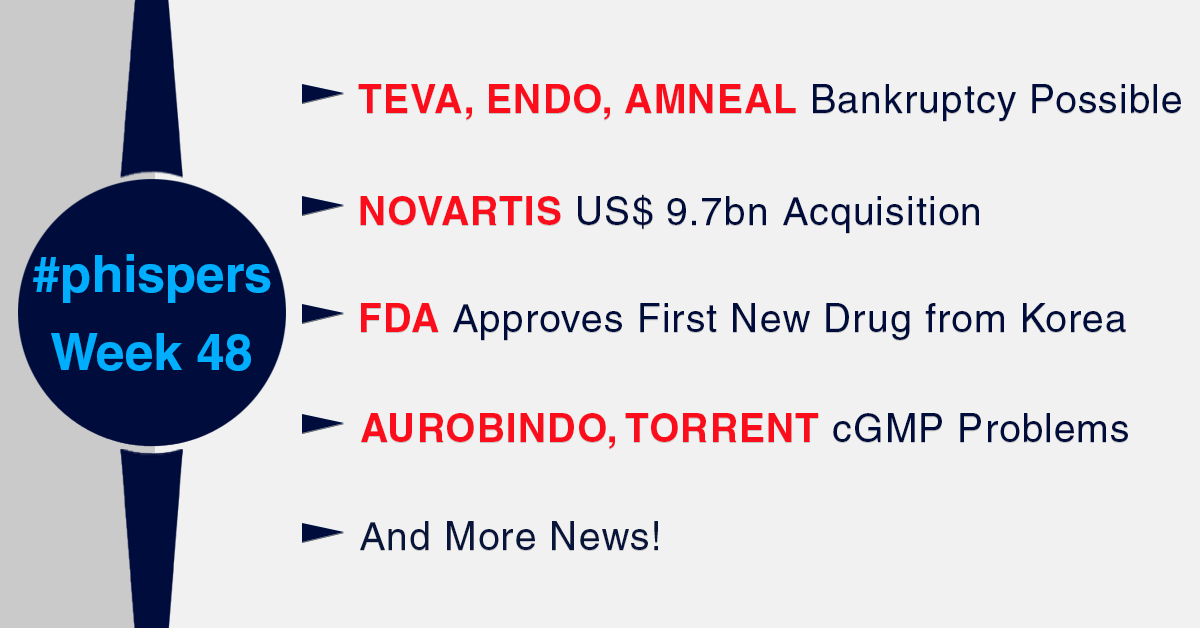
This week, Phispers has news of a study that identifies 31 troubled biopharma companies that are at very high risk of going bankrupt in the next 12 months.
Novartis has agreed to buy The Medicines Company for US$ 9.7 billion.
After Chinese biotech BeiGene, this week there is news of another Asian firm — South Korea’s SK Life Science — winning the FDA nod for its epilepsy drug.
Sanofi’s new CEO Paul Hudson is likely to announce a new strategic plan in December and may sell or spin-off its consumer health unit.
And in compliance news, the operations of Aurobindo Pharma and Acharya Chemicals in India and Torrent Pharma in the US land in regulatory trouble.
Teva, Endo,
Amneal, Bausch among top companies likely to go bankrupt, says study
An analysis
undertaken by BioPharma Dive has identified 31 troubled biopharma
companies that are at highest risk of going bankrupt in the next 12 months.
Amongst these are companies like Teva, Bausch Health,
Endo International, Mallinckrodt and Amneal Pharmaceuticals. Also on high risk are small biotechs
like Clovis Oncology and Puma Biotechnology.
BioPharma Dive used data from CreditRiskMonitor, a firm
that calculates the probability that a company will go bankrupt in the next
year using a 10-point scale called a FRISK score. The company says FRISK scores
have been 96 percent accurate in predicting bankruptcy.
Though bankruptcy
filings have typically been rare in the drug industry, they have ticked up this
year primarily due to rising legal, political and market pressures.
Teva is the
biggest company on the list. The Israeli drugmaker has struggled to chart a convincing
path forward given its rising legal liabilities and eroding revenues. Teva also
finds itself at the center of several prominent controversies.
Legally, Teva
faces charges of helping spur an opioid epidemic and of conspiring to fix
prices with other generic drugmakers.
In December 2017,
hundreds of opioid-related court cases were consolidated into a case proceeding
in the Ohio federal district court, with Teva one among many industry players
facing charges. That led to a recent round of early settlements with two Ohio
counties.
Along with these
prominent legal battles, analysts have also voiced concern about Teva’s high debt levels, which stood at nearly
US$ 27 billion as of the end of September this year.
Novartis agrees
to buy The Medicines Company
for US$ 9.7 billion
Novartis has agreed to buy New
Jersey-headquartered The Medicines Company (MedCo) for US$ 9.7 billion. The buyout will give Novartis a late-stage PCSK9 therapy named inclisiran.
Inclisiran is a small, interfering RNA (siRNA) drug which works by blocking the synthesis of PCSK9 in the liver rather than targeting the protein itself.
This allows more
receptors on the liver cell surfaced to capture LDL cholesterol to break down.
By lowering LDL levels (popularly known as the ‘bad’ cholesterol), the likelihood of major
cardiac events decreases.
“The prospect
of bringing inclisiran to patients fits with our overall strategy to transform
Novartis into a focused medicines company and adds an investigational therapy
with the potential to be a significant driver of Novartis’ growth in the medium to long term,” Novartis CEO Vas Narasimhan said.
According to
MedCo, the planned approval for inclisiran is set to be completed before the
end of the year in the US, and in Europe in the first quarter of 2020, With Novartis picking up MedCo, the rumor mill is abuzz once again. Amarin is said to be another target of a big
acquisition with an FDA decision on a heart-helping label expansion for Vascepa coming late next month and prescriptions for the lipid-lowering drug on the rise.
Some bullish
investors also think the MedCo deal for PCSK9 candidate inclisiran could spell
a buying boom in the cardiology space. They believe an Amarin deal could
be worth more than US$ 20 billion, with suitors like Pfizer and Amgen speculated to be in the running. Amarin has not commented on these reports, which it terms as “rumor and speculation”.
After Chinese
firm, first Korean drug company bags FDA nod for its epilepsy drug
The US Food and Drug Administration (FDA) appears to be approving drugs from the Far East at a steady pace. Last week, we reported on the FDA approving zanubrutinib (branded as Brukinsa) developed by
Chinese biotech BeiGene. The drug secured accelerated approval for adult patients with mantle cell lymphoma (MCL) — a typically aggressive and rare form of blood cancer.
This week, there
is news that the agency approved a new treatment for partial-onset seizures in adults.
The drug — cenobamate — will be sold as Xcopri by SK Life Science, the US subsidiary of the massive Korean
conglomerate SK Group. Xcopri will provide another therapeutic option for
patients with epilepsy. This approval marks the first time a Korean company has
independently brought a compound from discovery to FDA approval.
The company plans to hire a salesforce to support the drug’s launch, which is expected by the second quarter of next year. Xcopri is SK Life Science’s first commercial product.
Cho Jeong-woo, the
CEO of SK Biopharmaceuticals and SK Life Science, said the Xcopri approval is a “major step” towards the Korean firm’s goal of becoming a “fully integrated global pharmaceutical company that can discover, develop and deliver new treatment options in epilepsy and central nervous system.”
The launch will
take place after the requisite review by the Drug Enforcement Administration,
which is typically completed within three months of the FDA approval.
The FDA nod wraps
a decade of quiet growth from SK Life Science, which has been developing its
presence in the pharmaceutical industry.
The FDA approval
is based on results from two global, randomized, double-blind,
placebo-controlled studies and a large, global, multi-center, open-label safety
study.
Compliance Recap: Operations of Torrent, Aurobindo, Acharya Chemicals run into
trouble
Aurobindo Pharma: News of compliance problems at Aurobindo Pharma continues to emerge. Last month, a US
Food and Drug Administration (FDA) inspection of the firm’s Unit VII had raised concerns over the data
generated at the site and new Form 483s posted by the FDA showed similar
problems at other units. At Unit V and Unit VIII, which were inspected in October 2019,
the FDA found no scientific basis for Aurobindo’s quality
control chemists to invalidate out-of-specification (OOS) results and
investigation conclusions were not supported by scientific data.
Earlier this
month, Aurobindo’s Unit IV, a
key site for Indian generic major which generates between 10 to 15 percent of
its revenues, was issued a 37-page Form 483.
The sterile drug manufacturing
facility was found to have inadequate procedures to prevent microbial
contamination of drug products. The environmental monitoring activities in the
aseptic processing areas were found deficient as were the systems for
maintaining any equipment used to control aseptic conditions. In addition, the
quality control unit was found to lack authority to review production
records to assure that no errors have occurred.
However, unlike
the other units there were no concerns raised over the handling of
OOS results.
Torrent Pharma:
Two years back, the FDA warned manufacturers of
non-sterile, water-based drug products of Burkholderia cepacia
complex (BCC or B cepacia)
contamination, as it had led
to the presence of the water-borne opportunistic pathogen in pharmaceutical
water systems. The contamination had led to product recalls.
Two years on, Torrent Pharma’s US manufacturing operations was issued a
warning letter for failing to control the presence of
BCC. Torrent’s US facility in Levittown, Pennsylvania,
had discovered the presence of Burkholderia cepacia on its manufacturing equipment. It
further identified that their water system was the source of the contamination.
Torrent’s facility in Levittown produces drug
products such as rectal suppositories and oral solutions. Following the
inspection, which was held from March 11 to April 9, 2019, the firm, committed
to cease using its current water system and recalled all batches of drug
product which were on the market.
People exposed to
BCC are at an increased risk for illness or infection, especially patients with
compromised immune systems.
Acharya
Chemicals: An API manufacturer based in India — Acharya Chemicals — failed a cGMP inspection performed by the Swiss Agency for Therapeutic
Products (Swissmedic) after the
inspectors found two critical and three major deficiencies.
The firm that produces APIs such as metronidazole benzoate, amlodipine besylate and cetirizine dihydrochloride failed to address cross-contamination
concerns as they did not take appropriate measures while introducing a new
chemical entity into their production area. The non-compliance certificate also
highlights dust and rust at the facility along with improper solvent recovery
management.
Acharya Chemicals’ failure will impact another API manufacturer — Glochem Industries — as the firm supplies the key intermediate for Glochem’s amlodipine besylate and cetirizine dihydrochloride
APIs and has been removed as a registered intermediate manufacturer from
Glochem’s regulatory filings.
Sanofi CEO to
unveil new strategy in Dec; to sell or spin-off consumer health unit
French drugmaker Sanofi is considering a joint venture or outright sale of its
consumer healthcare unit as it readies its new strategic plan that is likely to
be announced next month, a Reuters news report said.
Sanofi’s newly appointed CEO Paul Hudson plans to meet investors for a capital markets day in Cambridge, Massachusetts, on December 10.
Also likely to
figure in its new strategic plan is an initial public offering (IPO) of the
consumer healthcare business, which could be worth around US$ 30 billion,
sources said. However, no final decision had been made so far, they added.
According to
analysts, divestment or spin-off of Sanofi’s consumer
healthcare arm would enable the group to invest more in internal research. Revenue of the consumer healthcare arm grew by 3
percent at constant exchange rates last year to US$ 5.2 billion (Euro 4.7
billion).
Sanofi may also
take decision about the future of Sanofi’s ailing
diabetes business, which has been under constant pricing pressure in the US,
while drawing up its new strategic plan.
Hudson said last
month he and his teams would study the performances of every Sanofi division to
decide where to invest.
“Prioritization will become increasingly important going forward,” Hudson had told reporters in October. “The reality in business is that some things are more important than others and we have to understand where we must win.”
Meanwhile, Muzammil
Mansuri, Sanofi’s head of strategy and
business development and member of the French drugmaker’s executive
committee, will be retiring from the company. This is the first major
management change under Hudson, who took over on September 1.
Mansuri had joined
Sanofi in 2016 from Gilead Sciences where he was in charge of research and
development strategy and corporate development.
Hudson said in the
memo that Alban de la Sabliere, currently head of business development, and
Laurent Van Lerberghe, head of strategy, would take on more responsibilities as
of December 1 and report directly to him. Even though the group’s new strategy is still in the works,
Hudson has made no secret that significant changes were underway.















 Share
Share