The market for pharmaceutical excipients — or inactive substances used in the production of drugs — continued to witness significant transformation in the first quarter (Q1) of 2026. The rise of biologics, increasing demand for personalized medicine, and innovations in drug delivery systems are driving demand for a wider range of functional excipients. As a
result, the pharmaceutical excipients market is estimated to grow at a compound annual
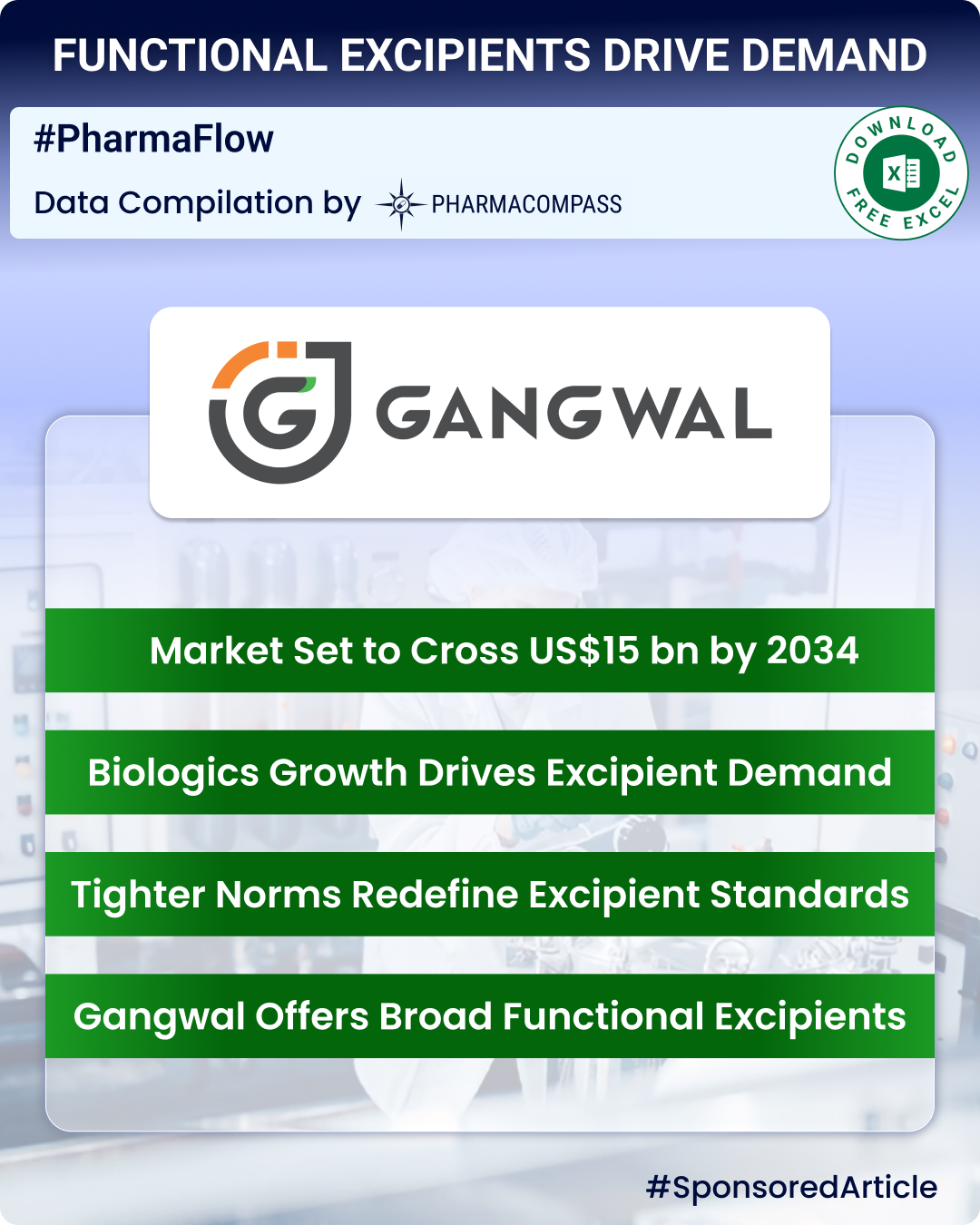
growth rate (CAGR) of 5.75 percent, to exceed US$ 15.43 billion by 2034. Its
size was estimated at US$ 9.31 billion in 2025. The
North American market for excipients was estimated at US$ 3.1 billion in 2024
and is estimated to increase to US$ 5.66 billion by 2034. In comparison, the European market for
pharmaceutical excipients was estimated at US$ 2.35 billion in 2024 and is
predicted to reach around US$ 3.95 billion by 2034, while the Asia Pacific
market stood at US$ 1.94 billion in 2024 and is projected to grow to US$ 3.65
billion by 2034.The sector remains highly competitive and fragmented. Major excipient providers include BASF, Roquette, Gangwal Healthcare, Croda International, DuPont, Seqens, SPI Pharma, Evonik, PMC Isochem, Pfanstiehl, Colorcon, Kewpie Corporation, ICE Pharma, Nanjing Well Pharmaceutical, Merck KGaA-owned MilliporeSigma, Minakem, Ashland Global and Nippon Fine Chemical.Clariant sets up its first PEG excipients facility in US; Croda
opens greenfield facility in India Swiss specialty chemical company Clariant is expanding its Clear Lake
(Texas) site to include GMP-compliant manufacturing
of pharmaceutical-grade polyethylene glycol (PEG) excipients. This will improve availability and reliability for North American customers, with extended reach to Latin America. The multi-phase expansion addresses critical industry priorities around supply chain security, continuity, and responsiveness while demonstrating Clariant’s long-term strategic commitment to the US pharmaceutical market. This is the first Clariant facility in the US to manufacture PEG excipients for oral and topical applications.British
specialty chemicals company Croda International has inaugurated a greenfield manufacturing facility in Dahej, India, that
strengthens its ability to serve fast-growing markets in Asia. The new site
represents a significant investment in India and will enhance Croda’s supply capabilities, improve responsiveness to customer demand, and support future growth in high-value sectors. Located in Gujarat, the facility benefits from strong logistics connectivity and is designed to serve both domestic customers and select export markets. It will support demand across Croda’s consumer care, life sciences, and industrial specialties sectors. Following the acquisition of IFF Pharma Solutions in 2025, French excipient company Roquette has introduced an expanded
cosmetics portfolio under the Roquette Beauté brand. This portfolio integrates IFF Pharma Solutions’ ingredients — Methocel, Avicel, Aquacoat, Ethocel, and Polyox — with Roquette’s legacy range, while its core portfolio continues to include widely used pharmaceutical excipients. View Our Dashboard on Major Excipient Companies in 2026 (Free Excel Available)SPI Pharma-Anek Prayog, Ingredion-Univar ink distribution deals;
DFE Pharma, Gericke launch CM platformIn
February, US-based pharmaceutical excipient and ingredients company SPI Pharma announced a global distribution partnership with Indian
pharmaceutical excipient manufacturer Anek Prayog. Under this agreement, SPI
will exclusively sell, promote, and distribute Lubripharm Pro SSF, a
next-generation sodium stearyl fumarate lubricant manufactured by
Anek Prayog.The
Ingredients + Specialties division of Univar Solutions was appointed as a distributor for Ingredion Pharma Solutions. The agreement includes distribution of Ingredion’s global pharmaceuticals portfolio and positions Univar as the exclusive distributor of pharmaceutical starches in the US and Canada. The partnership expands its pharmaceutical and nutraceutical excipient offerings, including binders, fillers, superdisintegrants, lubricants, and
gelatin alternatives.German
excipient solutions company DFE Pharma has launched a continuous
manufacturing (CM) platform in collaboration with Switzerland-based Gericke
Group to support formulation development,
optimization, and lifecycle management. The platform integrates CM-ready
excipients, a flexible evaluation environment, and multidisciplinary expertise
to enable data-driven decisions from early development to commercial manufacturing.As
part of this initiative, DFE Pharma has established CM capabilities at its C2F
Center of Excellence in Hyderabad, featuring a Gericke Formulation Skid (GFS)
in a non-GMP setup. This modular system enables rapid testing, process
optimization, and practical assessment of continuous feeding and blending
without impacting existing GMP operations, while supporting alignment with ICH
Q13 (an international guideline on CM for drug substances and products).Gangwal Healthcare operates EXCiPACT-certified GMP facilities and offers a broad range of functional excipients, including co-processed blends like ProBlend, Starlose, Tyloxapole, and Microlose. Its excipients, including Solvostar (sodium starch glycolate) and LubMag-W (Magnesium Stearate, Sodium Lauryl Sulfate), support enhanced tablet disintegration and drug release. The company also provides taste-masking agents such as SucreX (sucralose) and CutCal (neotame), supporting the development of patient-friendly oral dosage forms. View Our Dashboard on Major Excipient Companies in 2026 (Free Excel Available)India harmonizes 22 excipient monographs; EMA updates TE
guidelines for inhalation products Regulators are increasingly tightening requirements around excipients, as they are no longer treated as passive ingredients. They are being recognized as critical to product performance and therapeutic equivalence.India
has introduced the Indian Pharmacopoeia 2026 with updated and harmonized standards for
pharmaceutical ingredients, including 22 excipient monographs. These revisions align Indian standards more closely with global pharmacopoeias. For excipient manufacturers and drug formulators, this means stricter compliance expectations. In August, India had notified an amendment to the Drugs Rules, 1945 to mandate inclusion of qualitative details of excipients in drug labels through barcodes or QR codes from 2026.The
European Medicines Agency (EMA) has issued updated guidelines on the pharmaceutical quality of inhalation and nasal medicines, as well as on demonstrating therapeutic equivalence (TE) of orally inhaled products (OIP) for asthma and chronic obstructive pulmonary disease. These guidelines require manufacturers to provide detailed information on the active substance, finished product composition, pharmaceutical development studies, and the control of excipients and other formulation components. Similar pharmaceutical quality requirements apply to nasal products under the pharmaceutical quality guideline.Excipients
are becoming increasingly linked to manufacturing technologies. For instance,
the US Food and Drug Administration (FDA) finalized its Advanced Manufacturing
Technologies (AMT) Designation Program in 2024. This is expected to
increase the need for excipients compatible with such technologies. View Our Dashboard on Major Excipient Companies in 2026 (Free Excel Available)Our view While the market for excipients is growing at a healthy pace, the ongoing conflict in the Middle East is disrupting pharmaceutical supply chains, with impacts now extending beyond APIs to critical excipients and packaging materials. Surging crude oil prices are driving up the cost of excipients, with key inputs like chloroform witnessing sharp price increases. In addition, disruptions in logistics are forcing drugmakers to reroute shipments through longer and more expensive routes due to closure of airports and certain sea routes. These developments will have a cascading effect on the pharmaceutical industry and its supply chain in the coming months.
















 Share
Share