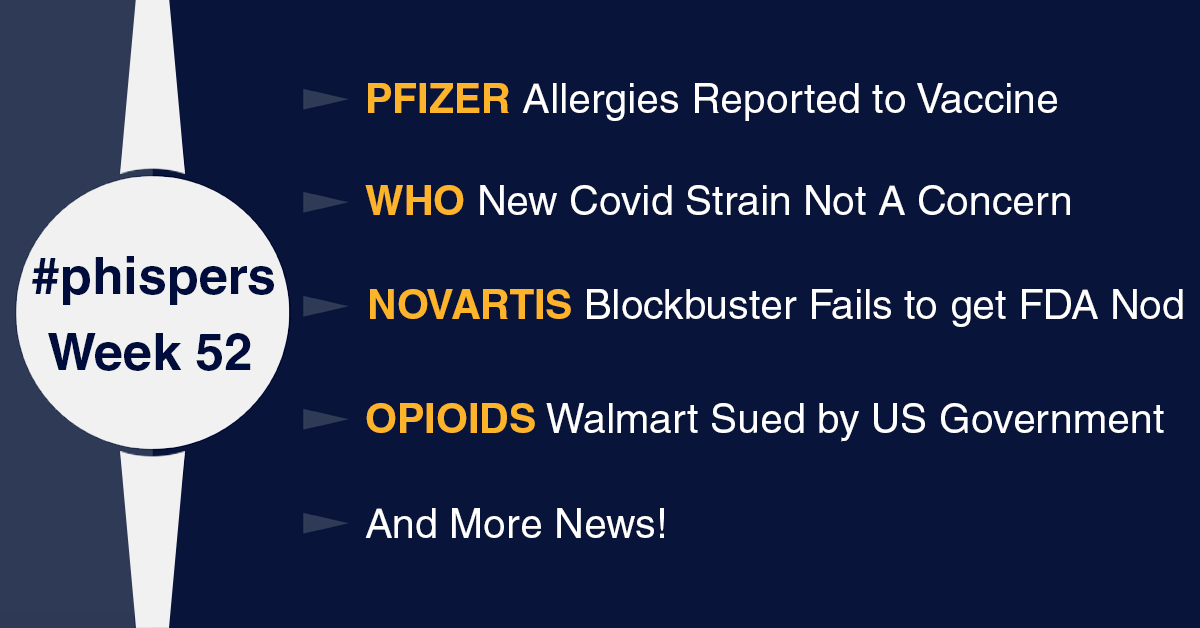
This week, Phispers brings you more updates on the coronavirus pandemic. The ‘fast spreading’ UK mutation of the coronavirus dominated headlines with people raising concerns over the efficacy of vaccines against this strain. The WHO said the variant is a normal part of the pandemic’s evolution and has cautioned against raising major alarm. Vaccine makers, such as Moderna and Pfizer, are investigating the impact of their jabs on this strain.
There is lots of news on Pfizer’s mRNA vaccine, which has triggered allergic reactions in at least eight people. Scientists say nanoparticles in Pfizer’s vaccine could be the reason behind the allergic reactions. Meanwhile, after a public tiff with the US government, Pfizer seems close to striking a deal to supply additional doses of its vaccines to the US from April to June next year.
In
non-Covid news, the US Department of Justice has sued Walmart for fueling the opioid crisis. The US Food and Drug Administration denied approval to Novartis’ lipid-lowering therapy — inclisiran — which bagged approval in Europe last week. The denial has been linked to the FDA’s inability to inspect the third-party facility that manufactures this drug. And the pharma industry continued to be in a deal-making mode, with Agios selling its cancer business to Servier for US$ 2 billion and GSK betting US$ 815 million on Surface Oncology’s antibody asset.
New ‘fast-spreading’ coronavirus strain surfaces in UK; WHO says no cause of concern
The mutant coronavirus in the United Kingdom seized
headlines this week, setting off alarm bells ringing all across the world with
many countries banning flights from the UK.
The
strain, known by the name B.1.1.7, appears to be more contagious. Therefore,
the UK Prime Minister Boris Johnson has announced stricter lockdown measures in the country.
Meanwhile
scientists are busy
studying the new strain and its human-to-human transmission. They’re also wondering how it evolved so fast — it has acquired 17 mutations all at once. Scientists say they have never seen a virus acquire more than a dozen mutations.
In London, over 60 percent of all the cases were of the new variant, and the slew of mutations may have increased the virus’ transmissibility
by 70 percent.
The new
variant has spread to Italy, the Netherlands, Denmark and Australia
and there is concern that B.1.1.7 could cause more severe disease. However, the
World Health Organization (WHO) has cautioned against major alarm over this
variant, saying it is a normal part of a pandemic’s
evolution.
Citing
data from Britain, WHO officials said they had no evidence that the variant
made people sicker or was deadlier than the existing strains of Covid-19,
although they said it did seem to spread more easily.
WHO
emergencies chief, Mike Ryan, said: “Being able to track a virus this closely, this carefully, this scientifically in real time is a real positive development for global public health, and the countries doing this type of surveillance should be commended.”
Meanwhile,
both Pfizer and Moderna are rushing to calm people over their vaccine, and are launching new studies to prove their vaccine will fend off the new coronavirus strain. The two companies, along with Pfizer’s partner BioNTech, are collecting data from
people who have received the shots to determine how well they may be able to
neutralize the new strain from the UK.
BioNTech has
said though it is “currently investigating the impact of its vaccine on the UK mutation”, it is confident
that its vaccine works against it.
Similarly,
Regeneron has said its Covid-19 antibody cocktail is likely to be
effective against the UK variant, adding that research is underway to confirm
the same.
Nanoparticles in Pfizer’s vaccine may be triggering allergic reactions, say scientists
Since Pfizer-BioNTech have begun administering their
Covid-19 vaccine, at least eight people who received the first shot said they
experienced severe allergy-like reactions. Now, scientists are saying such
reactions could be due to
polyethylene glycol (PEG) — a compound in the packaging of the messenger
RNA (mRNA) that forms the vaccine’s main ingredient. Moderna’s mRNA vaccine also contains PEG.
The US
Food and Drug Administration (FDA) is investigating around
five serious allergic reactions that happened after people were administered
the Pfizer-BioNTech
vaccine. Peter Marks, director of FDA’s Center for Biologics Evaluation and Research, said allergic reactions had been reported in more than one state, including Alaska.
PEG has
never been used before in an approved vaccine, but it is found in many drugs
that have occasionally triggered anaphylaxis, a potentially life-threatening
allergic reaction.
The US
National Institute of Allergy and Infectious Diseases (NIAID) convened several
meetings last week to discuss the allergic reactions with representatives of
FDA, Pfizer,
Moderna, independent scientists and physicians. NIAID is also setting up a
study in collaboration with the FDA to analyze the response to the vaccine in
people with allergies.
Clinical trials of Moderna and Pfizer-BioNTech’s vaccines mostly excluded people with a history of
allergies. The Centers for Disease Control and Prevention (CDC) website clearly
states that people who have had a severe allergic reaction—also known as anaphylaxis—to any ingredient in the Pfizer-BioNTech vaccine, should not get vaccinated.
Pfizer
strikes deal with US government: Recently, a public tiff broke out
between Pfizer and the US government, wherein the former made multiple offers
to provide additional doses of its Covid-19 vaccine if the latter used the
Defense Production Act to tell raw material suppliers to quickly fulfill Pfizer’s order. Pfizer-BioNTech had not taken R&D funding from the US government.
This offer
for additional doses was over and above the 100 million doses it promised in
its original contract. Now, there is news that Pfizer has struck a deal with the US government to
supply 100 million additional
doses of its vaccine by July 31, 2021. This agreement brings the total number
of doses to be delivered to the US to 200 million, allowing for 100 million
people to be vaccinated.
“Consistent with the original agreement announced in July 2020, the US government will pay US$ 1.95 billion for the additional 100 million doses,” Pfizer said in a statement.
Meanwhile,
President-elect Joe Biden received his first dose of the Pfizer vaccine this week, proving to Americans that it is “safe to take”. More than 600,000 Americans are said to have now received the
first Covid-19 vaccine doses as
of Monday.
Use extra doses in Pfizer’s vials, says FDA: There have been reports that
hospital pharmacists were throwing away one in every six doses of the first
Pfizer-BioNTech Covid-19 vaccines distributed in the US because of confusion
over labeling. The Pfizer vials are supposed to hold five doses, but pharmacists
had found enough for a sixth or even a seventh dose. Without clear approval
from the manufacturer, the extra dose had to be discarded.
Now, the
FDA has said extra doses from vials of Pfizer’s Covid-19 vaccine can be used. “At this time, given the public health emergency, FDA is advising that it is acceptable to use every full dose obtainable (the sixth, or possibly even a seventh) from each vial, pending resolution of the issue,” said an FDA representative in an emailed statement.
OWS
leader takes responsibility for delays: Last week, there was considerable
confusion over the distribution of
the Pfizer-BioNTech Covid-19 vaccine in the US. Over a dozen
governors complained that they had received far fewer doses than originally
promised. This mounted worries of potential delays in administering the shots
to healthcare workers and long-term care residents.
Gustave Perna, the military leader of America’s Operation Warp Speed, has said he takes sole responsibility for last week’s
confusion over the allotment of the Pfizer vaccine to states.
“Where I failed — I failed, nobody else failed — was to have a clear understanding of that cadence” of the vaccine distribution process, Perna said, adding: “It was my fault. I gave guidance. I am the one that approved the forecast sheets.”
COVAX program: The World Health Organization’s COVAX
program is the main global scheme to vaccinate people in poor and middle income
countries around the world against the coronavirus. It aims to deliver at least
2 billion vaccine doses by the end of 2021. However, a Reuters report
said the program is facing a very high risk of failure due to lack of funds, supply risks and complex contractual
arrangements.
“The risk of a failure to establish a
successful COVAX Facility is very high,” says an internal report to the board of Gavi, an alliance of governments, drug companies, charities and international organizations that arranges global vaccination campaigns.
USFDA declines approval to Novartis’ inclisiran due to inspection delays
Last week, we had carried news about the European Commission clearing Swiss drugmaker Novartis AG’s lipid-lowering therapy, inclisiran (branded as Leqvio). The drug came to Novartis’ fold through the US$ 9.7 billion acquisition of The Medicines Company last year.
However, this week, there is news that the US Food and Drug
Administration (FDA) has declined to approve
inclisiran.
In a statement, Novartis said the FDA
has not raised any concerns
related to the efficacy or safety of inclisiran. The
complete response letter (CRL) is due to unresolved facility inspection-related conditions. No
onsite inspection was conducted by the FDA, the company said. The supplier responsible for
manufacturing the drug for Novartis is Italy-based Corden Pharma Caponago.
“No onsite inspection was conducted of the single third-party facility in question,” the statement said. If a facility inspection is needed, the FDA will define an approach once safe travels may resume based on public health need and other factors, the Novartis statement added.
The drugmaker said it will work with the FDA and the third-party
manufacturing facility in Europe to complete the inclisiran review, in order to
bring the siRNA drug to patients in the US as quickly as possible.
M&A deals: Agios sells cancer biz to Servier;
Novartis to acquire Cadent Therapeutics
As the
year draws to a close, the pharmaceutical industry continues to remain in a
deal-making mode. This week, Agios Pharmaceuticals Inc said it is selling its cancer business to privately held
company Servier for around US$ 2 billion. The deal includes US$ 1.8 billion in upfront cash and US$ 200 million in milestone payments for its experimental brain cancer treatment — vorasidenib — as well as 5 percent royalties on US net sales of tibsovo, a treatment for acute
myeloid leukemia.
Novartis-Cadent
deal: Swiss
drugmaker Novartis is acquiring Cadent Therapeutics in a deal worth up to US$ 770 million. As per the terms of the deal, Cadent will receive an upfront payment of US$ 210 million, with
an additional US$ 560 million on achieving commercial and regulatory
milestones. With this deal, Novartis will get Cadent’s neuroscience portfolio. The deal is expected to close in the first quarter of next year.
GSK,
Surface Oncology deal:
GlaxoSmithKline is putting US$ 85 million upfront
and up to US$ 730 million in milestone payments to buy Surface Oncology’s early-stage antibody asset. The drug GSK is betting on— SRF813 — is a fully human, IgG1 antibody targeting PVRIG (also known as CD112R), an inhibitory protein expressed on natural killer cells and T cells.
Gilead
amends deal with Galapagos: After facing disappointment with the FDA rejecting filgotinib as a treatment for rheumatoid
arthritis, Gilead and its Belgian partner Galapagos have decided to downshift
their multibillion-dollar, 10-year pact that was completed in July 2019. The
two companies have said they will no longer pursue clinical trials in the US
with filgotinib against rheumatoid arthritis and other conditions. However,
they will pursue the drug as a treatment for inflammatory bowel disease.
US sues
Walmart for fueling opioid crisis; says retailer ignored warning signs
The
US Department of Justice (DOJ) has sued the world’s biggest
retailer Walmart Inc for fueling the opioid crisis in the country, for ignoring
warning signs from its pharmacists and for filling thousands of invalid
prescriptions. The DOJ has said Walmart failed to take its gatekeeping duties
as a pharmacy seriously.
The
lawsuit marks one of the most significant actions DOJ has taken in response to
the opioid epidemic. The lawsuit alleges that
Walmart created a system that turned its 5,000 in-store pharmacies into suppliers
of highly addictive painkillers, dating as early as June 2013.
However,
the company has rejected these allegations. “Justice
Department’s investigation is tainted by historical ethics violations, and this lawsuit invents a legal theory that unlawfully forces pharmacists to come between patients and their doctors, and is riddled with factual inaccuracies,” Walmart has said.

















 Share
Share