Please Wait
Applying Filters...
Menu
Xls

Digital Content read-more

Create Content with PharmaCompass, ask us

DATA COMPILATION #PharmaFlow

read-more
read-more
DMF filings hit all-time high in Q3 2024; China tops list with 58% increase in Type II submissions
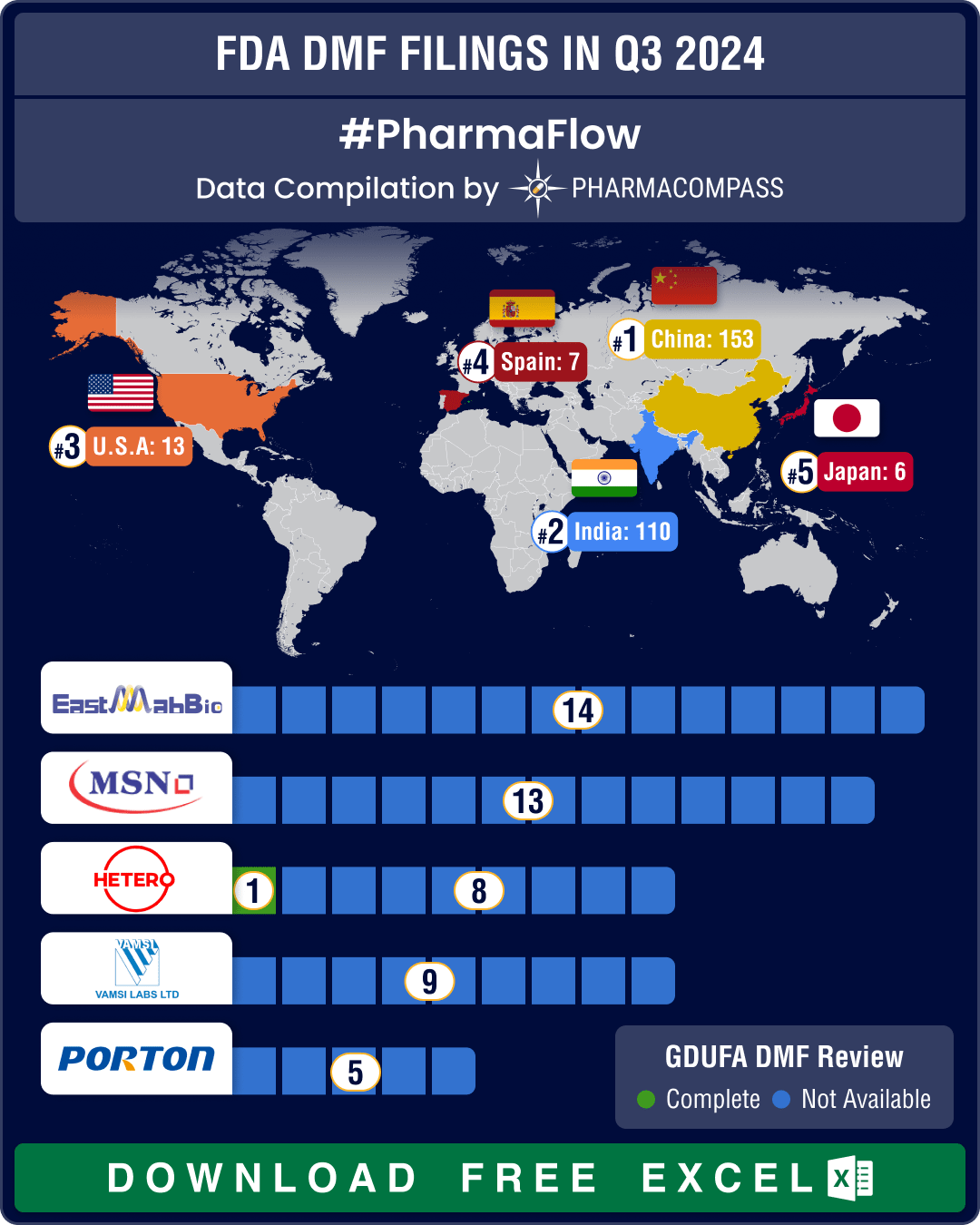
Drug Master Files, or DMFs, are confidential documents that play a crucial role in the pharmaceutical industry. These files, submitted to the US Food and Drug Administration (FDA), contain detailed information about ingredients, manufacturing processes, and packaging of medicines. They help the FDA oversee drug quality. Of the four types, Type II DMFs involve active pharmaceutical ingredients (APIs) for both branded and generic drugs. The third quarter (Q3) of 2024 saw Type II DMF submissions set a new record. A total of 309 Type II DMFs were submitted to the FDA during this period, a substantial 24.6 percent increase over Q3 2023 (with 248 submissions). The second quarter of 2024 too saw a remarkable increase, with 237 Type II DMFs being submitted compared to 178 in Q2 2023. View FDA DMF Filings in Q3 2024 (Power BI Dashboard, Free Excel Available) China witnesses steep rise in DMF submissions, beats India with maximum filings In Q3 2024, China filed 153 DMFs submissions, marking a substantial 57.7 percent increase from the 97 submissions filed in Q3 2023. India maintained its strong position but fell to the number two spot with 110 DMFs, representing a modest 3.8 percent increase from 106 in Q3 2023. The US, which came a distant third, saw a slight decline in DMF submissions, with 13 filed in Q3 2024, as compared to 18 in Q3 2023. For several years, India had a lead in Type II DMFs. Since 2020, which marked the start of the pandemic, we have noticed a gradual increase in DMFs filed by China. This year, China has surpassed India considerably in the first three quarters. During the first nine months of 2024, China submitted 372, while India filed 286 DMFs. If this lead is maintained in Q4, DMFs from China will surpass that of India in 2024.  Amongst European countries, Spain led with seven DMFs, followed by Italy at four, and Germany and the Netherlands at three each. Among other nations, Japan contributed six while Israel submitted four DMFs. In company-wise tally, China’s Jiangsu East-Mab Biomedical Technology topped the list with an impressive 14 DMFs. On its heels were Indian companies — MSN at 13 DMFs, and Vamsi Labs and Hetero Drugs at nine DMFs each. China’s Porton Pharma and Wuxi AppTec filed five, while Shanghai Keze Yongxin Biotechnology, and Qingdao Glycogene Pharmaceutical contributed four submissions each. India's Maithri Drugs also submitted four. Japanese company Santeja filed five. Overall, Asia accounted for nearly 90 percent, with China contributing a dominant 49.5 percent of all DMF submissions. India was at 35.6 percent, the US at 4.2 percent, while Europe contributed 6.5 percent.  View FDA DMF Filings in Q3 2024 (Power BI Dashboard, Free Excel Available) Diabetes, obesity, cancer, women’s health drugs emerge as hot molecules in Q3 2024 In terms of molecules, semaglutide (used for the treatment of type 2 diabetes and weight management) and relugolix (to treat prostate cancer and uterine fibroids) saw six DMF filings each in Q3 2024, indicating significant industry interest in these compounds. Following closely behind were semaglutide’s competitor tirzepatide and overactive bladder therapy vibegron, garnering four DMFs each. Finerenone (a non-steroidal drug for chronic kidney disease associated with type 2 diabetes) and voclosporin (an immunosuppressant for lupus nephritis) saw three DMFs each.  The last quarter also witnessed the introduction of 14 molecules with first-time DMFs. Among them were acetoxy empagliflozin, cabozantinib fumarate, tivozanib hydrochloride monohydrate, diosmetin, trilaciclib, clenbuterol hydrochloride, fenoterol hydrobromide, tapinarof and fezolinetant. Fezolinetant, with a DMF from Spain’s Moehs Iberica, is the active ingredient in Astellas’ Veozah, which is the first non-hormonal treatment for menopausal symptoms approved by the FDA. Tapinarof, filed by India’s Maithri Drugs, is used in Vtama, a novel steroid-free psoriasis cream. Other compounds that made their DMF debut include berotralstat, calcium phosphoryl choline chloride, phloroglucinol dihydrate, belumosudil mesylate and trimethylphloroglucinol. During Q2 2024, there were 19 drugs that saw DMF submissions for the first time, including molecules like triptorelin, sorafenib, pralsetinib, trilaciclib dihydrochloride, resmetirom (hepatology) and teneligliptin hydrochloride hydrate (metabolic disorders).  View FDA DMF Filings in Q3 2024 (Power BI Dashboard, Free Excel Available)    GDUFA fee for FY 2025: The FDA’s Generic Drug User Fee Amendments (GDUFA) is a law designed to speed access to safe and effective generic drugs to the public and reduce costs to the industry. The fiscal year 2025 fee rates were published on July 31, 2024. The FDA has revised fees under GDUFA III for all categories. While there is a slight increase in the DMF fee from US$ 94,682 in 2024 to US$ 95,084 in 2025, the ANDA fee has witnessed a significant jump — from US$ 252,453 in 2024 to US$ 321,920 in 2025. FY 2024 and FY 2025 User Fee Rates Generic drug fee category Fees rates for FY 2024 Fees rates for FY 2025 Applications: Abbreviated New Drug Application (ANDA) US$ 2,52,453   US$ 3,21,920   Drug Master File (DMF) US$ 94,682 US$ 95,084 Facilities: Active Pharmaceutical Ingredient (API)—Domestic US$ 40,464 US$ 41,580 API—Foreign US$ 55,464 US$ 56,580 Finished Dosage Form (FDF)—Domestic US$ 2,20,427   US$ 2,31,952 FDF—Foreign US$ 2,35,427   US$ 2,46,952 Contract Manufacturing Organization (CMO)—Domestic US$ 52,902 US$ 55,668 CMO—Foreign US$ 67,902 US$ 70,668 GDUFA Program: Large size operation generic drug applicant US$ 17,29,629   US$ 18,91,664 Medium size operation generic drug applicant US$ 6,91,852   US$ 7,56,666 Small business generic drug applicant US$ 1,72,963   US$ 1,89,166 Our view The highlight of the last few quarters has been the sharp rise in Type II DMF filings from China. The submission of a DMF is not required by law or any FDA regulation. FDA’s DMF guideline offers guidance on acceptable approaches to meeting regulatory requirements. Moreover, DMFs establish trust in APIs from lesser-known companies. With a growing emphasis on compliance and quality assurance, it appears that Chinese drug companies are eager to demonstrate their commitment to high standards and build trust in the US market. And that’s good news for the pharmaceutical industry.   

Impressions: 10745

https://www.pharmacompass.com/radio-compass-blog/dmf-filings-hit-all-time-high-in-q3-2024-china-tops-list-with-58-increase-in-type-ii-submissions

#PharmaFlow by PHARMACOMPASS
24 Oct 2024

WEEKLY NEWS RECAP #Phispers

read-more
read-more
Sanofi, Earendil Labs ink up to US$ 2.56 bn AI-driven autoimmune drug deal; CDC revises childhood immunization guidelines
The New Year began with two mid-size deals centered around the use of artificial intelligence (AI) in drug development. Sanofi and AI-powered biotech Earendil Labs struck a collaboration deal worth up to US$ 2.56 billion to discover and develop bispecific antibodies for autoimmune diseases. Eli Lilly partnered with Nimbus Therapeutics in an up to US$ 1.3 billion AI-driven obesity research program. Additionally, Lilly acquired clinical-stage biopharma Ventyx Biosciences for US$ 1.2 billion in cash for its experimental oral drugs for autoimmune diseases.In oncology, AbbVie licensed a late-stage cancer drug from China’s Suzhou Zelgen for up to US$ 1.2 billion. And British pre-clinical gene therapy company Ikarovec entered into a deal with Chicago-based VectorBuilder to use the latter’s novel AAV capsid technology along with its gene therapy candidate to explore a treatment for intermediate age-related macular degeneration (AMD). In the US, the Centers for Disease Control and Prevention (CDC) has revised the immunization guidelines for children. The Trump administration froze federal childcare and welfare funds worth over US$ 10 billion for five states. And India is planning to tackle the menace of contamination by proposing a ‘prescription-only’ model for the sale of cough syrups.In clinical trials, Jazz Pharmaceuticals reported positive phase 3 results for its drug to treat HER2-positive gastroesophageal cancer. Incyte said it plans to seek an expanded US Food and Drug Administration (FDA) approval for Monjuvi (tafasitamab) as a  first-line therapy for diffuse large B-cell lymphoma (DLBCL) following positive results from a phase 3 trial.  And AstraZeneca’s subcutaneous drug showed promising results in a phase 3 trial on lupus patients.Sanofi, Earendil ink AI-powered autoimmune drug deal worth up to US$ 2.56 bnArtificial intelligence-powered biotech Earendil Labs has signed a strategic collaboration with Sanofi to apply its discovery platform to multiple autoimmune and inflammatory disease programs. Sanofi will lead the development and worldwide commercialization of bispecific candidates arising from the collaboration. Under the agreement, Earendil will receive up to US$ 160 million in upfront and near-term payments linked to early program milestones. The deal’s total potential value is up to US$ 2.56 billion, including milestone payments. This collaboration builds on an earlier agreement signed between the two companies in April.Lilly, Nimbus sign up to US$ 1.3 bn AI-driven obesity drug research, licensing dealNimbus Therapeutics has entered into a multi-year research and licensing agreement with Eli Lilly to develop new oral treatments for obesity and other metabolic diseases using AI. Under the deal, Boston-based Nimbus will receive US$ 55 million in upfront and near-term milestone payments. Nimbus will be eligible to receive up to US$ 1.3 billion in total, which will include development, commercial and sales milestone payments. Nimbus will use its AI capabilities to identify potential drug candidates, while Lilly will contribute its expertise in metabolic diseases to help develop oral medicines. Lilly acquires Ventyx Biosciences for US$ 1.2 bn: Eli Lilly is acquiring San Diego-based clinical-stage biopharma Ventyx Biosciences for US$ 1.2 billion in cash. Ventyx is working on multiple oral drugs for inflammatory-mediated diseases, including treatments for autoimmune diseases, cardiovascular and neurological conditions.AbbVie inks up to US$ 1.2 bn deal with China’s Zelgen for its late-stage cancer drugAbbVie has signed a deal worth up to US$ 1.2 billion with China’s Suzhou Zelgen Biopharmaceuticals to strengthen its immuno-oncology pipeline. AbbVie has licensed Zelgen’s ZG006 (alveltamig), a trispecific T‑cell engager engineered to target small cell lung cancer and other tumors. AbbVie will receive exclusive rights to develop and commercialize the drug outside Greater China, while Zelgen keeps full rights in mainland China, Hong Kong, and Macau.Ikarovec, VectorBuilder ink deal: Ikarovec has entered into an exclusive worldwide option agreement with VectorBuilder to use its novel AAV capsid technology along with its gene therapy candidate IKAR-003 for intermediate AMD. The deal is expected to be worth over US$ 1 billion.CDC revises childhood vaccine guidelines; US freezes childcare, welfare funds to 5 statesThe CDC has overhauled America’s childhood immunization guidelines, reducing the number of diseases children should be vaccinated against from 17 to 11. The decision comes after the US President Donald Trump issued a memorandum to the CDC to review the childhood vaccine schedule. The updated schedule no longer recommends routine flu and Covid-19 vaccination for children. Shots for Covid and hepatitis A and B are recommended based on risk and “shared clinical decision-making” between doctors and parents. The CDC has also limited immunization against respiratory syncytial virus (RSV) to high-risk children and infants whose mothers were not vaccinated.US freezes funds to five states: The Trump administration is freezing more than US$ 10 billion in federal childcare and family assistance funding to California, Colorado, Illinois, Minnesota, and New York, citing concerns over fraud and misuse, the US Department of Health and Human Services (HHS) has said. The states’ access to these funds will remain restricted while the department conducts further review.India plans ‘prescription-only’ rule for cough syrups after contamination reportsIndia’s drug regulator, the Central Drugs Standard Control Organization has proposed removing cough syrups from the list of medicines that can be sold without a prescription. The proposal follows discussions at a drugs consultative committee meeting in November, where members were briefed on incidents linked to contaminated cough syrups.Incyte’s Monjuvi scores phase 3 win as first-line treatment for DLBCLIncyte plans to seek an expanded FDA approval for Monjuvi (tafasitamab) as a first-line treatment for DLBCL following positive results from a phase 3 trial. The study tested Monjuvi plus lenalidomide added to standard R-CHOP therapy (rituximab, cyclophosphamide, doxorubicin, vincristine, prednisone) in newly diagnosed patients. Tafasitamab was approved in combination with lenalidomide by the FDA in 2020 for adult patients with relapsed or refractory DLBCL not otherwise specified including DLBCL arising from low-grade lymphoma, and who are not eligible for autologous stem cell transplant.Jazz’s gastroesophageal cancer med posts phase 3 win: Jazz Pharmaceuticals announced positive results from the phase 3 trial testing Ziihera (zanidatamab) in combination with chemotherapy, with or without the PD-1 inhibitor Tevimbra (tislelizumab), as first-line treatment for adults with HER2-positive locally advanced or metastatic gastroesophageal adenocarcinoma (GEA), including cancers of the stomach, gastroesophageal junction and esophagus.Astra reports positive phase 3 results for its lupus med: AstraZeneca has reported positive results from a phase 3 trial evaluating a subcutaneous version of Saphnelo (anifrolumab) in patients with systemic lupus erythematosus (SLE). The subcutaneous version is already approved in the EU. 

Impressions: 1509

https://www.pharmacompass.com/radio-compass-phisper/sanofi-earendil-labs-ink-up-to-us-2-56-bn-ai-driven-autoimmune-drug-deal-cdc-revises-childhood-immunization-guidelines

#Phispers by PHARMACOMPASS
08 Jan 2026

NEWS #PharmaBuzz

read-more
read-more

https://www.nanoalvand.com/index.php/en/blog-en/10-releases/192-vicrista-release

PRESS RELEASE
03 Nov 2024

https://www.temad.com/%d8%b8%d8%b1%d9%81%db%8c%d8%aa-%da%af%db%8c%d8%a7%d9%87%d8%a7%d9%86-%d8%af%d8%a7%d8%b1%d9%88%db%8c%db%8c-%d8%af%d8%b1-%d8%b5%d9%86%d8%b9%d8%aa-%d8%af%d8%a7%d8%b1%d9%88%d9%87%d8%a7%db%8c-%d8%b6%d8%af/

PRESS RELEASE
13 Jan 2024

https://www.onclive.com/view/ibrutinib-plus-chemoimmunotherapy-fails-to-improve-pfs-in-pretreated-follicular-lymphoma-mzl

Caroline Seymour ONCLIVE
20 Jun 2023

https://www.onclive.com/view/lurbinectedin-doxorubicin-misses-os-end-point-in-relapsed-sclc-but-shows-superior-safety-vs-soc

ONCLIVE
10 Sep 2021
Teva to produce children's chemo drug again

15 Nov 2019

// Eric Palmer FIERCE PHARMA

https://www.fiercepharma.com/manufacturing/teva-to-produce-children-s-chemo-drug-again-as-shortage-leads-to-backlash

Eric Palmer FIERCE PHARMA
15 Nov 2019

https://www.fiercepharma.com/manufacturing/pfizer-scrambles-to-fill-void-after-teva-stops-making-chemo-drug-often-children

Eric Palmer FIERCE PHARMA
16 Oct 2019