Please Wait
Applying Filters...
Menu
Xls

Digital Content read-more

Create Content with PharmaCompass, ask us

DATA COMPILATION #PharmaFlow

read-more
read-more
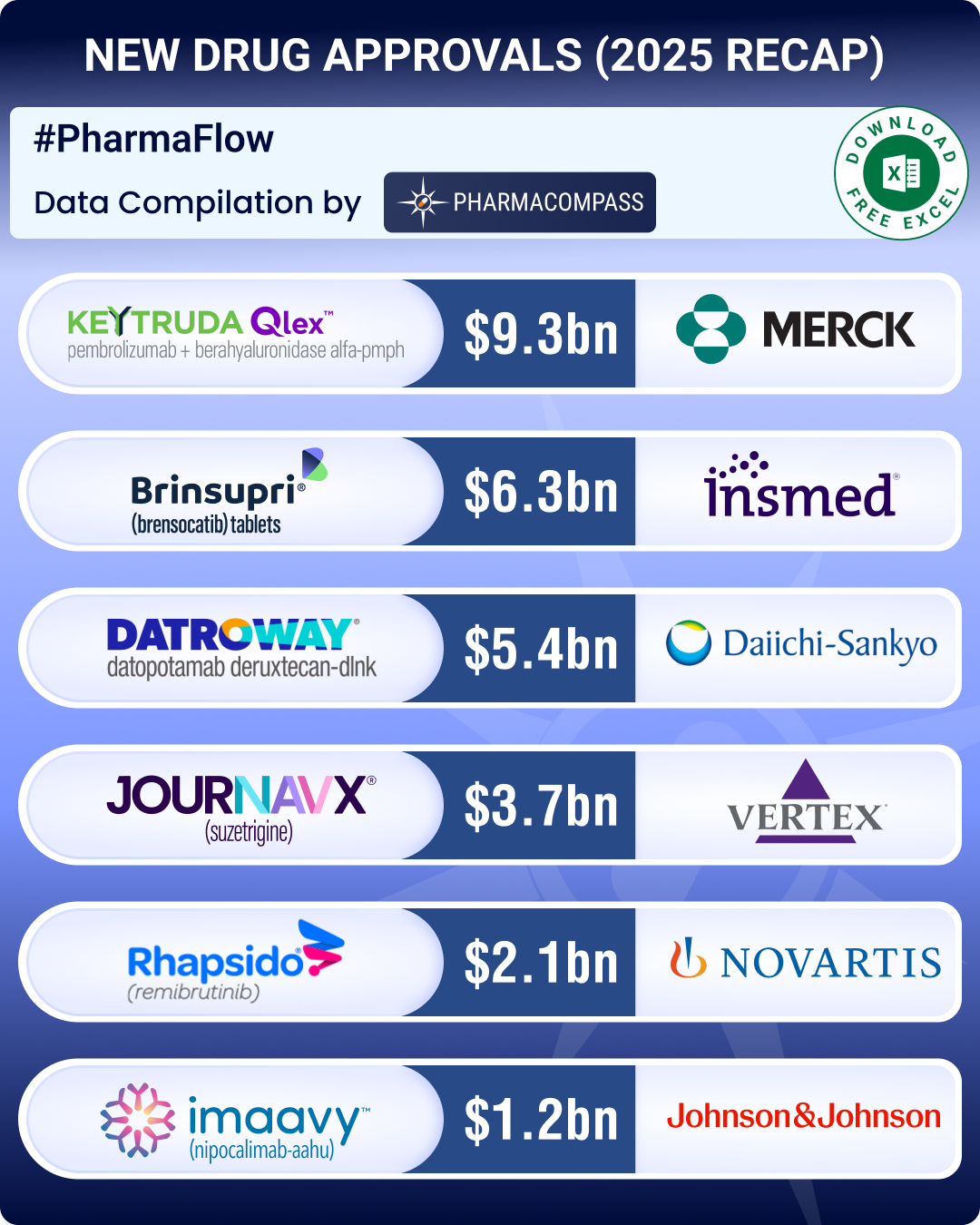
FDA approvals drop 8% in 2025, with fewer blockbusters; Brinsupri, Rhapsido make it to first-in-class list
Our update for new drug approvals by the US Food and Drug Administration (FDA) in the first half (H1) of 2025 had pointed out how upheavals at the agency had impacted its functioning, with drug approvals dropping by 24 percent.While the turbulence didn’t subside, approvals picked up considerably in the second half (H2) of 2025. FDA’s Center for Drug Evaluation and Research (CDER) approved 30 new drugs in H2 (as against 16 in H1), taking the total number of approvals for 2025 up to 46. This is an 8 percent drop compared with 50 approvals CDER had granted in 2024.During the year, CDER saw four new chiefs come and go — Jacqueline Corrigan-Curay (Jan-July 2025), George Tidmarsh (July-Nov 2025), Richard Pazdur (Nov-December 2025) and Tracy Beth Høeg (December 2025-present). In addition, the agency endured thousands of retrenchments. The US Department of Health and Human Services (HHS), under Health Secretary Robert F. Kennedy Jr., enforced funding cuts and changes in approval processes, especially for vaccines.Overall, we have been witnessing a steady drop in drug approvals by CDER — it approved 55 new drugs in 2023, 50 in 2024 and, 46 in 2025.Of the 46 new approvals in 2025, 20 were classified as first-in-class (therapies that use a new and unique mechanism of action), out of which 13 were approved in H2 2025. Overall, CDER approved 32 chemical entities and 14 biologics in 2025.In comparison, approvals by Health Canada and authorizations by the European Medicines Agency (EMA) rose in 2025. The EMA authorized 69 new therapies, up from 64 in 2024. Health Canada approved 46 new therapies in 2025, as compared with 28 in 2024.FDA’s Center for Biologics Evaluation and Research (CBER) approved 21 biologics in 2025, compared with 13 in 2024, of which eight were notable new drugs.Interestingly, both CDER and CBER rejected more drugs last year — 43 applications were rejected, including those for new drugs, supplemental filings, generics and biosimilars, as opposed to 29 in 2024. View New Drug Approvals in 2025 with Estimated Sales (Free Excel Available)Blockbuster drug approvals drop by 60%, European drugmakers score more FDA nods It wasn’t a year of blockbuster drug approvals — the agency approved a lower number of drugs that are expected to deliver sales of at least US$ 1 billion by 2030. While there were nearly 20 such drugs approved in 2024, the number dropped to just eight in 2025.Interestingly, European companies won many more approvals for new products than their counterparts in the US. GSK and Novartis achieved three approvals each, while Merck, Boehringer Ingelheim and Bayer AG won two approvals each.The first-in-class drugs approved in H2 are: Insmed's Brinsupri (brensocatib), Ionis's Dawnzera (donidalorsen), Stealth Bio's Forzinity (elamipretide), Boehringer's Jascayd (nerandomilast), UCB's Kygevvi (doxecitine and doxribtimine), Bayer's Lynkuet (elinzanetant), Chimerix's Modeyso (dordaviprone), Innoviva's Nuzolvence (zoliflodacin), Arrowhead's Redemplo (plozasiran), Novartis' Rhapsido (remibrutinib), Otsuka's Voyxact (sibeprenlimab-szsi), Sanofi's Wayrilz (rilzabrutinib) and Omeros' Yartemlea (narsoplimab-wuug). View New Drug Approvals in 2025 with Estimated Sales (Free Excel Available)Insmed’s Brinsupri approved for chronic lung disease; Novartis’ Rhapsido okayed for urticariaAs has been the trend, the field of oncology saw the maximum drug approvals (15), followed by rare diseases and disorders (7) and immunology (4). Three categories — infections and infectious diseases, respiratory diseases and cardiology/vascular diseases — saw three drug approvals each.Among the first-in-class approvals was Insmed’s Brinsupri (brensocatib), the first treatment for non-cystic fibrosis bronchiectasis, a chronic lung disease. Nature has estimated peak sales of US$ 6.3 billion for this treatment. Brinsupri was approved by the EMA in November.Another notable approval was granted to Novartis’ Rhapsido (remibrutinib), approved to treat the skin condition chronic spontaneous urticaria in adults who remain symptomatic despite treatment with antihistamines. Rhapsido is the first oral alternative to injectable treatments and has 2030 sales forecasts of US$ 2.1 billion. Novartis is also testing the drug for other immune conditions.A new drug that is estimated to bring in the maximum sales is Merck’s Keytruda Qlex, a subcutaneous formulation of pembrolizumab plus berahyaluronidase alfa approved for various solid tumors. While top-selling cancer drug Keytruda (pembrolizumab) was first approved in 2014, this is the first approval for an engineered variant of the hyaluronidase enzyme (berahyaluronidase alfa). Therefore, this combination counts as a novel approval. View New Drug Approvals in 2025 with Estimated Sales (Free Excel Available)Fondazion’s CGT okayed for Wiskott-Aldrich syndrome; three drugs approved for hereditary angioedema After a record nine new cell and gene therapy (CGT) approvals in 2024, only five CGTs were approved in 2025 (the lowest since 2022). With the exception of Novartis’ Itvisma (onasemnogene abeparvovec-brve), all other CGT approvals went to relatively lesser known companies such as Abeona, Precigen, Neurotech and Fondazione Telethon (an Italian firm that became the first nonprofit to get a CGT approval from the FDA).Fondazione Telethon’s Waskyra (etuvetidigene autotemcel) became the first gene therapy for Wiskott-Aldrich syndrome (WAS), a rare immune disorder that causes frequent infections, bleeding issues, and eczema. The one-time treatment uses patients’ own blood stem cells that are modified to restore the faulty WAS gene. Abeona’s Zevaskyntm (prademagene zamikeracel) became the first and only autologous cell sheet-based gene therapy indicated for the treatment of wounds in adult and pediatric patients with recessive dystrophic epidermolysis bullosa (a rare, genetic skin disorder).Patients with hereditary angioedema (or HAE, a genetic disorder characterized by recurrent episodes of severe swelling) gained access to three new drugs, including two first-in-class drugs — CSL Behring’s Andembry (garadacimab) and Ionis Pharma’s Dawnzera (donidalorsen). The third drug approved to treat HAE is KalVista Pharma’s Ekterly (sebetralstat). View New Drug Approvals in 2025 with Estimated Sales (Free Excel Available)Our viewThe FDA has been bringing about considerable changes to its processes. In June, it launched the Commissioner’s National Priority Vouchers (CNPV) program to cut review timelines from the usual 10 to 12 months to two months. But the recent rejection of Disc Medicine’s application for bitopertin as a treatment for a rare blood disorder under the program took four months to materialize. Not only did the rejection come in late, it was based on information already known to the FDA at the time of granting the coveted voucher, raising controversy around the program.The agency is going to bring about more changes soon. It has proposed a plausible mechanism pathway for rare and ultra-rare diseases where randomized controlled trials are not feasible. And in April, it announced plans to phase out animal toxicity testing in the development of monoclonal antibody therapies and other drugs. The agency is increasingly relying on AI, and recently  announced the deployment of agentic AI capabilities for all employees. It will be interesting to see how these changes impact drug approvals in 2026.

Impressions: 1130

https://www.pharmacompass.com/radio-compass-blog/fda-approvals-drop-8-in-2025-with-fewer-blockbusters-brinsupri-rhapsido-make-it-to-first-in-class-list

#PharmaFlow by PHARMACOMPASS
26 Feb 2026

STOCK RECAP #PipelineProspector

read-more
read-more
Pipeline Prospector November 2025: Kimberly-Clark to buy Kenvue for US$ 48.7 bn; FDA approves Novartis’ gene therapy
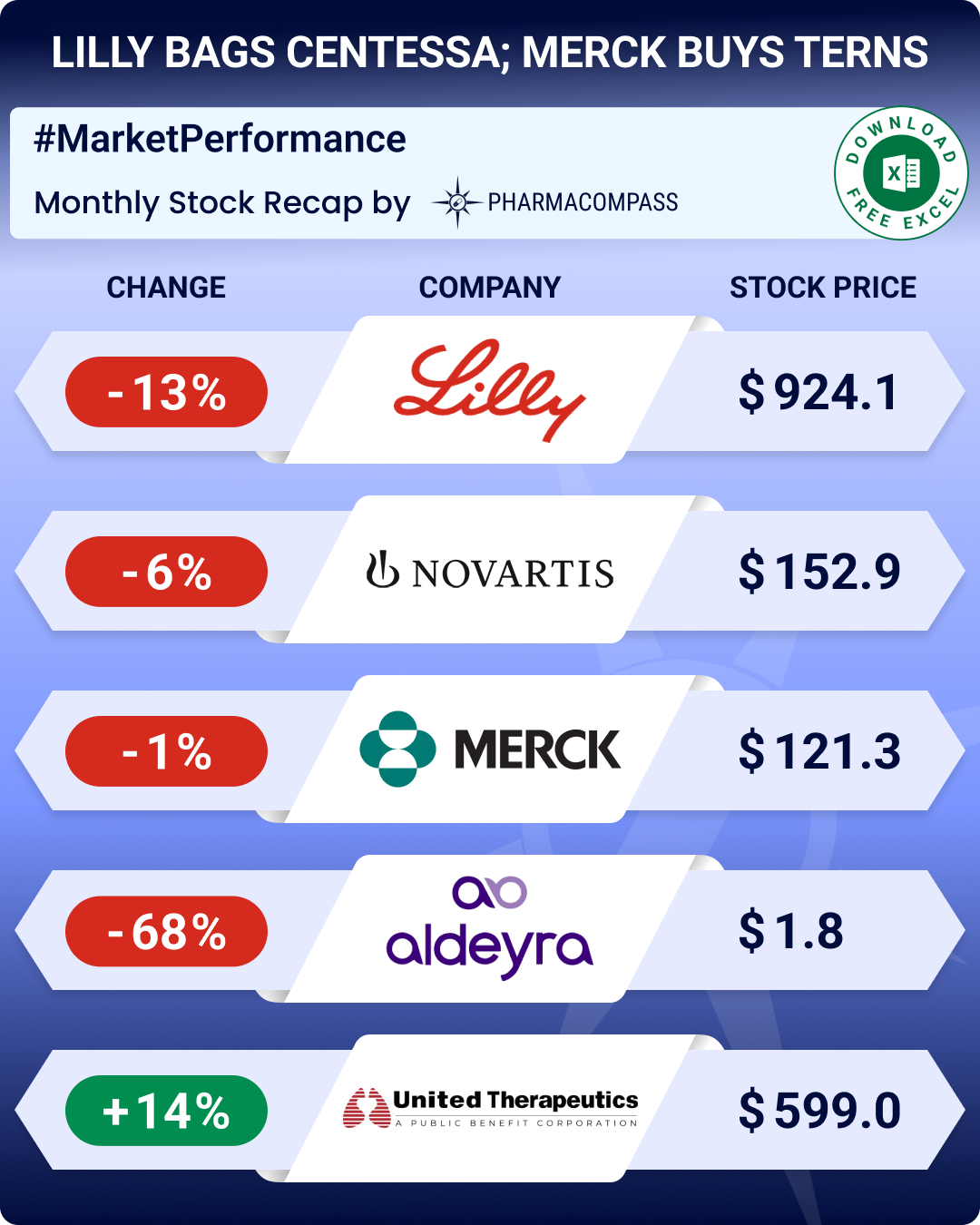
November saw several big ticket acquisitions across the consumer health and biopharma space, including the US$ 48.7 billion acquisition of Johnson & Johnson’s consumer health unit Kenvue by Kimberly-Clark and Pfizer’s up to US$ 10 billion acquisition of obesity-focused biotech Metsera. Additionally, the trend of companies announcing capacity expansions continued unabated.The month saw several key drug approvals by the US Food and Drug Administration (FDA), including Kura Oncology-Kyowa Kirin’s Komzifti (ziftomenib) for treating adults with relapsed or refractory acute myeloid leukemia (AML) with an NPM1 mutation.The indices rose substantially during the month. The Nasdaq Biotechnology Index (NBI) rose 8.85 percent, from 5,344.91 at the end of October to 5,818.03 by November-end. The SPDR S&P Biotech ETF (XBI) gained 10.97 percent from 110.98 to 123.16. The S&P Biotechnology Select Industry Index (SPSIBI) also advanced 9.08 percent — from 8,789.93 to 9,588.09. Access the Pipeline Prospector Dashboard for November 2025 Newsmakers (Free Excel)Pfizer clinches up to US$ 10 bn deal for Metsera; Merck to buy Cidara for US$ 9.2 bnPfizer inked an agreement worth up to US$ 10 billion to acquire obesity-focused biotech Metsera. The deal ended a competitive bidding process between Pfizer and Novo Nordisk. Pfizer had filed lawsuits, alleging that Metsera breached an earlier merger agreement. Metsera accepted Pfizer’s revised offer after raising concerns about potential antitrust risks associated with Novo’s competing bid. In early November, Kimberly-Clark announced the acquisition of Johnson & Johnson’s consumer health unit — Kenvue — in a cash-and-stock deal valued at US$ 48.7 billion. The merger will create a consumer health company with expected annual revenue of about US$ 32 billion and a portfolio of highly-valued brands, including Tylenol (paracetamol), Neutrogena, Aveeno, and Listerine.Merck announced the acquisition of Cidara Therapeutics in a deal valued at US$ 9.2 billion. The acquisition gives Merck access to an experimental influenza antiviral designed to provide season-long protection with a single dose. Its stock rose 22 percent in November.Johnson & Johnson is buying Halda Therapeutics for US$ 3.05 billion in cash. Halda, a Connecticut-based biotech, adds early-stage cancer programs to J&J’s pipeline, including a lead candidate in prostate cancer.Like Pfizer and Novo Nordisk, Lundbeck and Alkermes were also embroiled in a bidding war for Avadel Pharmaceuticals. Lundbeck later withdrew from the race, clearing the way for Alkermes, which eventually agreed to acquire Avadel for US$ 2.37 billion.Drugmakers continued to announce plans to expand capacities. Eli Lilly (whose stock rose 22 percent in November) announced plans to invest US$ 3 billion to build an oral medicines manufacturing site in the Netherlands to support its experimental GLP-1 pill, orforglipron. It will also invest more than US$ 1.2 billion to expand its facility in Puerto Rico.AstraZeneca said it will invest US$ 2 billion to expand its manufacturing capacity in Maryland (US). And Novartis said it will set up a flagship manufacturing hub in North Carolina, post a trade agreement that lowers US tariff rates on Swiss imports. Access the Pipeline Prospector Dashboard for November 2025 Newsmakers (Free Excel) FDA approves Komzifti for leukemia; Bayer’s Hyrnuo wins accelerated approval for lung cancerFDA approved Komzifti (ziftomenib), a once-daily pill from Kura Oncology and Japan’s Kyowa Kirin, for adults with relapsed or refractory acute myeloid leukemia (AML) with an NPM1 mutation.The agency also expanded the approval of Epkinly (epcoritamab), developed by AbbVie and Genmab, for use as a second-line treatment of relapsed or refractory follicular lymphoma.The agency also granted accelerated approval to Bayer’s Hyrnuo (sevabertinib) for people with non-squamous non-small cell lung cancer (NSCLC) that has recurred or spread and carries a specific HER2 mutation.Moreover, FDA approved UCB’s Kygevvi (doxecitine and doxribtimine), the first treatment for thymidine kinase 2 deficiency (TK2d), a rare inherited mitochondrial disorder that leads to progressive muscle weakness and respiratory complications.Further, FDA approved Redemplo (plozasiran sodium), Arrowhead Pharmaceuticals’ first marketed drug for adults with familial chylomicronemia syndrome (FCS), a rare genetic disorder that causes extremely high levels of triglycerides in the blood that can cause acute pancreatitis. During the month, Arrowhead’s stock price went up by 31 percent.FDA also granted accelerated approval to Otsuka’s Voyxact (sibeprenlimab-szsi) to help reduce excess urinary protein in adults with IgA nephropathy, a chronic kidney disease.Separately, FDA approved Novartis’ gene-replacement therapy Itvisma (onasemnogene abeparvovec-brve) for patients aged two years and older with spinal muscular atrophy (SMA) caused by an SMN1 mutation. Itvisma uses the same active ingredient as Zolgensma and is the first approved gene therapy for a broader SMA population.Other than these, the regulator approved the Padcev (enfortumab vedotin) and Keytruda (pembrolizumab) regimen for people with muscle-invasive bladder cancer who cannot receive cisplatin-based chemotherapy. The combination is the first and only approved regimen that can be used before and after surgery. Access the Pipeline Prospector Dashboard for November 2025 Newsmakers (Free Excel) Bayer’s asundexian shows benefit in strokes; Novo’s Rybelsus fails Alzheimer’s trialsThe month saw several trial wins. For instance, Bayer reported positive phase 3 results for asundexian, an experimental blood thinner that lowered the risk of repeated strokes without increasing major bleeding. In another phase 3 trial, Amgen’s Repatha (evolocumab) reduced major cardiovascular events in adults without prior heart attack or stroke when added to statins or other therapies.Cogent Biosciences (stock up 146 percent in November) reported strong phase 3 results for bezuclastinib in combination with sunitinib in patients with gastrointestinal stromal tumor (GIST) whose disease had progressed after earlier treatment.In trial failures, Novo Nordisk’s oral semaglutide pill, Rybelsus, failed to slow Alzheimer’s disease progression in two large phase 3 trials. The studies showed no benefit over placebo in more than 3,800 people with early-stage disease.The agency also paused two phase 3 studies of Intellia’s gene-editing therapy nexiguran ziclumeran after a patient developed severe liver problems. The share price of the company fell by 33 percent over the month.November wasn’t a good month for Sarepta (its stock was down 13 percent). The company said its late-stage trial of casimersen and golodirsen for Duchenne muscular dystrophy did not meet its main goal. Moreover, FDA added a boxed warning to Sarepta’s gene therapy Elevidys (delandistrogene moxeparvovec-rokl) following the deaths of two non-ambulatory children from acute liver failure. Access the Pipeline Prospector Dashboard for November 2025 Newsmakers (Free Excel) Our viewAfter a few difficult years marked by stock-market volatility and disruptions in global supply chains, the pharmaceutical sector is finally showing signs of sustained growth and stability. The uptick in big-ticket M&A activity is a clear indicator of the industry’s confidence. These are all huge positives as we move closer to 2026. Access the Pipeline Prospector Dashboard for November 2025 Newsmakers (Free Excel) 

Impressions: 2600

https://www.pharmacompass.com/pipeline-prospector-blog/pipeline-prospector-november-2025-kimberly-clark-to-buy-kenvue-for-us-48-7-bn-fda-approves-novartis-gene-therapy

#PharmaFlow by PHARMACOMPASS
04 Dec 2025

NEWS #PharmaBuzz

read-more
read-more

https://www.biospace.com/business/keytruda-hangs-on-to-best-seller-crown-as-glp-1s-gain-ground

BIOSPACE
04 Mar 2026

https://www.fiercepharma.com/pharma/padcev-keytruda-redefine-mibc-care-survival-win-amid-shifting-landscape

FIERCE PHARMA
28 Feb 2026

https://www.businesswire.com/news/home/20260228025853/en/KEYTRUDA-pembrolizumab-Plus-WELIREG-belzutifan-Given-as-Adjuvant-Therapy-Reduced-the-Risk-of-Disease-Recurrence-or-Death-by-28-Compared-to-KEYTRUDA-Monotherapy-in-Certain-Patients-With-Earlier-Stage-Renal-Cell-Carcinoma-RCC

BUSINESSWIRE
28 Feb 2026

https://www.indianpharmapost.com/news/zydus-hits-keytruda-biosimilar-milestone-with-successful-fyb206-trial-targets-usfda-filing-19237

INDPHARMAPOST
28 Feb 2026

https://www.businesswire.com/news/home/20260227462624/en/KEYTRUDA-pembrolizumab-Plus-Paclitaxel-With-or-Without-Bevacizumab-Significantly-Improved-Key-Secondary-Endpoint-of-Overall-Survival-OS-Versus-Paclitaxel-With-or-Without-Bevacizumab-in-Patients-With-Platinum-Resistant-Recurrent-Ovarian-Cancer

BUSINESSWIRE
27 Feb 2026

https://www.pharmiweb.com/press-release/2026-02-27/padcev-plus-keytruda-cuts-risk-of-recurrence-or-death-by-nearly-50-in-cisplatin-eligible-muscle-inva

PHARMIWEB
27 Feb 2026