Please Wait
Applying Filters...
Menu
Xls

Digital Content read-more

Create Content with PharmaCompass, ask us

DATA COMPILATION #PharmaFlow

read-more
read-more
FDA okays 50 new drugs in 2024; BMS’ Cobenfy, Lilly’s Kisunla lead pack of breakthrough therapies
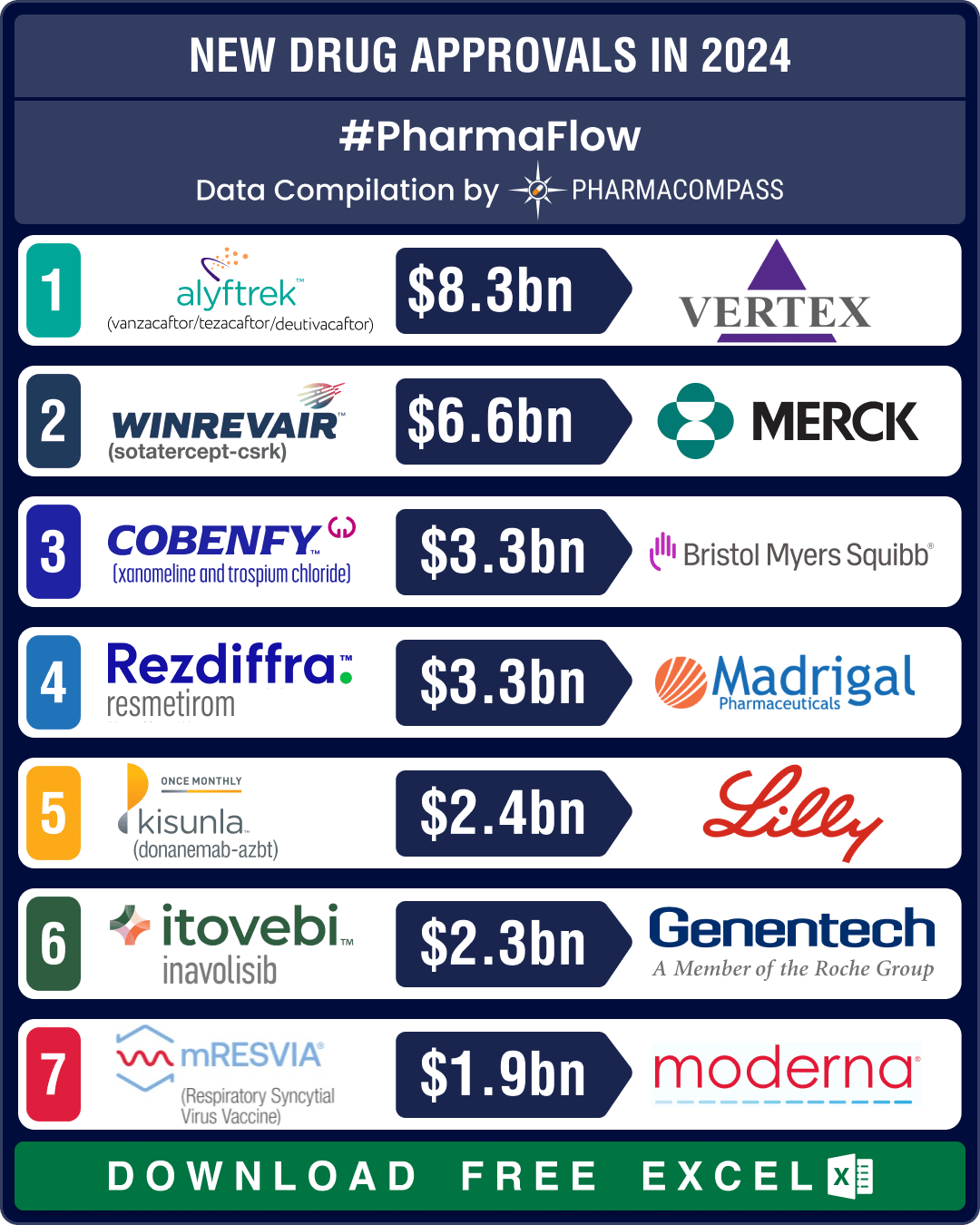
In 2024, the biopharma industry continued to advance on its robust trajectory of innovation. Though the US Food and Drug Administration’s Center for Drug Evaluation and Research (CDER) and the Center for Biologics Evaluation and Research (CBER) approved fewer drugs, there was a significant increase in medical breakthroughs.While the CDER approved 50 new drugs in 2024, as compared to 55 in 2023, the CBER granted 14 biologics approvals in 2024, down from 20 in 2023.The European Medicines Agency (EMA) approved 34 new therapies, up from 32 in 2023, while Health Canada granted 28 approvals, down from 38 in 2023.The year saw long-awaited treatments being approved in areas such as schizophrenia and Alzheimer’s disease in the second half (H2) of 2024. In H1 2024, drugs to treat metabolic dysfunction-associated steatohepatitis (MASH) and chronic obstructive pulmonary disease (COPD) had been granted FDA approvals.As the year drew to a close, FDA began approving drugs at a feverish pace, with 29 of the CDER’s 50 approvals coming in H2.Like most years, the landscape of drug approvals was dominated by oncology, with 15 of the 50 drugs (30 percent) approved targeting various forms of cancer. This was followed by dermatology and non-malignant hematology, each accounting for 12 percent of approvals. Notably, small molecules continued to dominate the market, making up for 64 percent of the new drug approvals, while 32 percent were proteins, including monoclonal and bi-specific antibodies. View New Drug Approvals in 2024 with Estimated Sales (Free Excel Available)Karuna-BMS’ schizophrenia drug, Lilly’s Alzheimer’s med, Neurocrine’s Crenessity dominate list of pathbreaking approvals in H2Out of the 50 new drugs approved in 2024, CDER identified 24 (48 percent) as first-in-class, showcasing novel mechanisms of action. The most anticipated approval of 2024 was Karuna and Bristol Myers Squibb’s Cobenfy, a groundbreaking treatment for schizophrenia. This fixed-dose combination of xanomeline and trospium chloride represents the first novel mechanism of action in decades for this debilitating psychiatric condition. Analysts forecast peak annual sales of over US$ 3.3 billion for Cobenfy. Eli Lilly’s Alzheimer’s drug Kisunla (donanemab) became the third amyloid-targeting antibody to gain FDA approval. Unlike its predecessors, Kisunla offers a unique limited-duration treatment regimen, allowing patients to discontinue therapy once amyloid levels in the brain drop below a certain threshold. Priced at approximately US$ 32,000 per year, it is positioned as a cost-effective alternative to existing treatments. Analysts estimate peak sales of US$ 2.4 billion for Kisunla.Crenessity (crinecerfont), developed by Neurocrine Biosciences, became the first FDA-approved treatment in decades for classic congenital adrenal hyperplasia (genetic conditions that affect the adrenal glands). Similarly, Vertex’s triple combination therapy of deutivacaftor, tezacaftor & vanzacaftor (Alyftrek) for cystic fibrosis represents a significant advancement in genetic disease treatment. Analysts forecast peak sales exceeding US$ 8.3 billion, underscoring the therapy’s potential to transform patient care.Meanwhile, Bridgebio’s Attruby (acoramidis hydrochloride) emerged as a promising treatment for cardiac amyloidosis, a life-threatening condition. View New Drug Approvals in 2024 with Estimated Sales (Free Excel Available) Roche’s Itovebi, Checkpoint’s Unloxcyt clinch FDA approvals in H2 2024; forecast to achieve blockbuster statusThe dominance of cancer drug approvals reflects the ongoing focus on targeted therapies, immuno-oncology, and precision medicine to improve outcomes for patients with hard-to-treat cancers.Among the year’s notable FDA approvals was Genentech’s Itovebi (inavolisib), another targeted therapy that treats hormone receptor-positive (HR+), HER2-negative breast cancer. Itovebi is a PI3Kα inhibitor designed specifically for patients with PIK3CA mutations, a common driver of resistance to endocrine therapy in breast cancer. It demonstrated a more tolerable safety profile. Roche projects Itovebi’s peak (annual) sales to reach CHF 2 billion (US$ 2.3 billion).Checkpoint Therapeutics’ Unloxcyt (cosibelimab) joined the crowded checkpoint inhibitor market as the eleventh PD-1/PD-L1-targeting monoclonal antibody approved by the FDA. It was granted approval for cutaneous squamous cell carcinoma (cSCC), an aggressive form of skin cancer with high recurrence rates. As compared to other checkpoint inhibitors, like Keytruda (pembrolizumab) and Opdivo (nivolumab), Unloxcyt is likely to offer an advantage in immune activation.FDA also approved Astellas’ Vyloy (zolbetuximab), a first-in-class monoclonal antibody for metastatic gastric and gastroesophageal junction (GEJ) adenocarcinoma. Analysts forecast peak sales of approximately US$ 850 million for Vyloy.Syndax Pharmaceuticals’ Revuforj (revumenib) was approved by FDA to treat a type of acute leukemia in both adults and children. This approval introduces a novel class of medications known as menin inhibitors. These agents are currently in clinical development for the treatment of genetically defined subsets of acute leukemia. These inhibitors function by preventing the activation of cancer growth-related proteins. View New Drug Approvals in 2024 with Estimated Sales (Free Excel Available) Potential blockbusters Lilly’s Ebglyss, Galderma’s Nemluvio lead advances in dermatologyEli Lilly’s Ebglyss (lebrikizumab) garnered significant attention. Approved by FDA for moderate-to-severe atopic dermatitis, this monoclonal antibody introduces a less burdensome dosing regimen compared to its competitors, with maintenance therapy required only once a month. This feature positions it as a potential contender to Dupixent (dupilumab), a market leader in atopic dermatitis. Ebglyss sales are forecast to reach US$ 1.9 billion by 2030.Galderma’s Nemluvio (nemolizumab) secured FDA approval for two indications in 2024 — prurigo nodularis (a chronic disorder of the skin) and moderate-to-severe atopic dermatitis in patients aged 12 years and older. As the first humanized IgG2 monoclonal antibody targeting the IL-31 receptor, Nemluvio directly inhibits the key driver of itch and inflammation in both these conditions. With its unique mechanism and broad dermatology potential, analysts forecast peak sales of approximately US$ 1.66 billion. Ebglyss and Nemluvio underscore the growing importance of biologics in dermatological care.Botanix Pharmaceuticals also made strides in dermatology by clinching an FDA approval for Sofdra (sofpironium) in June. The drug has been okayed for the treatment of primary axillary hyperhidrosis, a condition characterized by excessive sweating.Ascendis Pharma’s Yorvipath (palopegteriparatide), a therapy approved by FDA to treat hypoparathyroidism, is forecast to achieve blockbuster sales of US$ 1.8 billion by 2030, highlighting its potential to transform endocrine care. View New Drug Approvals in 2024 with Estimated Sales (Free Excel Available) Our viewOverall, 2024 was defined by its breakthrough drug approvals. The year also saw significant reduction in complete response letters (CRLs) — they dropped from 43 in 2023 to just 29 in 2024. This suggests improved industry preparedness and alignment with regulatory expectations.The new year began with the approval of Datroway (datopotamab deruxtecan) from AstraZeneca and Daiichi Sankyo, marking a significant advancement in oncology. Several other promising new drugs are coming up for FDA approval this year, such as J&J’s nipocalimab, Vertex Pharmaceuticals’ suzetrigine, Elevar Therapeutics’ rivoceranib/camrelizumab, Sanofi’s fitusiran and GSK’s gepotidacin. Hopefully, the momentum of breakthrough approvals will continue through 2025, political headwinds in the US notwithstanding. 

Impressions: 14116

https://www.pharmacompass.com/radio-compass-blog/fda-okays-50-new-drugs-in-2024-bms-cobenfy-lilly-s-kisunla-lead-pack-of-breakthrough-therapies

#PharmaFlow by PHARMACOMPASS
30 Jan 2025

STOCK RECAP #PipelineProspector

read-more
read-more
Pipeline Prospector Feb 2025: Bain buys Mitsubishi Tanabe for US$ 3.4 bn; Japan’s Ono gets FDA nod for rare joint tumor drug

February was a mixed bag for biopharma indices, underscoring the volatility and uncertainty in the sector. The Nasdaq Biotechnology Index (NBI) managed a modest gain of 1.16 percent, climbing from 4,466.41 to 4,518.06. However, the SPDR S&P Biotech ETF (XBI) fell 2.06 percent from 90.58 to 88.71, and the S&P Biotechnology Select Industry Index (SPSIBI) experienced a more substantial drop of 4.26 percent, declining from 7,222.3 to 6,914.8.The month saw several notable developments among Asian pharmaceutical companies, signaling their growing influence. Meanwhile, the confirmation of Robert F. Kennedy Jr. as the US Secretary of Health and Human Services (HHS) cast a veil of uncertainty over the sector, prompting investors to brace for potential shifts in vaccine policy and regulatory oversight. Access the Pipeline Prospector Dashboard for February 2025 Newsmakers (Free Excel)Bain buys Mitsubishi Tanabe in US$ 3.4 bn deal; Japan’s Ono secures FDA nod for joint tumor drugUS private equity firm Bain Capital acquired Mitsubishi Tanabe Pharma for approximately JPY 510 billion (US$ 3.4 billion). This strategic acquisition positions Bain to leverage the Osaka-based pharmaceutical company’s expertise in central nervous system disorders, immuno-inflammation, and oncology.Bain’s investment reflects growing confidence in Japan’s life sciences sector, particularly in light of the recent initiatives by the Japanese government to accelerate the development and approval of innovative medicines. Japan’s Ono Pharmaceutical (stock up 2 percent) received FDA approval for Romvimza (vimseltinib), a treatment for tenosynovial giant cell tumor (TGCT), a rare condition affecting joints. The approval follows Ono’s US$ 2.4 billion acquisition of Deciphera Pharmaceuticals, which included Romvimza and other cancer drugs. Romvimza will compete with Daiichi Sankyo’s Turalio (pexidartinib), the only other FDA-approved systemic treatment for TGCT.Meanwhile, Radiance Biopharma has acquired an antibody-drug conjugate (ADC) asset from China’s CSPC Megalith Biopharmaceutical. The ADC targets ROR1 (receptor tyrosine kinase-like orphan receptor 1), a protein implicated in embryonic development and cancer pathways. The transaction structure includes an upfront payment of US$ 15 million, with potential milestone payments exceeding US$ 1 billion.Continuing with its aggressive dealmaking, Novartis agreed to acquire Anthos Therapeutics, an anticoagulant drug development company majority-owned by investment firm Blackstone, for up to US$ 3.1 billion, with US$ 925 million paid upfront. Anthos emerged from a partnership between Blackstone and Novartis to develop abelacimab, a novel blood-thinning drug aimed at preventing strokes and dangerous blood clots in patients with atrial fibrillation. Access the Pipeline Prospector Dashboard for February 2025 Newsmakers (Free Excel) FDA okays SpringWorks’ med for rare genetic condition, AbbVie-Pfizer’s antibiotic for drug-resistant infectionsFDA approved SpringWorks Therapeutics’ Gomekli (mirdametinib) for the treatment of neurofibromatosis type 1 (NF1), a rare genetic condition that causes tumors to grow along nerve tissues throughout the body, often resulting in severe pain and physical deformity. Gomekli is the first and only medicine approved for addressing this condition in both pediatric and adult populations with inoperable tumors. SpringWorks’ shares skyrocketed 57 percent in February. Meanwhile, reports suggest that Germany’s Merck KGaA is currently in advanced talks to acquire Connecticut-based SpringWorks.AbbVie and Pfizer received FDA approval for Emblaveo (aztreonam and avibactam), a novel intravenous antibiotic developed jointly for the treatment of complicated intra-abdominal infections (cIAIs) in adults with limited or no alternative treatment options. To be used in combination with metronidazole, Emblaveo targets gram-negative bacteria, including drug-resistant strains.AbbVie (stock up 9 percent) further strengthened its oncology portfolio with a collaboration with Xilio Therapeutics to develop novel tumor-activated immunotherapies, including masked T-cell engagers. This partnership could potentially be worth over US$ 2 billion.Mirum Pharma’s Ctexli (chenodiol) was approved as the first targeted treatment for cerebrotendinous xanthomatosis (CTX), a rare lipid storage disease.In drug-device combinations, Supernus Pharmaceuticals received FDA approval for Onapgo, a treatment of motor fluctuations in adults with advanced Parkinson’s disease. Onapgo is a wearable device that continuously delivers apomorphine hydrochloride subcutaneously throughout waking hours.Meanwhile, Roche’s Susvimo (ranibizumab injection) eye implant received a label expansion to include the treatment of diabetic macular edema (DME). Additionally, Roche (stock up 8 percent) reported promising late-stage clinical data for its blood cancer drug Gazyva (obinutuzumab) in lupus nephritis. Access the Pipeline Prospector Dashboard for February 2025 Newsmakers (Free Excel) RFK Jr’s confirmation as HHS Secy hits vaccine makers; GSK gains on buyback plan; FDA okays 5-strain meningitis vaccineWith RFK Jr taking charge of HHS, stocks of vaccine makers took a hit. For instance, Bavarian Nordic’s stock fell by 11 percent, even though its chikungunya vaccine Vimkunya got approved by the FDA on February 14.Meanwhile, FDA paused a late-stage trial of Moderna’s experimental norovirus vaccine, mRNA-1403. The pause came after a single reported case of Guillain–Barré syndrome — a rare neurological side effect. Moderna’s stock fell 21 percent.In contrast, GSK’s stock rose 9 percent after it launched a £ 2 billion (US$ 2.5 billion) share buyback and raised its long-term sales target to nearly US$ 50 billion by 2031, largely driven by robust growth in specialty medicines, such as its HIV and cancer treatments. The British pharma giant also received FDA approval for its meningitis combination vaccine, Penmenvy. This five-in-one vaccine protects against five strains of Neisseria meningitidis, combining protective components of two existing vaccines into a single shot. Sanofi (stock up 2 percent) announced plans to repurchase € 5 billion (US$ 5.21 billion) worth of its shares in 2025 following the anticipated sale of its Opella consumer healthcare unit to private equity firm Clayton, Dubilier & Rice for € 15.5 billion (US$ 16.11 billion). The French giant also indicated it could be “a bit more” active with mergers and acquisitions in the near future. As part of Sanofi’s share buyback program, L’Oréal has agreed to sell a € 3 billion (US$ 3.11 billion) stake in Sanofi back to the drugmaker.The month saw some dramatic exits in the gene therapy space. Bluebird Bio, which was once valued at about US$ 10 billion, agreed to be acquired by private equity firms Carlyle and SK Capital Partners for less than US$ 30 million. Similarly, Pfizer announced it would discontinue the global development and commercialization of its hemophilia B gene therapy Beqvez (fidanacogene elaparvovec-dzkt), which is priced at US$ 3.5 million per treatment. Access the Pipeline Prospector Dashboard for February 2025 Newsmakers (Free Excel) Our view The biopharma sector is doing the right things by taking strategic business decisions, focusing on innovation and a strong drug pipeline. However, the geopolitical environment is uncertain. With a trade war ensuing between the US, China, Mexico and Canada, and the Trump administration suspending all military aid to Ukraine, we are entering uncertain times when it's difficult to say what the next few months would look like for the biopharma sector.

Impressions: 3307

https://www.pharmacompass.com/pipeline-prospector-blog/pipeline-prospector-feb-2025-bain-buys-mitsubishi-tanabe-for-us-3-4-bn-japan-s-ono-gets-fda-nod-for-rare-joint-tumor-drug

#PharmaFlow by PHARMACOMPASS
06 Mar 2025

WEEKLY NEWS RECAP #Phispers

read-more
read-more
Lilly to invest US$ 27 bn in US as Trump threatens big pharma with tariffs; FDA scrambles to rehire after mass layoffs
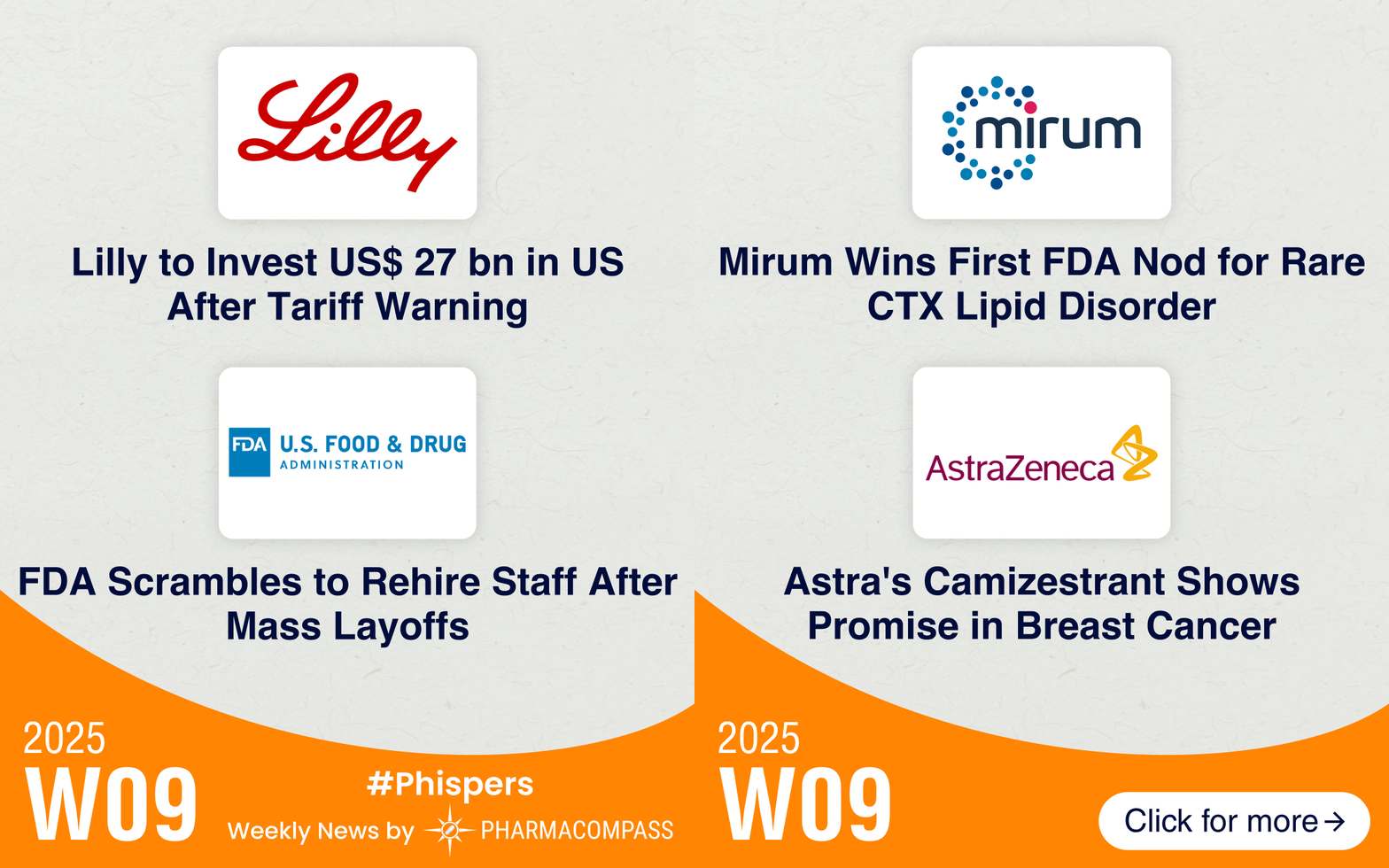
In the US, President Donald Trump has been putting pressure on Big Pharma to reshore or face tariffs. Eli Lilly has been the first to comply as it unveiled an ambitious plan to invest at least US$ 27 billion in four new plants across the US over the next five years.Though layoffs have been continuing unabated across agencies in America, the US Food and Drug Administration (FDA) reversed its controversial mass layoffs and reportedly moved to rehire hundreds of employees to stabilize critical operations.In drug approvals, Mirum Pharma’s Ctexli became the first FDA-approved treatment for a rare lipid storage disease. In trials, AstraZeneca’s experimental drug camizestrant demonstrated significant improvements in progression-free survival in a late-stage breast cancer trial.In the field of gene therapy, Pfizer announced it will discontinue Beqvez for hemophilia B citing limited market interest, while Bluebird Bio said it is selling itself to private equity firms.In regulatory news, FDA has shot off warning letters to two Indian API manufacturers for critical cGMP violations, and issued a Form 483 to Piramal Pharma post an inspection held at its Navi Mumbai plant this month.Lilly to invest US$ 27 bn in US, as Trump threatens Big Pharma with tariffsPharmaceutical giant Eli Lilly has unveiled an ambitious plan to invest at least US$ 27 billion in constructing four new manufacturing plants across the US over the next five years. The announcement comes amid increasing pressure from President Donald Trump, who met privately with top executives from Big Pharma — including Pfizer, Merck, Lilly and lobby group PhRMA.During the meeting, Trump warned that failing to reshore manufacturing operations could result in tariffs as high as 25 percent. Lilly’s new facilities are expected to generate over 3,000 skilled jobs in engineering and science, alongside approximately 10,000 construction roles. This boosts the Indiana drugmaker’s total investment in the US to over US$ 50 billion since 2020.Compounders sue FDA over GLP-1 drug shortages: Pharmaceutical compounders are suing FDA following the agency’s recent declarations that shortages of key weight loss drugs have ended. Compounders are contesting that the “reckless and arbitrary decision” to remove Novo Nordisk’s semaglutide (Ozempic and Wegovy) from the shortage list is premature. In a parallel development, Lilly has cut the price for vials of its weight-loss drug Zepbound (tirzepatide) by US$ 50 or more in order to stave off competition from compounding pharmacies and its Danish rival.FDA reverses course, moves to rehire hundreds after mass layoffsIn a swift policy reversal, FDA is working to rehire hundreds of employees who were terminated just days earlier as part of a mass layoff initiative. The initial firings, ordered by the Trump administration and led by Elon Musk's Department of Government Efficiency, affected over 1,000 FDA staffers responsible for critical areas such as drug and medical device review, food safety, and tobacco regulation. The layoffs drew significant backlash from industry stakeholders. Reports suggest that approximately 300 staff members are being asked to return.Mirum’s Ctexli bags FDA approval for rare lipid storage diseaseFDA has approved Mirum Pharma’s Ctexli (chenodiol) as the first targeted treatment for cerebrotendinous xanthomatosis (CTX), a rare lipid storage disease. Patients with CTX are unable to effectively break down cholesterol, leading to a toxic build-up of cholestanol in tissues, and suffer from neurological abnormalities.AstraZeneca’s camizestrant shows promise in late-stage breast cancer trialAstraZeneca has announced that its experimental drug, camizestrant, has demonstrated  significant improvement in progression-free survival for patients with advanced breast cancer. The trial specifically targeted patients with hormone receptor-positive, HER2-negative advanced breast cancer possessing a particular (emergent ESR1) genetic mutation. The British-Swedish drugmaker has set a peak sales target of US$ 5 billion for this drug.Emalex’s ecopipam cuts Tourette syndrome relapse: Emalex Biosciences has reported a major win in its phase 3 trial on ecopipam, a med for Tourette syndrome (a neurological disorder that causes involuntary tics, repetitive movements or sounds). In the study, pediatric patients who continued treatment with ecopipam experienced a relapse rate of 41.9 percent compared to 68.1 percent in those who switched to placebo. Similar benefits were seen in the combined pediatric and adult groups. Pfizer shifts focus to Hympavzi after discontinuing US$ 3.5 mn hemophilia gene therapyThe field of gene therapy has been facing a tough period for the last few years. Ergo, Pfizer has announced the discontinuation of global development and commercialization of Beqvez, a gene therapy designed to treat adults with moderate to severe hemophilia B.Despite receiving approvals in Canada, the US, and Europe throughout 2024, the company cited limited patient and physician interest in hemophilia gene therapies as the primary reason for this decision. Beqvez (fidanacogene elaparvovec-dzkt) is priced at US$ 3.5 million per treatment.This move effectively leaves Pfizer without any active gene therapy programs in its portfolio. The company plans to redirect its resources toward Hympavzi (marstacimab-hncq), its other therapy for hemophilia A and B that received FDA approval in October 2024.Bluebird Bio gets sold for ~US$ 30 million: Cash-strapped Bluebird Bio that develops gene therapies for severe genetic disorders has entered into a definitive agreement to be acquired by private equity firms Carlyle and SK Capital Partners for less than US$ 30 million.FDA slaps two Indian API firms with warning letters; Piramal Pharma gets Form 483FDA has issued warning letters and import alerts to two Indian API manufacturers — Jagsonpal Pharmaceuticals and Tyche Industries — following inspections that revealed significant cGMP violations. The agency discovered that Jagsonpal had engaged a third-party contract manufacturer to produce APIs, which it then claimed as its own on import records. The company, based in Gurugram near New Delhi, downright refused entry to FDA inspectors on March 15, 2024, FDA said. Inspectors were eventually allowed entry on March 20, 2024, but with limited access to the requested documents. In the case of Tyche Industries, FDA inspectors reported that during an inspection, a member of management stated that two operators admitted to falsifying temperature data for a drying oven that was not turned on during the manufacture of a batch.Form 483 for Piramal Pharma: FDA has issued a Form 483, with six observations, to Piramal Pharma after conducting a Good Manufacturing Practice (GMP) inspection at its Turbhe, Navi Mumbai facility from February 11-17, 2025.

Impressions: 1280

https://www.pharmacompass.com/radio-compass-phisper/lilly-to-invest-us-27-bn-in-us-as-trump-threatens-big-pharma-with-tariffs-fda-scrambles-to-rehire-after-mass-layoffs

#Phispers by PHARMACOMPASS
27 Feb 2025

NEWS #PharmaBuzz

read-more
read-more

https://www.reuters.com/business/healthcare-pharmaceuticals/pfizer-says-it-will-end-global-development-gene-therapy-beqvez-nikkei-reports-2025-02-20/

REUTERS
21 Feb 2025

https://www.prnewswire.com/news-releases/labcorp-receives-fda-approval-for-first-companion-diagnostic-for-use-with-pfizers-newly-approved-gene-therapy-to-treat-patients-with-hemophilia-b-302129932.html

PR NEWSWIRE
29 Apr 2024

https://www.businesswire.com/news/home/20240425269649/en

BUSINESSWIRE
26 Apr 2024

https://www.reuters.com/business/healthcare-pharmaceuticals/canada-approves-pfizers-gene-therapy-bleeding-disorder-2024-01-03/

REUTERS
04 Jan 2024
FDA, EMA accept Pfizer's hemophilia B gene therapy

27 Jun 2023

// Paul Schloesser ENDPTS

https://endpts.com/fda-ema-accept-pfizers-hemophilia-b-gene-therapy-setting-up-showdown-with-csl-behring/

Paul Schloesser ENDPTS
27 Jun 2023