Please Wait
Applying Filters...
Menu
Xls

Digital Content read-more

Create Content with PharmaCompass, ask us

DATA COMPILATION #PharmaFlow

read-more
read-more
CEP Q1 2026 Update: CEP 2.0, EDQM’s new guidelines strengthen ecosystem; Indian firms top list of CEPs issued
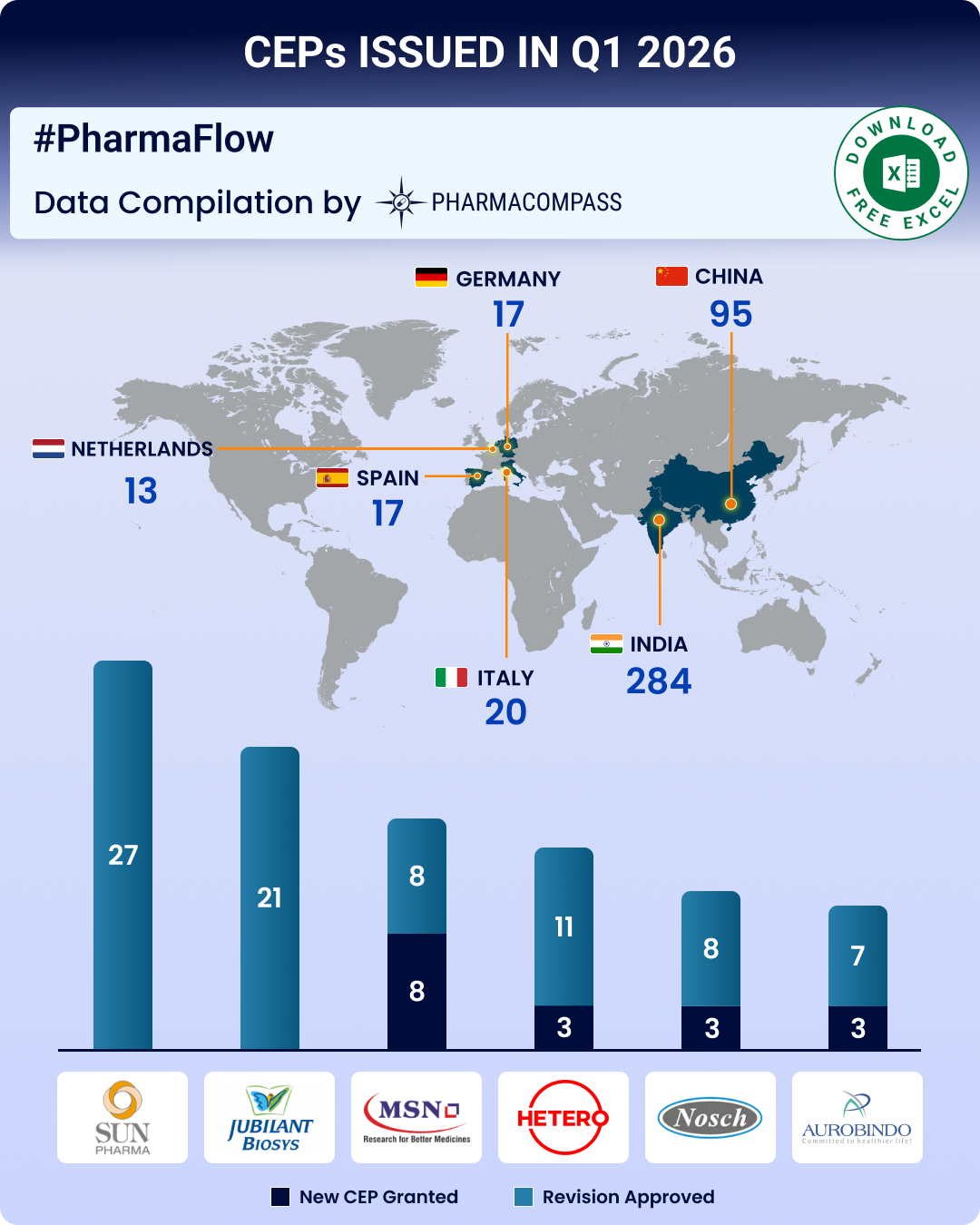
PharmaCompass is introducing a new regulatory update that tracks developments in Certificates of Suitability to the Monographs of the European Pharmacopoeia, referred to as CEPs. These certificates are a critical regulatory instrument in the global pharmaceutical supply chain.Also known as a Certification of Suitability (COS), CEPs are issued by the European Directorate for the Quality of Medicines and HealthCare (EDQM), with or without inspection of the manufacturing site. A CEP must be renewed every five years from its original issue date to remain valid, regardless of any revisions made during the interim period. However, a CEP does not replace Good Manufacturing Practice certification.CEPs are recognized as a trusted reference for API quality, thereby simplifying global registration strategies. Apart from Europe, the CEP system is widely used by many regulatory authorities, including those in Canada, Australia, Brazil, Singapore and South Africa. View CEPs Issued in Q1 2026 (Power BI Dashboard, Free Excel Available)CEP 2.0 enhances regulatory clarity, brings efficiency, global interoperability There are several types of CEPs, depending on the nature of the substance and evaluation. The most common type is the Chemical CEP, which confirms that a chemically synthesized API meets standards for purity and impurity control. Then there are Herbal CEPs for herbal substances and preparations.Another key category is the TSE CEP, which addresses risks associated with transmissible spongiform encephalopathies in animal-derived materials. In addition, there are Combined CEPs that may cover multiple aspects, such as chemical quality, TSE risk, and sterility. However, biological products such as vaccines and blood products fall outside the scope of the CEP framework.In 2023, the CEP system underwent a major transformation with the introduction of CEP 2.0, which marks a shift from a largely document-based system to a more structured, transparent, and digitally aligned model. This makes it easier for companies to manage compliance while improving trust among global regulators.While increasing data and compliance requirements for API manufacturers, CEP 2.0 enables better regulatory clarity, streamlined dossier integration, and stronger global acceptance. Overall, CEP 2.0 is designed to enhance regulatory clarity while making the system more efficient and globally interoperable. View CEPs Issued in Q1 2026 (Power BI Dashboard, Free Excel Available)Indian firms issued maximum CEPs; Sun Pharma and its subsidiaries, Jubilant Biosys top listIndia topped the charts for CEPs issued, both in terms of new CEPs and revisions in the first quarter (Q1) of 2026. Indian companies were issued 81 new CEPs in Q1 2026 (as against 40 in Q1 2025) and 203 revisions (as against 129 in Q1 2025). In comparison, Chinese companies were issued 42 new CEPs in Q1 2026 (against 25 in Q1 2025) and 53 revisions (against 67 in Q1 2025). Italy came a distant third, followed by Germany and Spain.India’s Sun Pharmaceuticals and its subsidiaries topped the list of companies with the maximum number of CEPs issued— while no new CEP was issued, 27 CEPs were revised in Q1 2026. At second place was Jubilant Biosys — 21 CEPs were revised in Q1 2026.In terms of products, the maximum CEPs were issued for amlodipine besylate (a calcium channel blocker used for treating hypertension), followed by sitagliptin phosphate (a type 2 diabetes medicine) and pregabalin (a drug used to treat neuropathic pain, fibromyalgia, seizures, and generalized anxiety disorder). Both amlodipine besylate and sitagliptin phosphate had not been issued new CEPs or revisions in Q1 2025. View CEPs Issued in Q1 2026 (Power BI Dashboard, Free Excel Available)EDQM introduces new guidelines to accelerate CEP assessments The EDQM charges fees for various services related to CEPs that depend on the type of request or regulatory activity involved. In general, fees apply to handling CEP applications, revisions or renewals and for offering technical advice (where applicants seek scientific or regulatory guidance).In March 2026, the EDQM introduced two new guidelines aimed at accelerating CEP assessments. The first is a reliance-based assessment pathway, which allows regulators to leverage prior approvals from trusted authorities, such as those in the EU, UK, Australia, Canada, and the WHO pre-qualification program. The second is a fast-track assessment route designed to expedite reviews in situations such as medicine shortages and to support initiatives like the EU Critical Medicines Act.Timelines have been significantly compressed under these new pathways. Initial evaluations are completed within 46 working days, compared to up to 115 days under the standard procedure. Applicants are given 30 calendar days to respond to queries, after which regulators complete the final assessment within 23 working days.Another important regulatory update relates to electronic submissions. From April 1, 2026, the EDQM will reject non-compliant CEP applications at the point of submission. All applications must include a validated electronic Common Technical Document (eCTD) dossier along with a proper validation report, submitted in line with the updated Common European Submission Portal (CESP) guidelines. Taken together, these developments signal a more rigorous yet efficient CEP ecosystem. View CEPs Issued in Q1 2026 (Power BI Dashboard, Free Excel Available)Our viewThe shift to CEP 2.0 signals a move toward greater transparency, digitalization, and global regulatory alignment. Though enhanced disclosure and stricter e-submission requirements may increase the compliance burden, especially for smaller manufacturers, the long-term gains are expected to be significant. Going forward, companies that invest in data quality and regulatory readiness stand to gain from these changes.

Impressions: 2696

https://www.pharmacompass.com/radio-compass-blog/cep-q1-2026-update-cep-2-0-edqm-s-new-guidelines-strengthen-ecosystem-indian-firms-top-list-of-ceps-issued

#PharmaFlow by PHARMACOMPASS
09 Apr 2026

STOCK RECAP #PipelineProspector

read-more
read-more
Pipeline Prospector Sept 2024: BMS wins landmark FDA approval for schizophrenia med; Sanofi’s Dupixent okayed for COPD
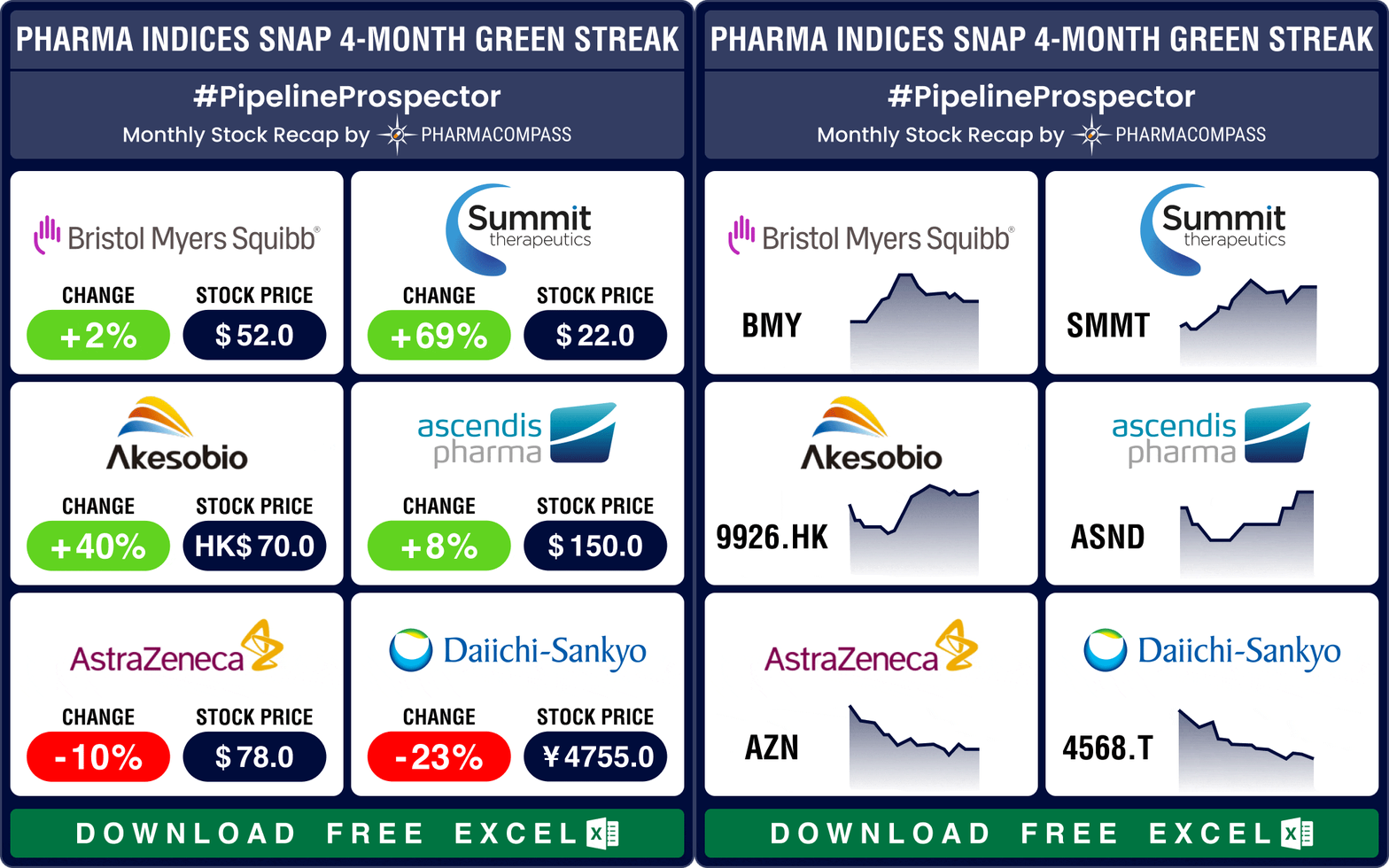
Pharma indices settled slightly lower in September after four months of solid gains. The three major pharma indices dropped about 2 percent each. The Nasdaq Biotechnology Index (NBI) closed at 4,767.84, down from 4,870.17, the SPDR S&P Biotech ETF (XBI) dropped to 98.8 from 101.1, and the S&P Biotechnology Select Industry Index (SPSIBI) fell to 7,707.36 from 7,897.9. Despite these declines, September was a dynamic month for the pharmaceutical industry, marked by significant regulatory approvals.September saw notable developments in the field of chronic obstructive pulmonary disease (COPD). After over a decade, COPD saw two significant approvals. The US Food and Drug Administration (FDA) expanded the label of Regeneron and Sanofi’s mega-blockbuster drug, Dupixent, to include the treatment of COPD. Already a game-changer in treating conditions like asthma and atopic dermatitis, Dupixent became the first-ever biologic medicine for COPD patients in the US.Additionally, GSK’s asthma drug Nucala scored a vital win in a late-stage study for treating COPD. The British drugmaker reported that the monoclonal antibody significantly and meaningfully reduced the annualized rate of moderate to severe exacerbations of what is the world’s third leading cause of death. These developments come on the heels of FDA’s approval of Verona’s Ohtuvayre in June. Ohtuvayre has a novel mechanism of action for the maintenance treatment of COPD. Access the Pipeline Prospector Dashboard for September 2024 Newsmakers (Free Excel)BMS’ Karuna bet pays off with schizo drug approval; FDA okays Astra’s nasal spray flu shotIn what was one of the most closely watched decisions this year, BMS’ KarXT won a landmark FDA approval for treating schizophrenia. Branded Cobenfy, the drug is the first antipsychotic that targets cholinergic receptors. Ever since the 1950s, when antipsychotics began being used to treat schizophrenia, they have worked by blocking a dopamine receptor. But those have been associated with serious side effects like weight gain, high rates of cardiac disease, early death and patients complaining about feeling sluggish and unmotivated. Cobenfy’s new approach has experts excited, and its peak sales are expected to come in at US$ 7.5 billion a year, validating BMS’ US$ 14 billion acquisition of Karuna Therapeutics. BMS’ stock gained 2 percent.That wasn’t the only landmark move. FDA approved two treatments for Niemann-Pick disease type C (NPC), an ultra-rare and progressive neurodegenerative disorder. Zevra Therapeutics’ Miplyffa became the first-ever treatment approved for NPC, addressing a critical unmet need for patients who, on average, only live about 13 years. Soon after Miplyffa’s approval, IntraBio’s Aqneursa was also granted approval by the FDA. Designed to alleviate neurological symptoms in both adults and children weighing at least 15 kilograms, Aqneursa stands out as the only FDA-approved stand-alone therapy for NPC.Just in time for winter, AstraZeneca’s first self-administered flu vaccine — FluMist — also bagged FDA approval last month. This nasal spray vaccine can be used at home, potentially increasing vaccination rates among needle-averse individuals. Access the Pipeline Prospector Dashboard for September 2024 Newsmakers (Free Excel) Astra’s Tagrisso okayed for inoperable lung cancer; UCB Bimzelx bags 3 new approvalsMonths after AstraZeneca’s Tagrisso posted impressive phase 3 results, the drug received FDA approval for treating inoperable, stage 3 epidermal growth factor receptor-mutated (EGFRm) non-small cell lung cancer (NSCLC). This makes Astra’s blockbuster the first targeted therapy for the indication.UCB’s Bimzelx secured three new FDA approvals for treating adults with active psoriatic arthritis, non-radiographic axial spondyloarthritis, and ankylosing spondylitis. With a novel approach to treating these chronic inflammatory diseases, the company expects Bimzelx to significantly bolster sales, with peak sales of the med projected at € 4 billion (US$ 4.4 billion) or more.Eli Lilly’s Ebglyss was approved for moderate-to-severe eczema in patients who are unable to control symptoms with topical or other systemic treatments. Notably, Ebglyss offers a more convenient once-monthly dosing compared to twice-monthly for competitors, a feature that analysts note as attractive to both experts and patients. Access the Pipeline Prospector Dashboard for September 2024 Newsmakers (Free Excel)Astra-Daiichi’s ADC suffers double whammy; Intercept’s Ocaliva faces setbackThe month also brought its share of challenges. AstraZeneca (stock down 10 percent) and Daiichi Sankyo’s (stock down 23 percent) investigational antibody-drug conjugate (ADC) datopotamab deruxtecan suffered a double blow in late-stage trials. It first failed to significantly outperform the standard-of-care chemotherapy — docetaxel — in treating NSCLC. And then it failed to show notable improvement in overall survival compared to chemotherapy in breast cancer.Analysts had expected datopotamab deruxtecan to potentially become one of Astra’s best-selling drugs. The British-Swedish drugmaker had paid Daiichi US$ 1 billion upfront and promised an additional US$ 5 billion in milestone payments.Intercept Pharmaceuticals faced a major setback as FDA’s advisory committee voted against the confirmatory data for Ocaliva, which was granted accelerated approval in 2016 for primary biliary cholangitis.Vanda Pharmaceuticals hit back at FDA after the agency issued it a Complete Response Letter, declining to approve its drug — tradipitant — to treat gastroparesis. The company expressed deep frustration, highlighting the urgent need for new treatments. Access the Pipeline Prospector Dashboard for September 2024 Newsmakers (Free Excel)GSK’s asthma drug halves attacks; Abbvie’s Parkinson’s med meets all endpointsAmong late-stage wins, GSK’s new long-acting asthma drug, depemokimab, reduced asthma exacerbations by 54 percent and achieved a 72 percent reduction in exacerbations that required hospitalization or an ER visit. GSK is counting depemokimab among one of its 12 blockbuster launches and expects it to generate £ 3 billion (US$ 3.9 billion) in annual peak-sales.Similarly, Abbvie’s tavapadon, which was the subject of its US$ 8.7 billion buyout of Cerevel Therapeutics, met its primary and secondary endpoints in patients with early Parkinson's disease. Akeso and Summit Therapeutics’ experimental drug ivonescimab beat the world’s best-selling drug Keytruda hands down in a late-stage NSCLC trial. Ivonescimab reduced the risk of disease progression or death by 49 percent compared to Keytruda. Akeso and Summit’s stock jumped 40 percent and 69 percent, respectively.And, Ascendis Pharma announced topline data from a pivotal trial on TransCon CNP, a therapy to treat achondroplasia, a common form of dwarfism. TransCon CNP demonstrated a statistically significant annualized growth velocity of 5.89 cm/year in children treated, compared to 4.41 cm/year in the placebo group. Access the Pipeline Prospector Dashboard for September 2024 Newsmakers (Free Excel) Our viewWhile September didn’t witness a mega-deal, it did see groundbreaking advancements being signed off by the FDA. We have seen enough ups and downs in the pharma indices this year. Let’s hope the final quarter of the year ends on a strong note, both in terms of drug approvals and indices. Access the Pipeline Prospector Dashboard for September 2024 Newsmakers (Free Excel)

Impressions: 3533

https://www.pharmacompass.com/pipeline-prospector-blog/pipeline-prospector-sept-2024-bms-wins-landmark-fda-approval-for-schizophrenia-med-sanofi-s-dupixent-okayed-for-copd

#PharmaFlow by PHARMACOMPASS
03 Oct 2024

WEEKLY NEWS RECAP #Phispers

read-more
read-more
Lilly becomes first pharma to hit US$ 1 tn valuation; FDA clears Padcev-Keytruda combo for bladder cancer
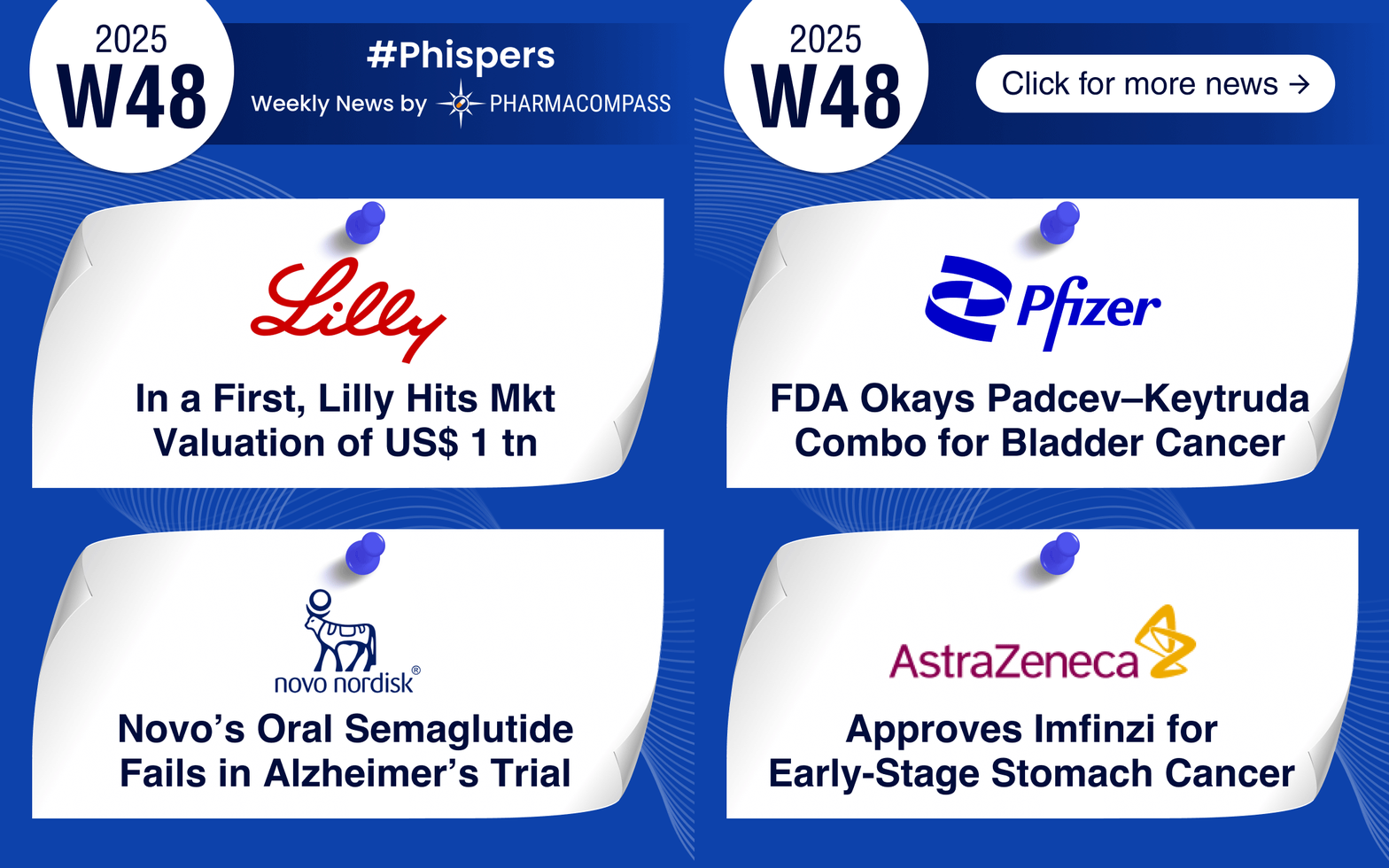
In Phispers this week, Eli Lilly became the first pharmaceutical company to reach a market valuation of US$ 1 trillion, driven by strong demand for its obesity and diabetes drugs Zepbound and Mounjaro. AstraZeneca announced a US$ 2 billion investment to expand its Maryland biologics plant.In approvals, the US Food and Drug Administration (FDA) cleared a Padcev-Keytruda combination for treating people with muscle-invasive bladder cancer who can’t receive cisplatin-based chemotherapy. It okayed AstraZeneca’s Imfinzi as the first perioperative immunotherapy for resectable, early-stage and locally advanced stomach cancer. It approved Novartis’ new gene therapy Itvisma for treating spinal muscular atrophy (SMA). The agency also granted accelerated approval to Otsuka’s kidney drug Voyxact.Separately, FDA initiated a safety investigation into Takeda’s Adzynma after the death of a child with a rare blood disorder. The agency delayed its decision on Ascendis Pharma’s treatment for achondroplasia, a rare genetic condition, by three months. Meanwhile, Denmark granted compensation to four patients who experienced vision loss after using Novo Nordisk’s semaglutide-based drugs.The US Medicare program has announced large price cuts under the Inflation Reduction Act for 15 of its most expensive prescription drugs, which will take effect in 2027.In news from clinical trials, Bayer reported a major phase 3 win for its next-generation blood thinner asundexian. However, Novo Nordisk’s oral semaglutide pill failed in two phase 3 Alzheimer’s trials.Eli Lilly becomes first pharma company to hit US$ 1 trillion market valuationEli Lilly has reached a market valuation of US$ 1 trillion, becoming the first drugmaker to join a league largely dominated by tech companies. The milestone was achieved on account of the overwhelming demand for its obesity and diabetes medicines Mounjaro (tirzepatide) and Zepbound (tirzepatide). Lilly pulled ahead of Novo Nordisk as supply issues impacted its obesity drug Wegovy (semaglutide).Medicare unveils price cuts for next 15 drugs: The US Medicare program has announced large price cuts for 15 of its most expensive prescription drugs, which will take effect in 2027 under the Inflation Reduction Act. The drugs include Ozempic and Rybelsus for diabetes, Wegovy for weight loss (all semaglutide), Xtandi (enzalutamide) for prostate cancer, Ibrance (palbociclib) for breast cancer and Trelegy Ellipta (fluticasone+umeclidinium+vilanterol) for lung conditions. According to Medicare, the negotiated prices will lower the program’s annual spending by US$ 8.5 billion each year. Another set of 15 drugs will be selected for negotiation next year, with prices taking effect in 2028.Astra to expand Maryland operations: AstraZeneca will invest US$ 2 billion to expand its manufacturing operations in Maryland. The company will nearly double capacity at its biologics plant and begin producing medicines for rare diseases and cancer. It will also open a new clinical manufacturing site to expand its footprint in Gaithersburg.FDA approves Padcev-Keytruda combo for bladder cancer patientsFDA has approved a combination of Pfizer-Astella’s Padcev (enfortumab vedotin-ejfv) and Merck’s Keytruda (pembrolizumab) for people with muscle-invasive bladder cancer who cannot receive cisplatin-based chemotherapy, a common but harsh chemo drug that many patients are unable to tolerate because it can affect the kidneys, hearing, and nerves. This regimen can be used before and after surgery.Grants accelerated approval to Otsuka’s kidney drug: FDA has granted accelerated approval to Otsuka’s Voyxact (sibeprenlimab-szsi) to help reduce excess protein in urine of adults with IgA nephropathy, a kidney disease that can worsen over time.FDA approves Imfinzi for early-stage stomach cancerAstraZeneca’s Imfinzi (durvalumab) has become the first and only immunotherapy approved to treat resectable, early-stage stomach and gastroesophageal junction (GEJ) cancers both before and after surgery. FDA has allowed doctors to add Imfinzi to standard FLOT (fluorouracil, leucovorin, oxaliplatin and docetaxel) chemotherapy before surgery, continue it with chemo after surgery, and then give Imfinzi alone as maintenance treatment. Imfinzi already has approvals in similar perioperative settings for lung and bladder cancers.Okays Novartis’ Itvisma for treating SMA: FDA has approved Novartis’ new gene therapy Itvisma (onasemnogene abeparvovec-brve) for patients aged two years and older with spinal muscular atrophy (SMA) caused by a confirmed SMN1 mutation. Itvisma uses the same active ingredient as Novartis’ earlier therapy Zolgensma (onasemnogene abeparvovec-xioi), which is approved only for children under two. With this approval, Itvisma becomes the first and only gene-replacement therapy available to a broader SMA population.Probes Takeda’s Adzynma post death of child: FDA is investigating Takeda’s rare-disease therapy Adzynma (ADAMTS13, recombinant-krhn) after the death of a child with congenital thrombotic thrombocytopenic purpura (cTTP), a rare, inherited blood disorder. The regulator says multiple patients have developed harmful “neutralizing antibodies” after treatment. Takeda said it has been updating the agency since July and maintains that no confirmed causal link has been established.Delays decision on Ascendis’ dwarfism med: FDA has pushed back its decision on TransCon CNP (navepegritide), Ascendis Pharma’s treatment for achondroplasia, a rare genetic condition that causes dwarfism. The agency has extended the review deadline to February 28, 2026 after Ascendis submitted new information earlier this month related to a required follow-up study.Bayer claims major phase 3 win for its next-gen blood thinnerBayer has reported a strong phase 3 win for its experimental pill asundexian, which aims to prevent repeat strokes. In the study, the drug significantly lowered the risk of another stroke without increasing major bleeding, a key safety concern with today’s blood thinners. The result is a big turnaround for Bayer after a previous major trial failed two years ago.Novo’s oral semaglutide pill fails in two phase 3 Alzheimer’s trialsNovo Nordisk’s oral semaglutide pill (Rybelsus) has failed to slow the progression of Alzheimer’s disease in two large phase 3 trials. The studies tested the drug in more than 3,800 people with early-stage Alzheimer’s but found no meaningful benefit compared with placebo. The results end hopes that semaglutide, best known as Ozempic and Wegovy, could open a major new treatment area for Alzheimer’s.Meanwhile, four patients in Denmark who experienced vision loss after using Novo’s Wegovy or Ozempic have been granted compensation. The two drugs, which contain semaglutide, have been linked in very rare cases to a serious eye condition, which can cause permanent vision loss.Lundbeck opts out of Avadel race: Lundbeck has officially withdrawn from its effort to acquire sleep-medicine biotech Avadel Pharmaceuticals. Last week, Lundbeck had made an unsolicited offer worth up to US$ 2.42 billion, topping Alkermes’ earlier US$ 2.1 billion agreement. 

Impressions: 1822

https://www.pharmacompass.com/radio-compass-phisper/lilly-becomes-first-pharma-to-hit-us-1-tn-valuation-fda-clears-padcev-keytruda-combo-for-bladder-cancer

#Phispers by PHARMACOMPASS
27 Nov 2025

NEWS #PharmaBuzz

read-more
read-more

https://www.globenewswire.com/news-release/2026/06/02/3304984/0/en/beyondspring-presents-the-latest-update-of-a-phase-2-study-demonstrating-durable-clinical-benefit-of-pembrolizumab-plus-plinabulin-docetaxel-in-metastatic-nsclc-after-progression-o.html

GLOBENEWSWIRE
02 Jun 2026

https://www.globenewswire.com/news-release/2026/05/18/3296480/0/en/beyondspring-announces-poster-presentation-at-2026-asco-annual-meeting.html

GLOBENEWSWIRE
18 May 2026

https://www.indianpharmapost.com/drug-approval/alembic-pharma-receives-usfda-tentative-approval-for-darolutamide-tablets-20209

INDPHARMAPOST
15 May 2026

https://www.globenewswire.com/news-release/2026/03/25/3262191/0/en/BeyondSpring-Reports-2025-Year-End-Financial-Results.html

GLOBENEWSWIRE
25 Mar 2026

https://www.fiercepharma.com/pharma/fierce-pharma-regulatory-tracker-2026

FIERCE PHARMA
16 Mar 2026

https://www.expresspharma.in/bayer-secures-india-approval-for-expanded-use-of-nubeqa/

EXPRESSPHARMA
27 Feb 2026