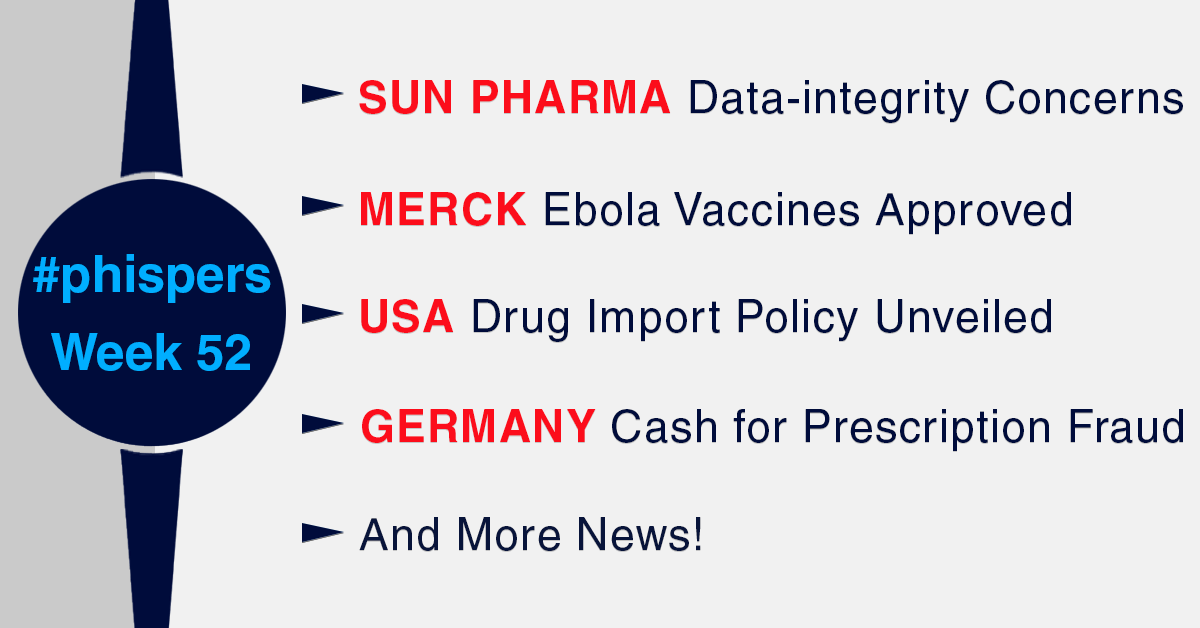
This week,
Phispers brings you news on Merck’s vaccine for the deadly Ebola virus disease (EVD) — Ervebo — as it bagged FDA approval.
The US agency has warned against the use of opioids and certain other drugs in combination with popular nervous
system drugs — such as Lyrica and Neurontin.
In Germany, the police raided several doctors and pharmacists for allegedly taking cash from a pharma company in return for prescribing its cancer drugs.
Trump administration released drafts of
two policy documents that would facilitate import of cheaper drugs from other countries, including Canada.
After getting a clearance from market regulators in the US and Britain for its US$ 4.3 billion takeover of Spark Therapeutics, Roche struck a deal with Sarepta to bag ex-US rights to its investigational gene therapy to treat Duchenne muscular
dystrophy (DMD).
And Sun Pharmaceutical got issued a Form 483 after a nine-day inspection of its Halol plant earlier this month which revealed data-integrity concerns.
Data-integrity
concerns emerge at Sun Pharma’s
Halol facility
In June 2018, Indian
drug major Sun Pharmaceutical Industries Limited had received an establishment inspection report (EIR) from the FDA for its
Halol plant,
situated in the state of Gujarat in India. The report paved the way for fresh
approvals for its products in the United States, and ended a multi-year
struggle created by a December 2015 FDA warning letter.
The EIR resulted in
the closure of the 2015 inspection and confirmed that issues raised in the
December 2015 warning letter had been addressed. This came as a boon for Sun,
for whom the US has always been a key market for expansion.
But the company’s good run seems short-lived. Earlier this month, a nine-day inspection of Halol’s finished pharmaceutical manufacturing
operations revealed data-integrity concerns and also questioned the compliance
of drug products produced at the site with established quality standards.
The Form 483 issued by the FDA following the inspection
highlighted that Sun “failed to establish and implement controls which ensure data integrity” in the use of the environmental monitoring computerized system used in its microbiology laboratory for all samples including those that are used to establish a sterile manufacturing environment. The FDA investigators found a range of deficiencies in the system and highlighted that all users of the computer system had the ability to delete information to be printed on sample labels.
The FDA also had
repeat observations from previous inspections, such as instructions a microbiology analyst must follow during the sampling process of critical operations. In the case of Sun’s Halol plant, the instructions lacked sufficient details. This raised doubts that the sampling process was sufficiently robust and could detect potential microbiological contaminants, a critical requirement for sterile manufacturing operations.
During a walkthrough
of the facility, the FDA investigators also raised data integrity concerns in
raw material dispensing as container labels related to a raw material dispensed
for tablet manufacturing were completed by an employee ahead of time. In
addition, the employee (documented as the dispenser) did not dispense the raw
material and was simply the verifier of the operation.
As is common with
other FDA inspection observations, the source of out-of-specification (OOS)
test results were not determined and manufactured batches were released to
market.
Merck wins FDA
approval for Ebola vaccine
Last week, the US
Food and Drug Administration (FDA) approved drugmaker Merck & Co’s Ebola vaccine Ervebo. This is the first FDA-authorized vaccine against the
deadly virus.
Though cases of the
Ebola virus disease (EVD) are extremely rare in the US, the FDA nod is a big win for
Merck, which is known as MSD outside the United States and Canada. Last month,
Merck had received approval from the European Commission to market Ervebo.
Anna Abram, FDA Deputy Commissioner for Policy, Legislation, and International Affairs termed Ervebo’s approval as “an important step” in FDA’s efforts to fight Ebola in close coordination with the US Department of Health and Human Services and the World Health Organization (WHO).
The
vaccine, which is administered as a single-dose injection, will help prevent
EVD caused by Zaire ebolavirus in patients aged 18 years and older, the
regulator said in a statement.
The
duration of protection conferred by Ervebo
is unknown, and the vaccine also does not protect against other species of
Ebola virus or Marburg virus.
During 2014 to 2016,
Ervebo was used by the WHO and Democratic Republic of the Congo as an
investigational vaccine to help reduce EVD outbreaks in few West African
countries.
The Ebola virus,
which causes hemorrhagic fever and spreads from person to person through direct
contact with body fluids, has killed more than 2,100 people in Congo since the
middle of the year, making it the second-largest Ebola outbreak in history.
Trump
administration unveils draft policy to import drugs from other nations
Last week, Trump
administration released two highly anticipated policy documents that
would facilitate the importation of cheaper drugs from abroad. However, the
policies represent early first steps towards that goal.
The drafts create two
pathways for importation. One would let states, drug wholesalers, or pharmacies
apply to import certain drugs from Canada, pending a sign-off from the
Department of Health and Human Services (HHS). The second would let drugmakers
import their own products sold in other countries. Both must still undergo a
formal regulatory review, a process that can take months or even longer. But
the administration insists it is moving as fast as the law permits.
HHS Secretary Alex
Azar, who had earlier expressed concerns over the policy, now insists drug importation
can be done safely. “We will not take steps that would put patients, or our drug supply, at risk,” he said.
The policy move is
being seen as a last-ditch bid by the Trump administration, which has had to
abandoned most of its other big ideas to lower drug prices. Some ideas of the
administration have also been struck down in court.
The idea is highly
controversial and drugmakers, wholesalers, and pharmacist groups have spoken
against it when it was first floated in July, saying it would put American
patients at risk.
Former FDA commissioner
Scott Gottlieb took to
Twitter to castigate the policy without making any direct reference to it. In
his tweet, he wrote: “Our closed drug system doesn’t allow imports of unapproved foreign drugs for key historical reasons. We should not open up a side channel for foreign drugs.”
After FTC, CMA nod for acquiring Spark, Roche
strikes deal with Sarepta
Last week, Swiss
drugmaker Roche said it plans to complete its US$ 4.3 billion takeover of
US-based gene therapy specialist Spark Therapeutics after the Federal Trade Commission (FTC)
in the US and Britain’s
Competition and Markets Authority (CMA) approved the deal without demanding any
sale of assets.
Roche is buying Spark
to expand in gene therapy and boost its hemophilia A portfolio. Following
completion of the merger, Spark will become a wholly owned subsidiary of Roche.
Roche’s existing drug Hemlibra will surpass US$ 1 billion sales in 2019. The regulatory authorities had feared Roche might sabotage Spark’s hemophilia program to benefit Hemlibra, but later ruled that the deal would not hurt competition in hemophilia A treatment.
Hemophilia A, where
patients lack a protein needed for blood clotting, has traditionally been one
of the most expensive treatment areas, with traditional treatments running into
millions of dollars annually.
Roche is upbeat on
gene therapy. Immediately after the decision on Spark, Roche announced it is paying US$ 1.15 billion upfront for the ex-US rights to Sarepta Therapeutics’ investigational gene therapy to treat Duchenne muscular dystrophy (DMD) — SRP-9001.
Roche will pay US$
750 million in cash and US$ 400 million in equity upfront for the ex-US rights
to SRP-9001
“This deal
should increase confidence in Sarepta’s entire DMD gene therapy program, remove any financing overhang, and allow Sarepta to retain control and flexibility,” Cantor Fitzgerald analyst Alethia Young said in a note.
DMD is a rare
degenerative neuromuscular disorder, which affects about one in 3,500 to 5,000
male births worldwide, causes severe progressive muscle loss and premature
death.
FDA warns of
breathing risks with commonly used nerve pain medicines
The FDA has warned that popular nervous system medications — known generically as gabapentin and pregabalin — can cause dangerous breathing problems when
combined with opioids and certain other drugs.
The agency said it
received nearly 50 reports of breathing problems linked to gabapentin and
pregabalin between 2012 and 2017, including 12 deaths. Drugmakers are required
to report such problems to the FDA, though it is voluntary for doctors and
patients to do so.
The FDA said it will
add new warnings to the packagings for Neurontin, Lyrica and generic versions of these medications, which are used
to treat seizures, nerve pain, restless leg syndrome and other conditions.
The new labels will
warn doctors against prescribing the drugs with other medications that can slow
breathing, including opioid painkillers. The breathing risks also apply to
elderly patients and those with existing lung problems.
Poison control
centers have been receiving an increased number of calls involving the nerve
drugs, which are often abused in combination with opioids, cocaine and
marijuana.
While doctors,
hospitals and other healthcare providers have scaled back their use of opioids
amid the opioid epidemic
in the US, the number of physicians prescribing gabapentin and pregabalin has
increased, and so has the misuse of these medications.
Though the nerve
drugs are not FDA-approved for conventional muscle and joint pain, doctors
frequently prescribe them for those uses and other uses such as for the
treatment of migraines and psychiatric conditions.
Police raid
doctors, pharmacists in Germany over cash for prescription fraud
Germany saw the largest raid of its kind last week when hundreds
of police officers searched the offices of doctors and pharmacists,
suspected to be fraudsters who were taking cash from a pharma company named
ZytoService in return for prescribing its cancer drugs.
Forty-seven properties
were searched in the states of Hamburg, Schleswig-Holstein and Lower Saxony
and 420 police officers and six state prosecutors took part in the raid.
Investigators say 14 people — nine doctors, three pharmacists and two pharmaceutical company managers — had allegedly set up an illegal business model that involved kickback payments of more than US$ 557,000 (€500,000), as well as bribes in the form
of loans that did not require repayment and the use of luxury cars. No
arrest warrants have been issued so far.
According to research
undertaken by Die Zeit
newspaper and the public broadcaster ARD, ZytoService bribed doctors to
issue prescriptions for their infusions, causing significant losses for health
insurers. ZytoService is a market leader for cancer drugs.
As a result of this fraud, TK, one of Germany’s largest public health insurers, is reported to have lost US$ 9.5 million (€8.6
million) since 2017 through the prescriptions. Cancer treatment can cost up to
US$ 110,957 (€100,000)
in Germany, and doctors choose which specialist pharmacy they issue
prescriptions for.
















 Share
Share