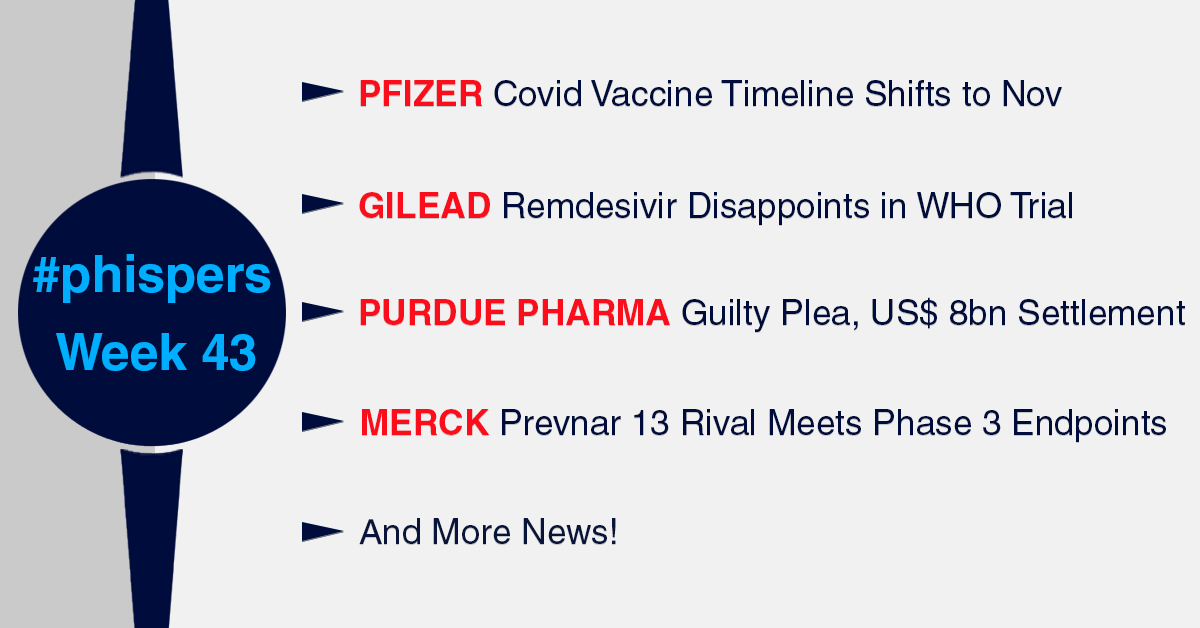
This week, Phispers has more updates on experimental Covid-19 vaccines and treatments.
Gilead’s remdesivir, which bagged an emergency use authorization from the FDA in May this year, showed little or no effect on mortality or in the length of hospital stay among Covid patients in WHO’s Solidarity Trial.
Pfizer’s CEO changed his bullish tone on the company’s experimental vaccine and said it would not apply for an EUA before the third week of November.
Earlier, he had said initial results on the vaccine candidate were expected in late October, and the company would seek the FDA’s EUA soon after that.
In other Covid vaccine news, Moderna said it expects interim results from its trial next month and hopes to file an EUA sometime in December.
Reports say AstraZeneca may resume the trial of its vaccine in the US sometime this week.
In non-Covid news, OxyContin player, Purdue Pharma, will plead guilty to three criminal charges leveled on it in the US as a part of a US$ 8 billion settlement.
Merck’s rival to Pfizer’s blockbuster pneumonia vaccine met Phase 3 endpoints. And Endo acquired BioSpecifics Technologies for US$ 658 million.
Remdesivir
disappoints in Solidarity Trial; experts say EU must renegotiate deal
Last week,
we had brought you news that the European Union has agreed to pay over €1 billion (US$ 1.2 billion) to Gilead for a six-month supply of its antiviral
drug, remdesivir, shortly before publication
of the final results of the biggest trial of the Covid-19 medication.
Interestingly,
soon after the €1 billion deal was announced, news emerged that the World Health Organization’s Solidarity Trial showed that the much touted antiviral drug appeared to have little or no effect
on the mortality or length of hospital stays among patients with Covid-19.
In May,
remdesivir had received an emergency
use authorization (EUA) from the FDA to treat Covid-19 on the basis of a study
that showed how the drug had cut recovery time for hospitalized patients by 31
percent.
Meanwhile, experts have said the EU should renegotiate the €1 billion contract it sealed with Gilead recently. The Commission “needs to present the reasons behind the rush to conclude the latest contract with Gilead and move to review it in light of the Solidarity Trial findings,” said Yannis Natsis, who represents patients’ organizations on the board of the European Medicines Agency (EMA), the EU drug regulator.
According to the WHO, Gilead had known about the results of the Solidarity Trial since October 6. Gilead, however, has said that the “emerging data appear inconsistent
with more robust evidence from multiple randomized, controlled studies
published in peer-reviewed journals validating the clinical benefit of Veklury
(remdesivir).”
According to the company, “the data from this open label global trial have not undergone the rigorous review required to allow for constructive scientific discussion”. Gilead also said it did not plan to adjust remdesivir’s
price for wealthy countries after the WHO trial.
The
effectiveness of remdesivir in the treatment of Covid-19 has been under
question for some months now. In July, a Bloomberg report had mentioned
that there is limited evidence on
the effectiveness of remdesivir, and that the drug should be put to a large clinical
trial to know if it works at curing Covid-19.
According to news reports, WHO’s guideline development group will examine the data and possibly
update their policy on the use of remdesivir in a couple of weeks. Earlier,
Gilead had said it expects Veklury to bring in US$ 3.5 billion this year.
Vaccine Update: Pfizer shifts timeline of vaccine to Nov;
Moderna may file for EUA in Dec
Last
month, US President Donald Trump had said American drug giant Pfizer Inc could secure approval
of a Covid-19 vaccine in the coming weeks. This would be the first vaccine to
secure an approval in the US, Trump had said.
Even Pfizer’s CEO, Albert Bourla,
had maintained
that the company would know this month whether its Covid-19 vaccine, that it is developing along
with BioNTech, works or not.
However,
Bourla has changed his bullish
stance after the FDA released detailed guidelines on
emergency use authorization (EUA) for vaccines. For an EUA, the FDA wants at
least two months of safety data on half of the trial participants after their
final vaccine doses have been administered.
In an open
letter, Bourla has said that Pfizer won’t
apply for an EUA before the third week of November. This is a clear shift from
Bourla’s previous comments, wherein he talked about expecting initial results in late-October and seeking FDA’s EUA soon after that.
This month, the company was meant to know whether the vaccine — BNT162 — is effective or not. Bourla said the company still needs to gather enough safety data for an application.
“So let me be clear, assuming positive data, Pfizer will apply for Emergency Authorization Use in the US soon after the safety milestone is achieved in the third week of November,” Bourla said.
“The timelines above reflect our best estimates of when these important milestones could be achieved,” he added.
Meanwhile, Pfizer has started work on
manufacturing hundreds of thousands of Covid-19 vaccines ahead of an expected
US approval in November. The coronavirus vaccines are being made at the company’s factory in Puurs, Belgium. The company says it hopes to make
100 million doses available this year, should the vaccine be granted regulatory
approval, with plans to manufacture 1.3 billion doses in 2021. Every patient
will need to receive two doses of the vaccine.
AstraZeneca’s US trial likely to resume this week: According to
a Reuters report, AstraZeneca’s Covid-19
vaccine trial in the US is expected to resume as early as this week, after the FDA completed its review of a serious illness in a study participant. The report has attributed this news to anonymous sources. AstraZeneca’s spokeswoman, however, said the communication is not from the company and it “cannot verify the content,” referring to the draft letter to study participants quoted by the sources. The sources have said the trial could resume later this week.
AstraZeneca’s large, late-stage US trial has been on hold
since September 6, after a participant in the company’s UK trial fell ill with what was suspected
to be a rare spinal inflammatory disorder called transverse myelitis.
Meanwhile, Brazil’s National Health Surveillance Agency
(ANVISA) said on Wednesday that a volunteer in a clinical trial of the Covid-19 vaccine developed by
AstraZeneca and Oxford University had died, but said the trial would continue.
It was not immediately clear whether the volunteer received the vaccine or the
placebo.
Moderna expects interim results next month: The CEO of Moderna Inc, Stéphane Bancel, has said he
expects interim results from the company’s Covid-19 vaccine trial in November and that the US government could give an EUA to the vaccine in December.
Bancel also said it takes longer to get sufficient interim results from
the study and that the government’s permission to use the vaccine may not
come until next year.
“That first analysis is likely to occur in
November, but it’s hard to predict exactly which week because it depends on the cases, the number of people getting sick,” the report quoted Bancel as saying. Bancel had told Financial
Times last month that Moderna would not be ready to apply for EUA
of its Covid-19 vaccine before November 25 at the earliest. Bancel also highlighted
that ramping up of production is a challenge. “If one ingredient is missing, we cannot make the vaccine,” he had said.
Over 1 billion vaccine doses in 2021, says Sinopharm: Liu Jingzhen, the Chairman of China National Pharmaceutical Group (Sinopharm), has said
it may have the capacity to produce more than 1 billion doses of its
coronavirus vaccine in 2021.
About 60,000 people have received Chinese coronavirus vaccine candidates
during Phase 3 clinical trials, with no serious side effects reported so far,
Tian Baoguo, an official at China’s Ministry of Science and Technology, said.
In addition, hundreds of thousands of people in China have been given experimental trial-stage vaccines as part of an emergency inoculation program launched in July. According to a tweet that quotes the head of China’s coronavirus vaccine development task force, China is expected to produce
up to 610 million doses of Covid-19 vaccines by the end of this year.
Purdue
Pharma to plead guilty to three criminal charges over opioid epidemic case
OxyContin player Purdue Pharma will plead guilty to three federal
criminal charges as part of a settlement of more than US$ 8 billion, the US
Department of Justice (DOJ) officials said on
Wednesday.
OxyContin is the powerful prescription painkiller that is said to have
helped initiate an opioid epidemic in the US.
The
settlement is the most high-profile display yet of the federal government
seeking to hold a major drugmaker liable for an opioid addiction and overdose
crisis. There have been over 470,000 deaths in the US since 2000 due to the
opioid epidemic.
The
company will plead guilty to three counts, including conspiracy to defraud the US,
and violating federal anti-kickback laws, the officials said. The resolution
will be detailed in a bankruptcy court filing in federal court.
The
deal does not release any of the company’s executives or owners — members of the wealthy Sackler family — from criminal liability, and a criminal investigation that is going on.
“The global settlement announced today involves the company pleading guilty to three felony counts for defrauding the United States and violating the Anti-Kickback Statute from 2009 to 2017,” the Deputy Attorney General Jeffrey A. Rosen said in his remarks.
“With criminal guilty pleas,
a federal settlement of more than US$ 8 billion, and the dissolution of a
company and repurposing its assets entirely for the public’s
benefit, the resolution in today’s announcement re-affirms that the Department of Justice will not relent in its multi-pronged efforts to combat the opioids crisis,” a DOJ statement said.
Endo acquires BioSpecifics
for US$ 688 million
In 2018,
Pennsylvania-headquartered Endo Pharmaceuticals’ deal to purchase Somerset Therapeutics had fallen through. But now, the parent company,
Endo International, is back in the M&A realm with a much bigger acquisition
up its sleeve.
Dublin-headquartered
Endo International is acquiring BioSpecifics Technologies Corp for an estimated equity value of
approximately US$ 658.0 million (US$ 540.0 million in enterprise value net of cash on hand),
or US$ 88.50 per share in cash.
The
transaction was unanimously approved by the board of both the companies and is
anticipated to close during the fourth quarter of 2020.
The two
companies had signed a research agreement in 2004. Under the 2004 agreement,
BioSpecifics received royalties from Endo’s
collagenase-based therapies, which Endo marketed in the US. The main drugs
behind the deal are Xiaflex, a shot used to treat Dupuytren’s contracture and Peyronie’s disease, and Qwo, which Endo says is
the first FDA-approved injectable for cellulite. But now instead of getting
those royalties, BioSpecifics is cashing out a few months before Qwo is
expected to launch.
Merck’s rival to Pfizer’s pneumonia vaccine meets Phase 3 endpoints
Last month, there was news that Merck’s experimental pneumonia vaccine had spurred an immune response that was equal to Pfizer’s blockbuster, Prevnar 13. In one of the studies, Merck’s candidate had outperformed
Pfizer’s shot on three strains of pneumonia-causing bacteria.
This week, there were more updates on phase 3 trials of Merck’s challenger to Prevnar 13. Two more phase 3 trials of Merck’s vaccine have met their immunogenicity endpoints. The results suggest that Merck’s V114 vaccine provides broader protection from pneumococcal bacteria than Pfizer’s Prevnar 13.
Back in May last year, there was news of Merck being upbeat on results
from phase 2 data from a big clinical program on its pneumonia vaccine. Back
then, Merck was already aiming to topple Pfizer’s Prevnar 13.
For years, Pfizer has led the pneumococcal vaccine market with Prevnar
13, which was launched in 2010. It prevents invasive disease resulting from 13
strains of the bacteria. The shot is Pfizer's biggest selling product. Prevnar 13
generated sales of US$ 5.8 billion for Pfizer last year.

















 Share
Share