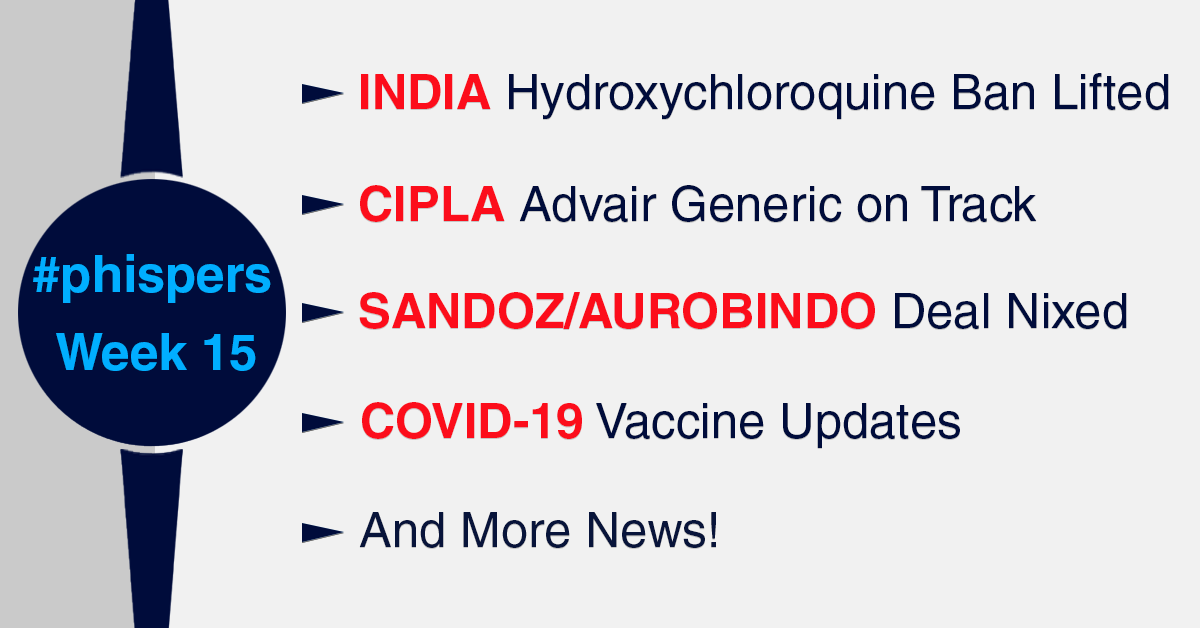
This week, Phispers has more updates on the deadly novel coronavirus.
The US, which has reported over 400,000 cases of Covid-19, is receiving shipments of 29 million doses of hydroxychloroquine (HCQ), an anti-malarial drug believed to be a treatment for the disease.
There is visible traction in the area of vaccine development as British drugmaker GlaxoSmithKline made an equity investment of US$ 250 million in Vir Biotechnology that is working on solutions for coronaviruses.
GSK also struck a deal with China’s Xiamen Innovax Biotech, which is also working on a Covid-19 vaccine.
Similarly, a potential vaccine partially funded by Bill Gates has begun testing it in people, after Moderna made a similar announcement last month.
In non-Covid news, Indian drugmaker Cipla successfully completed
Phase-3 clinical trials for its generic version of GSK’s respiratory drug Advair Diskus.
And Novartis and Aurobindo Pharma USA announced they are terminating their US$ 1 billion deal wherein Aurobindo was to buy the US general oral solids and dermatology businesses of Sandoz.
Covid-19
update: India supplies HCQ to US; surge in drug
demand for critical patients
The President of United States Donald Trump confirmed that shipments of 29 million
doses of hydroxychloroquine (HCQ), an anti-malarial drug believed to be effective in treatment of the novel coronavirus, were on its way to the US. “A lot of it comes out of India,” Trump said.
This announcement was preceded by reports of Trump talking about a
possible retaliation if the Indian Prime Minister Narendra Modi didn’t allow HCQ to reach the US.
“I know that he stopped it for other countries (but) I spoke to him yesterday and we had a very good talk... I said we’d appreciate you allowing our supply to come out. If he doesn’t allow it to come... there may be retaliation,” Trump had said on Monday, speaking of his phone conversation with Modi. The following day, he confirmed that 29 million doses of HCQ were reaching the US. “I asked him (Modi) if he would release it. He was great. He was really good,” Trump said.
US has reported over 400,000 cases of Covid-19, and over 13,000 deaths. Trump’s bulk purchase of the drug, which he called a “game-changer”, is in anticipation of it being declared a viable treatment option. HCQ is being tested on at least 1,500 Covid-19 patients in New York.
Last
month, the Indian government restricted the exports of
13 APIs along with some of their finished formulations. The list included paracetamol, tinidazole, metronidazole, acyclovir, vitamin B1, vitamin B6, vitamin B12, progesterone, chloramphenicol and neomycin. This was followed by the Indian government issuing a directive which prohibited the export of HCQ API and
formulations made from HCQ.
The directives did, however, offer exemptions to some exports like those made from
special economic zones/export-oriented units as well as those “allowed by the Government of India to other countries on humanitarian grounds on case to case basis on the recommendation of Ministry of External Affairs”.
Last week,
the restriction on the drug exports was lifted on all the APIs along
with their finished formulations, except paracetamol and HCQ.
India manufactures around 70 per cent (approximately 200 million tablets of 200 mg each) of the world’s HCQ. Last week, the U.S. Food and Drug Administration (FDA) had issued an Emergency
Use Authorization (EUA) to permit the emergency use of HCQ to treat adults who
were hospitalized with COVID-19 for whom a clinical trial was not available. However, the drug is currently placed on FDA’s drug shortage list and imports are the only way out for the US, which
has seen the maximum reported cases of Covid-19 in the world.
On Tuesday, India’s Ministry of External Affairs (MEA)
spokesperson said: “In view of the humanitarian aspects of the pandemic, it has been decided that India would license
paracetamol and HCQ in appropriate quantities to all our neighboring countries who are dependent on our capabilities. We will also be supplying these essential drugs to some nations who have been particularly badly affected by the pandemic”.
There is
likely to be further pressure on the drug supply chain. According to a report
published in STAT by Pharmalot, there has been a significant
increase in demand in the US for medicines needed for patients who are placed
on ventilators. The list includes sedatives, anesthetics, painkillers, and
muscle relaxants like propofol, dexmedetomidine, etomidate, ketamine, lorazepam, midazolam, hydromorphone, fentanyl, morphine, cisatracurium, rocuronium, succinylcholine chloride, and vecuronium.
PharmaCompass has generated detailed supply
chain map reports for paracetamol and hydroxychloroquine. In case you’re interested, email us at support@pharmacompass.com
Cipla’s Advair generic successfully completes Phase-3 clinical
Indian drugmaker Cipla Ltd has said it has successfully completed the clinical
endpoint study evaluating the safety and efficacy of its generic Advair Diskus,
GlaxoSmithKline Plc’s
respiratory drug.
The Mumbai-headquartered
company said Phase-3 clinical trials were conducted over a 15-month period at
more than 100 sites in the US enrolling 1,400 asthma patients.
If approved, Cipla’s
generic Advair will be the fourth such drug. UK-based Hikma Pharmaceuticals
is expected to launch its generic Advair in the second half of 2020. Analysts
expect Cipla to be able to launch the drug only in FY 2023, as this is a
complex drug.
In February, Sandoz
had said it has stopped work on the generic version of Advair, after working on it for years. Sandoz’s parent Novartis recorded an impairment charge of US$ 442 million related to its
write-down of the Advair generic program.
The product — fluticasone propionate
and salmeterol inhalation powder (100/50 mcg) — is indicated to treat asthma in patients four years and older as a twice-daily prescription medicine and in the long term to treat chronic obstructive pulmonary, including chronic bronchitis, emphysema, or both.
Advair Diskus and its
generic equivalents posted US sales of about US$ 2.9 billion for the 12-month
period ending February 2020.
While the drug generated more than US$
4 billion in revenue for GSK
in 2017, prices have come crashing down since the launch of Mylan’s
generic-version at a discount of about 70 percent. Analysts now estimate the
market size, including generics, at roughly US$ 1 billion.
Delays by FTC lead to nixing of US$ 1 billion Sandoz deal between Novartis, Aurobindo
In a statement, Novartis AG
has said it has terminated its US$ 1 billion deal to sell the Sandoz
US generic oral solids and dermatology businesses to Aurobindo Pharma USA Inc.
The decision was taken mutually by Aurobindo Pharma USA Inc and Novartis.
According to the
statement, the decision had to be taken
because approval from the US Federal Trade
Commission for the transaction was not obtained within
anticipated timelines.
Had the deal been
cleared, it would have created the second-largest generics player in the US.
According to news reports, there’s no breakup fee
associated with the termination. Sandoz will continue to operate its oral
solids and dermatology business as part of the Sandoz US business.
The deal was signed in
September 2018, as part of Novartis CEO Vas Narasimhan’s
plan to focus on innovative
medicines. At that time, selling off the US oral generics company seemed like a wise step as pricing pressure had mounted across the US, impacting Sandoz’s overall performance.
Originally, Novartis was
hoping to close the deal in 2019, but US antitrust review caused
significant delays. The regulators had requested more information on a lawsuit
against Aurobindo, a development that pushed the planned closure to 2020.
According to a report
published in The Economic Times, brokerages see the
termination of the deal as a setback for Indian drugmaker Aurobindo Pharma’s efforts to
scale up sales in the US even though many analysts say the cancellation has
also eased the financial burden for the company.
In 2019, increased
antitrust scrutiny on biopharma deals became commonplace. Such scrutinies led
to multiple delays in Roche’s US$ 5.1
billion acquisition of Spark Therapeutics
and forced Celgene
to sell its blockbuster psoriasis drug
Otezla
to win clearance for its US$ 74 billion merger with Bristol Myers Squibb.
It also derailed Illumina’s
proposed US$ 1.2 billion offer for smaller DNA sequencer player Pacific
Biosciences.
Covid-19 vaccine update: GSK buys stake in Vir Biotech, Innovax; human trials
at Moderna, Inovio
There is visible
traction in the area of vaccine development for the deadly novel coronavirus.
British pharmaceutical giant GlaxoSmithKline is
making an equity investment
in Vir Biotechnology
as part of a collaboration to research and develop solutions for coronaviruses.
According to the terms of the deal, GSK is making an equity investment of US$
250 million in Vir.
The companies say they will use Vir’s proprietary monoclonal antibody platform technology to accelerate existing anti-viral antibodies and identify new ones, use GSK’s expertise in functional genomics and combine their capabilities in CRISPR screening and artificial intelligence.
GSK-Vir’s immediate focus will be on
VIR-7831 and VIR-7832, a pair of antibodies identified by Vir’s
monoclonal antibody technology that bind tightly to the spike protein of the
novel coronavirus. The companies expect to begin Phase II testing of the
therapies within the next three to five months.
A few days back, GSK had
struck a vaccine development agreement
with China’s Xiamen Innovax Biotech. Innovax is developing
its Covid-19 XWG-03 vaccine candidate technology.
Meanwhile, the first human trial of a vaccine to
prevent the coronavirus could advance to the next step this spring, Moderna
Chairman Noubar Afeyan said. Afeyan said Moderna
has entered phase 1 trials and is likely to enter into phase 2 trials by early
summer.
Public distribution of such a
vaccine is likely in the next 12 to 18 months, which would be the “ultimate game changer” in the fight against the pandemic, White House health advisor Anthony Fauci said.
Meanwhile, a
potential coronavirus vaccine funded by Bill Gates has begun testing in people. After Moderna, Inovio’s candidate INO-4800 is the second potential coronavirus vaccine to start human trials in the US. According to reports, Inovio’s vaccine trials have started in Philadelphia, Kansas City.
Inovio Pharmaceuticals, a small biotech in Pennsylvania, received regulatory clearance to begin testing. The Bill and Melinda Gates Foundation and other nonprofits have poured funding into Inovio’s vaccine project. The biotech said it
expects to have early safety data by late summer and aims to produce 1 million
doses by the end of 2020.












 Share
Share