In the US, President Donald Trump has been putting
pressure on Big Pharma to reshore or face tariffs.
Eli Lilly has been the first to comply as it unveiled an ambitious plan to
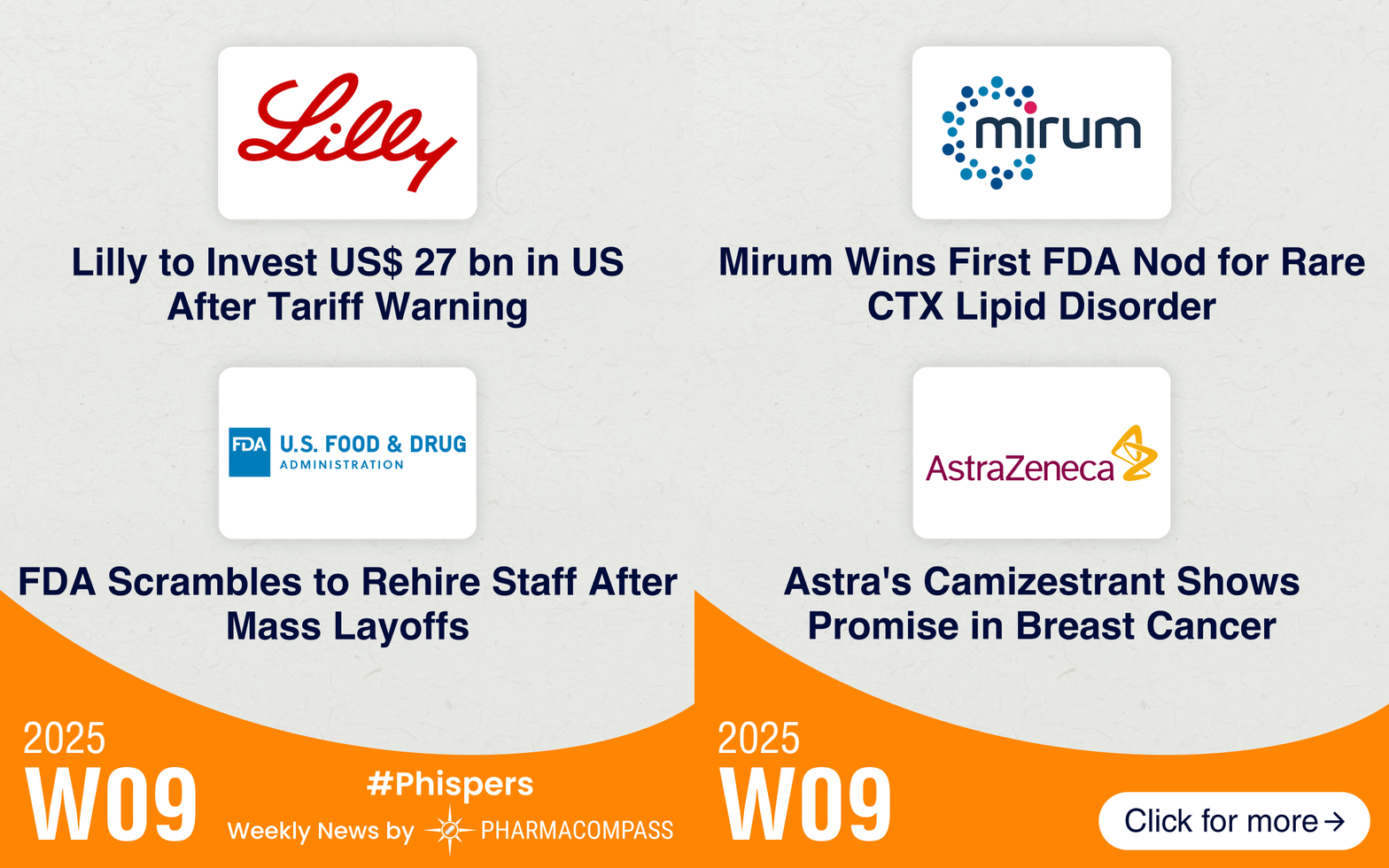
invest at least US$ 27 billion in four new plants across the US over the next five years.Though layoffs have been continuing unabated across agencies in America, the US Food and Drug Administration (FDA) reversed its controversial mass layoffs and reportedly moved to rehire hundreds of employees to stabilize critical operations.In drug approvals, Mirum Pharma’s Ctexli became the first FDA-approved treatment for a rare lipid storage disease. In trials, AstraZeneca’s experimental drug camizestrant demonstrated significant improvements in progression-free survival in a late-stage breast cancer trial.In the field of gene therapy, Pfizer announced it will
discontinue Beqvez for hemophilia B citing limited market interest, while
Bluebird Bio said it is selling itself to private equity firms.In regulatory news, FDA has shot off warning letters to
two Indian API manufacturers for critical cGMP violations, and issued a Form
483 to Piramal Pharma post an inspection held at its Navi Mumbai plant this
month.Lilly to invest US$ 27 bn in
US, as Trump threatens Big Pharma with tariffsPharmaceutical giant Eli Lilly has unveiled an ambitious plan to invest at least US$ 27 billion in constructing four new manufacturing
plants across the US over the next five years. The announcement comes amid increasing pressure from President Donald Trump, who met privately with top executives from Big Pharma — including Pfizer, Merck, Lilly and lobby group PhRMA.During the meeting, Trump warned that failing to reshore manufacturing operations could result in tariffs as high as 25 percent. Lilly’s new facilities are expected to generate over 3,000 skilled jobs in engineering and science, alongside approximately 10,000 construction roles. This boosts the Indiana drugmaker’s total investment in the US to over US$ 50 billion since 2020.Compounders sue FDA over GLP-1 drug shortages: Pharmaceutical compounders are suing FDA following the agency’s recent declarations that shortages of key weight loss drugs have ended. Compounders are contesting that the “reckless
and arbitrary decision” to remove Novo Nordisk’s semaglutide (Ozempic and Wegovy) from
the shortage list is premature. In a parallel development, Lilly has cut the
price for vials of its weight-loss drug Zepbound (tirzepatide) by US$ 50 or more in order to stave
off competition from compounding pharmacies and its Danish rival.FDA reverses course, moves to
rehire hundreds after mass layoffsIn a swift policy reversal, FDA is working to rehire hundreds of employees who were
terminated just days earlier as part of a mass layoff
initiative. The initial firings, ordered by the Trump
administration and led by Elon Musk's Department of
Government Efficiency, affected over 1,000 FDA staffers responsible for critical
areas such as drug and medical device review, food safety, and
tobacco regulation. The layoffs drew significant backlash from industry stakeholders.
Reports suggest that approximately 300 staff members are being asked to return.Mirum’s Ctexli bags FDA approval for rare lipid storage diseaseFDA has approved Mirum Pharma’s Ctexli (chenodiol) as the
first targeted treatment for
cerebrotendinous xanthomatosis (CTX), a rare
lipid storage disease. Patients
with CTX are
unable to effectively break
down cholesterol, leading to a toxic build-up of cholestanol in tissues, and suffer from neurological abnormalities.AstraZeneca’s camizestrant shows promise in late-stage breast cancer trialAstraZeneca has announced that its experimental drug, camizestrant, has demonstrated significant improvement in progression-free
survival for patients with advanced breast cancer. The trial specifically targeted patients with hormone
receptor-positive, HER2-negative advanced breast cancer possessing a particular
(emergent ESR1) genetic mutation. The British-Swedish drugmaker has set a peak
sales target of US$ 5 billion for this drug.Emalex’s ecopipam cuts Tourette syndrome relapse: Emalex
Biosciences has reported a major win
in its phase 3
trial on ecopipam, a med
for Tourette syndrome (a neurological disorder that causes involuntary tics, repetitive movements or sounds). In the study, pediatric patients who
continued treatment with ecopipam experienced a relapse rate of 41.9 percent
compared to 68.1 percent in those who switched to placebo. Similar benefits
were seen in the combined pediatric and adult groups.
Pfizer shifts focus to
Hympavzi after discontinuing US$ 3.5 mn hemophilia gene therapyThe field of gene therapy has been facing a tough period for the
last few years. Ergo, Pfizer has announced the discontinuation of global development and commercialization of Beqvez, a gene therapy
designed to treat adults with moderate to severe hemophilia B.Despite receiving approvals in Canada, the US, and Europe
throughout 2024, the company cited limited patient and physician interest in
hemophilia gene therapies as the primary reason for this decision. Beqvez (fidanacogene
elaparvovec-dzkt) is priced at US$ 3.5 million per treatment.This move effectively leaves Pfizer without any active gene therapy programs in its portfolio. The company plans to redirect its
resources toward Hympavzi (marstacimab-hncq), its other therapy for
hemophilia A and B that received FDA approval in October 2024.Bluebird Bio gets sold for ~US$ 30 million: Cash-strapped Bluebird Bio that develops gene therapies
for severe genetic disorders has entered into a definitive agreement to be acquired by private equity firms Carlyle
and SK Capital Partners for less than US$ 30 million.FDA slaps two Indian API
firms with warning letters; Piramal Pharma gets Form 483FDA has issued warning letters and import
alerts to two Indian API manufacturers — Jagsonpal Pharmaceuticals and Tyche Industries — following inspections that revealed significant cGMP violations. The agency discovered that Jagsonpal had engaged a
third-party contract manufacturer to produce APIs, which it then claimed as its
own on import records. The company, based in Gurugram near New Delhi,
downright refused entry to FDA inspectors on March 15, 2024, FDA said.
Inspectors were eventually allowed entry on March 20, 2024, but with limited
access to the requested documents. In the case of Tyche Industries, FDA inspectors reported that during an inspection, a member of management stated that two operators admitted to falsifying temperature data for a drying oven that was not turned on during the manufacture of a batch.Form 483 for Piramal Pharma: FDA has issued a Form 483, with six observations, to Piramal Pharma after conducting a Good
Manufacturing Practice (GMP) inspection at its Turbhe, Navi Mumbai facility from February 11-17, 2025.

















 Share
Share