Please Wait
Applying Filters...
Menu
Xls

Digital Content read-more

Create Content with PharmaCompass, ask us

DATA COMPILATION #PharmaFlow

read-more
read-more
DMF filings rise 4.5% in Q3 2025; China holds lead, India records 20% growth in submissions
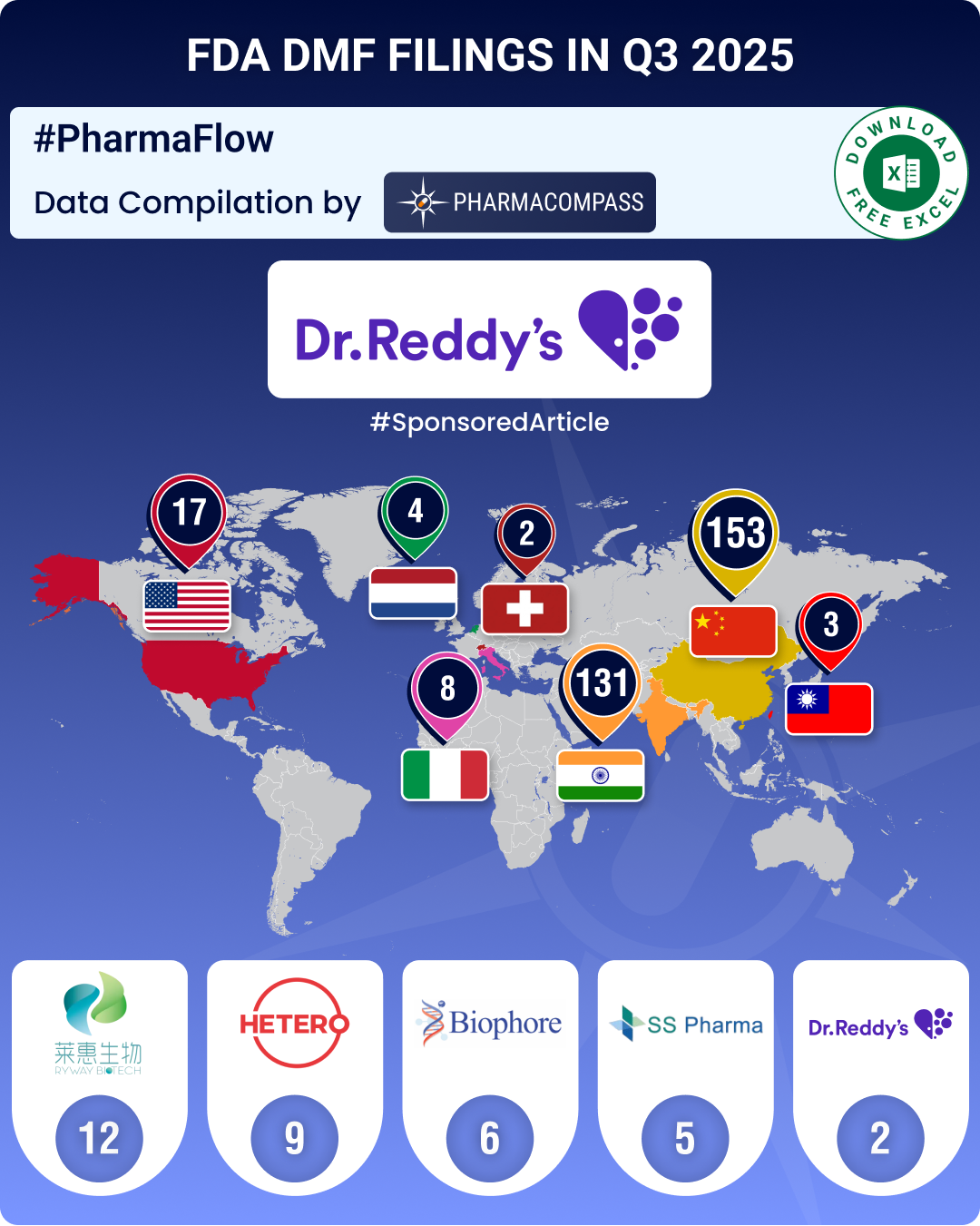
The third quarter (Q3) of 2025 witnessed a steady rise in Drug Master File (DMF) submissions to the US Food and Drug Administration (FDA). DMFs are used to provide confidential, detailed information about facilities, processes, or articles used in the manufacturing, processing, packaging, and storing of human drug productsA total of 323 Type II DMFs were submitted during this period, as opposed to 309 submissions in Q3 2024, marking an increase of 4.53 percent. This is the second highest number since 2018. In Q1 2025, 339 Type II filings were recorded.Across all DMF types (II, III, IV, and V), 479 DMFs were filed in Q3 2025, compared to 394 in Q3 2024, representing a 21.57 percent increase. Out of the 323 Type II DMFs submitted in Q3 2025, 40 had completed their review by the end of Q3, reflecting a processing lag between submission and review completion. View FDA DMF Filings in Q3 2025 (Power BI Dashboard, Free Excel Available)China maintains its lead while India posts double-digit growth in DMF submissions China and India continued to dominate DMF submissions in Q3 2025. China retained the top spot with 153 Type II DMFs, matching its submission count from Q3 2024. India recorded 131 DMFs, marking a 20.18 percent increase over 109 filings during the corresponding period last year.The United States stood a distant third with 17 filings, compared to 13 in Q3 2024. Among European nations, Italy recorded eight DMFs, doubling its 2024 tally. The Netherlands filed four, up from three. Spain submitted only one DMF, as against seven submitted in Q3 2024. Taiwan made three filings, up from one submitted in Q3 2024. Together, India, China and Taiwan accounted for about 88.9 percent of all Type II DMFs filed during the quarter. View FDA DMF Filings in Q3 2025 (Power BI Dashboard, Free Excel Available) China’s Suzhou Ryway Biotech tops corporate tally; India’s Hetero, Biophore followChina’s Suzhou Ryway Biotech led the company-wise tally with 12 DMF submissions in Q3 2025. The company had not filed any DMFs in Q3 2024.India’s Hetero Group followed with nine DMFs, maintaining the same number of filings as Q3 2024. Biophore India Pharmaceuticals ranked third with six DMFs, doubling its count from three last year.Other notable contributors include Sai Sreyas Pharmaceuticals (India) and Shanghai Haoyuan Chemexpress (China), with five DMFs each. Companies such as SNJ Group, Lunan Pharmaceutical, Allsino Pharmaceutical, Shankus Pharma, Jiangxi Xinganjiang Pharmaceutical, Sunpure Extracts, Lee Pharma, Umedica Laboratories, Linhai Tianyu Pharmaceutical and Maithri Drugs filed four DMFs each. View FDA DMF Filings in Q3 2025 (Power BI Dashboard, Free Excel Available) Olaparib, semaglutide lead molecular filings; Dr. Reddy’s files DMF for edoxaban & tucatinibDr. Reddy’s Laboratories also featured among key DMF filers in Q3 2025, submitting two DMFs — for edoxaban tosylate monohydrate and tucatinib copovidone. Edoxaban tosylate monohydrate (marketed as Savaysa by Daiichi Sankyo) is a prescription anticoagulant used to reduce the risk of stroke and to treat deep vein thrombosis and pulmonary embolism. Patent exclusivity for Savaysa extends until October 2026 in the United States, with no generic currently available.In terms of molecules, the highest number of DMFs were filed for olaparib, semaglutide, ruxolitinib phosphate, ferric carboxymaltose, and vismodegib, with three DMFs each in Q3 2025.Olaparib, sold by AstraZeneca under the brand name Lynparza, saw DMFs being filed by BDR Lifesciences and Intas Pharmaceuticals from India, and by ScinoPharm Taiwan during the quarter.Semaglutide, a glucagon-like peptide-1 (GLP-1) receptor agonist developed by Novo Nordisk, continued to draw strong interest from API manufacturers. DMFs for semaglutide were filed by three Chinese companies: Yangzhou Aurisco Pharmaceutical, Zhejiang Peptites Biotech, and Fujian Genohope Biotech.Ruxolitinib phosphate, marketed by Incyte as Jakafi, saw three DMFs. Three Indian companies — Alembic Pharmaceuticals, Valary Labs, and Devi Pharmatech — filed DMFs for this API in Q3 2025. Other molecules that received multiple DMF submissions include ferric carboxymaltose (used to treat iron-deficiency anemia) and vismodegib (an oral therapy for basal-cell carcinoma). View FDA DMF Filings in Q3 2025 (Power BI Dashboard, Free Excel Available) First-time DMF filings span 17 companies; India leads with nine first-time DMFs The quarter saw first-time DMF filings from 17 companies. India took a lead here with nine first-time DMF filings, followed by China (six), and the US (two).The DMF filings in this quarter included inclisiran sodium (filed by Aurisco Pharmaceutical of China), pacritinib citrate (by TAPI Nl B.V. of the Netherlands), and vosoritide (by Apicore LLC of the US).Out of the 19 first-time DMFs filed in Q3 2025, four completed their Generic Drug User Fee Amendments (GDUFA) review process during the quarter. View FDA DMF Filings in Q3 2025 (Power BI Dashboard, Free Excel Available) GDUFA fee for FY 2026: The FDA Generic Drug User Fee Amendments (GDUFA) is a law designed to speed access to safe and effective generic drugs to the public and reduce costs to the industry.Fee rates for fiscal year 2026 were published on July 30, 2025. FDA has revised fees under GDUFA III across all categories. While there is a slight increase in the DMF fee from US$ 95,084 in 2025 to US$ 102,584 in 2026, the ANDA fee has seen a sharp rise: from US$ 321,920 in 2025 to US$ 358,247 in 2026.FY 2025 and FY 2026 User Fee Rates Generic drug fee category Fees rates for FY 2025 Fees rates for FY 2026 Applications:     Abbreviated New Drug Application (ANDA) US$ 3,21,920 US$ 3,58,247 Drug Master File (DMF) US$ 95,084 US$ 1,02,584 Facilities:     Active Pharmaceutical Ingredient (API)—Domestic US$ 41,580 US$ 43,549 API—Foreign US$ 56,580 US$ 58,549 Finished Dosage Form (FDF)—Domestic US$ 2,31,952 US$ 2,38,943 FDF—Foreign US$ 2,46,952 US$ 2,53,943 Contract Manufacturing Organization (CMO)—Domestic US$ 55,668 US$ 57,346 CMO—Foreign US$ 70,668 US$ 72,346 GDUFA Program:     Large size operation generic drug applicant US$ 18,91,664 US$ 19,18,377 Medium size operation generic drug applicant US$ 7,56,666 US$ 7,67,351 Small business generic drug applicant US$ 1,89,166 US$ 1,91,838 Our viewFor several years prior to the pandemic, India had a lead in Type II DMF submissions. In recent years, China has surpassed India in DMF filings. But Q3 2025 numbers indicate that Indian drugmakers are fast catching up. Since DMFs establish trust in APIs from across the world, we feel this healthy competition between drugmakers from the two countries is good for the global pharmaceutical industry. 

Impressions: 4786

https://www.pharmacompass.com/radio-compass-blog/dmf-filings-rise-4-5-in-q3-2025-china-holds-lead-india-records-20-growth-in-submissions

#PharmaFlow by PHARMACOMPASS
13 Nov 2025

WEEKLY NEWS RECAP #Phispers

read-more
read-more
FDA proposes limits on ‘sartan’ nitrosamine impurities; Text messages add new twist to US generic price fixing litigation
In our final Phispers of 2018, we bring you news on how the big pharmaceutical companies in the US plan to ring in the new year with price hikes. In the price fixing case, three drugmakers are being accused of working in collusion to hike the price of nystatin, a generic anti-fungal drug. At the heart of this allegation is a text message from an employee working at Heritage Pharmaceuticals.  FTC has approved an application by Teva to reopen and modify its decision and order in connection with the 2012 merger of Watson Pharmaceuticals and Actavis. In the sartan adulteration saga, Torrent has voluntarily recalled two lots of losartan potassium tablets due to the detection of NDEA impurity. Meanwhile, FDA has proposed limits on nitrosamine impurities in angiotensin II receptor blockers (ARBs) for drugmakers to use. And after last year, EU inspectors have uncovered data integrity violations at Kores India once again. A ‘smiley-faced’ text message is at the center of generic price fixing lawsuit   In the US, three drugmakers have been accused of working in collusion to hike the price of a decades-old generic anti-fungal medicine, known as nystatin. According to a major federal lawsuit, the drugmakers colluded to increase the price of nystatin back in 2014.  At the heart of this accusation is a ‘smiley-faced’ text message from an employee working for the New Jersey drugmaker Heritage Pharmaceuticals. The text message was sent to an employee of a rival company. It read: “Work news: we are raising price on Nystatin. Just letting you know. :),”  According to the attorneys, post receiving that text message, the competitor (Indian drugmaker Sun Pharmaceuticals) also started increasing the price of its nystatin. A Sun representative, however, said the allegations were meritless and that the company would continue to defend itself “vigorously.” The complaint alleges that rival companies shared information about price increases by way of phone calls and text messages, and often doubled drug prices in unison. This large civil antitrust complaint includes communications between employees. According to the complaint, nystatin was made by at least three generic drugmakers, all of which had employees in close contact and exchanged notes on the ensuing price hike. Forms of nystatin are used to treat common fungal infections such as yeast infections and diaper rash. The attorneys general claim that conversations between two nystatin manufacturers Teva and Heritage date back to mid-2013. They allege the price increases had been broached internally at Teva first. However, the Teva employee who headed the pricing team initially opposed them. Teva said in a statement that it denied the allegations and “will continue to vigorously defend itself.” Other medications outlined in the complaint treat conditions like epilepsy, heart failure, anxiety, insomnia, hypertension, diabetes, asthma, and arthritis. While Heritage fired its former president and CEO in 2016 after an internal investigation revealed “serious misconduct”, it said it is also suing a former executive in a separate ongoing suit. The high-ranking employees of former Heritage Pharmaceuticals, who also happen to be brothers-in-law — Jason Malek, its former president, and Jeffrey Glazer, its former CEO — have previously pleaded guilty to price-fixing and other charges in separate criminal cases. FDA proposes limits on nitrosamine impurities; Torrent recalls losartan made with Hetero’s API   Last month, Sandoz Inc had issued a voluntary recall of one lot of losartan potassium and hydrochlorothiazide due to the detection of trace amounts of NDEA (N-Nitrosodiethylamine) impurity found in the API which was manufactured by Zhejiang Huahai Pharmaceutical Co Limited. And last week, there was news that Torrent Pharmaceuticals Limited too is voluntarily recalling two lots of losartan potassium tablets to the consumer level due to the detection of trace amounts of the same impurity — NDEA — in its API manufactured by Hetero Labs Limited. To date, Torrent Pharmaceuticals has not received any reports of adverse events related to this recall, FDA said. Losartan is used in the treatment of hypertension and hypertensive patients with left ventricular hypertrophy. It is also used to treat nephropathy in type 2 diabetes. Meanwhile, the agency has also published interim acceptable intake levels of nitrosamine impurities in angiotensin II receptor blockers (ARBs) for manufacturers to use. This should help ensure their finished drug products are safe for patients. The agency evaluated safety data for N-Nitrosodimethylamine (NDMA) and NDEA to determine an interim acceptable intake level for these impurities. The agency will use the interim limits to recommend manufacturers to conduct a voluntary recall if laboratory testing confirms the presence of nitrosamine impurities in their finished drug product. FDA’s Interim Limits for NDMA and NDEA in Angiotensin II Receptor Blockers (ARBs) Drug Maximum Daily Dose (mg/day) Acceptable Intake NDMA (ng/day)*    Acceptable Intake NDMA (ppm)** Acceptable Intake NDEA (ng/day)*     Acceptable Intake NDEA (ppm)** Valsartan 320 96 0.3 26.5 0.083 Losartan 100 96 0.96 26.5 0.27 Irbesartan 300 96 0.32 26.5 0.088 Azilsartan 80 96 1.2 26.5 0.33 Olmesartan 40 96 2.4 26.5 0.66 Eprosartan 800 96 0.12 26.5 0.033 Candesartan 32 96 3.0 26.5 0.83 Telmisartan 80 96 1.2 26.5 0.33 * The acceptable intake is a daily exposure to a compound such as NDMA or NDEA that results in a 1:100,000 cancer risk after 70 years exposure  ** These values are based on a drug's maximum daily dose as reflected in the drug label In the US, big pharma to ring in the new year with price hikes   Pharmaceutical companies in the US have been under pressure from the Trump administration to lower drug prices. But it seems like they don’t intend to cower down to that pressure anymore. Thirty drug companies, including AstraZeneca Plc., Biogen Inc., Allergan, GlaxoSmithKline Plc, Amgen, Novartis AG and Bayer AG, have taken steps to raise the prices of their medicines in January. Several drugmakers filed notifications with California agencies in early November disclosing that they planned to raise prices in the next 60 days or more. Under a state law passed last year, companies are required to notify payers in California if they intend to raise the US list price on any drug by more than 16 percent over a two-year period. Drug behemoth Pfizer has also announced plans to hike prices on 41 of its drugs in mid-January. In July, Pfizer had rolled back planned price increases after President Trump said in a tweet that the drugmaker “should be ashamed” and that his administration would respond to the hikes. Novartis is planning to raise prices on more than 100 indications of over 30 different drugs in January, with increases ranging from 4.5 percent to 9.9 percent. Drugs on the list are expected to account for more than US$ 20 billion of Novartis’ revenue this year and include multiple sclerosis drug Gilenya, psoriatic arthritis treatment Cosentyx, and leukemia treatment Tasigna. The list also includes Novartis’ Diovan, the brand name version of blood pressure treatment valsartan. Generic versions of Diovan have been facing shortages ever since a potential carcinogen was detected in its active pharmaceutical ingredient (API) made in China, prompting widespread recalls. Similarly, Bayer filed notifications with California agencies to increase prices on six of its drugs in January, many of which are birth control products. Most of these price increases are 5 percent. The hikes scheduled for next month will pose a new challenge to the Trump administration and its pledge to lower the costs of prescription drugs. FTC opens Teva’s plea to modify decision regarding Watson’s acquisition of Actavis   In the US, the Federal Trade Commission (FTC) has approved an application by Teva to reopen and modify its decision and order in connection with the 2012 merger of Watson Pharmaceuticals Inc. and Actavis Inc. The Commission had alleged that the merger might lessen future competition for a number of generic drugs, including the generic version of the abuse-resistant opioid painkiller sold under the brand name Embeda. The 2012 decision and order required Watson and Actavis to supply Embeda to Pfizer for four years after Pfizer’s relaunch of Embeda, which occurred in January 2015.  The decision and order also required Watson and Actavis to assist in the transfer of technology for manufacturing Embeda to Pfizer or a third party. In 2016, Teva acquired Actavis’ rights and obligations under the Embeda supply agreement. At Pfizer’s request, Teva sought to extend the Embeda supply agreement for an additional period as Pfizer has not yet completed the technology transfer for Embeda manufacturing to a third party. Without Teva’s supply of Embeda, Pfizer will be unable to supply patients with Embeda after December 2018. This year too, EU inspectors uncover data integrity violations at Kores India    In 2017, an inspection by Italian health authorities at the API manufacturing facilities of Kores (India) Limited uncovered “serious GMP non-compliance”. The inspectors found major deficiencies related to electronic and paper analytical data integrity.  The inspection was performed in the framework of the CEP (certificate of suitability) dossier for the manufacture of ambroxol hydrochloride and the inspection team recommended the suspension of all CEPs from the manufacturing site. A year later, in October 2018, the French health agency (ANSM) came to inspect the manufacturing process of ambroxol at Kores and once again uncovered data integrity violations. The French inspectors also raised concern over the cross contamination risk pertaining to the production equipment. As a follow-up to the inspection, the EDQM will consider the withdrawal of the CEPs n°2013-115 Ambroxol HCl, n°2015-012 Ambroxol HCl and n°2015-224 Glimepiride. The inspection report states that the deficiencies found could affect the other APIs manufactured at the site. These include Doxofylline, Etofylline, Acefylline, Glimepiride, 3-Methylxanthine, 2-Amino-3,5-dibromobenzaldehyde, 8-ChloroTheophylline, 8-Benzyl Theophylline, Theobromine, Acebrophylline, Theophylline, Piperazine/Acepifylline, Pamabrom, Ivabradine HCl, Dorzolamide Hydrochloride.

Impressions: 5092

https://www.pharmacompass.com/radio-compass-phisper/fda-proposes-limits-on-sartan-nitrosamine-impurities-text-messages-add-new-twist-to-us-generic-price-fixing-litigation

#Phispers by PHARMACOMPASS
27 Dec 2018

NEWS #PharmaBuzz

read-more
read-more

https://www.loncompharm.com/Biocom-Unveils-at-CPHI-Shanghai-Benefits-The-Globe-with-Full-Industrial-Chain-Collaboration-id49824006.html

PRESS RELEASE
30 Jun 2025

https://www.accessdata.fda.gov/scripts/cder/daf/index.cfm?event=overview.process&ApplNo=216699

FDA
06 Feb 2025

http://www.accessdata.fda.gov/scripts/cder/daf/index.cfm?event=overview.process&varApplNo=217490

FDA
21 Jan 2025

https://www.accessdata.fda.gov/scripts/cder/daf/index.cfm?event=overview.process&ApplNo=217490

FDA
21 Jan 2025

https://www.accessdata.fda.gov/scripts/cder/daf/index.cfm?event=overview.process&ApplNo=218737

FDA
06 Aug 2024

https://economictimes.indiatimes.com/industry/healthcare/biotech/pharmaceuticals/zydus-lifesciences-gets-tentative-approval-from-usfda-for-bp-lowering-drug/articleshow/111485120.cms

ECONOMIC TIMES
05 Jul 2024