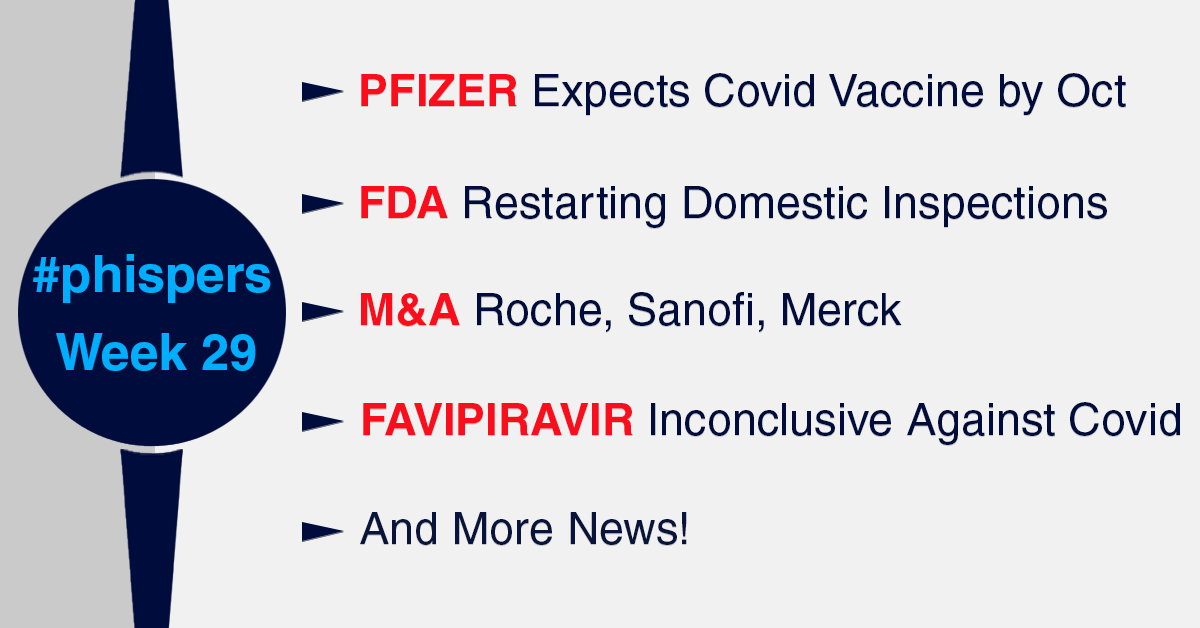
This week, Phispers brings you updates on vaccines for the novel coronavirus.
While the FDA gave fast track designation to two experimental Covid vaccines being developed by BioNTech and Pfizer, Moderna said it plans to start phase 3 trials on its vaccine by the end of the month.
The FDA said it is looking to restart inspections in the US.
In M&A news, Roche shelled out US$ 775 million for Blueprint Medicine’s RET inhibitor, pralsetinib; Blackstone launched a fund for life sciences; and Zymeworks expanded its collaboration with Merck to develop up to three additional multi-specific antibody candidates.
Sanofi entered into a multi-program strategic collaboration with biotech
firm Kymera Therapeutics to develop and commercialize first-in-class protein
degrader therapies.
Japanese researchers said Fujifilm Holdings
Corp’s Avigan (favipiravir) yielded inconclusive results as a treatment of
Covid-19. And, there was yet another explosion at a chemical plant in
Visakhapatnam, situated in south India.
Vaccine update: FDA fast tracks Pfizer’s
shot; Moderna to start phase 3 trials on July 27
The
US Food and Drug Administration (FDA) has given the ‘fast track’ designation to two experimental coronavirus vaccines being jointly developed by
German biotech firm BioNTech and US pharma giant Pfizer.
Pfizer and BioNTech have four investigational vaccine candidates from their BNT162 mRNA-based vaccine program being assessed in ongoing trials in the US and Germany. Out of these, two candidates — BNT162b1 and BNT162b2 — are the most advanced.
The
fast track status granted to BNT162b1 and BNT162b2 will speed up the review
process. The companies said they expect to begin a large trial with up to
30,000 participants later this month.
Earlier
this month, the companies said BNT162b1 showed potential against the virus and
was found to be well tolerated in early stage human trials. The data is expected
to be released in July.
If
the ongoing studies are successful, and the vaccine candidate receives
regulatory approval, the companies said they expect to make up to 100 million
doses by 2020-end and potentially more than 1.2 billion doses by 2021-end.
In an interview with TIME, Pfizer CEO Albert Bourla said he believes the FDA approval
could come by October. BioNTech CEO Ugur Sahin also said the
mRNA vaccine candidate could be ready for regulatory
submission by the fall or winter, pending success in a massive pivotal study.
After
Bourla made that statement, Merck CEO Kenneth Frazier said raising Covid-19 vaccine hopes is “a grave disservice”. In a Harvard Business Review report, Frazier said
Covid-19 vaccines under development are not guaranteed to work and people who
say they expect a vaccine before year-end are doing a “grave disservice to the public.”
“If
you’re going to use a vaccine on billions of people, you better know what that vaccine does,” he added.
Moderna to begin phase 3 trials by month-end: The first published data from an early-stage trial of Moderna’s experimental Covid-19 vaccine showed it led patients to produce antibodies that can neutralize
the novel coronavirus, though it caused minor side effects in many patients.
The
results were published in the New England Journal of Medicine. Moderna
had previously released some results in a press release, but many experts said
they were not sufficient to draw many conclusions.
Moderna
posted a listing on clinicaltrials.gov, a government registry, that says it
will start a Phase 3 study in 30,000 patients on July 27.
FDA looking to restart domestic inspections; unlikely to
send teams to China for now
The
US Food and Drug Administration (FDA) has said it plans to resume onsite domestic
inspections beginning July 20, 2020, after a four-month moratorium on most on-site
walkthroughs due to the ongoing pandemic. The inspections will be "prioritized", FDA Commissioner
Stephen Hahn said.
The agency will weigh local virus activity when deciding which
sites to inspect. FDA said it will prioritize which inspections it conducts in the
coming months using a new risk assessment system to determine the state- and
county-level risk posed by the virus. FDA said the risk level will determine
what types of regulatory activities the agency and its partners carry out.
Hahn
said the agency will rely on both White House and Centers for Disease Control
and Prevention (CDC) guidelines to steer its inspections operations and protect
its staff from being exposed to the virus.
As
a safety measure, FDA will pre-announce all inspections. The announcement comes
nearly two months after the agency said it will implement a phased approach to
restarting surveillance inspections.
Risk of arbitrary detention in China: FDA inspections in China are not likely to get started anytime soon
since the US warned its citizens of “heightened risk of arbitrary detention” in China as tensions between the two countries have been on the rise. According to the websites of US Embassy & Consulates in China, American citizens may be detained without access to US consular services or information about their alleged crimes.
M&A update: Roche buys Blueprint’s cancer drug; Blackstone launches life
sciences fund
Roche is paying Blueprint Medicines US$ 775 million upfront for
rights to its RET inhibitor (a drug that targets RET genetic alterations), pralsetinib. The deal prepares Roche to
compete with Eli Lilly for patients with RET
fusion-positive tumors affecting organs including the lungs and thyroid. Two
months back, Lilly received FDA nod for Retevmo (selpercatinib) — the first therapy specifically for patients with advanced RET-driven lung and thyroid cancer.
According
to Roche, pralsetinib could win FDA approval in non-small cell
lung cancer (NSCLC) later this year. Blueprint has filed for approval of
pralsetinib in the US and Europe this year on the strength of data linking it
to a 91 percent response rate in RET fusion thyroid cancer. Pralsetinib achieved a
65 percent response rate in RET fusion-positive NSCLC and a 50 percent response
rate across all RET fusion-positive solid tumors.
Blackstone’s life sciences fund:
Last
week, Blackstone launched a fund for life sciences, known as Blackstone Life Sciences. The fund was oversubscribed and closed at US$ 4.6 billion in total capital commitments — the largest life sciences private fund raised to date.
Blackstone
Life Sciences is a private, global investment platform with capabilities to
invest across the lifecycle of companies and products within the key life
science sectors. Blackstone Life Sciences has three main investment strategies:
strategic collaborations with established life science companies, late-stage
product financings, and growth investments in emerging companies.
Zymeworks expands collaboration with Merck: After a decade
of first partnering with Merck, Canadian biotech company Zymeworks has expanded
its collaboration with the New Jersey-headquartered pharma giant.
Zymeworks
signed a new licensing agreement with Merck, granting the American drugmaker
the right to develop up to three additional multi-specific antibody candidates.
In exchange, Zymeworks will receive an undisclosed upfront payment and nearly
US$ 900 million in combined regulatory (US$ 411 million) and commercial (US$
480 million) milestones.
The
deal also comes with an option on three more antibodies for Merck’s animal health
group with its own set of terms.
Sanofi in strategic partnership with Kymera: French
drugmaker Sanofi has entered
into a multi-program strategic collaboration with Cambridge,
Massachusetts-based biotech firm Kymera Therapeutics.
The two drugmakers will develop and commercialize first-in-class
protein degrader therapies targeting IRAK4 in patients with immune-inflammatory
diseases. IRAK4 (short for interleukin-1 receptor-associated kinase 4) is a
protein kinase involved in signaling innate immune responses from toll-like
receptors. The companies will also partner on a second early stage program.
As per the terms of the partnership, Kymera will receive US$ 150
million in cash upfront and may receive more than US$ 2 billion in potential
development, regulatory and sales milestones, as well as significant royalty
payments. Kymera retains the option to participate in development and
commercialization for both programs in the US.
Fujifilm’s favipiravir
shows inconclusive results, say Japanese researchers
Japanese
researchers had some bad news for Fujifilm Holdings Corp’s Avigan (favipiravir) — in the clinical trials, the drug yielded inconclusive results as a treatment for Covid-19.
Although
patients who were given the drug early in the trial showed more
improvement than those who got delayed doses, the results did not reach
statistical significance, Fujita Health University researcher Yohei Doi said.
Avigan was developed by a
subsidiary of Fujifilm and it was approved in Japan as an emergency influenza
treatment in 2014. In March, a Chinese official said it appeared to help
patients recover from Covid-19. It is now the subject of at least 25 clinical
trials around the world.
In
May, Japanese Prime Minister Shinzo Abe had said he hoped the drug would be
approved as a Covid-19 treatment. A shortage of patients in Japan had delayed
the progress of clinical trials.
The
results were announced at a news conference held last week after the completion
of a clinical trial conducted between March and May on 89 patients across
Japan.
In May, the lead researcher on the Avigan trial had said it’s too early to make a call on whether the
drug works or not, and patients are still being enrolled. Favipiravir has been approved as a
Covid-19 treatment in Russia and India.
Vizag (India) witnesses second accident at
pharma unit in two weeks
In India,
the city of Visakhapatnam in Andhra Pradesh has witnessed a spat of gas leaks
and explosions. After a gas leak at Sainor Life Sciences plant in the Vizag Pharma City on June 30, which killed two people, there was a massive explosion
at a chemical plant this week.
On July
13, a huge fire broke out at the solvents’ recovery
unit of Visakha Solvents Ltd, which recovers waste solvents from pharmaceutical
units, located in Ramky Pharma City of Paravada on the outskirts of
Visakhapatnam.
According
to news website The Hans Ind, a charred body was found at the site of
Visakha Solvents. The body was identified as that of K. Srinivasa Rao, a senior
chemist, working in the company.
According
to preliminary investigations, there were five reactors in the plant and one of
them exploded. This is the third such accident in the district in the last two
months. Apart from the gas leak at
Sainor Life Sciences, Visakhapatnam also saw a gas leak at LG Polymers
India Ltd in May
this year.














 Share
Share