The
raging war in the Middle East has disrupted global pharmaceutical supply
chains, which are dependent on both sea and air routes. Major airports, such as
Dubai, Abu Dhabi and Doha, are operating far below capacity due to strikes by Iran in response to attacks by the US and Israel. This has impacted the flow of critical medicines to the region. The closure of the Strait of Hormuz is pushing up crude oil prices.Given the geopolitical turbulence, the industry displayed
grit, with March witnessing a flurry of high-value acquisitions.However, the war impacted pharma indices, which had been rising steadily since June 2025. The Nasdaq Biotechnology Index (NBI) fell by 2.12 percent in March, moving from 5,965.89 to 5,839.40. The SPDR S&P Biotech ETF (XBI) rose by 2.49 percent, from 124.63 to 127.73, and the S&P Biotechnology Select Industry Index (SPSIBI) inched up by 0.23 percent — from 9,954.55 to 9,977.73. In comparison, the S&P 500 fell by 4.34 percent — from 6,824.36 to 6,528.52. Access the Pipeline Prospector Dashboard for March 2026 Newsmakers (Free Excel)Lilly acquires Centessa for its sleep disorder treatments; Merck
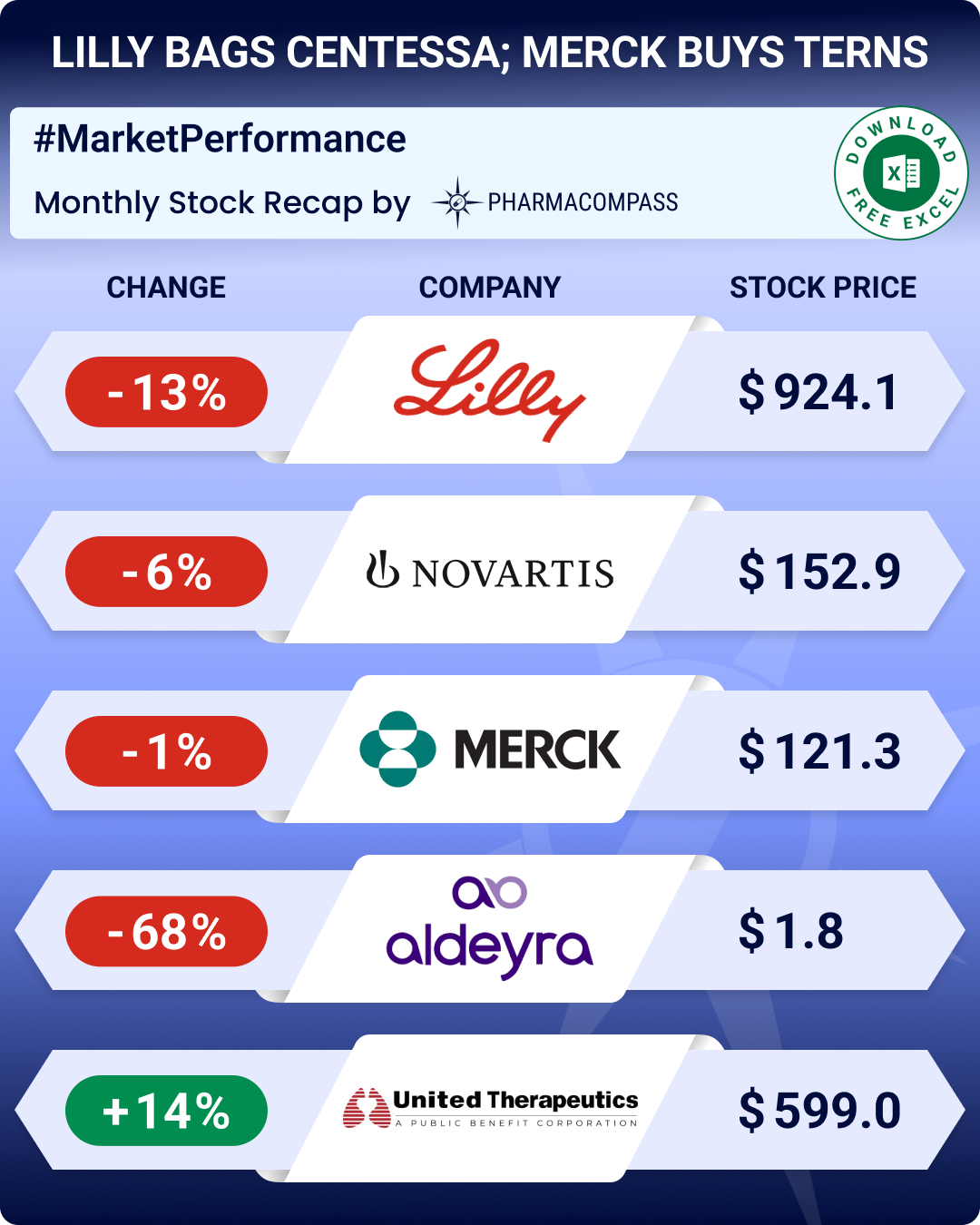
buys Terns Pharma to strengthen oncology pipeline On the last day of the month, Eli Lilly announced the acquisition of British drugmaker Centessa Pharmaceuticals in a deal worth up to US$ 7.8 billion.
Centessa is developing a new class of treatments
designed to target orexin, a molecule in the brain that regulates the
sleep-wake cycle.On
the same day, Biogen announced the acquisition of Apellis Pharmaceuticals for about US$ 5.6 billion in cash, adding approved immunology
medicines Empaveli and Syfovre (both pegcetacoplan) to its portfolio.Meanwhile,
Merck announced a US$ 6.7 billion acquisition of American biotech Terns Pharmaceuticals. The biotech is developing treatments for rare blood and bone cancers, and is expected to strengthen Merck’s oncology pipeline, as its blockbuster Keytruda (pembrolizumab) faces a patent cliff.Novartis made a significant move by acquiring Pikavation
Therapeutics, a subsidiary of US biotech firm Synnovation Therapeutics, and its portfolio, which includes an experimental breast cancer drug candidate — SNV4818 — for up to US$ 3 billion. Novartis also deepened
its focus on immunology through
the up to US$ 2 billion acquisition of Excellergy, a private biotech
company developing next-generation anti-IgE therapies.French
pharmaceutical group Servier announced the acquisition of Day One Biopharmaceuticals for about US$ 2.5 billion. This buyout gives Servier access to FDA-approved Ojemda (tovorafenib), a monotherapy for
pediatric low-grade glioma, the most common form of brain tumor in children.Gilead Sciences is acquiring Ouro Medicines for up to US$ 2.18 billion to expand its presence in autoimmune diseases. Luxembourg-based CVC Capital
Partners made a €10.9 billion (US$ 12.6 billion) offer to acquire Italian drugmaker
Recordati, where it already holds a 47 percent stake.In
other deals, Insilico Medicine entered into a US$ 2.75
billion global licensing and research collaboration with Eli Lilly to leverage generative AI to accelerate R&D and improve pipeline efficiency. And Tenaya Therapeutics tied up with Alnylam Pharmaceuticals to work on disease-modifying treatments for
cardiovascular diseases in a deal worth up to US$ 1.14 billion. Access the Pipeline Prospector Dashboard for March 2026 Newsmakers (Free Excel)Biogen’s Spinraza approved for spinal muscular atrophy; J&J’s pill okayed for plaque psoriasisThe
month witnessed multiple FDA approvals and label expansions. Biogen secured FDA approval for a higher-dose regimen of Spinraza (nusinersen) for spinal muscular atrophy
(SMA), a genetic disorder that
causes muscle weakness.The agency also approved Johnson & Johnson’s oral pill Icotyde (icotrokinra) for the treatment of moderate-to-severe plaque
psoriasis in adults and pediatric patients 12 years of age and older.Besides these, FDA granted accelerated approval to Denali Therapeutics’ Avlayah (tividenofusp alfa), which was approved for the treatment of children with Hunter
syndrome, a rare genetic disorder. And
it expanded the labels of Bristol Myers Squibb’s Sotyktu (deucravacitinib), Novo Nordisk’s Sogroya and GSK’s RSV vaccine Arexvy. Access the Pipeline Prospector Dashboard for March 2026 Newsmakers (Free Excel)Merck’s drug cuts LDL cholesterol by 64.6%; Xenon’s epilepsy med meets main goal in late-stage trialMerck reported that its oral cholesterol drug enlicitide decanoate reduced low-density
lipoprotein (LDL) cholesterol by approximately 64.6 percent in a head-to-head late-stage trial, outperforming non-statin therapies.Xenon Pharmaceuticals’ experimental epilepsy drug azetukalner met its main goal by
significantly reducing seizure frequency, while United Therapeutics’ ralinepag reduced disease
progression risk by 55 percent in pulmonary arterial hypertension.Bristol Myers Squibb’s mezigdomide demonstrated improved survival outcomes in relapsed or refractory multiple myeloma when used in combination with Amgen’s Kyprolis (carfilzomib) and dexamethasone.Another therapy that posted a trial win was Pfizer and Astellas’ Padcev (enfortumab vedotin) when used in combination with Keytruda. In a phase 3 trial, it significantly improved outcomes in patients with
muscle-invasive bladder cancer eligible for cisplatin-based chemotherapy.Roche reported positive phase 3 data for its multiple
sclerosis drug fenebrutinib, though safety concerns (including patient
deaths during trials) could complicate regulatory review. Eli Lilly’s atopic dermatitis drug Ebglyss (lebrikizumab) achieved both primary and secondary endpoints in a
phase 3 trial in children aged six months to 18 years. The drug is already approved for people over 12 years with eczema who weigh over 40 kg. Access the Pipeline Prospector Dashboard for March 2026 Newsmakers (Free Excel)FDA lifts hold on Intellia’s gene therapy, hands Aldeyra’s dry eye disease med its third rejection FDA lifted the clinical hold placed on Intellia Therapeutics’ gene therapy for transthyretin amyloidosis with cardiomyopathy, a fatal heart condition. The clinical holds on two trials of the therapy were imposed in October after a patient
developed severe liver complications.Some drugmakers faced setbacks. For
instance, FDA asked for additional data for uniQure’s Huntington’s disease gene therapy (a
fatal, inherited neurodegenerative disorder). Similarly, the agency handed Aldeyra’s reproxalap a third rejection. The drug was being developed to treat dry eye
disease, a chronic condition characterized by insufficient tear production.Australian
biotech Immutep discontinued a crucial phase 3 trial for Efti (eftilagimod alfa), which is administered along with Keytruda and was being
developed as a first-line treatment for advanced non-small cell lung
cancer (NSCLC). And Roche said its breast cancer pill, giredestrant, failed to meaningfully help newly diagnosed patients with breast cancer in a phase 3 trial. Access the Pipeline Prospector Dashboard for March 2026 Newsmakers (Free Excel)Our viewWhile geopolitical disruptions have exposed vulnerabilities in global supply chains, they have not dented the industry’s appetite for growth and innovation. That said, a prolonged conflict could alter this trajectory, forcing pharma leaders to reassess strategic priorities.


















 Share
Share