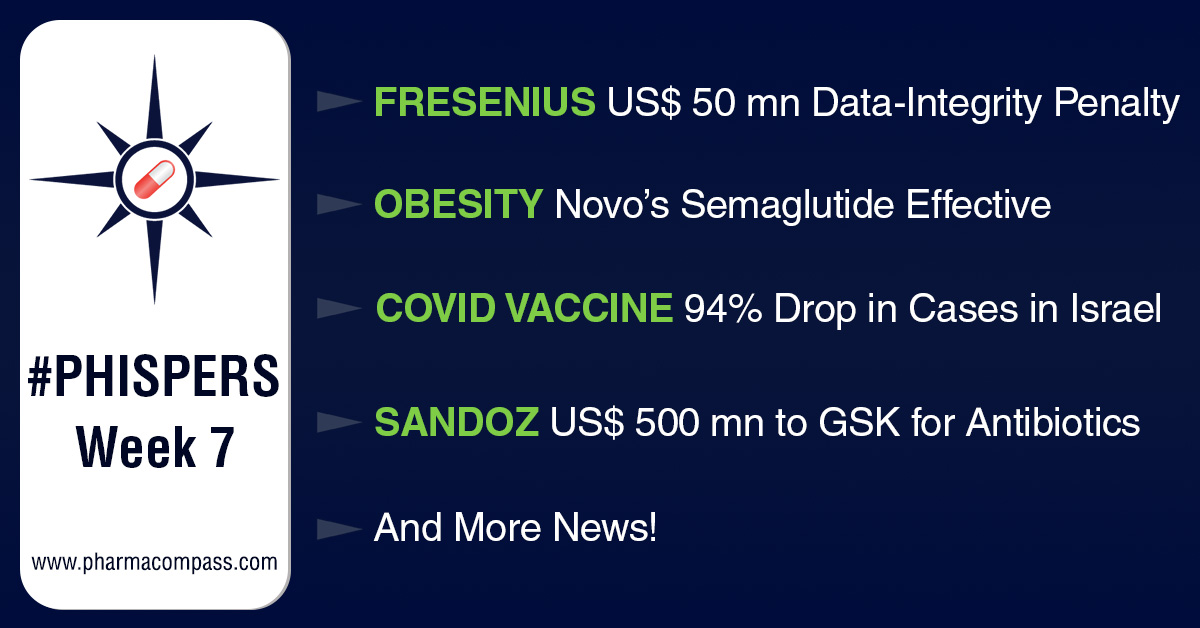
This week, Phispers has news on antibiotics and cancer therapies. While Novartis’ Sandoz unit said it is buying three
antibiotics from GSK for US$ 500 million, Bristol Myers announced a
collaboration worth US$ 1.3 billion with Molecular Templates for its next
generation engineered toxin body cancer platform. After bagging FDA approval
for liso-cel, Bristol Myers said it is abandoning a second CAR-T therapy, orva-cel.
Novo Nordisk’s diabetes drug semaglutide has shown effectiveness in
treating obesity in a clinical trial involving 2,000 participants at 129
centers in 16 countries.
Israel witnessed a 94 percent drop in symptomatic Covid cases among 600,000 people who were given two doses of the Pfizer-BioNTech vaccine.
The
Gilead-Galapagos partnership received yet another setback as Gilead
abandoned another drug (ziritaxestat) it was developing under the deal after
poor outcomes in a phase 3 trial.
Fresenius Kabi has agreed to pay US$ 50 million for data
integrity violations at its Indian operations; and Bristol-Myers and Sanofi
were ordered to pay Hawaii US$ 834 million over the warning label for its blood
thinner Plavix.
Novartis’ Sandoz buys three antibiotics from GSK for US$ 500 million
Novartis’ generic unit, Sandoz, is buying three of British drugmaker GlaxoSmithKline’s cephalosporin antibiotics for US$ 350 million upfront
and an additional US$ 150 million in downstream milestone-linked payments.
The
deal is expected to close later this year, and excludes rights previously sold by GSK (in the US, Australia and
Germany). GSK will also retain rights to the three antibiotics in India,
Pakistan, Egypt, Japan, and China.
The three antibiotics — Zinnat, Zinacef and Fortum — posted US$ 140 million in sales in 2020, in the markets Novartis is picking up.
Over the
last few years, several major drugmakers have exited the antibiotics space,
which has been hit by antibiotic resistant “super bugs” and scarce
innovation. Novartis too
had left that space in 2018, but is still hanging on to generic antibiotics,
and even adding to that portfolio.
Cephalosporins
is one of the two
key antibiotic modalities alongside penicillin and adding the former to its
portfolio is bound to increase revenues for Novartis. The Swiss drugmaker plans
to leverage its existing production site in Kundl, Austria, to manufacture
Zinnat.
GSK to shut
UK unit post 2025: GSK
has said it plans to shut down antibiotics production in the
UK, after it transfers assets to Sandoz by 2025. Its deal with Sandoz lasts
through 2025.
Zinnat is made at GSK’s UK sites in Ulverston in Cumbria and Barnard Castle in County Durham. Ulverston will shut down completely but Barnard Castle will continue to manufacture
other GSK products. In all, 300 employees will lose their jobs — 130 in Ulverston and 170 in Barnard Castle.
Zinacef
and Fortum are made by ACS Dobfar in Verona, Italy.
However, GSK isn’t abandoning antibiotics. The company plans to hold on to augmentin as well as gepotidacin. Overall, GSK is backing away from older antibiotics as it increases its focus on vaccines and specialty drugs, including “innovative antibiotics,” the company said.
Fresenius Kabi pays US$
50 million for data integrity violations at Indian operations
Indian
drugmaker Fresenius Kabi Oncology Limited (FKOL) has
agreed to pay US$ 50 million in fines and forfeiture and plead guilty to concealing and
destroying records prior to a US Food and Drug Administration (FDA) inspection
of its plant in 2013, the US Department of Justice (DOJ) said. FKOL was charged
with violating the Federal Food, Drug and Cosmetic Act by failing to provide
certain records to FDA investigators.
According
to a press statement, FKOL has also agreed to implement a compliance and ethics program designed to prevent, detect, and correct violations of US laws relating to FKOL’s manufacture of cancer drugs intended for terminally ill patients.
According
to court documents, FKOL owned and operated a manufacturing plant in Kalyani,
West Bengal, that manufactured active pharmaceutical ingredients (APIs) used in
various cancer drug products distributed in the United States.
The
US government alleges that prior to a January 2013 FDA inspection of the
Kalyani facility, the FKOL plant management directed employees to remove
certain records from the premises and delete other records from computers that
would have revealed FKOL was manufacturing drug ingredients in contravention to
FDA requirements. The offenses are federal misdemeanors.
Bristol
Myers inks pact with Molecular Templates, abandons CAR-T therapy orva-cel
Earlier
this month, Bristol Myers Squibb finally bagged US Food and Drug Administration’s approval for its new CAR-T therapy Breyanzi (lisocabtagene maraleucel, or liso-cel) for adults with relapsed or refractory large B-cell lymphoma.
Post the much
sought after approval, Bristol Myers has rejigged its drug
pipeline. While it announced a tie-up
for a next-generation engineered toxin body (ETB) cancer platform with Texas-based
Molecular Templates for US$ 1.3 billion, it also decided to abandon a second CAR-T therapy — orva-cel.
Interestingly,
the ETB deal involves an upfront payment of only US$ 70 million. The remaining
US$ 1.23 billion will be paid on the achievement of milestones.
Under the
pact, Molecular Templates will conduct research activities for the discovery of
next-generation ETBs for multiple targets, of which the first target has already
been selected by BMS, although it has not been made public.
Bristol
Myers is abandoning a second CAR-T therapy, orva-cel (orvacabtagene
autoleucel), and taking a US$ 470 million write-off. Like
liso-cel, orva-cel was originally developed by Juno Therapeutics, which was acquired by Celgene for US$ 9 billion. Later, Celgene
got acquired by Bristol Myers for US$ 74 billion.
Deal in
trouble: After handing back filgotinib to Galapagos, Gilead abandons
ziritaxestat
Over the
last few years, Gilead has put in a lot of money into its deal
with Galapagos. However, the US$ 5 billion
Gilead-Galapagos research partnership has turned out to be disastrous.
In
December, Gilead had said it will not pursue US approval of filgotinib in rheumatoid
arthritis. The two drugmakers had been co-developing filgotinib
since 2015. But in August, FDA rejected filgotinib due to concerns regarding
the safety of its high dose. Gilead also decided to pay Galapagos US$ 193 million (€160
million) to take over most ongoing clinical trials and return responsibility
for the drug in Europe.
Last week,
Gilead abandoned another drug (ziritaxestat) it was developing under the
deal. An independent body checked phase 3 data for the experimental drug in patients with idiopathic pulmonary fibrosis (IPF). The outcome was not good. Following a regular review of unblinded data, an independent monitoring board concluded that “ziritaxestat’s benefit-risk profile no longer supported continuing these studies.” Gilead said the phase 3 program is to be canned. And a phase 2 trial of the drug in systemic sclerosis “will be discontinued.”
Gilead had
in-licensed ex-European rights to ziritaxestat back in July 2019 and was also
sharing the phase 3 costs.
The
failure of ziritaxestat is another nail in the coffin for
the partnership. Gilead has, in the meantime, placed its bets on Immunomedics, a cancer
biotech it bought last year for US$ 21 billion.
Novo’s diabetes drug semaglutide shows effectiveness against obesity
Obesity is
a global health challenge
with only a few pharmacologic options. However, it seems we may finally have a
cure for obesity other than surgery, dieting and exercise. In a clinical trial,
participants taking
Novo Nordisk’s diabetes drug semaglutide lost 15 percent of their body
weight, on average.
During the
trial, published in the New England Journal of Medicine, researchers at
Northwestern University in Chicago tested semaglutide at a much higher dose as
an anti-obesity medication.
Nearly
2,000 participants, at 129 centers in 16 countries, injected themselves weekly
with semaglutide or a placebo for 68 weeks. Those who got the drug lost close
to 15 percent of their body weight, on average, compared with 2.4 percent among
those receiving the placebo.
More than
a third of the participants receiving the drug lost more than 20 percent of
their weight. Symptoms of diabetes and pre-diabetes improved in many patients.
Those
results mark a “game-changer” in an obesity field that, to this point,
has not seen results as effective as these, study leader Robert Kushner told The
New York Times.
The findings of this study will help Novo address two indications — obesity and diabetes — with one drug, since there are no approved obesity medications in the US that also prevent or treat type 2 diabetes.
Israel witnesses a 94 percent drop in symptomatic Covid cases with Pfizer’s jab
Israel’s largest healthcare provider has reported a 94 percent drop in symptomatic Covid-19 infections among 600,000 people who received two doses of the Pfizer-BioNTech vaccine. This is the biggest study
Israel has undertaken to date.
Israel has
been conducting a rapid vaccine rollout and its database offers insights into
vaccine effectiveness and at what point countries might attain herd immunity.
Clalit, a health organization in Israel that covers more than half the population, said the same group was also 92 percent less likely to develop severe illness from the virus.
The
comparison was against a group of the same size, with matching medical
histories, who had not received the vaccine.
“It
shows unequivocally that Pfizer’s coronavirus vaccine is extremely effective in the real world a week after the second dose, just as it was found to be in the clinical study,” said Ran Balicer, Clalit’s
chief innovation officer.
Balicer
said the Pfizer vaccine is even more effective two or more weeks after the
second shot.
Researchers
at the Weizmann Institute of Science, who have been tabulating national data,
said a sharp decline in hospitalization and serious illness identified earlier
among people aged 60 or more, was being seen for the first time in those aged
55 and older.
Bristol-Myers,
Sanofi ordered to pay Hawaii US$ 834 million over Plavix warning label
This week,
a judge in Hawaii ordered Bristol-Myers Squibb and Sanofi to pay over US$ 834 million to the state for failing to properly warn
non-white patients of health risks from its blood thinner Plavix.
Bristol-Myers
and Sanofi produced Plavix in partnership. The judge, who presided over a
four-week, non-jury trial conducted over Zoom, ordered Bristol-Myers and Sanofi
to pay US$ 417 million each in penalties.
The judge
said the companies engaged in unfair and deceptive business practices from 1998
to 2010 by failing to change the drug’s
label to warn doctors and patients, despite
knowing some of the risks.
Hawaii
Attorney General Clare Connors, whose office sued the companies in 2014, said
the ruling “puts the pharmaceutical industry on notice that it will be held accountable for conduct that deceives the public and places profit above safety.”
In a joint
statement, Bristol Myers and Sanofi have vowed to appeal the judgement, saying
the decision was “unsupported by the law” and “was at odds with the evidence at trial.” They called Plavix safe and effective. Plavix is prescribed to prevent strokes and heart attacks. The blood thinner needs to be activated by the body’s
own enzymes, which can vary genetically.
Studies have shown that about 14 percent of Chinese patients are unable to metabolize the drug properly, compared with 4 percent of black and 2 percent of white patients. In 2010, the US Food and Drug Administration issued a new Plavix warning label to reflect this information.













 Share
Share