Please Wait
Applying Filters...
Menu
Xls

Digital Content read-more

Create Content with PharmaCompass, ask us

DATA COMPILATION #PharmaFlow

read-more
read-more
DMF filings hit all-time high in Q3 2024; China tops list with 58% increase in Type II submissions
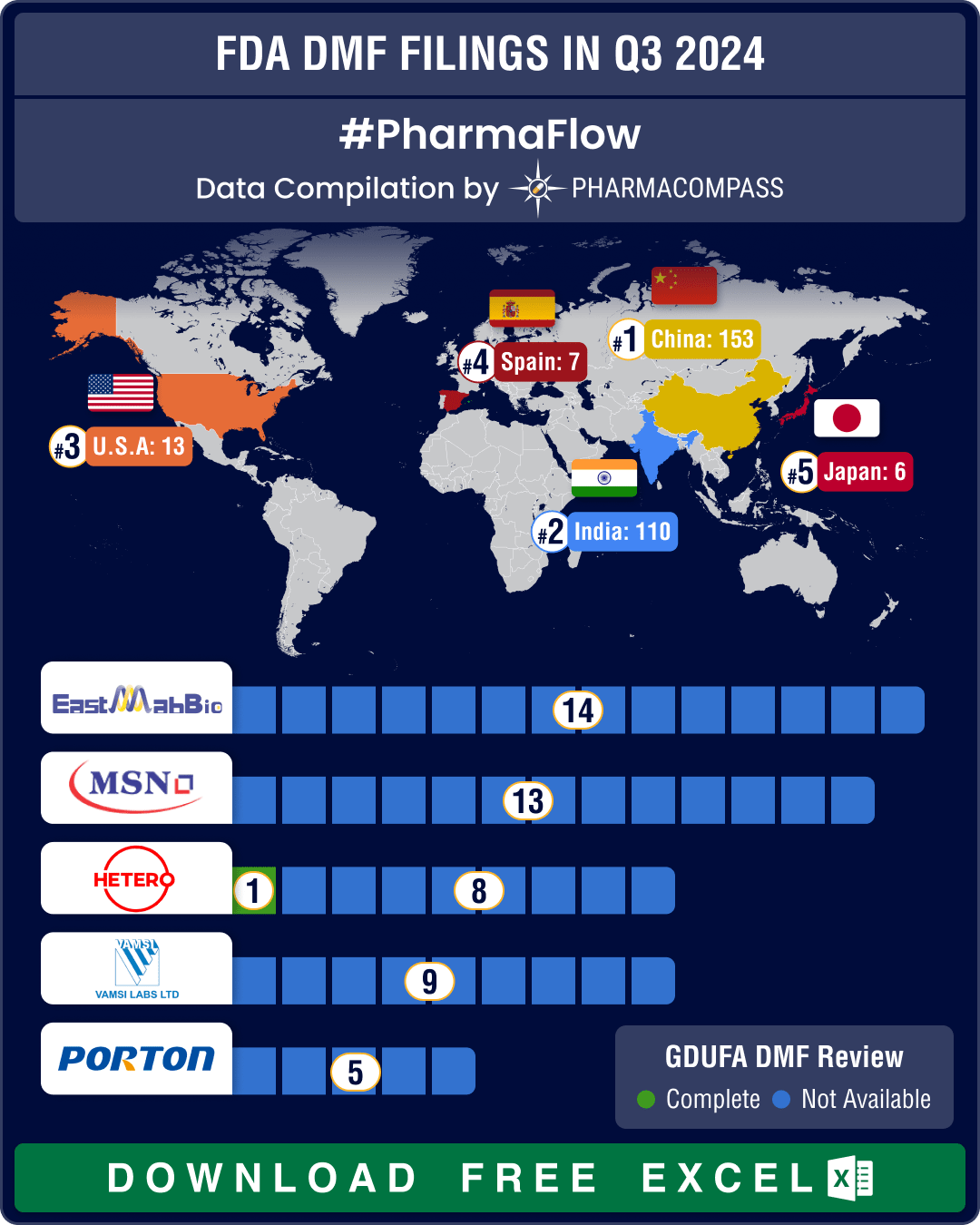
Drug Master Files, or DMFs, are confidential documents that play a crucial role in the pharmaceutical industry. These files, submitted to the US Food and Drug Administration (FDA), contain detailed information about ingredients, manufacturing processes, and packaging of medicines. They help the FDA oversee drug quality. Of the four types, Type II DMFs involve active pharmaceutical ingredients (APIs) for both branded and generic drugs. The third quarter (Q3) of 2024 saw Type II DMF submissions set a new record. A total of 309 Type II DMFs were submitted to the FDA during this period, a substantial 24.6 percent increase over Q3 2023 (with 248 submissions). The second quarter of 2024 too saw a remarkable increase, with 237 Type II DMFs being submitted compared to 178 in Q2 2023. View FDA DMF Filings in Q3 2024 (Power BI Dashboard, Free Excel Available) China witnesses steep rise in DMF submissions, beats India with maximum filings In Q3 2024, China filed 153 DMFs submissions, marking a substantial 57.7 percent increase from the 97 submissions filed in Q3 2023. India maintained its strong position but fell to the number two spot with 110 DMFs, representing a modest 3.8 percent increase from 106 in Q3 2023. The US, which came a distant third, saw a slight decline in DMF submissions, with 13 filed in Q3 2024, as compared to 18 in Q3 2023. For several years, India had a lead in Type II DMFs. Since 2020, which marked the start of the pandemic, we have noticed a gradual increase in DMFs filed by China. This year, China has surpassed India considerably in the first three quarters. During the first nine months of 2024, China submitted 372, while India filed 286 DMFs. If this lead is maintained in Q4, DMFs from China will surpass that of India in 2024.  Amongst European countries, Spain led with seven DMFs, followed by Italy at four, and Germany and the Netherlands at three each. Among other nations, Japan contributed six while Israel submitted four DMFs. In company-wise tally, China’s Jiangsu East-Mab Biomedical Technology topped the list with an impressive 14 DMFs. On its heels were Indian companies — MSN at 13 DMFs, and Vamsi Labs and Hetero Drugs at nine DMFs each. China’s Porton Pharma and Wuxi AppTec filed five, while Shanghai Keze Yongxin Biotechnology, and Qingdao Glycogene Pharmaceutical contributed four submissions each. India's Maithri Drugs also submitted four. Japanese company Santeja filed five. Overall, Asia accounted for nearly 90 percent, with China contributing a dominant 49.5 percent of all DMF submissions. India was at 35.6 percent, the US at 4.2 percent, while Europe contributed 6.5 percent.  View FDA DMF Filings in Q3 2024 (Power BI Dashboard, Free Excel Available) Diabetes, obesity, cancer, women’s health drugs emerge as hot molecules in Q3 2024 In terms of molecules, semaglutide (used for the treatment of type 2 diabetes and weight management) and relugolix (to treat prostate cancer and uterine fibroids) saw six DMF filings each in Q3 2024, indicating significant industry interest in these compounds. Following closely behind were semaglutide’s competitor tirzepatide and overactive bladder therapy vibegron, garnering four DMFs each. Finerenone (a non-steroidal drug for chronic kidney disease associated with type 2 diabetes) and voclosporin (an immunosuppressant for lupus nephritis) saw three DMFs each.  The last quarter also witnessed the introduction of 14 molecules with first-time DMFs. Among them were acetoxy empagliflozin, cabozantinib fumarate, tivozanib hydrochloride monohydrate, diosmetin, trilaciclib, clenbuterol hydrochloride, fenoterol hydrobromide, tapinarof and fezolinetant. Fezolinetant, with a DMF from Spain’s Moehs Iberica, is the active ingredient in Astellas’ Veozah, which is the first non-hormonal treatment for menopausal symptoms approved by the FDA. Tapinarof, filed by India’s Maithri Drugs, is used in Vtama, a novel steroid-free psoriasis cream. Other compounds that made their DMF debut include berotralstat, calcium phosphoryl choline chloride, phloroglucinol dihydrate, belumosudil mesylate and trimethylphloroglucinol. During Q2 2024, there were 19 drugs that saw DMF submissions for the first time, including molecules like triptorelin, sorafenib, pralsetinib, trilaciclib dihydrochloride, resmetirom (hepatology) and teneligliptin hydrochloride hydrate (metabolic disorders).  View FDA DMF Filings in Q3 2024 (Power BI Dashboard, Free Excel Available)    GDUFA fee for FY 2025: The FDA’s Generic Drug User Fee Amendments (GDUFA) is a law designed to speed access to safe and effective generic drugs to the public and reduce costs to the industry. The fiscal year 2025 fee rates were published on July 31, 2024. The FDA has revised fees under GDUFA III for all categories. While there is a slight increase in the DMF fee from US$ 94,682 in 2024 to US$ 95,084 in 2025, the ANDA fee has witnessed a significant jump — from US$ 252,453 in 2024 to US$ 321,920 in 2025. FY 2024 and FY 2025 User Fee Rates Generic drug fee category Fees rates for FY 2024 Fees rates for FY 2025 Applications: Abbreviated New Drug Application (ANDA) US$ 2,52,453   US$ 3,21,920   Drug Master File (DMF) US$ 94,682 US$ 95,084 Facilities: Active Pharmaceutical Ingredient (API)—Domestic US$ 40,464 US$ 41,580 API—Foreign US$ 55,464 US$ 56,580 Finished Dosage Form (FDF)—Domestic US$ 2,20,427   US$ 2,31,952 FDF—Foreign US$ 2,35,427   US$ 2,46,952 Contract Manufacturing Organization (CMO)—Domestic US$ 52,902 US$ 55,668 CMO—Foreign US$ 67,902 US$ 70,668 GDUFA Program: Large size operation generic drug applicant US$ 17,29,629   US$ 18,91,664 Medium size operation generic drug applicant US$ 6,91,852   US$ 7,56,666 Small business generic drug applicant US$ 1,72,963   US$ 1,89,166 Our view The highlight of the last few quarters has been the sharp rise in Type II DMF filings from China. The submission of a DMF is not required by law or any FDA regulation. FDA’s DMF guideline offers guidance on acceptable approaches to meeting regulatory requirements. Moreover, DMFs establish trust in APIs from lesser-known companies. With a growing emphasis on compliance and quality assurance, it appears that Chinese drug companies are eager to demonstrate their commitment to high standards and build trust in the US market. And that’s good news for the pharmaceutical industry.   

Impressions: 10747

https://www.pharmacompass.com/radio-compass-blog/dmf-filings-hit-all-time-high-in-q3-2024-china-tops-list-with-58-increase-in-type-ii-submissions

#PharmaFlow by PHARMACOMPASS
24 Oct 2024

WEEKLY NEWS RECAP #Phispers

read-more
read-more
Aceto wins case for use of foreign API in US government contracts; GSK may split
This week in Phispers, we bring you news about a landmark court ruling in the US that permitted Aceto to supply drugs to the US Department of Veterans Affairs that contain APIs produced in foreign countries. Meanwhile, the FDA has been directed by the US government to explore ways in which medicines can be imported from other countries to check a dramatic price rise. This happened even as companies like Pfizer, Novartis, Merck and Roche stated their commitments towards holding the line on any drug price hikes to the average inflation rate. Takeda CEO said he hopes China could be its second largest business in the long term. Novartis bought an atopic dermatitis drug from MorphoSys and Galapagos. It also sued over two dozen generic firms in the hope of blocking a generic to its blockbuster MS drug — Gilenya. And the first new treatment for malaria in 60 years — GSK’s tafenoquine — won the FDA nod, even as GSK reportedly planned to split itself to form a drug and vaccines company over the next two to three years. Aceto gets a favorable ruling for using non-US made API in government contacts   In a landmark ruling, a federal judge in the US ruled that Aceto Corporation, a New York-based pharmaceutical company, can supply drugs to the US Department of Veterans Affairs (VA) that contain active pharmaceutical ingredients (APIs) produced in foreign countries. The court granted a declaratory judgment and the Judge Margaret Sweeney of the US Court of Federal Claims ruled that under the Buy American Act, the VA is allowed to buy drugs made in the US even if they contain some compounds produced outside the country. Earlier this year, the US Customs and Border Protection agency and the Department of Homeland Security had issued a notice that processing drugs in the US that contain APIs manufactured in other countries like India and China “does not result in a substantial transformation” and they considered those drugs as originating in foreign countries.  The ruling will most likely allow Aceto to regain some of the 11 VA contracts it lost earlier this year after the federal government said the company must either provide generics that didn’t contain ingredients made in India or lose the business. The government has 90 days to appeal the ruling. China and India are major producers of APIs bound for the US market. The VA contracts comprised about 15 percent of Aceto’s revenues. According to the US government (US Customs and Border Protection, or CBP), the country of origin of the API in Rosuvastatin Calcium Tablets, Levofloxacin Tablets, Levetiracetam Tablets, Metoprolol Tartrate Tablets, Gabapentin Capsules, Carvedilol Tablets, Paroxetine Hydrochloride Tablets, Entecavir Tablets, Montelukast Sodium Tablets, Simvastatin Tablets, Donepezil Hydrochloride Tablets for US government procurement purposes is India. “CBP found that the API imported from two different countries was not substantially transformed when combined with stabilizers and excipients,” a government document had said. FDA told to import drugs to check price rise, despite commitments by pharma biggies   PharmaCompass has been covering FDA’s endeavors at exploring ways to reduce prices of drugs, as also to address drug shortages. In a latest move, the FDA has been directed by the US Health and Human Services (HSS) to explore ways in which medicines could be safely imported from other countries “in the event of a dramatic price increase for a drug produced by one manufacturer and not protected by patents or exclusivities.” US HSS Secretary Alex Azar has directed the FDA to create a working group that aims at examining ways in which drugs could be safely imported from other countries. The directive comes as part of an ongoing effort to “address price hikes and supply disruptions that are harming American patients.” The Pharmaceutical Research and Manufacturers of America (PhRMA), the drug industry’s most powerful trade lobby, has criticized the idea stating that the measures would “circumvent the robust safety requirements” in the US, thereby posing a “serious public health risk” and jeopardizing the country’s secure medicine system. However the initiative has received praise from various academics, analysts and observers. This happened even as pharma giants like Pfizer, Novartis and Merck stated their commitments towards holding the line on any drug price hikes to the average inflation rate. Merck is slashing the price of its hepatitis C combo Zepatier by 60 percent while also promising a 10 percent cut on other therapies. In all, Merck has lowered the price of six drugs. Merck said it was lowering the prices in an effort to reduce out-of-pocket costs for patients. Both Pfizer and Novartis had been subject to considerable scorn from the US government over raising prices recently. However, in a tweet last week, Trump expressed his appreciation for these companies. “Thank you to Novartis for not increasing your prices on prescription drugs. Likewise to Pfizer. We are making a big push to actually reduce the prices, maybe substantially, on prescription drugs,” Trump tweeted on July 19. Meanwhile, Roche has announced its intention to not increase prices of its drugs, after two rounds of price hikes in January and July. Roche told the HHS on July 11 that it will not take any more price increases this year. Takeda bets big on China; sees it as second largest market, on par with US, Europe   In what maybe seen as a big shift in focus for the Japanese drugmaker, which is on its way to acquire Irish drug company Shire for US$ 62 billion, the Takeda CEO Christophe Weber recently said he hopes China could be its second-largest business in the long term. Takeda is betting big on China for global growth, and sees the country ‘on a par’ with the US and Europe “There’s no reason in the long term China shouldn’t be our second-biggest business in the world,” Weber said in a recent interview, China’s drug market is the world’s second-largest after the US, and is slated to reach US$ 167 billion by 2020, according to a 2016 report by the US Department of Commerce. But most global pharma companies are yet to realize China’s potential.  Takeda is likely to take a long time to boost its China sales. In fact, Takeda’s revenue from China has dropped in recent years — from 66 billion Japanese yen (US$ 594 million) in 2015 fiscal year (April 2015 to March 2016) to ¥57.6 billion (US$ 518.2 million) in 2016 and then to ¥49.6 billion (US$ 446.2 million) in 2017. In comparison, it posted nearly ¥600 billion (US$ 5.4 billion) and ¥510 billion (US$ 4.6 billion) from sales in the US and Japan, respectively.  This means Japan, currently second on Takeda’s sales list, is worth ten times that of China insofar as the drugmaker’s global sales revenue is concerned. Shire sells only three drugs in China right now, its hemophilia drug Advate, albumin injection Flexbumin and renal product Fosrenol. Moreover, Takeda’s China management team has recently been through big changes. However, Takeda plans to launch seven new products in China over the next five years. Novartis makes a billion dollar buy; files lawsuits against two dozen generic firms   Novartis has bought a MorphoSys/Galapagos drug — MOR106, an IL-17C monoclonal antibody — in a US$ 1.1 billion deal. In exchange, MorphoSys and Galapagos will give up all development and marketing rights. The duo will also split the US$ 111 million (€95 million) upfront payment, and potential milestone payments totaling US$ 1 billion (€850 million). The drug will be the second atopic dermatitis drug in Novartis’ pipeline, the first one being ZPL389, the Phase II eczema treatment it acquired from Ziarco in 2016. Novartis will pay for all future R&D, manufacturing and commercialization costs. MorphoSys and Galapagos will remain involved in both the ongoing early-stage trials and any future trials to support development of MOR106 in this indication. Meanwhile, Novartis is suing over two dozen generic drugmakers in the hope of blocking a Gilenya generic entrance until 2027. Last week, Novartis got a reprieve when the US Patent and Trademark Office (PTO) upheld a patent on its multiple sclerosis blockbuster Gilenya. The Swiss drugmaker now wants to use that win in court against generics makers in the hope to block Gilenya copycats from entering the US market until 2027. Post the PTO ruling, Novartis filed four lawsuits that name multiple generic makers, including Apotex, Mylan, Torrent Pharma, Teva, Sun Pharma and Accord Healthcare, all of which are seeking to make copies of Gilenya. Currently approved for relapsing multiple sclerosis, Gilenya generatedmore than US$ 3 billion in revenue in 2017, with a little more than half of that coming from sales in the United States. GSK may split drugs and vaccines into new firm; its malaria drug bags FDA nod  GlaxoSmithKline’s chairman Philip Hampton is considering splitting the company. According to a Financial Times report, Hampton has discussed creating a new company from its pharma and vaccines divisions. This news came after several of GSK’s top 10 investors asked the board to consider spinning off its consumer division. GSK currently divides its business into pharmaceuticals, vaccines and consumer branches. According to the report, a split up could happen within two or three years. A GSK spokesman said the group’s priority is to improve the performance of its pharmaceutical business, especially research and development. The company is set to outline its new approach for the division next week. In June, GSK completed its purchase of Novartis AG’s 36.5 percent stake in their consumer healthcare joint venture for US$ 13 billion. Meanwhile, a new drug to treat malaria — tafenoquine — manufactured by GSK, has received the USFDA’s nod. This is the first new treatment approved in 60 years for malaria, an endemic in Asia and Latin America. Tafenoquine has been in existence since the 1970s. By working with (non-profit organisation) Medicines for Malaria, GSK has repurposed the drug so that it can be used to get rid of malaria parasites in the liver. The medicine is meant for the recurring form of malaria caused by the parasite plasmodium vivax that makes 8.5 million people ill each year. Treating this type of malaria is a challenge as it can remain dormant in the liver for years before reawakening. Scientists have described tafenoquine as a “phenomenal achievement”. Regulators around the world will now look at the drug to see if they can recommend it for their populations. There is already a medication that can be used to get rid of malaria hiding in the liver called primaquine. But unlike tafenoquine (which requires only single dose), primaquine often needs to be taken for 14 days. Some experts are concerned that many people feel better after just a few days and stop taking the pills, allowing the parasite to awaken at a later date. In 2016, there were roughly 216 million malaria cases worldwide (an increase of 5 million on 2015), and an estimated 445,000 malaria deaths.  

Impressions: 1827

https://www.pharmacompass.com/radio-compass-phisper/aceto-wins-case-for-use-of-foreign-api-in-us-government-contracts-gsk-may-split

#Phispers by PHARMACOMPASS
26 Jul 2018

NEWS #PharmaBuzz

read-more
read-more

https://www.indianpharmapost.com/drug-approval/alembic-receives-usfda-final-approval-for-paroxetine-extended-release-tablets-19472

INDPHARMAPOST
28 Mar 2026

https://www.accessdata.fda.gov/scripts/cder/daf/index.cfm?event=overview.process&ApplNo=219954

FDA
05 Mar 2026

https://economictimes.indiatimes.com/industry/healthcare/biotech/pharmaceuticals/alembic-pharma-gets-usfda-nod-for-generic-drug-to-treat-depression-anxiety/articleshow/124110588.cms

ECONOMICTIMES
25 Sep 2025

https://www.accessdata.fda.gov/scripts/cder/daf/index.cfm?event=overview.process&ApplNo=209748

FDA
04 Jan 2024

https://www.pharmacompass.com/pdf/news/enforcement-report-week-of-december-6-2023-46648.pdf

FDA
06 Dec 2023

https://www.accessdata.fda.gov/scripts/cder/daf/index.cfm?event=overview.process&ApplNo=211248

FDA
03 Nov 2021