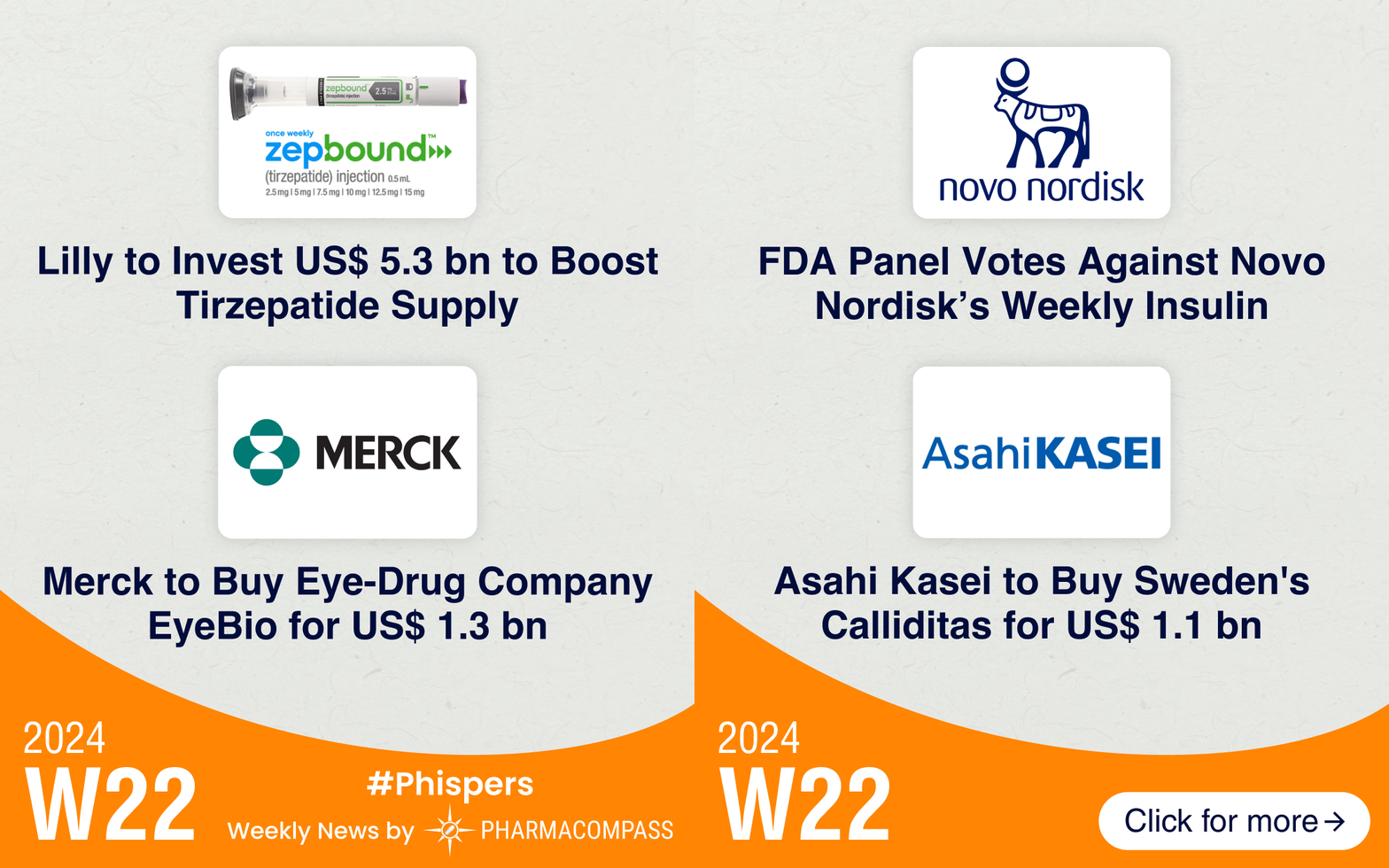
This week’s Phispers comes packed with news of investments, acquisitions, deals and trials. Eli Lilly has more than doubled its investment at its Lebanon (Indiana) site in the US by investing an additional US$ 5.3 billion. This investment will enhance Lilly’s capacity to manufacture the active pharmaceutical ingredient (API) used in its obesity and type 2 diabetes drugs — Zepbound and Mounjaro.In deals, Merck announced it is buying clinical-stage ophthalmology biotech EyeBio for US$ 1.3 billion. Johnson & Johnson has scooped up the rights to an eczema antibody for US$ 1.25 billion. Japanese conglomerate Asahi Kasei said it is buying Sweden’s Calliditas for US$ 1.1 billion. And, Takeda has inked a potential US$ 1.2 billion deal with Shanghai-based Degron Therapeutics to discover and develop a new class of drugs, known as molecular glue degraders (MGDs).The US Food and Drug Administration (FDA) has approved a
once-daily treatment to treat attention deficit hyperactivity disorder (ADHD) in patients who are six years of age or older. And, an FDA advisory panel has voted against the benefits of Novo Nordisk’s once-weekly Awiqli (insulin icodec) outweighing its risks.At the European Renal Association (ERA) congress, Novo Nordisk presented detailed results that showed Ozempic reduced the risk of death due to kidney disease in people with diabetes. The ERA congress also saw Novartis tout two promising late-stage readouts for rare kidney disease treatments. And, preliminary results from a confirmatory trial showed NS Pharma’s Viltepso failed to reach its primary endpoint after it was given FDA’s accelerated approval to treat Duchenne muscular dystrophy.Lilly to invest additional
US$ 5.3 bn in US site to boost Zepbound, Mounjaro supplyThe battle to gain a larger share of the
obesity-diabetes pie just got fiercer. Eli Lilly has more than doubled its investment at
its Lebanon (Indiana, US) manufacturing site with a new US$ 5.3 billion commitment. This raises Lilly’s investment at this site to US$ 9 billion, up from US$ 3.7 billion. This expansion will enhance Lilly’s capacity to manufacture the API — tirzepatide — for its Zepbound and Mounjaro injections so that more adults with chronic diseases like obesity and type 2 diabetes may benefit from these important treatments, the company said.Merck set to buy
clinical-stage ophthalmology biotech EyeBio for US$ 1.3 bnMerck has announced it is buying ophthalmology
biotechnology firm Eyebiotech Limited (EyeBio) for US$ 1.3 billion. The
deal also includes US$ 1.7 billion in additional milestone payments. London-headquartered EyeBio’s lead candidate Restoret has finished early to mid-stage
testing for diabetic macular edema (DME)
and neovascular age-related macular degeneration (NVAMD).J&J scoops up rights to eczema antibody for US$ 1.25 bn: Johnson & Johnson has agreed to buy the rights to an experimental skin disorder treatment from Numab Therapeutics for around US$ 1.25 billion. The therapy — NM26 — is phase 2-ready and targets two clinically proven pathways in atopic dermatitis (AD), commonly known as eczema. Last week, J&J had acquired Proteologix for US$ 850 million, which was also to
help it address key unmet needs for AD patients.Takeda inks potential US$
1.2bn deal with Degron; Asahi Kasei to buy CalliditasJapan’s Takeda has inked a deal with Shanghai-headquartered
Degron Therapeutics to discover and develop novel molecular glue degraders
(MGDs) for multiple targets in oncology, neuroscience, and inflammation.
The deal could be valued at around US$ 1.2 billion. MGDs are an emerging class
of potentially therapeutic compounds touted as exciting opportunities for novel drug discovery.Meanwhile, Japanese conglomerate — Asahi Kasei — said it has offered to buy out Swedish drugmaker
Calliditas Therapeutics for SEK 11.1 billion (US$ 1.1 billion) as the former seeks to become a global
player in the pharma industry. Calliditas focuses on novel treatments for
orphan indications and patients with unmet needs.FDA okays Tris Pharma’s once-daily, non-stimulant pediatric ADHD drugFDA has okayed Onyda XR (clonidine hydrochloride), a once-a-day treatment for attention deficit
hyperactivity disorder (ADHD) for patients six years and older. This makes it the first
liquid non-stimulant ADHD drug approved in the US. It is expected to be
available in pharmacies in the second half of 2024. FDA panel votes against Novo’s weekly insulin for type 1 diabetesFDA’s advisory committee on endocrinologic and metabolic drugs has voted seven to four against the benefits of Novo Nordisk’s once-weekly Awiqli (insulin
icodec). The panel said the benefits of Awiqli do not outweigh its risks. The Danish drugmaker was
aiming to bring to market the first weekly insulin product, which would lower
the treatment burden for diabetes patients. An increased risk of low blood sugar was
flagged by the advisors in patients with type 1 diabetes.Ozempic impresses in
late-stage trial for kidney disease: Detailed results presented at the ERA congress and published in the New England Journal of Medicine showed Ozempic (semaglutide) lowered the risk of death in type 2 diabetes patients
with chronic kidney disease. A late-stage trial with 3,533 people showed weekly
semaglutide injections reduced kidney failure and death due to kidney
complication by 24 percent.Novartis tees up two rare
kidney disease therapy approvals after late-stage winsThe ERA congress also saw Novartis tout two promising late-stage readouts for rare kidney disease treatments as it tees up two potential approvals in
the renal therapy space. Interim results showed the Swiss drugmaker’s experimental drug atrasentan, along with supportive care, reduced proteinuria (elevated protein in the urine) by 36.1 percent in patients with IgAN. Novartis plans on applying for FDA’s approval in the first half of this year.The
other drug is Fabhalta (iptacopan), which was being trialed in patients with the ultra-rare kidney
disease C3 glomerulopathy (C3G). In combination with supportive care, Fabhalta
lowered proteinuria by 35.1 percent at six months. C3G currently has no
approved therapies.NS Pharma’s DMD drug fails confirmatory trial: Preliminary results from a confirmatory trial show NS Pharma’s Viltepso (viltolarsen) has failed to reach its primary endpoint after it was given FDA’s accelerated approval in August 2020 to treat Duchenne muscular dystrophy (DMD). However, NS Pharma remains confident in viltolarsen and said it is “conducting further detailed data analyses”.Four deaths mar J&J’s prostate cancer trial: Johnson & Johnson’s experimental prostate cancer drug that uses a rare
radioactive particle called actinium-225 has helped three patients by reducing their tumors
significantly. However, those results were marred by the death of four patients in the early-stage study. The first-in-human study concluded that “JNJ-6420 elicited profound and durable biochemical and radiographic responses.” However, 61 percent of the participants experienced grade 3 or higher treatment-emergent adverse events.















 Share
Share