
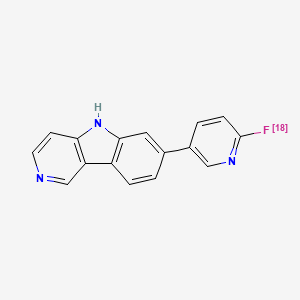
1. (18f)flortaucipir
2. Flortaucipir (f 18)
3. Flortaucipir (f-18)
4. Flortaucipir (18f)
5. (18)f-flortaucipir
1. Flortaucipir F 18
2. Flortaucipir F18
3. Tauvid
4. Flortaucipir (18f)
5. 1522051-90-6
6. T1jp1kyu9o
7. 18f-av-1451
8. T807 F-18
9. T-807 F-18
10. (18f)flortaucipir
11. Ly3191748
12. Ly-3191748
13. 7-(6-(f-18)fluoropyridin-3-yl)-5h-pyrido(4,3-b)indole
14. Av-1451 F-18
15. (f-18)t807
16. [f-18]t807
17. Dtxsid001027893
18. [18f]flortaucipir
19. Flortaucipirum (18f)
20. Refchem:56271
21. Fluorine F18 T807
22. Dtxcid701513453
23. (18f)t807
24. (f18)t807
25. F 18 T807
26. ((18)f)t807
27. 2-(1?f)fluoro-5-(5h-pyrido(4,3-b)indol-7-yl)pyridine
28. Fluorine-18 Labeled 7-(6-fluoropyridin-3-yl)-5h-pyrido(4,3-b)indole
29. 7-(6-fluoranylpyridin-3-yl)-5h-pyrido(4,3-b)indole
30. Flortaucipir F 18 [usan]
31. Unii-t1jp1kyu9o
32. (18f)av 1451
33. 18-f Av-1451
34. Ly 3191748
35. Flortaucipir F 18 (usan)
36. Flortaucipirf-18
37. Tauvid (tn)
38. Flortaucipir (18f) (inn)
39. Flortaucipir ((1)f) [inn]
40. Gtpl9100
41. Flortaucipir F18 [mi]
42. Chembl3545253
43. Schembl13640613
44. Schembl29379518
45. Schembl29707635
46. Ebc-26363
47. At18475
48. Db14914
49. Flortaucipir (18f) [who-dd]
50. Flortaucipir F-18 [orange Book]
51. D11210
52. Q21936669
53. 7-(6-(18f)fluoranylpyridin-3-yl)-5h-pyrido[4,3-b]indole
| Molecular Weight | 262.27 g/mol |
|---|---|
| Molecular Formula | C16H10FN3 |
| XLogP3 | 3.3 |
| Hydrogen Bond Donor Count | 1 |
| Hydrogen Bond Acceptor Count | 3 |
| Rotatable Bond Count | 1 |
| Exact Mass | Da |
| Monoisotopic Mass | Da |
| Topological Polar Surface Area | 41.6 |
| Heavy Atom Count | 20 |
| Formal Charge | 0 |
| Complexity | 351 |
| Isotope Atom Count | 1 |
| Defined Atom Stereocenter Count | 0 |
| Undefined Atom Stereocenter Count | 0 |
| Defined Bond Stereocenter Count | 0 |
| Undefined Bond Stereocenter Count | 0 |
| Covalently Bonded Unit Count | 1 |
Flortaucipir F-18 is a radioactive agent indicated for positron emission tomography (PET) imaging of aggregated tau neurofibrillary tangles (NFTs) in adult patients under evaluation for Alzheimer's disease. Flortaucipir F-18 is not indicated for use in patients under evaluation for chronic traumatic encephalopathy.
FDA Label
Contrast Media
Substances used to allow enhanced visualization of tissues.
V - Various
V09 - Diagnostic radiopharmaceuticals
V09A - Central nervous system
V09AX - Other central nervous system diagnostic radiopharmaceuticals
V09AX07 - Flortaucipir (18F)
ATCvet Code
QV - Various
QV09 - Diagnostic radiopharmaceuticals
QV09A - Central nervous system
QV09AX - Other central nervous system diagnostic radiopharmaceuticals
QV09AX07 - Flortaucipir (18f)
Absorption
Flortaucipir F-18 is administered as an intravenous bolus injection, and peak brain uptake in mice of 4.16% ID/g is achieved by 2 minutes. Fast transfer from the peripheral circulation to the brain was corroborated by human studies that demonstrated peak SUV in gray matter >2 across subjects approximately 5 minutes after administration. Pharmacokinetic studies in humans suggest that equilibrium is achieved by 55 minutes (Logan DVR) and by 80 - 100 minutes (SUVR), and current guidelines recommend initiating imaging approximately 80 minutes after initial administration.
Route of Elimination
The major route of elimination for Flortaucipir F-18 is via the kidneys.
Volume of Distribution
Flortaucipir F-18 injected into mice accumulates primarily in the kidneys (14.99 0.39 %ID/g at five minutes and 5.52 0.91 %ID/g at 30 minutes post-injection) and liver (4.44 0.16/5.99 0.42 %ID/g at five/30 minutes, respectively). It is able to cross the blood-brain barrier, with relatively high penetration early (4.43 0.91 %ID/g at five minutes) and low residual penetration later (0.62 0.06 %ID/g at 30 minutes). Detectable amounts of Flortaucipir F-18 are found in the systemic circulation, as well as in muscle and bone.
Initial studies in mice described the parent compound and four uncharacterized metabolites, one of which, termed metabolite 1, is presumed to be [18F]fluoride. Plasma radioactivity corresponded only to the parent compound and metabolite 1. All metabolites were detected in the liver while all metabolites except metabolite 2 were found in the kidneys.
Flortaucipir F-18 plasma half-life was calculated at 17.0 4.2 minutes; correction for metabolite half-life yielded a biexponential distribution with half-lives of 18.1 5.8 and 2.4 0.5 minutes.
Alzheimer's disease is a progressive neurodegenerative disease characterized by the build-up of hyperphosphorylated tau protein aggregates. Hyperphosphorylated tau forms dimers termed paired helical filaments (PHFs), which aggregate further to form neurofibrillary tangles (NFTs) associated with neurodegeneration and severity of Alzheimer's symptoms. Flortaucipir F-18 is a small molecule that contains radioactive 18F, which decays by positron emission to 18O with a half-life of 109.8 minutes. As a small relatively lipophilic molecule, flortaucipir F-18, following intravenous injection, quickly passes through systemic circulation, crosses the blood-brain barrier, and binds to NFTs. Once bound, the ensuing radioactive decay emits pairs of 511 keV gamma photons useful in diagnostic imaging. The pattern and intensity of emission during imaging is used in the diagnosis of Alzheimer's disease.