Find Thymol manufacturers, exporters & distributors on PharmaCompass

PharmaCompass

Synopsis

Synopsis

ACTIVE PHARMA INGREDIENTS

0

CEP/COS

0

JDMF

0

EU WC

0

KDMF

0

NDC API

0

VMF

0INTERMEDIATES

REF. STANDARDS OR IMPURITIES

0

EDQM

0

USP

0

JP

FINISHED DOSAGE FORMULATIONS

0

FDA Orange Book

0

Australia

0

South Africa

FDF Dossiers

DRUG PRODUCT COMPOSITIONS

137RELATED EXCIPIENT COMPANIES

245EXCIPIENTS BY APPLICATIONS

PATENTS & EXCLUSIVITIES

0

US Patents

0

US Exclusivities

0

Health Canada Patents

GLOBAL SALES INFORMATION

US Medicaid

NA

Annual Reports

NA

Regulatory FDF Prices

NA

MARKET PLACE

0

FDF

DIGITAL CONTENT

0

Data Compilation #PharmaFlow

0

Stock Recap #PipelineProspector

0

Weekly News Recap #Phispers

0

News #PharmaBuzz
Chemistry

Click the arrow to open the dropdown
read-moreClick the button for full data set
Also known as: 89-83-8, 2-isopropyl-5-methylphenol, Thyme camphor, 5-methyl-2-isopropylphenol, 6-isopropyl-m-cresol, 5-methyl-2-(1-methylethyl)phenol
Molecular Formula
C10H14O
Molecular Weight
150.22  g/mol
InChI Key
MGSRCZKZVOBKFT-UHFFFAOYSA-N
FDA UNII
3J50XA376E

Thymol
A phenol obtained from thyme oil or other volatile oils used as a stabilizer in pharmaceutical preparations, and as an antiseptic (antibacterial or antifungal) agent.
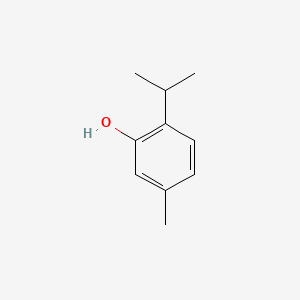
1 2D Structure

Thymol

2 Identification
2.1 Computed Descriptors
2.1.1 IUPAC Name
5-methyl-2-propan-2-ylphenol
2.1.2 InChI
InChI=1S/C10H14O/c1-7(2)9-5-4-8(3)6-10(9)11/h4-7,11H,1-3H3
2.1.3 InChI Key
MGSRCZKZVOBKFT-UHFFFAOYSA-N
2.1.4 Canonical SMILES
CC1=CC(=C(C=C1)C(C)C)O
2.2 Other Identifiers
2.2.1 UNII
3J50XA376E
2.3 Synonyms
2.3.1 MeSH Synonyms

1. Apiguard

2.3.2 Depositor-Supplied Synonyms

1. 89-83-8

2. 2-isopropyl-5-methylphenol

3. Thyme Camphor

4. 5-methyl-2-isopropylphenol

5. 6-isopropyl-m-cresol

6. 5-methyl-2-(1-methylethyl)phenol

7. Thymic Acid

8. 3-p-cymenol

9. Phenol, 5-methyl-2-(1-methylethyl)-

10. P-cymen-3-ol

11. 3-hydroxy-p-cymene

12. 6-isopropyl-3-methylphenol

13. Isopropyl Cresol

14. 5-methyl-2-(propan-2-yl)phenol

15. M-thymol

16. Apiguard

17. 5-methyl-2-propan-2-ylphenol

18. 5-methyl-2-isopropyl-1-phenol

19. 3-methyl-6-isopropylphenol

20. 1-hydroxy-5-methyl-2-isopropylbenzene

21. P-cymene, 3-hydroxy-

22. M-cresol, 6-isopropyl-

23. 1-methyl-3-hydroxy-4-isopropylbenzene

24. 2-hydroxy-1-isopropyl-4-methylbenzene

25. 6-isopropyl-p-cresol

26. 2-isopropyl-5-methyl-phenol

27. Fema No. 3066

28. Phenol, 2-isopropyl-5-methyl-

29. 3-hydroxy-1-methyl-4-isopropylbenzene

30. Thymolum

31. Nsc 11215

32. Nsc-11215

33. Nsc-47821

34. Nsc-49142

35. Chembl29411

36. Chebi:27607

37. 3j50xa376e

38. Ncgc00159373-02

39. Ncgc00159373-04

40. Thymol (natural)

41. Dsstox_cid_14972

42. Dsstox_rid_79231

43. Dsstox_gsid_34972

44. Cymophenol, Alpha-

45. Wln: Qr C1 Fy1&1

46. Caswell No. 856a

47. Fema Number 3066

48. Cas-89-83-8

49. Ccris 7299

50. Hsdb 866

51. Thymol [jan:nf]

52. Einecs 201-944-8

53. Epa Pesticide Chemical Code 080402

54. Thymate

55. Unii-3j50xa376e

56. Ai3-00708

57. Thymol, Puriss.

58. Thymol & Propolis

59. 5-methyl-2-(1-methylethyl)-phenol

60. Mfcd00002309

61. Thymol (tn)

62. Thymol,(s)

63. Thymol Crystal Puriss

64. Thymol, Fcc, Fg

65. Thymolum [hpus]

66. Thymol (jp17/nf)

67. Thymol [vandf]

68. Thymol [fhfi]

69. Thymol [hsdb]

70. Thymol [inci]

71. Thymol [fcc]

72. Thymol [jan]

73. Thymol [usp-rs]

74. Thymol [who-dd]

75. Thymol [ii]

76. Thymol [mi]

77. Thymol [mart.]

78. Ec 201-944-8

79. Thymol, Analytical Standard

80. Thymol, >=98.5%

81. Schembl22165

82. Mls001074692

83. Bidd:er0658

84. Thymol [ep Monograph]

85. Gtpl2499

86. Dtxsid6034972

87. 5-methyl-2-propan-2-yl-phenol

88. 1e06

89. Hms2267p15

90. Zinc967597

91. Hy-n6810

92. Nsc11215

93. Nsc47821

94. Nsc49142

95. Tox21_111613

96. Tox21_300358

97. Bbl011604

98. Bdbm50240432

99. S5157

100. Stk397445

101. Thymol, Tested According To Ph.eur.

102. Akos000119786

103. Tox21_111613_1

104. Ccg-266209

105. Db02513

106. Ks-5170

107. Lmpr0102090029

108. Mb00129

109. Thymol, Saj First Grade, >=98.0%

110. 1-methyl-3-hydroxy-4-isopropyl Benzene

111. Ncgc00159373-03

112. Ncgc00159373-05

113. Ncgc00254459-01

114. Ac-34742

115. Smr000471893

116. Db-002030

117. Cs-0008421

118. Ft-0612711

119. M0410

120. C09908

121. D01039

122. Thymol, Primary Pharmaceutical Reference Standard

123. A845314

124. A861043

125. Ae-562/43461428

126. Q408883

127. Sr-01000763796

128. Sr-01000763796-2

129. W-100357

130. Thymol, Standard For Quantitative Nmr, Tracecert(r)

131. Z57127464

132. Benzene,2-hydroxy,1-isopropyl,4-methyl Thymol

133. F0001-2201

134. Thymol, European Pharmacopoeia (ep) Reference Standard

135. Thymol, United States Pharmacopeia (usp) Reference Standard

136. Thymol, Meets Analytical Specification Of Ph. Eur., Bp, Nf, 99-101%

137. Thymol, Pharmaceutical Secondary Standard; Certified Reference Material

2.4 Create Date
2005-03-26
3 Chemical and Physical Properties
Molecular Weight 150.22 g/mol
Molecular Formula C10H14O
XLogP33.3
Hydrogen Bond Donor Count1
Hydrogen Bond Acceptor Count1
Rotatable Bond Count1
Exact Mass150.104465066 g/mol
Monoisotopic Mass150.104465066 g/mol
Topological Polar Surface Area20.2 Ų
Heavy Atom Count11
Formal Charge0
Complexity120
Isotope Atom Count0
Defined Atom Stereocenter Count0
Undefined Atom Stereocenter Count0
Defined Bond Stereocenter Count0
Undefined Bond Stereocenter Count0
Covalently Bonded Unit Count1
4 Drug and Medication Information
4.1 Therapeutic Uses

Anti-Infective Agents; Anti-Infective Agents, Local; Antifungal Agents

National Library of Medicine's Medical Subject Headings online file (MeSH, 2014)


EXPL THER Thymol, a naturally occurring monocyclic phenolic compound derived from Thymus vulgaris (Lamiaceae), has been reported to exhibit anti-inflammatory property in vivo and vitro. However, the mechanism of thymol is not clear. The aim of the present study was to investigate the effects of thymol on allergic inflammation in OVA-induced mice asthma and explore its mechanism. The model of mouse asthma was established by the induction of OVA. Thymol was orally administered at a dose of 4, 8, and 16 mg/kg body weight 1hr before OVA challenge. At 24h after the last challenge, mice were sacrificed, and the data were collected by various experimental methods. The results revealed that pretreatment with thymol reduced the level of OVA-specific IgE, inhibited recruitment of inflammatory cells into airway, and decreased the levels of IL-4, IL-5, and IL-13 in BALF. Moreover, the pathologic changes of lung tissues were obviously ameliorated and goblet cell hyperplasia was effectively inhibited by the pretreatment of thymol. In addition, thymol reduced the development of airway hyperresponsiveness and blocked the activation of NF-kappaB pathway. All data suggested that thymol ameliorated airway inflammation in OVA-induced mouse asthma, possibly through inhibiting NF-kappaB activation. These findings indicated that thymol may be used as an alternative agent for treating allergic asthma.

PMID:24785965 Zhou E et al; Fitoterapia. 2014 Jul;96:131-7. doi: 10.1016/j.fitote.2014.04.016


EXPL THER Obesity has become a worldwide health problem. Most of the synthetic anti-obesity drugs have failed to manage the obesity due to either ineffectiveness or adverse effect. The research of prominent chemical constituents from herbal for the management of obesity has greatly increased. The main objective of the present study was intended to examine the effects of thymol in high-fat diet (HFD)-induced obesity in murine model. Male Wistar rats were fed HFD for 6 weeks to induce obesity. Thymol (14 mg/kg) administered orally twice a day to HFD-fed rats for 4 weeks. Alteration in body weight gain, visceral fat-pads weight and serum biochemical markers were assessed. At the end of study, rats fed with HFD exhibited significantly (p< 0.001) enhanced body weight gain, visceral pad weight, lipids, alanine aminotransferase (ALT), aspartate aminotransaminase (AST), lactate dehydrogenase (LDH), blood urea nitrogen (BUN), glucose, insulin and leptin levels compared with rats fed with normal diets. Thymol treatment showed significantly (p< 0.001) decreased body weight gain, visceral fat-pad weights, lipids, ALT, AST, LDH, BUN, glucose, insulin, and leptin levels in HFD-induced obese rats. Furthermore, thymol treatment showed significantly decreased serum lipid peroxidation and increased antioxidant levels in HFD-induced obese rats. Thymol prevents HFD-induced obesity in murine model through several mechanisms including attenuation of visceral fat accumulation, lipid lowering action, improvement of insulin and leptin sensitivity and enhanced antioxidant potential.

PMID:24175857 Haque MR et al; Toxicol Mech Methods. 2014 Feb;24(2):116-23. doi: 10.3109/15376516.2013.861888. Epub 2013 Dec 5


EXPL THER Mast cells play a critical role in inflammatory skin diseases through releasing proinflammatory mediators; however, few therapies directly target these cells. In 1878, the use of topical thymol, a now recognized potent agonist for transient receptor potential channels, was first described to treat eczema and psoriasis. /The objective was/ to determine the mechanisms through which thymol can alter skin inflammation. METHODS: /This study/ examined the effect of topical thymol on IgE-dependent responses using a mast cell-dependent passive cutaneous anaphylaxis (PCA) model, as well as in vitro-cultured mast cells. Thymol dose-dependently inhibited PCA when administered topically 24 hours before antigen challenge but provoked an ear-swelling response directly on application. This direct effect was associated with local mast cell degranulation and was absent in histamine-deficient mice. However, unlike with PCA responses, there was no late-phase swelling. In vitro thymol directly triggered calcium flux in mast cells through transient receptor potential channel activation, along with degranulation and cytokine transcription. However, no cytokine protein was produced. Instead, thymol induced a significant increase in apoptotic cell death that was seen both in vitro and in vivo. /The authors/ propose that the efficacy of thymol in reducing IgE-dependent responses is through promotion of activation-induced apoptotic cell death of mast cells and that this likely explains the clinical benefits observed in early clinical reports.

PMID:24486068 Full text: https://www.ncbi.nlm.nih.gov/pmc/articles/PMC4040322 Wechsler JB et al; J Allergy Clin Immunol. 133 (6): 1735-43 (2014)


For more Therapeutic Uses (Complete) data for THYMOL (8 total), please visit the HSDB record page.


5 Pharmacology and Biochemistry
5.1 MeSH Pharmacological Classification

Antifungal Agents

Substances that destroy fungi by suppressing their ability to grow or reproduce. They differ from FUNGICIDES, INDUSTRIAL because they defend against fungi present in human or animal tissues. (See all compounds classified as Antifungal Agents.)


Anti-Infective Agents

Substances that prevent infectious agents or organisms from spreading or kill infectious agents in order to prevent the spread of infection. (See all compounds classified as Anti-Infective Agents.)


Anti-Infective Agents, Local

Substances used on humans and other animals that destroy harmful microorganisms or inhibit their activity. They are distinguished from DISINFECTANTS, which are used on inanimate objects. (See all compounds classified as Anti-Infective Agents, Local.)


5.2 Absorption, Distribution and Excretion

Aromatic herbs as feed additives in animal production are encountering growing interest, but data on the fate of the aromatic compounds from the plant in the animal body are very scarce. In the present study, thyme (Thymus vulgaris) herb consisting of leaves and flowers without stems was used as an ingredient in the diet for broilers. The herb was fed for 35 days to five groups of broilers (0, 0.1, 0.2, 0.3, and 1% w/w in the diet). Animal performance and the concentrations of the main essential oil component from thyme, thymol, were measured in gut contents, plasma and liver and muscle tissues using solid phase microextraction and gas chromatography/mass spectrometry. There were no differences between the groups in feed intake, daily weight gain, feed conversion and slaughter weight. Thymol was detected in gut contents, plasma and liver and muscle tissues. Increased intestinal thymol concentrations were found in the group with 1% thyme compared with the other groups (P<0.05). In liver and muscle tissues the thymol levels were close to the limit of quantification. The data do not indicate a positive effect of thyme on animal performance. With high dietary levels of thyme herb, thymol concentrations increased in gut contents and plasma but were very low in edible tissues such as liver and flesh.

PMID:24862829 Haselmeyer A et al; J Sci Food Agric. 2014 May 24. doi: 10.1002/jsfa.6758.


Thymol is readily absorbed from the gastrointestinal tract following oral administration. It is essentially excreted in the urine within the first 24 hours after absorption.

Toxikologische Bewertung. Heidelberg, Berufsgenossenschaft der chemischen Industrie 259 38 p (2000)


5.3 Metabolism/Metabolites

Only small amounts of the absorbed substance undergo urinary excretion as hydroxylated compounds. Thymol is predominantly excreted unchanged and in the form of its glucuronide and sulfate conjugates.

Toxikologische Bewertung. Heidelberg, Berufsgenossenschaft der chemischen Industrie 259 38 p (2000)


Substituted monophenols, thymol ... which occur in essential oils of plants, particularly thyme, are ... conjugated with glucuronic acid & sulfate.

Parke, D. V. The Biochemistry of Foreign Compounds. Oxford: Pergamon Press, 1968., p. 147


Thymol has known human metabolites that include Thymoquinol, p-Cymen-8-en-3-ol, p-Cymene-2,3-diol, thymol O-glucuronide, and thymol sulfate.

S73 | METXBIODB | Metabolite Reaction Database from BioTransformer | DOI:10.5281/zenodo.4056560


5.4 Mechanism of Action

The potent role of thymol, a natural compound, in modulation of macrophage activity was evaluated by determining all the sequential steps involved during phagocytosis. We found a significant increase in the proliferation of splenocytes in the presence of thymol and it proved to be a good mitogen. Uptake capacity of macrophages was enhanced due to increased membrane fluidity after treatment with thymol and it also increases lysosomal activity of macrophages. Data of superoxide anion generation revealed the involvement of thymol in the generation of respiratory burst as it potentiated this property of macrophages at a concentration of 150 uM. In the case of TNF-a, IL-1beta and PGE(2) a decreased level of secretion was observed 154 pg/mL, 736.1 pg/mL, and 151 pg/mL respectively when compared with lipopolysaccharide treated cells, where the level of these cytokines was significantly high. We also determined the anti-complementary activity of thymol which showed to be more effective than rosmarinic acid. Thus, the results obtained from the study suggest the potential role of thymol as a natural immunostimulatory drug which can be used in the treatment of various immunological disorders.

PMID:24316253 Chauhan AK et al; Int Immunopharmacol. 2014 Feb;18(2):340-6. doi: 10.1016/j.intimp.2013.11.025. Epub 2013 Dec 5.


Related Excipient Companies

Upload your portfolio for free, ask us

Excipients by Applications

Click here to find the perfect excipient manufacturers by their capabilities

Solubilizers

read-more
read-more

Topical

read-more
read-more

Parenteral

read-more
read-more

Thickeners and Stabilizers

read-more
read-more

Coating Systems & Additives

read-more
read-more

Film Formers & Plasticizers

read-more
read-more

Taste Masking

read-more
read-more

Emulsifying Agents

read-more
read-more

Surfactant & Foaming Agents

read-more
read-more

Fillers, Diluents & Binders

read-more
read-more

API Stability Enhancers

read-more
read-more

Empty Capsules

read-more
read-more

Controlled & Modified Release

read-more
read-more

Direct Compression

read-more
read-more

Chewable & Orodispersible Aids

read-more
read-more

Rheology Modifiers

read-more
read-more

Co-Processed Excipients

read-more
read-more

Granulation

read-more
read-more

Disintegrants & Superdisintegrants

read-more
read-more

Lubricants & Glidants

read-more
read-more

Soft Gelatin

read-more
read-more

Market Place

Do you need sourcing support? Ask us

APIs

read-more
read-more
PharmaCompass
Full Screen ViewFULL SCREEN VIEW Click here to open all results in a new tab [this preview display 10 results]

REF. STANDARDS & IMPURITIES

Upload your portfolio for free, ask us

ABOUT THIS PAGE

Looking for 89-83-8 / Thymol API manufacturers, exporters & distributors?

Thymol manufacturers, exporters & distributors 1

49

PharmaCompass offers a list of Thymol API manufacturers, exporters & distributors, which can be sorted by GMP, USDMF, JDMF, KDMF, CEP (COS), WC, and more, enabling you to easily find the right Thymol manufacturer or Thymol supplier for your needs.

Send us enquiries for free, and we will assist you in establishing a direct connection with your preferred Thymol manufacturer or Thymol supplier.

API | Excipient name

Thymol

Synonyms

89-83-8, 2-isopropyl-5-methylphenol, Thyme camphor, 5-methyl-2-isopropylphenol, 6-isopropyl-m-cresol, 5-methyl-2-(1-methylethyl)phenol

Cas Number

89-83-8

Unique Ingredient Identifier (UNII)

3J50XA376E

About Thymol

A phenol obtained from thyme oil or other volatile oils used as a stabilizer in pharmaceutical preparations, and as an antiseptic (antibacterial or antifungal) agent.

Thymate Manufacturers

A Thymate manufacturer is defined as any person or entity involved in the manufacture, preparation, processing, compounding or propagation of Thymate, including repackagers and relabelers. The FDA regulates Thymate manufacturers to ensure that their products comply with relevant laws and regulations and are safe and effective to use. Thymate API Manufacturers are required to adhere to Good Manufacturing Practices (GMP) to ensure that their products are consistently manufactured to meet established quality criteria.

click here to find a list of Thymate manufacturers with USDMF, JDMF, KDMF, CEP, GMP, and COA related information on PhamaCompass.

Thymate Suppliers

A Thymate supplier is an individual or a company that provides Thymate active pharmaceutical ingredient (API) or Thymate finished formulations upon request. The Thymate suppliers may include Thymate API manufacturers, exporters, distributors and traders.

click here to find a list of Thymate suppliers with USDMF, JDMF, KDMF, CEP, GMP, and COA related information on PharmaCompass.

Thymate USDMF

A Thymate DMF (Drug Master File) is a document detailing the whole manufacturing process of Thymate active pharmaceutical ingredient (API) in detail. Different forms of Thymate DMFs exist exist since differing nations have different regulations, such as Thymate USDMF, ASMF (EDMF), JDMF, CDMF, etc.

A Thymate DMF submitted to regulatory agencies in the US is known as a USDMF. Thymate USDMF includes data on Thymate's chemical properties, information on the facilities and procedures used, and details about packaging and storage. The Thymate USDMF is kept confidential to protect the manufacturer’s intellectual property.

click here to find a list of Thymate suppliers with USDMF on PharmaCompass.

Thymate GMP

Thymate Active pharmaceutical ingredient (API) is produced in GMP-certified manufacturing facility.

GMP stands for Good Manufacturing Practices, which is a system used in the pharmaceutical industry to make sure that goods are regularly produced and monitored in accordance with quality standards. The FDA’s current Good Manufacturing Practices requirements are referred to as cGMP or current GMP which indicates that the company follows the most recent GMP specifications. The World Health Organization (WHO) has its own set of GMP guidelines, called the WHO GMP. Different countries can also set their own guidelines for GMP like China (Chinese GMP) or the EU (EU GMP).

PharmaCompass offers a list of Thymate GMP manufacturers, exporters & distributors, which can be sorted by USDMF, JDMF, KDMF, CEP (COS), WC, and more, enabling you to easily find the right Thymate GMP manufacturer or Thymate GMP API supplier for your needs.

Thymate CoA

A Thymate CoA (Certificate of Analysis) is a formal document that attests to Thymate's compliance with Thymate specifications and serves as a tool for batch-level quality control.

Thymate CoA mostly includes findings from lab analyses of a specific batch. For each Thymate CoA document that a company creates, the USFDA specifies specific requirements, such as supplier information, material identification, transportation data, evidence of conformity and signature data.

Thymate may be tested according to a variety of international standards, such as European Pharmacopoeia (Thymate EP), Thymate JP (Japanese Pharmacopeia) and the US Pharmacopoeia (Thymate USP).


Inform the supplier about your product requirements, specifying if you need a product with particular monograph like EP (Ph. Eur.), USP, JP, BP, or any other quality. In addition, clarify whether you need hydrochloride (HCl), anhydricum, base, micronisatum or a specific level of purity. To find reputable suppliers, utilize the filters and select those certified by GMP, FDA, or any other certification as per your requirement.
For your convenience, we have listed synonyms and CAS numbers to help you find the best supplier. The use of synonyms and CAS numbers can be helpful in identifying potential suppliers, but it is crucial to note that they might not always indicate the exact same product. It is important to confirm the product details with the supplier before making a purchase to ensure that it meets your requirements.
Ask Us for Pharmaceutical Supplier and Partner
Ask Us, Find A Supplier / Partner
No Commissions, No Strings Attached, Get Connected for FREE

What are you looking for?

How can we help you?

The request can't be empty

Please read our Privacy Policy carefully

You must agree to the privacy policy

The name can't be empty
The company can't be empty.
The email can't be empty Please enter a valid email.
The mobile can't be empty