Synopsis
Synopsis
0
USDMF
0
CEP/COS
0
JDMF
0
EU WC
0
KDMF
0
NDC API
0
VMF
0
EDQM
0
USP
0
JP
0
Others
0
FDF Dossiers
0
FDA Orange Book
0
Europe
0
Canada
0
Australia
0
South Africa
0
Listed Dossiers

DRUG PRODUCT COMPOSITIONS
0
US Patents
0
US Exclusivities
0
Health Canada Patents
US Medicaid
NA
Annual Reports
NA
Regulatory FDF Prices
NA
0
API
0
FDF
0
Data Compilation #PharmaFlow
0
Stock Recap #PipelineProspector
0
Weekly News Recap #Phispers
0
News #PharmaBuzz
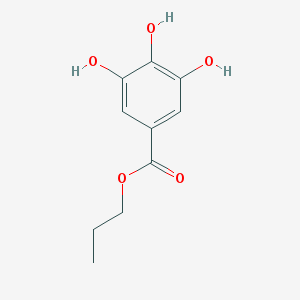
1. 121-79-9
2. Propyl 3,4,5-trihydroxybenzoate
3. N-propyl Gallate
4. Progallin P
5. Gallic Acid, Propyl Ester
6. Tenox Pg
7. Nipagallin P
8. Gallic Acid Propyl Ester
9. Nipa 49
10. Propylester Kyseliny Gallove
11. Benzoic Acid, 3,4,5-trihydroxy-, Propyl Ester
12. Fema No. 2947
13. N-propyl 3,4,5-trihydroxybenzoate
14. 3,4,5-trihydroxybenzene-1-propylcarboxylate
15. Gallate, Propyl
16. N-propyl Ester Of 3,4,5-trihydroxybenzoic Acid
17. Nipanox S 1
18. Nsc 2626
19. Nci-c505888
20. 3,4,5-trihydroxybenzoic Acid, Propyl Ester
21. 3,4,5-trihydroxybenzoic Acid N-propyl Ester
22. Nsc-2626
23. Propyl Gallate (e 310)
24. 8d4snn7v92
25. Ins No.310
26. E310
27. Ai3-17136
28. Ins-310
29. Nsc2626
30. Anhydrous Propyl Gallate (e 310)
31. E-310
32. Refchem:176492
33. 3,4,5-trihydroxybenzoic Acid, N-propyl Ester
34. 204-498-2
35. 3,4,5-trihydroxybenzoic Acid Propyl Ester
36. Gallic Acid N-propyl Ester
37. Mfcd00002196
38. Dtxsid5021201
39. Propyl Gallate (nf)
40. Propyl Gallate [nf]
41. Gallic Acid-propyl Ester
42. Propyl Gallate (standard)
43. Chembl7983
44. Gallic Acid, N-propyl Ester
45. Ncgc00164234-01
46. Dtxcid901201
47. Pro Gallin P
48. Cas-121-79-9
49. Ccris 541
50. Hsdb 591
51. N-propyl-3,4,5-trihydroxybenzoate
52. Einecs 204-498-2
53. Propylester Kyseliny Gallove [czech]
54. Unii-8d4snn7v92
55. Propylgallate
56. Propyl-gallate
57. Propyl Galiate
58. N-propyl-gallate
59. Sustane Pg
60. Propyl Gallate, Powder
61. Propyl Gallate, 98%
62. 3,4,5-trihydroxy-benzoic Acid Propyl Ester
63. Propyl Gallate [ii]
64. Propyl Gallate [mi]
65. Oprea1_580415
66. Schembl22630
67. Cbdive_013134
68. Propyl Gallate [fcc]
69. 56274-95-4
70. Bidd:er0334
71. Propyl 3,5-trihydroxybenzoate
72. Propyl Gallate [fhfi]
73. Propyl Gallate [hsdb]
74. Wln: Qr Bq Cq Evo3
75. Propyl Gallate [vandf]
76. Gallic Acid Propyl Ester , Pg
77. Orb1303372
78. Orb3025155
79. Propyl Gallate [mart.]
80. Propyl Gallate [usp-rs]
81. Propyl Gallate [who-dd]
82. Chebi:10607
83. Fema 2947
84. Hy-n0524r
85. N-propyl 3,5-trihydroxybenzoate
86. Propyl Gallate, >=98%, Fcc
87. Msk2308
88. Hms5084f07
89. Nci-c50588
90. Hy-n0524
91. Tox21_113531
92. Tox21_202286
93. Tox21_300060
94. Bdbm50032154
95. S5113
96. Sbb060377
97. Propyl Gallate [ep Monograph]
98. Akos001603853
99. Ccg-207932
100. Db12450
101. Ebc-439046
102. Fp32547
103. T3s1866
104. Ncgc00164234-02
105. Ncgc00164234-03
106. Ncgc00164234-04
107. Ncgc00254138-01
108. Ncgc00259835-01
109. 3,5-trihydroxybenzene-1-propylcarboxylate
110. 3,5-trihydroxybenzoic Acid, Propyl Ester
111. Ac-11365
112. Ac-34485
113. As-11986
114. Nci60_002094
115. Propyl Gallate, Usp, 98.0-102.0%
116. Sy020323
117. Db-003766
118. Db-327302
119. Benzoic Acid,4,5-trihydroxy-, Propyl Ester
120. Cs-0009059
121. Eu-0036319
122. G0018
123. Ns00013163
124. St50307922
125. N-propyl Ester Of 3,5-trihydroxybenzoic Acid
126. D02382
127. E80666
128. Propyl Gallate, Antioxidant, >=98.0% (hplc)
129. F216645
130. Q608726
131. Sr-01000944710
132. Propyl Gallate, For Microscopy, >=98.0% (hplc)
133. Sr-01000944710-1
134. Efff5ffa-651c-4de3-a25f-d807c65d5537
135. N-propyl Ester Of 3,4,5- Trihydroxybenzoic Acid
136. Propyl Gallate, European Pharmacopoeia (ep) Reference Standard
137. Propyl Gallate, United States Pharmacopeia (usp) Reference Standard
138. Propyl Gallate, Pharmaceutical Secondary Standard; Certified Reference Material
139. Inchi=1/c10h12o5/c1-2-3-15-10(14)6-4-7(11)9(13)8(12)5-6/h4-5,11-13h,2-3h2,1h
| Molecular Weight | 212.20 g/mol |
|---|---|
| Molecular Formula | C10H12O5 |
| XLogP3 | 1.8 |
| Hydrogen Bond Donor Count | 3 |
| Hydrogen Bond Acceptor Count | 5 |
| Rotatable Bond Count | 4 |
| Exact Mass | Da |
| Monoisotopic Mass | Da |
| Topological Polar Surface Area | 87 |
| Heavy Atom Count | 15 |
| Formal Charge | 0 |
| Complexity | 206 |
| Isotope Atom Count | 0 |
| Defined Atom Stereocenter Count | 0 |
| Undefined Atom Stereocenter Count | 0 |
| Defined Bond Stereocenter Count | 0 |
| Undefined Bond Stereocenter Count | 0 |
| Covalently Bonded Unit Count | 1 |
/EXPL THER/ In addition to the hepatocellular edema and cytoplasmic eosinophilia, sludging of blood was present in liver of mice exposed to trinitrotoluene (TNT). Single necrosis of the partical liver cell was seen occasionally. Liver damage induced by TNT was significantly alleviated by orally administrated propyl gallate (PG). Futhermore, PG can promote the regeneration of the hepatocytes following TNT-exposed mice. The results suggest that PG showed a protective effect on the histopathologic changes of liver injury induced by TNT.
PMID:10684118 Li Z et al; Wei Sheng Yan Jiu 27 (3): 151-3 (1998)
/EXPL THER/ Phosgene, widely used in industrial processes, can cause life-threatening pulmonary edema and acute lung injury. One mechanism of protection against phosgene-induced lung injury may involve the use of antioxidants. The present study focused on dietary supplementation in mice using n-propyl gallate (nPG)--a gallate acid ester compound used in food preservation--and vitamin E. Five groups of male mice were studied: group 1, control-fed with Purina rodent chow 5002; group 2, fed 0.75% nPG (w/w) in 5002; group 3, fed 1.5% nPG (w/w) in 5002; group 4 fed 1% (w/w) vitamin E in 5002; and group 5, fed 2% (w/w) vitamin E also in 5002. Mice were fed for 23 days. On day 23 mice were exposed to 32 mg m-3 (8 ppm) phosgene for 20 min (640 mg. min m-3) in a whole-body exposure chamber. Survival rates were determined at 12 and 24 hr. In mice that died within 12 h, the lungs were removed and lung wet weights, dry weights, wet/dry weight ratios, lipid peroxidation (thiobarbituric acid reactive substances, TBARS) and glutathione (GSH) were assessed. Vitamin E had no positive effect on any outcome measured. There was no significant difference between 1.5% nPG and any parameter measured or survival rate compared with 5002 + phosgene. However, dietary treatment with 0.75% nPG significantly increased survival rate (p
PMID:11180278 Sciuto AM, Moran TS; J Appl Toxicol 21 (1): 33-9 (2001)
/EXPL THER/ ... In the present study we explored the role of oxidants present in ambient particles in causing damage to the mucociliary epithelium. We explored the protective effects of pretreatment with three substances (n-propyl gallate, DL-alpha-tocopherol acetate, and EDTA) on the frog palate exposed to residual oil fly ash (ROFA). The parameters analyzed were mucociliary transport (MCT) and ciliary beating frequency (CBF) after 0, 10, 20, 30, 60, and 120 min of exposure. MCT was decreased significantly by ROFA (p<0.001), with a significant interaction effect (p=0.02) between the duration of exposure and treatment with antioxidants. The inhibitory effects on MCT of the substances tested were significantly different (p=0.002); vitamin E was similar to control (Ringer) and different from all other groups. CBF showed no significant effect of duration of exposure (p=0.465), but a significant interaction between duration of exposure and treatments was observed (p=0.011). Significant differences were detected among treatments (p<0.001), with ROFA and n-propyl gallate at concentrations of 50 uM presenting a short-lived increase in CBF, which was not observed in the remaining groups. The results showed that both MCT and CBF were affected within a short period (100 min) of exposure to ROFA and that the presence of antioxidant substances, such as vitamin E (4 mg/mL) and n-propyl gallate (300 uM), protected against the mucociliary impairment induced by ROFA on the frog palate.
PMID:15910789 Carvalho-Oliveira R et al; Environ Res 98 (3): 349-54 (2005)
/EXPL THER/ Ca(2+) sensitizers are cardiotonic agents that directly increase the Ca(2+) sensitivity of cardiac myofilament. To find a novel Ca(2+) sensitizer, we have screened a group of phenolic compounds by examining their effects on the Ca(2+)-dependent force generation in cardiac muscle fibers. We found that propyl gallate, a strong antioxidant, increased the Ca(2+) sensitivity of cardiac myofilament in a dose-dependent and reversible manner. The present study indicates that propyl gallate is a novel type of Ca(2+) sensitizer with antioxidant activity, which might be more beneficial for the treatment of congestive heart failure associated with oxidative stress than existing Ca(2+) sensitizers.
PMID:19305124 Tadano N et al; J Pharmacol Sci 109 (3): 456-8 (2009)
For more Therapeutic Uses (Complete) data for PROPYL GALLATE (8 total), please visit the HSDB record page.
Antioxidants
Naturally occurring or synthetic substances that inhibit or retard oxidation reactions. They counteract the damaging effects of oxidation in animal tissues.
Propyl gallate was quickly metabolized and excreted when administered orally to rats and rabbits. ...When fed to rats, most of the propyl gallate was passed in the feces as the original ester. The urinary components detected were the original ester and gallic acid, and these were excreted completely within 24 hours. When administered orally to rabbits, 79 percent of the administered dose of propyl gallate was excreted in the urine, 72 percent as 4-methoxygallic acid glucuronide and 6.7 percent as unconjugated phenolic compounds. Minor metabolites included pyrogallol (free and conjugated) and free 4-methoxy gallic acid.
EPA/Office of Prevention, Pesticides, and Toxic Substances; Memorandum: Reassessment of Two Exemptions from the Requirement of a Tolerance For Propyl Gallate (CAS Reg. No. 121-79-9) p. 5 (2005). Available from, as of October 12, 2016: https://www3.epa.gov/
In rats, /SRP: some/ of an oral dose of propyl gallate is absorbed in the GI tract. In vivo, the gallate esters are hydrolized to gallic acid and free alcohol. Free alcohol is metabolized through the Krebs cycle, and most of the gallic acid is converted into 4-O-methyl gallic acid. Free gallic acid or a conjugated derivative of 4-O-methyl gallic acid is excreted in the urine. Significant amounts of unchanged esters are excreted in the feces of rats.
Bingham, E.; Cohrssen, B.; Powell, C.H.; Patty's Toxicology Volumes 1-9 5th ed. John Wiley & Sons. New York, N.Y. (2001)., p. V6 731
Propyl gallate was quickly metabolized and excreted when administered orally to rats and rabbits. ...When fed to rats, most of the propyl gallate was passed in the feces as the original ester. The urinary components detected were the original ester and gallic acid, and these were excreted completely within 24 hours. When administered orally to rabbits, 79 percent of the administered dose of propyl gallate was excreted in the urine, 72 percent as 4-methoxygallic acid glucuronide and 6.7 percent as unconjugated phenolic compounds. Minor metabolites included pyrogallol (free and conjugated) and free 4-methoxy gallic acid.
EPA/Office of Prevention, Pesticides, and Toxic Substances; Memorandum: Reassessment of Two Exemptions from the Requirement of a Tolerance For Propyl Gallate (CAS Reg. No. 121-79-9) p. 5 (2005). Available from, as of October 12, 2016: https://www3.epa.gov/
In rats, /SRP: some/ of an oral dose of propyl gallate is absorbed in the GI tract. In vivo, the gallate esters are hydrolized to gallic acid and free alcohol. Free alcohol is metabolized through the Krebs cycle, and most of the gallic acid is converted into 4-O-methyl gallic acid. Free gallic acid or a conjugated derivative of 4-O-methyl gallic acid is excreted in the urine. Significant amounts of unchanged esters are excreted in the feces of rats. In pigs, the metabolism is similar to rats.
Bingham, E.; Cohrssen, B.; Powell, C.H.; Patty's Toxicology Volumes 1-9 5th ed. John Wiley & Sons. New York, N.Y. (2001)., p. V6 731
The available evidence indicates that the gallate esters are hydrolyzed in the body to gallic acid. Most of the gallic acid is converted into 4-O-methyl gallic acid. Free gallic acid or a conjugated derivative of 4-O-methyl gallic acid is excreted in the urine. Conjugation of the 4-O-methyl gallic acid with glucuronic acid was demonstrated ... .
International Programme on Chemical Safety/World Health Organization; Food Additives Series 32, Gallates (1993). Available from, as of October 10, 2016: https://www.inchem.org/documents/jecfa/jecmono/v32je02.htm
In vitro incubations with propyl, octyl and dodecyl gallate were performed using homogenates of liver, mucosa of the small intestine, and contents of caecum/colon as a source of intestinal microflora. The various homogenates were incubated at 37 C with the individual gallate esters. At various time points up to 24 hr, samples were taken and analyzed by HPLC. ... All test substances were extensively metabolized by the homogenate of the intestinal mucosa. ... Furthermore, the caecum and colon contents also showed a high metabolic capacity, especially towards propyl gallate. The amt of gallic acid detected in the incubations was always much smaller than the total decrease of the amt of ester. It seems likely that apart from hydrolysis of the ester bond, other biotransformation routes ... are of major importance for all three gallate esters.
International Programme on Chemical Safety/World Health Organization; Food Additives Series 32, Gallates (1993). Available from, as of October 10, 2016: https://www.inchem.org/documents/jecfa/jecmono/v32je02.htm
The present study aimed to assess anti-inflammatory activity and underlying mechanism of n-propyl gallate, the n-propyl ester of gallic acid. n-Propyl gallate was shown to contain anti-inflammatory activity using two experimental animal models, acetic acid-induced permeability model in mice, and air pouch model in rats. It suppressed production of nitric oxide and induction of inducible nitric oxide synthase and cyclooxygenase-2 in the lipopolysaccharide (LPS)-stimulated RAW264.7 macrophage cells. It was able to diminish reactive oxygen species level elevated in the LPS-stimulated RAW264.7 macrophage cells. It also suppressed gelatinolytic activity of matrix metalloproteinase-9 enhanced in the LPS-stimulated RAW264.7 macrophage cells. It inhibited inhibitory kappaB-aplha degradation and enhanced NF-kappaB promoter activity in the stimulated macrophage cells. It was able to suppress phosphorylation of c-Jun NH(2)-terminal kinase 1/2 (JNK1/2) and activation of c-Jun promoter activity in the stimulated macrophage cells. In brief, n-propyl gallate possesses anti-inflammatory activity via down-regulation of NF-kappaB and JNK pathways.
PMID:20689985 Jung HJ et al; Inflammation 34 (5): 352-61 (2011)
... In the present study, we demonstrate that propyl gallate (PG) reduced cell viability in THP-1, Jurkat, and HL-60 leukemia cells and induced apoptosis in THP-1 cells. PG activated caspases 3, 8, and 9 and increased the levels of p53, Bax, Fas, and Fas ligand. PG activated mitogen-activated protein kinases (MAPKs), inhibited nuclear translocation of the nuclear factor erythroid 2-related factor 2 (Nrf-2) and induced intracellular glutathione (GSH) depletion. In addition, PG increased superoxide dismutase-1 expression and decreased intracellular levels of reactive oxygen species. Our data show ... that an early event of PG-induced apoptosis is MAPKs/Nrf-2-mediated GSH depletion and that PG induced apoptosis via multiple pathways in human leukemia. PG might serve as a potential chemotherapeutic agent or food supplement for human leukemia patients.
PMID:21112369 Chen CH et al; Food Chem Toxicol 49 (2): 494-501 (2011)
ABOUT THIS PAGE