
Find Oleic Acid Chloride manufacturers, exporters & distributors on PharmaCompass

PharmaCompass

Synopsis

Synopsis

ACTIVE PHARMA INGREDIENTS

0

JDMF

0

EU WC

0

KDMF

0

NDC API

0

VMF

0

Listed Suppliers

0INTERMEDIATES

REF. STANDARDS OR IMPURITIES

0

USP

0

JP

FINISHED DOSAGE FORMULATIONS

0

FDA Orange Book

0

Europe

0

Canada

0

Australia

0

South Africa

0 DRUGS IN DEVELOPMENT

FDF Dossiers

DRUG PRODUCT COMPOSITIONS

0RELATED EXCIPIENT COMPANIES

0EXCIPIENTS BY APPLICATIONS

PATENTS & EXCLUSIVITIES

0

US Patents

0

US Exclusivities

0

Health Canada Patents

GLOBAL SALES INFORMATION

US Medicaid

NA

Annual Reports

NA

Regulatory FDF Prices

NA

MARKET PLACE

0

FDF

DIGITAL CONTENT

0

Stock Recap #PipelineProspector

0

Weekly News Recap #Phispers

0

News #PharmaBuzz
Chemistry

Click the arrow to open the dropdown
read-moreClick the button for full data set
Also known as: 112-80-1, Cis-9-octadecenoic acid, Oleate, (z)-octadec-9-enoic acid, Elaidoic acid, Cis-oleic acid
Molecular Formula
C18H34O2
Molecular Weight
282.5  g/mol
InChI Key
ZQPPMHVWECSIRJ-KTKRTIGZSA-N
FDA UNII
2UMI9U37CP

Oleic Acid Chloride
An unsaturated fatty acid that is the most widely distributed and abundant fatty acid in nature. It is used commercially in the preparation of oleates and lotions, and as a pharmaceutical solvent. (Stedman, 26th ed)
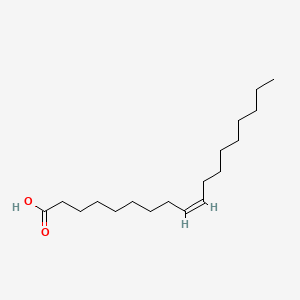
1 2D Structure

Oleic Acid Chloride

2 Identification
2.1 Computed Descriptors
2.1.1 IUPAC Name
(Z)-octadec-9-enoic acid
2.1.2 InChI
InChI=1S/C18H34O2/c1-2-3-4-5-6-7-8-9-10-11-12-13-14-15-16-17-18(19)20/h9-10H,2-8,11-17H2,1H3,(H,19,20)/b10-9-
2.1.3 InChI Key
ZQPPMHVWECSIRJ-KTKRTIGZSA-N
2.1.4 Canonical SMILES
CCCCCCCCC=CCCCCCCCC(=O)O
2.1.5 Isomeric SMILES
CCCCCCCC/C=C\CCCCCCCC(=O)O
2.2 Other Identifiers
2.2.1 UNII
2UMI9U37CP
2.3 Synonyms
2.3.1 MeSH Synonyms

1. 9 Octadecenoic Acid

2. 9-octadecenoic Acid

3. Cis 9 Octadecenoic Acid

4. Cis-9-octadecenoic Acid

5. Oleate

2.3.2 Depositor-Supplied Synonyms

1. 112-80-1

2. Cis-9-octadecenoic Acid

3. Oleate

4. (z)-octadec-9-enoic Acid

5. Elaidoic Acid

6. Cis-oleic Acid

7. Wecoline Oo

8. Vopcolene 27

9. Glycon Wo

10. Pamolyn 100

11. Glycon Ro

12. Metaupon

13. Oelsauere

14. Groco 5l

15. Groco 2

16. Groco 4

17. Groco 6

18. Tego-oleic 130

19. Emersol 211

20. 9z-octadecenoic Acid

21. Cis-octadec-9-enoic Acid

22. Industrene 105

23. Industrene 205

24. Industrene 206

25. Pamolyn

26. Z-9-octadecenoic Acid

27. 9-octadecenoic Acid (z)-

28. Oleinic Acid

29. Emersol 210

30. Emersol 213

31. 9-octadecenoic Acid (9z)-

32. L'acide Oleique

33. Century Cd Fatty Acid

34. Emersol 6321

35. Extraolein 90

36. Oleine 7503

37. 9-octadecenoic Acid, (z)-

38. Emersol 205

39. Emersol 233ll

40. Hy-phi 1055

41. Hy-phi 1088

42. Hy-phi 2066

43. Hy-phi 2088

44. Hy-phi 2102

45. Elaic Acid

46. Priolene 6906

47. 9-octadecenoic Acid

48. White Oleic Acid

49. Wochem No. 320

50. Emersol 220 White Oleic Acid

51. Fema No. 2815

52. Extra Oleic 80r

53. Extra Oleic 90

54. Extra Oleic 99

55. Extra Olein 80

56. Extra Olein 90r

57. Lunac O-ca

58. Lunac O-ll

59. Lunac O-p

60. Neo-fat 92-04

61. Priolene 6907

62. Priolene 6928

63. Priolene 6930

64. Priolene 6933

65. Elainic Acid

66. Emersol 6313nf

67. Cis-oleate

68. Delta9-cis-oleic Acid

69. (9z)-octadec-9-enoic Acid

70. (9z)-octadecenoic Acid

71. Fema Number 2815

72. D 100 (fatty Acid)

73. Emersol 221 Low Titer White Oleic Acid

74. K 52

75. Oelsaeure

76. 9-cis-octadecenoic Acid

77. Hsdb 1240

78. Red Oil

79. D 100

80. (9z)-9-octadecenoic Acid

81. Oleic Acid [nf]

82. 9-octadecylenic Acid

83. Emersol 233

84. Oleicacid

85. 18:1delta9cis

86. Priolene 6936

87. Chebi:16196

88. Nsc-9856

89. 9,10-octadecenoic Acid

90. C18:1n-9

91. Neo-fat 90-04

92. .delta.9-cis-oleic Acid

93. 9-(z)-octadecenoic Acid

94. (z)-9-octadecanoic Acid

95. 9-octadecenoic Acid, Cis-

96. Cis-.delta.9-octadecenoate

97. 2umi9u37cp

98. Chembl8659

99. Cis-.delta.9-octadecenoic Acid

100. Cis-delta(9)-octadecenoic Acid

101. Nsc9856

102. Oleic Acid (nf)

103. Osteum

104. Mfcd00064242

105. C18:1 N-9

106. Fa 18:1

107. Octadec-9-enoic Acid

108. Ncgc00091119-02

109. 18:1 N-9

110. C18:1

111. Cis-9-octadecenoate

112. (9z)- Octadecenoic Acid

113. Dsstox_cid_5809

114. 18:1(n-9)

115. Oleic Acid, Pure

116. Dsstox_rid_77930

117. Dsstox_gsid_25809

118. Oleic Acid (natural)

119. Caswell No. 619

120. Wecoline Oo (van)

121. Acide Oleique [french]

122. Acide Oleique

123. Cis-delta9-octadecenoic Acid

124. L'acide Oleique [french]

125. Cas-112-80-1

126. Smr000326739

127. Ccris 682

128. Naa 35

129. Sulfurized Oleic Acid

130. Sulphurized Oleic Acid

131. Oleic Acid, Sulfurized

132. Cis-delta(sup 9)-octadecenoic Acid

133. Nsc 9856

134. Einecs 204-007-1

135. Unii-2umi9u37cp

136. Epa Pesticide Chemical Code 031702

137. Brn 1726542

138. Distoline

139. Oleinate

140. Oleaic Acid

141. Rapinic Acid

142. Ai3-01291

143. 1gni

144. 1hms

145. 1vyf

146. 2lkk

147. Oleic Acid Liquid

148. Lunac Oa

149. Edenor Atio5

150. Edenor Ftio5

151. Industrene 104

152. Z-9-octadecenoate

153. Einecs 270-164-8

154. Oleic Acid, P.a.

155. Emersol 213nf

156. Emersol 214nf

157. Pamolyn 125

158. Priolene 6900

159. 9,10-octadecenoate

160. 9-octadecenoic Acid (z)-, Sulfurized

161. Oleic Acid (8ci)

162. Oleic Acid Extra Pure

163. Cis-octadec-9-enoate

164. Pamolyn 100 Fg

165. Pamolyn 100 Fgk

166. 9-(z)-octadecenoate

167. Emersol 7021

168. 9-octadecenoic Acid (9z)-, Sulfurized

169. (z)-9-octadecanoate

170. Emersol 6313 Nf

171. Emersol 6333 Nf

172. Oleic Acid-9,10-t

173. (9z)-9-octadecenoate

174. Z-octadeca-9-enoic Acid

175. Oleic Acid [ii]

176. Oleic Acid [mi]

177. Oleic Acid [fcc]

178. Epitope Id:187036

179. Oleic Acid [fhfi]

180. Oleic Acid [hsdb]

181. Oleic Acid [inci]

182. Oleic Acid, Natural, Fcc

183. Emersol 220 White Oleate

184. Oleic Acid [vandf]

185. Oleic Acid, Technical Grade

186. Schembl1138

187. Delta9-cis-octadecenoic Acid

188. Oleic Acid [mart.]

189. Wln: Qv8u9-c

190. Oleic Acid [usp-rs]

191. Oleic Acid [who-dd]

192. 4-02-00-01641 (beilstein Handbook Reference)

193. 99148-48-8

194. Mls001056779

195. Mls002153498

196. Mls002454427

197. 9-octadecenoic Acid, (9z)-

198. (9z)-9-octadecenoic Acid #

199. Gtpl1054

200. Oleic Acid, Analytical Standard

201. Dtxsid1025809

202. Oleic Acid, >=93% (gc)

203. Oleic Acid, >=99% (gc)

204. Regid_for_cid_445639

205. 1g74

206. Oleic Acid [ep Monograph]

207. Hms2234o13

208. Hms3649h21

209. Hms3885h18

210. Oleic Acid, Technical Grade, 90%

211. Hy-n1446

212. Zinc6845860

213. Endocine Component Oleic Acid

214. Tox21_111086

215. Tox21_201967

216. Tox21_303324

217. Bdbm50150484

218. Cis-9-octadecenoic Acid;elainic Acid

219. Hsci1_000362

220. Lmfa01030002

221. S4707

222. 9-octadecenoic Acid (9z)- (9ci)

223. Cis-9-octadecenoic-9,10-3h2 Acid

224. Emersol 221 Low Titer White Oleate

225. Akos017343225

226. Cis-.delta.(sup 9)-octadecenoic Acid

227. At13415

228. Ccg-267270

229. 9-octadecenoic-9,10-t2 Acid, (z)-

230. Ncgc00091119-01

231. Ncgc00091119-03

232. Ncgc00257233-01

233. Ncgc00259516-01

234. 68412-07-7

235. Ac-33767

236. As-16066

237. Bp-24023

238. Fa(18:1(9z))

239. Oleic Acid, Saj First Grade, >=70.0%

240. Oleic Acid, Selectophore(tm), >=99.0%

241. Cs-0016886

242. O0011

243. O0180

244. C00712

245. D02315

246. Oleic Acid, From Suet, Natural, >=60% (gc)

247. Ab00641912_08

248. 9-octadecenoic-9,10-t2 Acid, (9z)- (9ci)

249. A894525

250. Oleic Acid, Suitable For Cell Culture, Bioreagent

251. Q207688

252. Sr-01000780573

253. Oleic Acid (constituent Of Spirulina) [dsc]

254. Sr-01000780573-6

255. 9-octadecenoic Acid(z)-,oxidized,sulfonated,sodium Salts

256. F0001-0262

257. Oleic Acid (constituent Of Flax Seed Oil) [dsc]

258. Oleic Acid (constituent Of Saw Palmetto) [dsc]

259. Oleic Acid, Certified Reference Material, Tracecert(r)

260. Oleic Acid (constituent Of Borage Seed Oil) [dsc]

261. Oleic Acid, European Pharmacopoeia (ep) Reference Standard

262. 459ce4c0-c836-4249-8e2d-69874b714e9c

263. Oleic Acid (c18:1) (constituent Of Krill Oil) [dsc]

264. Oleic Acid (constituent Of Evening Primrose Oil) [dsc]

265. Oleic Acid, United States Pharmacopeia (usp) Reference Standard

266. Oleic Acid, Meets Analytical Specification Of Ph, Eur., 65.0-88.0% (gc)

267. Oleic Acid, Pharmaceutical Secondary Standard; Certified Reference Material

268. Oleic Acid-water Soluble, Powder, Bioreagent, Suitable For Cell Culture

269. Ole

270. Oleic Acid, Pharmagrade, Manufactured Under Appropriate Controls For Use As Raw Material In Pharma Or Biopharmaceutical Production.

2.4 Create Date
2004-09-16
3 Chemical and Physical Properties
Molecular Weight 282.5 g/mol
Molecular Formula C18H34O2
XLogP36.5
Hydrogen Bond Donor Count1
Hydrogen Bond Acceptor Count2
Rotatable Bond Count15
Exact Mass282.255880323 g/mol
Monoisotopic Mass282.255880323 g/mol
Topological Polar Surface Area37.3 Ų
Heavy Atom Count20
Formal Charge0
Complexity234
Isotope Atom Count0
Defined Atom Stereocenter Count0
Undefined Atom Stereocenter Count0
Defined Bond Stereocenter Count1
Undefined Bond Stereocenter Count0
Covalently Bonded Unit Count1
4 Drug and Medication Information
4.1 Therapeutic Uses

/EXPTL THER/ Ten Japanese boys with childhood adrenoleukodystrophy (ALD), one adult patient with adrenomyeloneuropathy (AMN), and two presymptomatic ALD boys were treated with dietary erucic acid (C22:1) for more than 12 months; except in a case of childhood ALD patient who died 7 months after beginning erucic acid therapy. During erucic acid therapy, the serum levels of very long-chain fatty acid (VLCFA) (C24:0/C22:0) decreased within 1-2 months in all patients, and these levels in four of the patients decreased to the normal range. Neurological examination and MRI findings in all 10 of the childhood ALD patients showed progression of the disease while they were receiving the dietary therapy. However, the mean interval between the onset of awkward gait and a vegetative state in diet-treated patients was significantly longer than that in the untreated patients. One AMN patient showed slight improvement of spastic gait and lessened pain in the lower limbs due to spasticity. The two presymptomatic ALD boys remained intact on clinical examination and on MRI findings for 38 and 23 months, respectively, after starting the diet.

PMID:7694994 Asano J et al; Brain Dev 16 (6): 454-8 (1994)


/EXPL THER/ An open 2 yr trial of oleic and erucic acids (Lorenzos oil) included 14 men with adrenomyeloneuropathy, 5 symptomatic heterozygous women and 5 boys with preclinical adrenomyeloneuropathy. No evidence of a clinically relevant benefit from dietary treatment in patients with adrenomyeloneuropathy (accumulation of very-long-chain fatty acids) could be found. /Lorenzos oil/

European Chemicals Bureau; IUCLID Dataset, (Z)-docos-13-enoic acid (CAS # 112-86-7) p.78 (2000 CD-ROM edition). Available from, as of January 29, 2008: https://esis.jrc.ec.europa.eu/


4.2 Drug Warning

40 male and 6 female patients with adrenoleukodystrophy received Lorenzos oil (20% erucic acid and 80% oleic acid). In 19 of these patients the platelet count decr significantly. In 6 patients with thrombocytopenia, platelet counts became normal within 2 to 3 mo after erucic acid was omitted from the diet. Observations suggested that strategies for the dietary management of adrenoleukodystrophy requiring the admin of large amt of erucic acid may be associated with thrombocytopenia and that the erucic acid component of Lorenzos oil is the cause of the thrombocytopenia. Patients treated with erucic acid should be followed closely with determinations of the platelet count. /Lorenzos oil: 20% erucic acid and 80% oleic acid/

European Chemicals Bureau; IUCLID Dataset, (Z)-docos-13-enoic acid (CAS # 112-86-7) p.78 (2000 CD-ROM edition). Available from, as of January 30, 2008: https://esis.jrc.ec.europa.eu/


15 men with adrenoleukodystrophy and 3 symptomatic heterozygous women were admin oleic and erucic acids (Lorenzos oil). Asymptomatic thrombocytopenia developed in 5 patients (platelet counts ranged between 37000 and 84000 per cu mm) but was reversed within 2 to 3 wk after erucic acid was omitted. In addition, long-term treatment with Lorenzos oil (for 24 to 43 mo) was associated with lymphocytopenia in these 5 patients. The observations suggested that the long-term treatment of adrenoleukodystrophy with Lorenzos oil can induce severe lymphocytopenia with immunosuppression and recurrent infections. /Lorenzos oil/

European Chemicals Bureau; IUCLID Dataset, (Z)-docos-13-enoic acid (CAS # 112-86-7) p.79 (2000 CD-ROM edition). Available from, as of January 30, 2008: https://esis.jrc.ec.europa.eu/


4.3 Minimum/Potential Fatal Human Dose

1. 1= PRACTICALLY NONTOXIC: PROBABLE ORAL LETHAL DOSE (HUMAN) ABOVE 15 G/KG, MORE THAN 1 QT (2.2 LB) FOR 70 KG PERSON (150 LB).

Gosselin, R.E., H.C. Hodge, R.P. Smith, and M.N. Gleason. Clinical Toxicology of Commercial Products. 4th ed. Baltimore: Williams and Wilkins, 1976., p. II-134


5 Pharmacology and Biochemistry
5.1 Absorption, Distribution and Excretion

Radioactivity has been traced to the heart, liver, lung, spleen, kidney, muscle, intestine, adrenal, blood, and lymph, and adipose, mucosal, and dental tissues after administration of radioactive oleic, palmitic, and stearic acids.

Cosmetic Ingredient Review; Final Report of the Cosmetic Ingredient Review Expert Panel; Final Report on the Safety Assessment of Oleic Acid, Lauric Acid, Palmitic Acid, Myristic Acid, and Stearic Acid; p. 15, June 2005.


Simultaneous ingestion of trace amounts of 14C-triolein (10 uCi) and 3H-oleic acid (20 uCi) in 42 g of carrier fat by patients with normal fecal fat excretion resulted in estimated fecal excretion of less than 10% of both substances. Gastrointestinal transit times for 14C-triolein, 3H-oleic acid, and a nonabsorbable marker, CrCl3, did not differ significantly.

Cosmetic Ingredient Review; Final Report of the Cosmetic Ingredient Review Expert Panel; Final Report on the Safety Assessment of Oleic Acid, Lauric Acid, Palmitic Acid, Myristic Acid, and Stearic Acid; p. 16, June 2005.


Oleic Acid has been reported to penetrate the skin of rats. On histological examination, fluorescence from absorbed oleic acid was found in epidermal cell layers of skin removed from treated rats within 10 min of its application. The path of penetration was suggested to be via the hair follicles. Only minute amounts of oleic acid were visualized in the blood vessels throughout the experiment. Skin permeability was shown to increase with the lipophilic nature of a compound.

Cosmetic Ingredient Review; Final Report of the Cosmetic Ingredient Review Expert Panel; Final Report on the Safety Assessment of Oleic Acid, Lauric Acid, Palmitic Acid, Myristic Acid, and Stearic Acid; p. 15, June 2005.


METABOLISM OF TRITIATED OLEIC ACID WAS STUDIED IN RATS DURING 600 DAYS. DURING FIRST 4 DAYS, HALF ACTIVITY IS FIXED TO WATER & HALF IS STORED IN ADIPOSE TISSUE WHICH IT LEAVES QUICKLY, THEN MORE SLOWLY WITH T/2 OF ABOUT 200 DAYS.

JEANMAIRE L ET AL; REPORT ISS CEA-R-4975 34 (1979)


For more Absorption, Distribution and Excretion (Complete) data for OLEIC ACID (10 total), please visit the HSDB record page.


5.2 Metabolism/Metabolites

Proposed mechanisms for fatty acid uptake by different tissues range from passive diffusion to facilitated diffusion or a combination of both. Fatty acids taken up by the tissues can either be stored in the form of triglycerides (98% of which occurs in adipose tissue depots) or they can be oxidized for energy via the beta-oxidation and tricarboxylic acid cycle pathways of catabolism.

Cosmetic Ingredient Review; Final Report of the Cosmetic Ingredient Review Expert Panel; Final Report on the Safety Assessment of Oleic Acid, Lauric Acid, Palmitic Acid, Myristic Acid, and Stearic Acid; p. 15, June 2005.


The beta-oxidation of fatty acids occurs in most vertebrate tissues (except the brain) using an enzyme complex for the series of oxidation and hydration reactions resulting in the cleavage of acetate groups as acetyl-CoA (coenzyme A). An additional isomerization reaction is required for the complete catabolism of Oleic Acid. Alternate oxidation pathways can be found in the liver (omega-oxidation) and in the brain (alpha-oxidation).

Cosmetic Ingredient Review; Final Report of the Cosmetic Ingredient Review Expert Panel; Final Report on the Safety Assessment of Oleic Acid, Lauric Acid, Palmitic Acid, Myristic Acid, and Stearic Acid; p. 15, June 2005.


Fatty acid biosynthesis from acetyl-CoA takes place primarily in the liver, adipose tissue, and mammary glands of higher animals. Successive reduction and dehydration reactions yield saturated fatty acids up to a 16-carbon chain length. Stearic Acid is synthesized by the condensation of palmitoyl-CoA and acetyl-CoA in the mitochondria, and Oleic Acid is formed via a mono-oxygenase system in the endoplasmic reticulum.

Cosmetic Ingredient Review; Final Report of the Cosmetic Ingredient Review Expert Panel; Final Report on the Safety Assessment of Oleic Acid, Lauric Acid, Palmitic Acid, Myristic Acid, and Stearic Acid; p. 15, June 2005.


The normal metabolic pathway of palmitic and stearic acids in mammals produces oleic acid. Oleic acid, on a series of elongation and desaturation steps, may be converted into longer chain eicosatrienoic and nervonic acid.

Bingham, E.; Cohrssen, B.; Powell, C.H.; Patty's Toxicology Volumes 1-9 5th ed. John Wiley & Sons. New York, N.Y. (2001)., p. 829


Weanling rats were fed diets containing rapeseed, canbra or ground nut oils for 8 or 60 days. They received simultaneously (14)C erucate and (3)H2 oleate by iv application. Animals were killed 2 or 19 hr after injection, lungs were removed and the distribution of (14)C and (3)H radioactivities was determined in pulmonary lipid fractions and in fatty acids of phospholipids and neutral lipids. More (14)C than (3)H radioactivity was recovered in lung lipids 3 and 19 hr after admin of labelled fatty acids. (14)C and (3)H radioactivity in the phospholipid fraction was larger than in the triglyceride fraction, the inverse was observed after 19 hr. The main part of (14)C radioactivity was present in the monounsaturated fatty acids, in decr order: 18:1, 24:1, 16:1 and 20:1. Erucic acid was slightly esterified in phospholipids.

European Chemicals Bureau; IUCLID Dataset, (Z)-docos-13-enoic acid (CAS # 112-86-7) p.76 (2000 CD-ROM edition). Available from, as of January 29, 2008: https://esis.jrc.ec.europa.eu/


Oleic acid has known human metabolites that include 17-Hydroxyoleic acid and 18-Hydroxyoleic acid.

S73 | METXBIODB | Metabolite Reaction Database from BioTransformer | DOI:10.5281/zenodo.4056560


5.3 Biological Half-Life

METABOLISM OF TRITIATED OLEIC ACID WAS STUDIED IN RATS DURING 600 DAYS. /ELIMINATION OCCURED/ SLOWLY WITH T/2 OF ABOUT 200 DAYS.

JEANMAIRE L ET AL; REPORT ISS CEA-R-4975 34 (1979)


5.4 Mechanism of Action

Insulin resistance is linked with a cluster of multiple risk factors and excessive acceleration of atherosclerosis. The underlying mechanism is not, however, fully understood. To determine the link between insulin resistance and altered vascular function, we focused on the effect of various non-esterified fatty acids on diacylglycerol-protein kinase C pathway and mitogen-activated protein kinase activity in cultured aortic smooth muscle cells. Incubation of the cells with saturated non-esterified fatty acids (200 micromol/L) for 24 hr, such as palmitate or stearate, induced a significant increase in diacylglycerol concentrations by about fivefold or eightfold, respectively, whereas oleate induced a slight increase in diacylglycerol concentrations by 1.8-fold and arachidonate induced none. In addition, the increased diacylglycerol concentrations induced by palmitate were completely restored to control concentrations by triacsin C, acyl-CoA synthetase inhibitor. These results suggest that saturated non-esterified fatty acids may increase diacylglycerol concentrations through de novo pathway by stepwise acylation. In parallel with the increased diacylglycerol, incubation of the cells with saturated non-esterified fatty acids significantly induced the activation of protein kinase C and mitogen-activated protein kinase. The palmitate-induced increase in mitogen-activated protein kinase activity was restored to control concentrations by GF109203X (5 x 10(-7) mol/L), a specific protein kinase C inhibitor, suggesting a protein kinase C-dependent activation of mitogen-activated protein kinase. Saturated non-esterified fatty acids induced an increase in de novo diacylglycerol synthesis and subsequent activation of protein kinase C and mitogen-activated protein kinase in cultured aortic smooth muscle cells. This could contribute to the altered vascular functions in the insulin resistant state.

PMID:11380080 Yu HY et al; Diabetologia 44 (5): 614-20 (2001)


API SUPPLIERS

read-more
read-more
Full Screen ViewFULL SCREEN VIEW Click here to open all results in a new tab [this preview display 10 results]

Digital Content read-more

Create Content with PharmaCompass, ask us

DATA COMPILATION #PharmaFlow

read-more
read-more

Market Place

Do you need sourcing support? Ask us

REF. STANDARDS & IMPURITIES

Upload your portfolio for free, ask us

ABOUT THIS PAGE

Looking for 112-80-1 / Oleic Acid Chloride API manufacturers, exporters & distributors?

Oleic Acid Chloride manufacturers, exporters & distributors 1

12

PharmaCompass offers a list of Oleic Acid Chloride API manufacturers, exporters & distributors, which can be sorted by GMP, USDMF, JDMF, KDMF, CEP (COS), WC, and more, enabling you to easily find the right Oleic Acid Chloride manufacturer or Oleic Acid Chloride supplier for your needs.

Send us enquiries for free, and we will assist you in establishing a direct connection with your preferred Oleic Acid Chloride manufacturer or Oleic Acid Chloride supplier.

API | Excipient name

Oleic Acid Chloride

Synonyms

112-80-1, Cis-9-octadecenoic acid, Oleate, (z)-octadec-9-enoic acid, Elaidoic acid, Cis-oleic acid

Cas Number

112-80-1

Unique Ingredient Identifier (UNII)

2UMI9U37CP

About Oleic Acid Chloride

An unsaturated fatty acid that is the most widely distributed and abundant fatty acid in nature. It is used commercially in the preparation of oleates and lotions, and as a pharmaceutical solvent. (Stedman, 26th ed)

Edenor ATiO5 Manufacturers

A Edenor ATiO5 manufacturer is defined as any person or entity involved in the manufacture, preparation, processing, compounding or propagation of Edenor ATiO5, including repackagers and relabelers. The FDA regulates Edenor ATiO5 manufacturers to ensure that their products comply with relevant laws and regulations and are safe and effective to use. Edenor ATiO5 API Manufacturers are required to adhere to Good Manufacturing Practices (GMP) to ensure that their products are consistently manufactured to meet established quality criteria.

Edenor ATiO5 Suppliers

A Edenor ATiO5 supplier is an individual or a company that provides Edenor ATiO5 active pharmaceutical ingredient (API) or Edenor ATiO5 finished formulations upon request. The Edenor ATiO5 suppliers may include Edenor ATiO5 API manufacturers, exporters, distributors and traders.

click here to find a list of Edenor ATiO5 suppliers with USDMF, JDMF, KDMF, CEP, GMP, and COA related information on PharmaCompass.

Edenor ATiO5 USDMF

A Edenor ATiO5 DMF (Drug Master File) is a document detailing the whole manufacturing process of Edenor ATiO5 active pharmaceutical ingredient (API) in detail. Different forms of Edenor ATiO5 DMFs exist exist since differing nations have different regulations, such as Edenor ATiO5 USDMF, ASMF (EDMF), JDMF, CDMF, etc.

A Edenor ATiO5 DMF submitted to regulatory agencies in the US is known as a USDMF. Edenor ATiO5 USDMF includes data on Edenor ATiO5's chemical properties, information on the facilities and procedures used, and details about packaging and storage. The Edenor ATiO5 USDMF is kept confidential to protect the manufacturer’s intellectual property.

click here to find a list of Edenor ATiO5 suppliers with USDMF on PharmaCompass.

Edenor ATiO5 CEP

A Edenor ATiO5 CEP of the European Pharmacopoeia monograph is often referred to as a Edenor ATiO5 Certificate of Suitability (COS). The purpose of a Edenor ATiO5 CEP is to show that the European Pharmacopoeia monograph adequately controls the purity of Edenor ATiO5 EP produced by a given manufacturer. Suppliers of raw materials can prove the suitability of Edenor ATiO5 to their clients by showing that a Edenor ATiO5 CEP has been issued for it. The manufacturer submits a Edenor ATiO5 CEP (COS) as part of the market authorization procedure, and it takes on the role of a Edenor ATiO5 CEP holder for the record. Additionally, the data presented in the Edenor ATiO5 CEP (COS) is managed confidentially and offers a centralized system acknowledged by numerous nations, exactly like the Edenor ATiO5 DMF.

A Edenor ATiO5 CEP (COS) is recognised by all 36 nations that make up the European Pharmacopoeia Convention. Edenor ATiO5 CEPs may be accepted in nations that are not members of the Ph. Eur. at the discretion of the authorities there.

click here to find a list of Edenor ATiO5 suppliers with CEP (COS) on PharmaCompass.

Edenor ATiO5 GMP

Edenor ATiO5 Active pharmaceutical ingredient (API) is produced in GMP-certified manufacturing facility.

GMP stands for Good Manufacturing Practices, which is a system used in the pharmaceutical industry to make sure that goods are regularly produced and monitored in accordance with quality standards. The FDA’s current Good Manufacturing Practices requirements are referred to as cGMP or current GMP which indicates that the company follows the most recent GMP specifications. The World Health Organization (WHO) has its own set of GMP guidelines, called the WHO GMP. Different countries can also set their own guidelines for GMP like China (Chinese GMP) or the EU (EU GMP).

PharmaCompass offers a list of Edenor ATiO5 GMP manufacturers, exporters & distributors, which can be sorted by USDMF, JDMF, KDMF, CEP (COS), WC, and more, enabling you to easily find the right Edenor ATiO5 GMP manufacturer or Edenor ATiO5 GMP API supplier for your needs.

Edenor ATiO5 CoA

A Edenor ATiO5 CoA (Certificate of Analysis) is a formal document that attests to Edenor ATiO5's compliance with Edenor ATiO5 specifications and serves as a tool for batch-level quality control.

Edenor ATiO5 CoA mostly includes findings from lab analyses of a specific batch. For each Edenor ATiO5 CoA document that a company creates, the USFDA specifies specific requirements, such as supplier information, material identification, transportation data, evidence of conformity and signature data.

Edenor ATiO5 may be tested according to a variety of international standards, such as European Pharmacopoeia (Edenor ATiO5 EP), Edenor ATiO5 JP (Japanese Pharmacopeia) and the US Pharmacopoeia (Edenor ATiO5 USP).


Inform the supplier about your product requirements, specifying if you need a product with particular monograph like EP (Ph. Eur.), USP, JP, BP, or any other quality. In addition, clarify whether you need hydrochloride (HCl), anhydricum, base, micronisatum or a specific level of purity. To find reputable suppliers, utilize the filters and select those certified by GMP, FDA, or any other certification as per your requirement.
For your convenience, we have listed synonyms and CAS numbers to help you find the best supplier. The use of synonyms and CAS numbers can be helpful in identifying potential suppliers, but it is crucial to note that they might not always indicate the exact same product. It is important to confirm the product details with the supplier before making a purchase to ensure that it meets your requirements.
Ask Us for Pharmaceutical Supplier and Partner
Ask Us, Find A Supplier / Partner
No Commissions, No Strings Attached, Get Connected for FREE

What are you looking for?

How can we help you?

The request can't be empty

Please read our Privacy Policy carefully

You must agree to the privacy policy

The name can't be empty
The company can't be empty.
The email can't be empty Please enter a valid email.
The mobile can't be empty