Find Sodium Ascorbate manufacturers, exporters & distributors on PharmaCompass

PharmaCompass

Synopsis

0INTERMEDIATES

REF. STANDARDS OR IMPURITIES

0

EDQM

0

USP

0

JP

FDF Dossiers

DRUG PRODUCT COMPOSITIONS

0RELATED EXCIPIENT COMPANIES

0EXCIPIENTS BY APPLICATIONS

PATENTS & EXCLUSIVITIES

0

US Exclusivities

GLOBAL SALES INFORMATION

US Medicaid

NA

Annual Reports

NA

Regulatory FDF Prices

NA

MARKET PLACE

0

FDF

DIGITAL CONTENT

0

Data Compilation #PharmaFlow

0

Stock Recap #PipelineProspector

0

Weekly News Recap #Phispers
Chemistry

Click the arrow to open the dropdown
read-moreClick the button for full data set
Also known as: 134-03-2, Sodium l-ascorbate, L-ascorbic acid sodium salt, Vitamin c sodium, Ascorbic acid sodium salt, Monosodium l-ascorbate
Molecular Formula
C6H7NaO6
Molecular Weight
198.11  g/mol
InChI Key
PPASLZSBLFJQEF-RXSVEWSESA-M
FDA UNII
S033EH8359

Sodium Ascorbate
A six carbon compound related to glucose. It is found naturally in citrus fruits and many vegetables. Ascorbic acid is an essential nutrient in human diets, and necessary to maintain connective tissue and bone. Its biologically active form, vitamin C, functions as a reducing agent and coenzyme in several metabolic pathways. Vitamin C is considered an antioxidant.
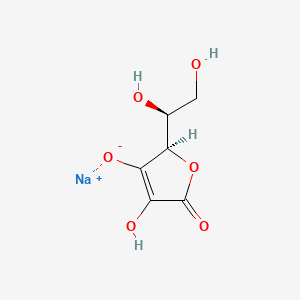
1 2D Structure

Sodium Ascorbate

2 Identification
2.1 Computed Descriptors
2.1.1 IUPAC Name
sodium;(2R)-2-[(1S)-1,2-dihydroxyethyl]-4-hydroxy-5-oxo-2H-furan-3-olate
2.1.2 InChI
InChI=1S/C6H8O6.Na/c7-1-2(8)5-3(9)4(10)6(11)12-5;/h2,5,7-10H,1H2;/q;+1/p-1/t2-,5+;/m0./s1
2.1.3 InChI Key
PPASLZSBLFJQEF-RXSVEWSESA-M
2.1.4 Canonical SMILES
C(C(C1C(=C(C(=O)O1)O)[O-])O)O.[Na+]
2.1.5 Isomeric SMILES
C([C@@H]([C@@H]1C(=C(C(=O)O1)O)[O-])O)O.[Na+]
2.2 Other Identifiers
2.2.1 UNII
S033EH8359
2.3 Synonyms
2.3.1 MeSH Synonyms

1. Acid, Ascorbic

2. Acid, L-ascorbic

3. Ascorbate, Ferrous

4. Ascorbate, Magnesium

5. Ascorbate, Sodium

6. Ascorbic Acid

7. Ascorbic Acid, Monosodium Salt

8. Di-l-ascorbate, Magnesium

9. Ferrous Ascorbate

10. Hybrin

11. L Ascorbic Acid

12. L-ascorbic Acid

13. Magnesium Ascorbate

14. Magnesium Ascorbicum

15. Magnesium Di L Ascorbate

16. Magnesium Di-l-ascorbate

17. Magnorbin

18. Vitamin C

2.3.2 Depositor-Supplied Synonyms

1. 134-03-2

2. Sodium L-ascorbate

3. L-ascorbic Acid Sodium Salt

4. Vitamin C Sodium

5. Ascorbic Acid Sodium Salt

6. Monosodium L-ascorbate

7. Vitamin C Sodium Salt

8. Ascorbicin

9. Sodascorbate

10. (+)-sodium L-ascorbate

11. L-ascorbic Acid, Monosodium Salt

12. Natrii Ascorbas

13. Vitamin C, Sodium Salt

14. Ascorbate

15. Ascorbate De Sodium

16. Ascorbin

17. Cevalin

18. L-ascorbic Acid Sodium

19. Ins No.301

20. L-ascorbic Acid (sodium Salt)

21. Ins-301

22. L-ascorbate, Sodium

23. Sodium (r)-2-((s)-1,2-dihydroxyethyl)-4-hydroxy-5-oxo-2,5-dihydrofuran-3-olate

24. S033eh8359

25. Cebitate

26. Aminofenitrooxon

27. E-301

28. Sodium (2r)-2-[(1s)-1,2-dihydroxyethyl]-4-hydroxy-5-oxo-2h-furan-3-olate

29. Iskia-c

30. Natri-c

31. Sodium (l)-ascorbate

32. Sodiumascorbate

33. Ascorbato Sodico

34. Ascorbato Sodico [dcit]

35. Sodium;(2r)-2-[(1s)-1,2-dihydroxyethyl]-4-hydroxy-5-oxo-2h-furan-3-olate

36. Mfcd00082340

37. Natrii Ascorbas [inn-latin]

38. Ascorbic Acid Sodium Derivative

39. Ccris 3291

40. Hsdb 694

41. 3-oxo-l-gulofuranolactone Sodium

42. Hbl 508

43. Ascorbate De Sodium [inn-french]

44. Einecs 205-126-1

45. Tianafacacid

46. Sodium Ascorbate [usp:inn]

47. Unii-s033eh8359

48. Sodium Derivative Of 3-oxo-l-gulofuranolactone

49. Ascorbic Acid Sodium

50. E301

51. Sodium L-ascorbate Salt

52. Dsstox_cid_105

53. Ec 205-126-1

54. Schembl3745

55. Dsstox_rid_75369

56. Dsstox_gsid_20105

57. Sodium Ascorbate [ii]

58. L(+)ascorbic Acid Sodium Salt

59. Sodium Ascorbate [fcc]

60. Sodium Ascorbate [inn]

61. Chembl591665

62. Sodium Ascorbate [hsdb]

63. Sodium Ascorbate [inci]

64. Dtxsid0020105

65. Sodium Ascorbate [vandf]

66. Hy-b0166a

67. Sodium Ascorbate [mart.]

68. Chebi:113451

69. Sodium Ascorbate [usp-rs]

70. Sodium Ascorbate [who-dd]

71. L-ascorbic Acid Sodium Salt,(s)

72. L-ascorbic Acid - Monosodium Salt

73. Tox21_300556

74. Akos015895058

75. L-ascorbic Acid, Sodium Salt (1:1)

76. Sodium Ascorbate [orange Book]

77. Ascorbic Acid Sodium Salt [mi]

78. Cs-6063

79. Db14482

80. Sodium Ascorbate [ep Monograph]

81. Sodium (2r)-2-[(1s)-1,2-dihydroxyethyl]-4-hydroxy-5-oxo-2,5-dihydrofuran-3-olate

82. Sodium Ascorbate [usp Monograph]

83. Ncgc00254355-01

84. Bp-30077

85. Cas-134-03-2

86. A0539

87. B1834

88. E80761

89. A806721

90. Q424551

91. J-006471

92. Sodium (2r)-2-[(1s)-1,2-bis(oxidanyl)ethyl]-4-oxidanyl-5-oxidanylidene-2h-furan-3-olate

93. Sodium(r)-2-((s)-1,2-dihydroxyethyl)-4-hydroxy-5-oxo-2,5-dihydrofuran-3-olate

2.4 Create Date
2008-02-05
3 Chemical and Physical Properties
Molecular Weight 198.11 g/mol
Molecular Formula C6H7NaO6
Hydrogen Bond Donor Count3
Hydrogen Bond Acceptor Count6
Rotatable Bond Count2
Exact Mass198.01403222 g/mol
Monoisotopic Mass198.01403222 g/mol
Topological Polar Surface Area110 Ų
Heavy Atom Count13
Formal Charge0
Complexity237
Isotope Atom Count0
Defined Atom Stereocenter Count2
Undefined Atom Stereocenter Count0
Defined Bond Stereocenter Count0
Undefined Bond Stereocenter Count0
Covalently Bonded Unit Count2
4 Drug and Medication Information
4.1 Therapeutic Uses

Antioxidants; Free Radical Scavengers

National Library of Medicine's Medical Subject Headings online file (MeSH, 1999)


Ascorbic acid and calcium and sodium ascorbates are used as antoxidants in pharmaceutical manufacturing and in the food industry.

Sweetman SC (ed), Martindale: The Complete Drug Reference. London: Pharmaceutical Press (2009), p.1985.


In 20 patients in acute asthmatic crisis, 16 recovered promptly after receiving 6 g sodium ascorbate iv. Chronic oral treatment (0.6-1 g/day/60 days) with Na ascorbate prevented asthmatic symptoms in 18/25 asthmatic patients.

Miyares C et al; Rev Cubana Med 10 (5): 469 (1971)


8 patients with hyphema were treated with iv glycerin in combination with sodium ascorbate. The results showed that glycerol in combination with sodium ascorbate diminished the hemorrhage in eye within 12-24 hr.

PMID:7272018 Latinovic S et al; Boll Chim Farm 120: 156-8 (1981)


For more Therapeutic Uses (Complete) data for Sodium ascorbate (6 total), please visit the HSDB record page.


4.2 Drug Warning

Each gram of sodium ascorbate contains approximately 5 mEq of sodium; this should be considered when the drug is used in patients on salt-restricted diets.

American Society of Health System Pharmacists; AHFS Drug Information 2009. Bethesda, MD. (2009)


5 Pharmacology and Biochemistry
5.1 MeSH Pharmacological Classification

Antioxidants

Naturally occurring or synthetic substances that inhibit or retard oxidation reactions. They counteract the damaging effects of oxidation in animal tissues. (See all compounds classified as Antioxidants.)


Vitamins

Organic substances that are required in small amounts for maintenance and growth, but which cannot be manufactured by the human body. (See all compounds classified as Vitamins.)


5.2 Absorption, Distribution and Excretion

Ascorbic acid, the reduced form of vitamin C, functions as a potent antioxidant as well as in cell differentiation. Ascorbate is taken up by mammalian cells through the specific sodium/ascorbate co-transporters SVCT1 and SVCT2. Although skeletal muscle contains about 50% of the whole-body vitamin C, the expression of SVCT transporters has not been clearly addressed in this tissue. ... This work ... analyzed the expression pattern of SVCT2 during embryonic myogenesis using the chick as model system. ... Immunohistochemical analyses showed that SVCT2 is preferentially expressed by type I slow-twitch muscle fibers throughout chick myogenesis as well as in post-natal skeletal muscles of several species, including human...

Low M et al; Histochem Cell Biol 131 (5): 565-74 (2009). Available from, as of March 15, 2010: https://www.ncbi.nlm.nih.gov/entrez/query.fcgi?cmd=Retrieve&db=pubmed&dopt=Abstract&list_uids=19125272


Humans use two sodium-ascorbate cotransporters (hSVCT1 and hSVCT2) for transporting the dietary essential micronutrient ascorbic acid, the reduced and active form of vitamin C. Although the human liver plays a pivotal role in regulating and maintaining vitamin C homeostasis, vitamin C transport physiology and regulation of the hSVCT systems in this organ have not been well defined. Thus, this research used a human hepatic cell line (HepG2), confirming certain results with primary human hepatocytes and determined the initial rate of ascorbic acid uptake to be Na(+) gradient, pH dependent, and saturable as a function of concentration over low and high micromolar ranges. Additionally, hSVCT2 protein and mRNA are expressed at higher levels in HepG2 cells and native human liver, and the cloned hSVCT2 promoter has more activity in HepG2 cells. Results using short interfering RNA suggest that in HepG2 cells, decreasing hSVCT2 message levels reduces the overall ascorbic acid uptake process more than decreasing hSVCT1 message levels. Activation of PKC intracellular regulatory pathways caused a downregulation in ascorbic acid uptake not mediated by a single predicted PKC-specific amino acid phosphorylation site in hSVCT1 or hSVCT2. However, PKC activation causes internalization of hSVCT1 but not hSVCT2. Examination of other intracellular regulatory pathways on ascorbic acid uptake determined that regulation also potentially occurs by PKA, PTK, and Ca(2+)/calmodulin, but not by nitric oxide-dependent pathways...

Reidling JC et al; Am J Physiol. Gastrointest Liver Physiol 295 (6): 1217-27 (2008). Available from, as of March 15, 2010: https://www.ncbi.nlm.nih.gov/entrez/query.fcgi?cmd=Retrieve&db=pubmed&dopt=Abstract&list_uids=18845575


5.3 Metabolism/Metabolites

... Adrenal cortex is closely associated with ascorbate metabolism ... Hydrocortisone was reported ... to stimulate synthesis of ascorbate from gluconolactone, but deoxycorticosterone or aldosterone caused ... increase in ascorbate excretion in normal or adrenalectomized rats...

The Chemical Society. Foreign Compound Metabolism in Mammals Volume 3. London: The Chemical Society, 1975., p. 607


5.4 Mechanism of Action

Mechanism of action of ascorbate is a superoxide radical scavenger.

Amdur, M.O., J. Doull, C.D. Klaasen (eds). Casarett and Doull's Toxicology. 4th ed. New York, NY: Pergamon Press, 1991., p. 524


... Sodium ascorbate decreases cellular iron uptake by melanoma cells in a dose- and time-dependent fashion, indicating that intracellular iron levels may be a critical factor in sodium ascorbate-induced apoptosis. Indeed, sodium ascorbate-induced apoptosis is enhanced by the iron chelator, desferrioxamine (DFO) while it is inhibited by the iron donor, ferric ammonium citrate (FAC). Moreover, the inhibitory effects of sodium ascorbate on intracellular iron levels are blocked by addition of transferrin, suggesting that transferrin receptor (TfR) dependent pathway of iron uptake may be regulated by sodium ascorbate. Cells exposed to sodium ascorbate demonstrated down-regulation of TfR expression and this precedes sodium ascorbate-induced apoptosis. Taken together, sodium ascorbate-mediated apoptosis appears to be initiated by a reduction of TfR expression, resulting in a down-regulation of iron uptake followed by an induction of apoptosis...

Kang JS et al; J Cell Physiol 204 (1): 192-7 (2005). Available from, as of March 15, 2010: https://www.ncbi.nlm.nih.gov/entrez/query.fcgi?cmd=Retrieve&db=pubmed&dopt=Abstract&list_uids=15672419


Humans use two sodium-ascorbate cotransporters (hSVCT1 and hSVCT2) for transporting the dietary essential micronutrient ascorbic acid, the reduced and active form of vitamin C. Although the human liver plays a pivotal role in regulating and maintaining vitamin C homeostasis, vitamin C transport physiology and regulation of the hSVCT systems in this organ have not been well defined. Thus, this research used a human hepatic cell line (HepG2), confirming certain results with primary human hepatocytes and determined the initial rate of ascorbic acid uptake to be Na(+) gradient, pH dependent, and saturable as a function of concentration over low and high micromolar ranges. Additionally, hSVCT2 protein and mRNA are expressed at higher levels in HepG2 cells and native human liver, and the cloned hSVCT2 promoter has more activity in HepG2 cells. Results using short interfering RNA suggest that in HepG2 cells, decreasing hSVCT2 message levels reduces the overall ascorbic acid uptake process more than decreasing hSVCT1 message levels. Activation of PKC intracellular regulatory pathways caused a downregulation in ascorbic acid uptake not mediated by a single predicted PKC-specific amino acid phosphorylation site in hSVCT1 or hSVCT2. However, PKC activation causes internalization of hSVCT1 but not hSVCT2. Examination of other intracellular regulatory pathways on ascorbic acid uptake determined that regulation also potentially occurs by PKA, PTK, and Ca(2+)/calmodulin, but not by nitric oxide-dependent pathways...

Reidling JC et al; Am J Physiol. Gastrointest Liver Physiol 295 (6): 1217-27 (2008). Available from, as of March 15, 2010: https://www.ncbi.nlm.nih.gov/entrez/query.fcgi?cmd=Retrieve&db=pubmed&dopt=Abstract&list_uids=18845575


Digital Content read-more

Create Content with PharmaCompass, ask us

NEWS #PharmaBuzz

read-more
read-more

Market Place

Do you need sourcing support? Ask us

Patents & EXCLUSIVITIES

Check the patents & exclusivity for this product

REF. STANDARDS & IMPURITIES

Upload your portfolio for free, ask us

ABOUT THIS PAGE

Looking for 134-03-2 / Sodium Ascorbate API manufacturers, exporters & distributors?

Sodium Ascorbate manufacturers, exporters & distributors 1

44

PharmaCompass offers a list of Sodium Ascorbate API manufacturers, exporters & distributors, which can be sorted by GMP, USDMF, JDMF, KDMF, CEP (COS), WC, and more, enabling you to easily find the right Sodium Ascorbate manufacturer or Sodium Ascorbate supplier for your needs.

Send us enquiries for free, and we will assist you in establishing a direct connection with your preferred Sodium Ascorbate manufacturer or Sodium Ascorbate supplier.

API | Excipient name

Sodium Ascorbate

Synonyms

134-03-2, Sodium l-ascorbate, L-ascorbic acid sodium salt, Vitamin c sodium, Ascorbic acid sodium salt, Monosodium l-ascorbate

Cas Number

134-03-2

Unique Ingredient Identifier (UNII)

S033EH8359

About Sodium Ascorbate

A six carbon compound related to glucose. It is found naturally in citrus fruits and many vegetables. Ascorbic acid is an essential nutrient in human diets, and necessary to maintain connective tissue and bone. Its biologically active form, vitamin C, functions as a reducing agent and coenzyme in several metabolic pathways. Vitamin C is considered an antioxidant.

E301 Manufacturers

A E301 manufacturer is defined as any person or entity involved in the manufacture, preparation, processing, compounding or propagation of E301, including repackagers and relabelers. The FDA regulates E301 manufacturers to ensure that their products comply with relevant laws and regulations and are safe and effective to use. E301 API Manufacturers are required to adhere to Good Manufacturing Practices (GMP) to ensure that their products are consistently manufactured to meet established quality criteria.

click here to find a list of E301 manufacturers with USDMF, JDMF, KDMF, CEP, GMP, and COA related information on PhamaCompass.

E301 Suppliers

A E301 supplier is an individual or a company that provides E301 active pharmaceutical ingredient (API) or E301 finished formulations upon request. The E301 suppliers may include E301 API manufacturers, exporters, distributors and traders.

click here to find a list of E301 suppliers with USDMF, JDMF, KDMF, CEP, GMP, and COA related information on PharmaCompass.

E301 USDMF

A E301 DMF (Drug Master File) is a document detailing the whole manufacturing process of E301 active pharmaceutical ingredient (API) in detail. Different forms of E301 DMFs exist exist since differing nations have different regulations, such as E301 USDMF, ASMF (EDMF), JDMF, CDMF, etc.

A E301 DMF submitted to regulatory agencies in the US is known as a USDMF. E301 USDMF includes data on E301's chemical properties, information on the facilities and procedures used, and details about packaging and storage. The E301 USDMF is kept confidential to protect the manufacturer’s intellectual property.

click here to find a list of E301 suppliers with USDMF on PharmaCompass.

E301 KDMF

In Korea, the Ministry of Food and Drug Safety (MFDS) is in charge of regulating pharmaceutical products and services.

Pharmaceutical companies submit a E301 Drug Master File in Korea (E301 KDMF) to the MFDS, which includes comprehensive information about the production, processing, facilities, materials, packaging, and testing of E301. The MFDS reviews the E301 KDMF as part of the drug registration process and uses the information provided in the E301 KDMF to evaluate the safety and efficacy of the drug.

After submitting a E301 KDMF to the MFDS, the registered manufacturer can provide importers or distributors with the registration number without revealing confidential information to Korean business partners. Applicants seeking to register their E301 API can apply through the Korea Drug Master File (KDMF).

click here to find a list of E301 suppliers with KDMF on PharmaCompass.

E301 CEP

A E301 CEP of the European Pharmacopoeia monograph is often referred to as a E301 Certificate of Suitability (COS). The purpose of a E301 CEP is to show that the European Pharmacopoeia monograph adequately controls the purity of E301 EP produced by a given manufacturer. Suppliers of raw materials can prove the suitability of E301 to their clients by showing that a E301 CEP has been issued for it. The manufacturer submits a E301 CEP (COS) as part of the market authorization procedure, and it takes on the role of a E301 CEP holder for the record. Additionally, the data presented in the E301 CEP (COS) is managed confidentially and offers a centralized system acknowledged by numerous nations, exactly like the E301 DMF.

A E301 CEP (COS) is recognised by all 36 nations that make up the European Pharmacopoeia Convention. E301 CEPs may be accepted in nations that are not members of the Ph. Eur. at the discretion of the authorities there.

click here to find a list of E301 suppliers with CEP (COS) on PharmaCompass.

E301 WC

A E301 written confirmation (E301 WC) is an official document issued by a regulatory agency to a E301 manufacturer, verifying that the manufacturing facility of a E301 active pharmaceutical ingredient (API) adheres to the Good Manufacturing Practices (GMP) regulations of the importing country. When exporting E301 APIs or E301 finished pharmaceutical products to another nation, regulatory agencies frequently require a E301 WC (written confirmation) as part of the regulatory process.

click here to find a list of E301 suppliers with Written Confirmation (WC) on PharmaCompass.

E301 NDC

National Drug Code is a comprehensive database maintained by the FDA that contains information on all drugs marketed in the US. This directory includes information about finished drug products, unfinished drug products, and compounded drug products, including those containing E301 as an active pharmaceutical ingredient (API).

Finished drug products

The FDA updates the NDC directory daily. The NDC numbers for E301 API and other APIs are published in this directory by the FDA.

Unfinished drugs

The NDC unfinished drugs database includes product listing information submitted for all unfinished drugs, such as active pharmaceutical ingredients (APIs), drugs intended for further processing and bulk drug substances for compounding.

Pharmaceutical companies that manufacture E301 as an active pharmaceutical ingredient (API) must furnish the FDA with an updated record of all drugs that they produce, prepare, propagate, compound, or process for commercial distribution in the US at their facilities.

Compounded drug products

The NDC directory also contains data on finished compounded human drug products that contain E301 and are produced by outsourcing facilities. While these outsourcing facilities are not mandated to assign a E301 NDC to their finished compounded human drug products, they may choose to do so.

click here to find a list of E301 suppliers with NDC on PharmaCompass.

E301 GMP

E301 Active pharmaceutical ingredient (API) is produced in GMP-certified manufacturing facility.

GMP stands for Good Manufacturing Practices, which is a system used in the pharmaceutical industry to make sure that goods are regularly produced and monitored in accordance with quality standards. The FDA’s current Good Manufacturing Practices requirements are referred to as cGMP or current GMP which indicates that the company follows the most recent GMP specifications. The World Health Organization (WHO) has its own set of GMP guidelines, called the WHO GMP. Different countries can also set their own guidelines for GMP like China (Chinese GMP) or the EU (EU GMP).

PharmaCompass offers a list of E301 GMP manufacturers, exporters & distributors, which can be sorted by USDMF, JDMF, KDMF, CEP (COS), WC, and more, enabling you to easily find the right E301 GMP manufacturer or E301 GMP API supplier for your needs.

E301 CoA

A E301 CoA (Certificate of Analysis) is a formal document that attests to E301's compliance with E301 specifications and serves as a tool for batch-level quality control.

E301 CoA mostly includes findings from lab analyses of a specific batch. For each E301 CoA document that a company creates, the USFDA specifies specific requirements, such as supplier information, material identification, transportation data, evidence of conformity and signature data.

E301 may be tested according to a variety of international standards, such as European Pharmacopoeia (E301 EP), E301 JP (Japanese Pharmacopeia) and the US Pharmacopoeia (E301 USP).


Inform the supplier about your product requirements, specifying if you need a product with particular monograph like EP (Ph. Eur.), USP, JP, BP, or any other quality. In addition, clarify whether you need hydrochloride (HCl), anhydricum, base, micronisatum or a specific level of purity. To find reputable suppliers, utilize the filters and select those certified by GMP, FDA, or any other certification as per your requirement.
For your convenience, we have listed synonyms and CAS numbers to help you find the best supplier. The use of synonyms and CAS numbers can be helpful in identifying potential suppliers, but it is crucial to note that they might not always indicate the exact same product. It is important to confirm the product details with the supplier before making a purchase to ensure that it meets your requirements.
Ask Us for Pharmaceutical Supplier and Partner
Ask Us, Find A Supplier / Partner
No Commissions, No Strings Attached, Get Connected for FREE

What are you looking for?

How can we help you?

The request can't be empty

Please read our Privacy Policy carefully

You must agree to the privacy policy

The name can't be empty
The company can't be empty.
The email can't be empty Please enter a valid email.
The mobile can't be empty