
Find Ammonium Chloride manufacturers, exporters & distributors on PharmaCompass

PharmaCompass

Synopsis

0INTERMEDIATES

REF. STANDARDS OR IMPURITIES

0

EDQM

0

USP

0

JP

0 DRUGS IN DEVELOPMENT

FDF Dossiers

DRUG PRODUCT COMPOSITIONS

39RELATED EXCIPIENT COMPANIES

56EXCIPIENTS BY APPLICATIONS

PATENTS & EXCLUSIVITIES

0

US Patents

0

US Exclusivities

0

Health Canada Patents

GLOBAL SALES INFORMATION

US Medicaid

NA

Annual Reports

NA

MARKET PLACE

0

FDF

DIGITAL CONTENT

0

Data Compilation #PharmaFlow

0

Stock Recap #PipelineProspector

0

Weekly News Recap #Phispers
Chemistry

Click the arrow to open the dropdown
read-moreClick the button for full data set
Also known as: 12125-02-9, Salmiac, Sal ammoniac, Ammonium muriate, Ammoniumchlorid, Darammon
Molecular Formula
ClH4N
Molecular Weight
53.49  g/mol
InChI Key
NLXLAEXVIDQMFP-UHFFFAOYSA-N
FDA UNII
01Q9PC255D

Ammonium Chloride
An acidifying agent that has expectorant and diuretic effects. Also used in etching and batteries and as a flux in electroplating.
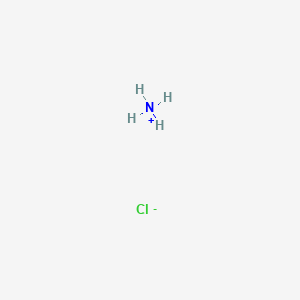
1 2D Structure

Ammonium Chloride

2 Identification
2.1 Computed Descriptors
2.1.1 IUPAC Name
azanium;chloride
2.1.2 InChI
InChI=1S/ClH.H3N/h1H;1H3
2.1.3 InChI Key
NLXLAEXVIDQMFP-UHFFFAOYSA-N
2.1.4 Canonical SMILES
[NH4+].[Cl-]
2.2 Other Identifiers
2.2.1 UNII
01Q9PC255D
2.3 Synonyms
2.3.1 MeSH Synonyms

1. Ammoniac, Sal

2. Chloride, Ammonium

3. Sal Ammoniac

2.3.2 Depositor-Supplied Synonyms

1. 12125-02-9

2. Salmiac

3. Sal Ammoniac

4. Ammonium Muriate

5. Ammoniumchlorid

6. Darammon

7. Ammonium Chloride ((nh4)cl)

8. Ammoniumchloride

9. Nh4cl

10. Amchlor

11. Ammoneric

12. 01q9pc255d

13. Ammoniumklorid

14. Chlorammonic

15. Salammonite

16. Ammonchlor

17. Chloramon

18. Elektrolyt

19. Sal Ammonia

20. Ammon Chlor

21. Ammonii Chloridum

22. Ammonium Chloratum

23. Cloruro De Amonio

24. Muriate Of Ammonia

25. Gen-diur (spain)

26. Ammonium Chloride Fume

27. Chlorammonic [france]

28. Chlorid Amonny [czech]

29. Chlorid Ammonia

30. Chlorid Amonny

31. Ammoniumchlorid [german]

32. Chlorid Ammonia [czech]

33. Ammonium Chloride Tablets

34. Ammonium Chloride Injection

35. Ccris 7262

36. Hsdb 483

37. Einecs 235-186-4

38. Ammonium Chloride 2.14%

39. Ammonium Chloride [usp:jan]

40. Unii-01q9pc255d

41. Ammonium Chlorid

42. Ammonium Choride

43. Ammonium Cloride

44. Amonium Chloride

45. Ai3-08937

46. Chloride Ammonium

47. Ammoniurn Chloride

48. Amrnonium Chloride

49. Arnmonium Chloride

50. Ammonium Chloride (nh4)(hcl2))

51. Ammonia Hydrochloride

52. Conclyte-a (tn)

53. Ammonium Chloride In Plastic Container

54. Ammonia Hydrochloride-

55. Ammonium Chloride Salt

56. Ammonium Chloride 0.9% In Normal Saline

57. Quaternary Ammonium Salt

58. Ec 235-186-4

59. Quaternary Ammonium Chloride

60. Ammonium Chloride Acs Grade

61. Ammonium Chloride (jan/usp)

62. Ammonium Chloride [ii]

63. Ammonium Chloride [mi]

64. Ammonium Chloride, Puratronic?

65. Ammonium Chloride [fcc]

66. Ammonium Chloride [jan]

67. Ammonium Chloride [hsdb]

68. Ammonium Chloride [inci]

69. Dtxsid0020078

70. Ammonium Chloride [vandf]

71. Ammonium Chloride [mart.]

72. Ammonium Muriaticum [hpus]

73. Ammonium Chloride [usp-rs]

74. Ammonium Chloride [who-dd]

75. Bcp29846

76. Ammonium Chloride, Biochemical Grade

77. Mfcd00143604

78. Akos015833109

79. Ammonium Chloride [green Book]

80. Ammonium Chloride [orange Book]

81. Db06767

82. Ammonium Chloride [ep Monograph]

83. Ammonium Chloride [usp Monograph]

84. Ammonium Chloride, 0.5m Aqueous Solution

85. Ft-0622314

86. Ai3-08937;chloride, Ammonium;ammoniac, Sal

87. Ammonia Nitrogen Standard Solution, 1000 Ppm

88. D01139

89. Ammonium Chloride, Trace Metals Grade, 99.97%

90. Ammonium, Ion Chromatography Standard Solution, Specpure?, Nh4+ 1000?g/ml

91. Ammonium Ion Chromatography Standard Solution, Ready-to-use, Traceable To Nist, In H2o

92. Buffer Solution, Ph 6.86 (?0.01 At 25?c), No Color, Specpure?, Nist Traceable

93. Ammonium Ion Solution For Ise, 0.1 M Nh4+, Analytical Standard (for Ion-selective Electrodes)

94. Ammonium Ion Solution For Ise, 1000 Mg/kg N, Analytical Standard (for Ion-selective Electrodes)

2.4 Create Date
2004-09-16
3 Chemical and Physical Properties
Molecular Weight 53.49 g/mol
Molecular Formula ClH4N
Hydrogen Bond Donor Count1
Hydrogen Bond Acceptor Count1
Rotatable Bond Count0
Exact Mass53.0032268 g/mol
Monoisotopic Mass53.0032268 g/mol
Topological Polar Surface Area1 Ų
Heavy Atom Count2
Formal Charge0
Complexity0
Isotope Atom Count0
Defined Atom Stereocenter Count0
Undefined Atom Stereocenter Count0
Defined Bond Stereocenter Count0
Undefined Bond Stereocenter Count0
Covalently Bonded Unit Count2
4 Drug and Medication Information
4.1 Drug Information
1 of 2  
Drug NameAmmonium chloride in plastic container
Active IngredientAmmonium chloride
Dosage FormInjectable
RouteInjection
Strength5meq/ml
Market StatusPrescription
CompanyHospira

2 of 2  
Drug NameAmmonium chloride in plastic container
Active IngredientAmmonium chloride
Dosage FormInjectable
RouteInjection
Strength5meq/ml
Market StatusPrescription
CompanyHospira

4.2 Therapeutic Uses

Mesh Heading: diuretics, expectorants

National Library of Medicine, SIS; ChemIDplus Record for Ammonium chloride (12125-02-9). Available from, as of April 13, 2006: https://chem.sis.nlm.nih.gov/chemidplus/chemidlite.jsp


Ammonium chloride is used as a systemic acidifier in patients with metabolic alkalosis resulting from chloride loss following vomiting, gastric suction, gastric fistula drainage, and pyloric stenosis. Ammonium chloride also has been used in the treatment of diuretic-induced chloride depletion. A solution containing isotonic or hypotonic sodium chloride with potassium chloride usually has been more effective than ammonium chloride in hypokalemic patients. Ammonium chloride also has been used to treat alkalosis resulting from excessive use of alkalinizing drugs.

American Society of Health-System Pharmacists 2014; Drug Information 2014. Bethesda, MD. 2014, p. 2776


Ammonium chloride has been used in a variety of conditions to induce incipient acidosis for the purpose of promoting diuresis, particularly in edematous conditions associated with hypochloremia. Ammonium chloride had limited value as a diuretic when used alone because of its limited period of effectiveness, but the drug has been useful when administered alone or in combination with a xanthine diuretic (e.g., caffeine, pamabrom) for short-term therapy to relieve temporary water-weight gain, edema, bloating, and/or full feeling associated with premenstrual and menstrual periods. Ammonium chloride also has been used for its diuretic effect in Meniere's syndrome.

American Society of Health-System Pharmacists 2014; Drug Information 2014. Bethesda, MD. 2014, p. 2776


MEDICATION (VET): As urinary acidifier, and to increase its rate of flow when it is given in large doses. Reduces incidence of urinary calculi in cattle and sheep. Increases intestinal tract acidity, thus increases calcium absorption and this is utilized in preventing milk fever in cattle. Stimulant and liquefier of bronchial secretions.

Rossoff, I.S. Handbook of Veterinary Drugs. New York: Springer Publishing Company, 1974., p. 16


For more Therapeutic Uses (Complete) data for AMMONIUM CHLORIDE (11 total), please visit the HSDB record page.


4.3 Drug Warning

Ammonium salts are contra-indicated in patients with hepatic or renal impairment.

SWEETMAN, S.C. (ed.) Martindale-The Complete Drug Reference. 36th ed. London: The Pharmaceutical Press, 2009., p. 1551


Patients receiving ammonium chloride should be closely monitored for signs and symptoms of ammonia toxicity such as pallor, sweating, irregular breathing, vomiting, bradycardia, cardiac arrhythmias, local or generalized twitching, asterixis, tonic seizures, and coma.

American Society of Health-System Pharmacists 2014; Drug Information 2014. Bethesda, MD. 2014, p. 2777


Sustained correction of hypochloremia cannot be achieved by administering ammonium chloride alone in patients with secondary metabolic alkalosis resulting from intracellular potassium depletion; concomitant administration of potassium chloride is necessary in such patients.

American Society of Health-System Pharmacists 2014; Drug Information 2014. Bethesda, MD. 2014, p. 2777


Ammonium chloride should be administered with caution to patients with pulmonary insufficiency or cardiac edema. The drug should not be used in patients with primary respiratory acidosis and high total carbon dioxide and buffer base.

American Society of Health-System Pharmacists 2014; Drug Information 2014. Bethesda, MD. 2014, p. 2777


For more Drug Warnings (Complete) data for AMMONIUM CHLORIDE (12 total), please visit the HSDB record page.


4.4 Drug Indication

1. Expectorant in cough syrups. 2. The ammonium ion (NH4+) in the body plays an important role in the maintenance of acid-base balance. The kidney uses ammonium (NH4+) in place of sodium (Na+) to combine with fixed anions in maintaining acid-base balance, especially as a homeostatic compensatory mechanism in metabolic acidosis. The therapeutic effects of Ammonium Chloride depend upon the ability of the kidney to utilize ammonia in the excretion of an excess of fixed anions and the conversion of ammonia to urea by the liver, thereby liberating hydrogen (H+) and chloride (Cl) ions into the extracellular fluid. Ammonium Chloride Injection, USP, after dilution in isotonic sodium chloride injection, may be indicated in the treatment of patients with: (1) hypochloremic states and (2) metabolic alkalosis.


5 Pharmacology and Biochemistry
5.1 Pharmacology

Systemic acidifier. In liver ammonium chloride is converted into urea with the liberation of hydrogen ions ( which lowers the pH) and chloride.


5.2 ATC Code

B - Blood and blood forming organs

B05 - Blood substitutes and perfusion solutions

B05X - I.v. solution additives

B05XA - Electrolyte solutions

B05XA04 - Ammonium chloride


G - Genito urinary system and sex hormones

G04 - Urologicals

G04B - Urologicals

G04BA - Acidifiers

G04BA01 - Ammonium chloride


5.3 Absorption, Distribution and Excretion

Absorption

Completely absorbed within 36 h. In healthy persons, absorption of ammonium chloride given by mouth was practically complete. Only 1 to 3% of the dose was recovered in the feces.


Route of Elimination

Excretion: Urine


Volume of Distribution

Data not found.


Clearance

Data not found.


From human incidentally exposures it was learnt that following oral administration, ammonium chloride is rapidly absorbed from the GI tract, complete absorption occurring within 3 -6 hours. Only 1 -3% of the dose was recovered in the feces. Substantial first pass metabolism occurs in the liver. For animals, after repeated oral administration, ammonium chloride enters readily the body and main targets for its toxicity are kidneys.

European Chemicals Agency (ECHA); Registered Substances, Ammonium chloridee (CAS Number: 12125-02-9) (EC Number: 235-186-4) (October 28, 2014). Available from, as of February 10, 2015: https://echa.europa.eu/en/information-on-chemicals


Ammonium chloride is effectively absorbed from the gastrointestinal tract ... . In healthy persons, absorption of ammonium chloride given by mouth was practically complete. Only 1 to 3% of the dose was recovered in the feces.

Reynolds, J.E.F., Prasad, A.B. (eds.) Martindale-The Extra Pharmacopoeia. 28th ed. London: The Pharmaceutical Press, 1982., p. 687


Following oral administration, ammonium chloride is rapidly absorbed from the GI tract, complete absorption occurring within 3-6 hours. However, an oral dosage form of ammonium chloride is no longer commercially available in the US.

American Society of Health-System Pharmacists 2014; Drug Information 2014. Bethesda, MD. 2014, p. 2777


Oral administration of ammonium chloride to healthy male and female volunteers at 9 mg/kg bw produced transient increases in blood ammonia in about half of the subjects. Patients with cirrhosis showed a greater and more prolonged increase over a higher baseline. This confirms substantial first pass metabolism in the liver.

European Chemicals Bureau; IUCLID Dataset, Ammonium chloride (12125-02-9) (2000 CD-ROM edition). Available from, as of July 17, 2006: https://esis.jrc.ec.europa.eu/


5.4 Metabolism/Metabolites

Ammonium ion is converted to urea in the liver; chloride ion replaces bicarbonate.


When ammonium ion is converted to urea, liberated hydrogen ion reacts with bicarbonate and other body buffers ... chloride ion displaces bicarbonate ion; latter is converted to carbon dioxide ... chloride load to kidneys is increased and appreciable amount escapes reabsorption along with equivalent amount of cation ... and isoosmotic quantity of water.

Osol, A. and J.E. Hoover, et al. (eds.). Remington's Pharmaceutical Sciences. 15th ed. Easton, Pennsylvania: Mack Publishing Co., 1975., p. 862


The toxicity of ammonium chloride depends on the ammonia which enters the living organism and hence the cell. This substance is readily absorbed by the gastrointestinal tract, and utilized in the liver to form amino acids and proteins. When ammonium ions are converted to urea, liberated hydrogen ion reacts with bicarbonate ion to form water and carbon dioxide. The chloride ion displaces the bicarbonate ion. Chloride is loaded into the kidneys. The increased chloride concentration in the extracellular fluid produces an increased load to the renal tubules. Increase excretion of electrolytes and water causes loss of extracellular fluid and promotes the mobilization of edema fluid.

European Chemicals Agency (ECHA); Registered Substances, Ammonium chloridee (CAS Number: 12125-02-9) (EC Number: 235-186-4) (October 28, 2014). Available from, as of February 10, 2015: https://echa.europa.eu/en/information-on-chemicals


/Ammonium chloride/ is metabolized in the liver to form urea and hydrochloric acid.

American Society of Health-System Pharmacists 2014; Drug Information 2014. Bethesda, MD. 2014, p. 2777


Male Sprague-Dawley rats gavaged with 1000 umol (15)N ammonium chloride each day for 5 days were found to excrete low, but significant amounts of excess (15)N nitrate in their urines on the five days of treatment and on the five subsequent days. A total of 0.28 + or - 0.03 umol excess (15)N nitrate (mean + or - SE) per rat was recovered which indicates that ammonia is converted to nitrate in a yield of approximately 0.0080%.

PMID:6690089 Saul RL, Archer MC; Carcinogenesis 5 (1): 77-81 (1984)


5.5 Biological Half-Life

Unknown


5.6 Mechanism of Action

Ammonium chloride increases acidity by increasing the amount of hydrogen ion concentrations. Ammonium chloride can be used as an expectorant due to its irritative action on the bronchial mucosa. This effect causes the production of respiratory tract fluid which in order facilitates the effective cough.


The acid-forming properties of ammonium chloride result from dissociation of the salt to an ammonium cation and a chloride anion. In patients with normal hepatic function, the ammonium cation is converted to urea by the liver and a hydrogen cation is released which reacts with a bicarbonate ion to form water and carbon dioxide. The chloride anion combines with fixed bases in the extracellular fluid, thereby reducing the alkaline reserve of the body. The net result is the displacement of bicarbonate ions by chloride anions. The displacement of bicarbonate by chloride alters the bicarbonate:carbonic acid ratio if the body and acidosis results. The increased chloride concentration in the extracellular fluid produces an increased load to the renal tubules and appreciable amounts of chloride anions escape reabsorption. These anions are excreted along with cations and water. Sodium is the principal cation excreted; however, potassium excretion may also be increased to some degree. By increasing the excretion of both extracellular electrolytes and water, ammonium chloride causes a net loss of extracellular fluid and promotes the mobilization of edema fluid.

American Society of Health-System Pharmacists 2014; Drug Information 2014. Bethesda, MD. 2014, p. 2777


Related Excipient Companies

Upload your portfolio for free, ask us

Excipients by Applications

Click here to find the perfect excipient manufacturers by their capabilities

Parenteral

read-more
read-more

Lubricants & Glidants

read-more
read-more

Thickeners and Stabilizers

read-more
read-more

Fillers, Diluents & Binders

read-more
read-more

Topical

read-more
read-more

Coating Systems & Additives

read-more
read-more

Taste Masking

read-more
read-more

Direct Compression

read-more
read-more

Chewable & Orodispersible Aids

read-more
read-more

Emulsifying Agents

read-more
read-more

Co-Processed Excipients

read-more
read-more

Granulation

read-more
read-more

Controlled & Modified Release

read-more
read-more

API Stability Enhancers

read-more
read-more

Solubilizers

read-more
read-more

Film Formers & Plasticizers

read-more
read-more

Digital Content read-more

Create Content with PharmaCompass, ask us

NEWS #PharmaBuzz

read-more
read-more

Global Sales Information

Do you need Business Intel? Ask us

Market Place

Do you need sourcing support? Ask us

REF. STANDARDS & IMPURITIES

Upload your portfolio for free, ask us

ABOUT THIS PAGE

Looking for 12125-02-9 / Ammonium Chloride API manufacturers, exporters & distributors?

Ammonium Chloride manufacturers, exporters & distributors 1

75

PharmaCompass offers a list of Ammonium Chloride API manufacturers, exporters & distributors, which can be sorted by GMP, USDMF, JDMF, KDMF, CEP (COS), WC, and more, enabling you to easily find the right Ammonium Chloride manufacturer or Ammonium Chloride supplier for your needs.

Send us enquiries for free, and we will assist you in establishing a direct connection with your preferred Ammonium Chloride manufacturer or Ammonium Chloride supplier.

API | Excipient name

Ammonium Chloride

Synonyms

12125-02-9, Salmiac, Sal ammoniac, Ammonium muriate, Ammoniumchlorid, Darammon

Cas Number

12125-02-9

Unique Ingredient Identifier (UNII)

01Q9PC255D

About Ammonium Chloride

An acidifying agent that has expectorant and diuretic effects. Also used in etching and batteries and as a flux in electroplating.

Ammonium Chloride Manufacturers

A Ammonium Chloride manufacturer is defined as any person or entity involved in the manufacture, preparation, processing, compounding or propagation of Ammonium Chloride, including repackagers and relabelers. The FDA regulates Ammonium Chloride manufacturers to ensure that their products comply with relevant laws and regulations and are safe and effective to use. Ammonium Chloride API Manufacturers are required to adhere to Good Manufacturing Practices (GMP) to ensure that their products are consistently manufactured to meet established quality criteria.

click here to find a list of Ammonium Chloride manufacturers with USDMF, JDMF, KDMF, CEP, GMP, and COA related information on PhamaCompass.

Ammonium Chloride Suppliers

A Ammonium Chloride supplier is an individual or a company that provides Ammonium Chloride active pharmaceutical ingredient (API) or Ammonium Chloride finished formulations upon request. The Ammonium Chloride suppliers may include Ammonium Chloride API manufacturers, exporters, distributors and traders.

click here to find a list of Ammonium Chloride suppliers with USDMF, JDMF, KDMF, CEP, GMP, and COA related information on PharmaCompass.

Ammonium Chloride USDMF

A Ammonium Chloride DMF (Drug Master File) is a document detailing the whole manufacturing process of Ammonium Chloride active pharmaceutical ingredient (API) in detail. Different forms of Ammonium Chloride DMFs exist exist since differing nations have different regulations, such as Ammonium Chloride USDMF, ASMF (EDMF), JDMF, CDMF, etc.

A Ammonium Chloride DMF submitted to regulatory agencies in the US is known as a USDMF. Ammonium Chloride USDMF includes data on Ammonium Chloride's chemical properties, information on the facilities and procedures used, and details about packaging and storage. The Ammonium Chloride USDMF is kept confidential to protect the manufacturer’s intellectual property.

click here to find a list of Ammonium Chloride suppliers with USDMF on PharmaCompass.

Ammonium Chloride KDMF

In Korea, the Ministry of Food and Drug Safety (MFDS) is in charge of regulating pharmaceutical products and services.

Pharmaceutical companies submit a Ammonium Chloride Drug Master File in Korea (Ammonium Chloride KDMF) to the MFDS, which includes comprehensive information about the production, processing, facilities, materials, packaging, and testing of Ammonium Chloride. The MFDS reviews the Ammonium Chloride KDMF as part of the drug registration process and uses the information provided in the Ammonium Chloride KDMF to evaluate the safety and efficacy of the drug.

After submitting a Ammonium Chloride KDMF to the MFDS, the registered manufacturer can provide importers or distributors with the registration number without revealing confidential information to Korean business partners. Applicants seeking to register their Ammonium Chloride API can apply through the Korea Drug Master File (KDMF).

click here to find a list of Ammonium Chloride suppliers with KDMF on PharmaCompass.

Ammonium Chloride CEP

A Ammonium Chloride CEP of the European Pharmacopoeia monograph is often referred to as a Ammonium Chloride Certificate of Suitability (COS). The purpose of a Ammonium Chloride CEP is to show that the European Pharmacopoeia monograph adequately controls the purity of Ammonium Chloride EP produced by a given manufacturer. Suppliers of raw materials can prove the suitability of Ammonium Chloride to their clients by showing that a Ammonium Chloride CEP has been issued for it. The manufacturer submits a Ammonium Chloride CEP (COS) as part of the market authorization procedure, and it takes on the role of a Ammonium Chloride CEP holder for the record. Additionally, the data presented in the Ammonium Chloride CEP (COS) is managed confidentially and offers a centralized system acknowledged by numerous nations, exactly like the Ammonium Chloride DMF.

A Ammonium Chloride CEP (COS) is recognised by all 36 nations that make up the European Pharmacopoeia Convention. Ammonium Chloride CEPs may be accepted in nations that are not members of the Ph. Eur. at the discretion of the authorities there.

click here to find a list of Ammonium Chloride suppliers with CEP (COS) on PharmaCompass.

Ammonium Chloride WC

A Ammonium Chloride written confirmation (Ammonium Chloride WC) is an official document issued by a regulatory agency to a Ammonium Chloride manufacturer, verifying that the manufacturing facility of a Ammonium Chloride active pharmaceutical ingredient (API) adheres to the Good Manufacturing Practices (GMP) regulations of the importing country. When exporting Ammonium Chloride APIs or Ammonium Chloride finished pharmaceutical products to another nation, regulatory agencies frequently require a Ammonium Chloride WC (written confirmation) as part of the regulatory process.

click here to find a list of Ammonium Chloride suppliers with Written Confirmation (WC) on PharmaCompass.

Ammonium Chloride GMP

Ammonium Chloride Active pharmaceutical ingredient (API) is produced in GMP-certified manufacturing facility.

GMP stands for Good Manufacturing Practices, which is a system used in the pharmaceutical industry to make sure that goods are regularly produced and monitored in accordance with quality standards. The FDA’s current Good Manufacturing Practices requirements are referred to as cGMP or current GMP which indicates that the company follows the most recent GMP specifications. The World Health Organization (WHO) has its own set of GMP guidelines, called the WHO GMP. Different countries can also set their own guidelines for GMP like China (Chinese GMP) or the EU (EU GMP).

PharmaCompass offers a list of Ammonium Chloride GMP manufacturers, exporters & distributors, which can be sorted by USDMF, JDMF, KDMF, CEP (COS), WC, and more, enabling you to easily find the right Ammonium Chloride GMP manufacturer or Ammonium Chloride GMP API supplier for your needs.

Ammonium Chloride CoA

A Ammonium Chloride CoA (Certificate of Analysis) is a formal document that attests to Ammonium Chloride's compliance with Ammonium Chloride specifications and serves as a tool for batch-level quality control.

Ammonium Chloride CoA mostly includes findings from lab analyses of a specific batch. For each Ammonium Chloride CoA document that a company creates, the USFDA specifies specific requirements, such as supplier information, material identification, transportation data, evidence of conformity and signature data.

Ammonium Chloride may be tested according to a variety of international standards, such as European Pharmacopoeia (Ammonium Chloride EP), Ammonium Chloride JP (Japanese Pharmacopeia) and the US Pharmacopoeia (Ammonium Chloride USP).


Inform the supplier about your product requirements, specifying if you need a product with particular monograph like EP (Ph. Eur.), USP, JP, BP, or any other quality. In addition, clarify whether you need hydrochloride (HCl), anhydricum, base, micronisatum or a specific level of purity. To find reputable suppliers, utilize the filters and select those certified by GMP, FDA, or any other certification as per your requirement.
For your convenience, we have listed synonyms and CAS numbers to help you find the best supplier. The use of synonyms and CAS numbers can be helpful in identifying potential suppliers, but it is crucial to note that they might not always indicate the exact same product. It is important to confirm the product details with the supplier before making a purchase to ensure that it meets your requirements.
Ask Us for Pharmaceutical Supplier and Partner
Ask Us, Find A Supplier / Partner
No Commissions, No Strings Attached, Get Connected for FREE

What are you looking for?

How can we help you?

The request can't be empty

Please read our Privacy Policy carefully

You must agree to the privacy policy

The name can't be empty
The company can't be empty.
The email can't be empty Please enter a valid email.
The mobile can't be empty