


NEWS
- Pharma & Biotech News #PharmaBuzz
- Weekly News Recap #Phispers
- Recent Product Approvals #GreenLight
- Quality Compliance Alerts #Warning!
- All News #Library
DRUGS & DEVELOPMENTS
MARKET INTEL by PharmaCompass

Create content with us, ask us
By PharmaCompass
2021-05-20
Impressions: 1,773 Article
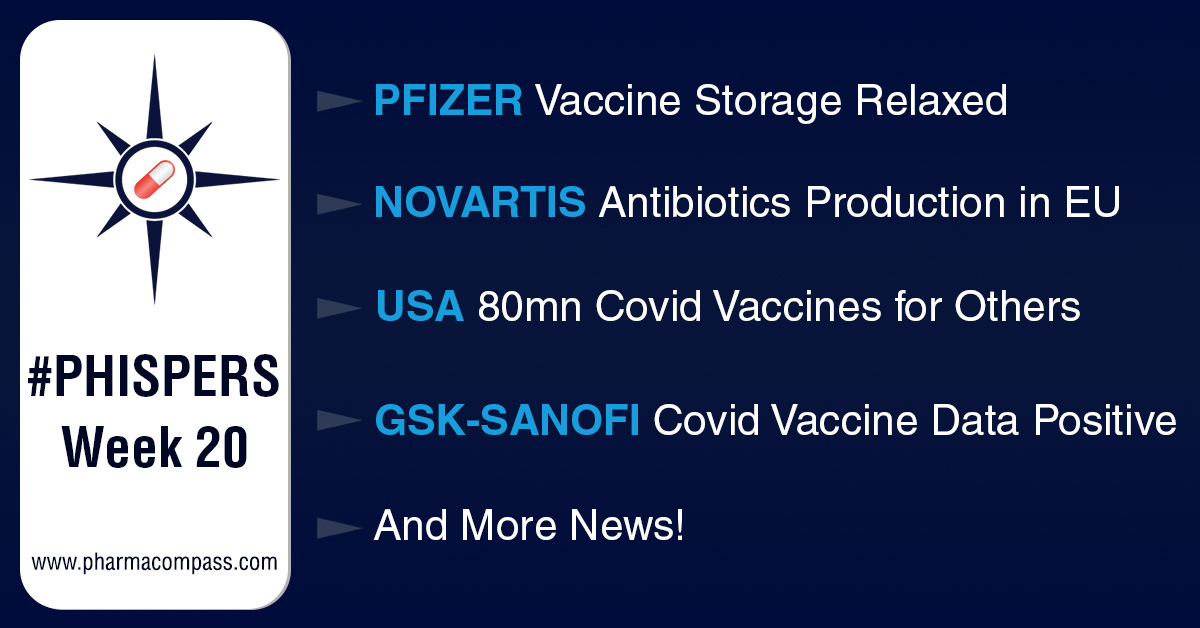
This week Phispers brings you more updates on Covid vaccines. The US has announced plans to share 80 million doses of Covid vaccines with the world, including 60 million doses of AstraZeneca’s vaccine, in order to reduce global disparities in the distribution of jabs.
Both the FDA and the EMA have recommended flexible storage of the Pfizer-BioNTech vaccine in an effort to make the vaccine more widely available.
After a setback in an earlier phase 1/2 trial, GSK and Sanofi’s experimental Covid-19 vaccine has displayed a robust immune response in phase 2 trials. The two drugmakers have said a global phase 3 trial will start in the coming weeks, involving over 35,000 adults.
Apart from Covid, we have news that Bristol Myers Squibb will pay biotech firm Agenus Inc up to US$ 1.56 billion to exclusively develop and commercialize its experimental cancer drug — AGEN1777.
In the US, the Supreme Court has denied Novartis’ subsidiary Sandoz’s petition to review a July 2020 decision concerning its biosimilar Erelzi for Amgen’s Enbrel. Sandoz announced plans to invest US$ 183 million in Austria and Spain to install new technology in order to produce antibiotics.
Novartis to invest US$ 183 million in European antibiotic production capabilities
A number of players in the global pharmaceutical industry have shifted their focus away from antibiotics. But Novartis’ Sandoz unit is doing the opposite. This week, Sandoz announced plans to strengthen its European antibiotics manufacturing network by further expanding production capabilities in Kundl, Austria and in Palafolls, Spain.




Sandoz plans to invest around US$183.32 million (€150 million) in facilities in Austria and Spain over the next three to five years. The company says it will phase out production of oral drug ingredients at a separate plant in Spain, which it plans to close down in 2024. The move comes after the company teamed up with the Austrian government in July 2020 for antibiotics production and inked a US$ 500 million deal for GlaxoSmithKline’s cephalosporin business in February.
As a part of the tie-up with the Austrian government, Sandoz will invest over US$ 122.21 million (€100 million) to equip its factory in Kundl with new manufacturing technology to produce oral amoxicillin, an active pharmaceutical ingredient in the company’s leading penicillin product amoxicillin/clavulanic acid — a generic version of Augmentin.
Sandoz will also spend over US$ 61 million (€50 million) to add new equipment and expand capacity for sterile penicillin APIs and sterile API mixtures at its Palafolls plant in Spain. As a part of its network modernization plan, Sandoz will phase out the current production of oral APIs at the Les Franqueses site in Spain, which it plans to close in 2024.
US to share 80 million Covid shots with other nations; G20 snubs IP waiver for vaccines
This week, the US President Joe Biden said America will share an additional 20 million doses of Covid-19 vaccines with the world in the coming six weeks in order to reduce the global disparities in the distribution of shots. The US has faced a drop in demand for vaccines.
The announcement comes on top of the Biden administration’s prior commitment to share about 60 million doses of the AstraZeneca vaccine by the end of June. These doses have not yet been authorized for use in the US and will be shipped only once they clear a safety review by the US Food and Drug Administration (FDA). Therefore, the US will be sharing 80 million vaccine doses with the world.
The additional 20 million doses will come from existing production of Pfizer, Moderna or Johnson & Johnson vaccine stocks. This will be the first time that the US-controlled doses of vaccines authorized for use in America will be shared overseas.
“We know America will never be fully safe until the pandemic that’s raging globally is under control,” Biden said. “It is the right thing to do. It is the smart thing to do. It is the strong thing to do,” he wrote in a tweet.
Meanwhile, the draft conclusions of a summit show that leaders of the world’s largest economies have backed “voluntary licensing” of Covid-19 vaccine patents. The G20 nations remain divided over the waiving of intellectual property rights for Covid-19 vaccines.
Earlier this month, the Biden administration had announced support for a global waiver on patent protection for Covid-19 vaccines. According to a Reuters report, the draft document lists commitments of G20 nations and other countries. It is to be adopted on Friday at a Global Health Summit in Rome, a major event to coordinate global actions against the pandemic. The draft is still subject to changes.
EMA, FDA recommend flexible storage of Pfizer-BioNTech vaccine to improve accessibility
Both the US Food and Drug Administration (FDA) and the European Medicine Agency’s human medicines committee (CHMP) have recommended a change to the approved storage conditions of the Covid-19 vaccine developed by BioNTech and Pfizer.
The FDA has authorized storage of the Pfizer vaccine at standard freezer temperatures for up to one month, in an effort to make the vaccine more widely available.
Similarly, CHMP’s new recommendations say thawed, undiluted Covid-19 vaccines can be stored at refrigerator temperatures of 2°C to 8°C for one month (31 days), instead of five days at fridge temperatures as previously indicated.
“This change should make this vaccine more widely available to the American public by facilitating the ability of vaccine providers, such as community doctors’ offices, to receive, store and administer the vaccine,” said Peter Marks, director of the FDA’s Center for Biologics Evaluation and Research.
In February, the FDA had approved the storage and transportation of the vaccine at standard freezer temperatures for up to two weeks instead of ultra-cold conditions.
Within this 31-day-period, transport of the thawed, undiluted vials is still possible for a maximum of 12 hours in total. The shelf life of the diluted vaccine does not change and is stable for six hours at 2°C to 30°C from the time of dilution and must be administered within this time, the EMA has said.
Meanwhile, a Spanish study on vaccine cocktails has found that giving a dose of Pfizer's Covid-19 jab to people who have already received a first shot of the AstraZeneca vaccine is highly safe and effective. The Combivacs study, run by Spain’s Carlos III Health Institute, found the presence of IgG antibodies in the bloodstream to be 30-40 times higher in people who got the follow-up Pfizer shot than in a control group who only received one AstraZeneca dose.
Amgen wins key biosimilar case against Sandoz in US Supreme Court
This week, the US Supreme Court denied Novartis’ subsidiary Sandoz’s petition to review the Federal Circuit’s July 2020 decision concerning its biosimilar Erelzi (etanercept-szzs) for reference medicine Enbrel (etanercept).
Erelzi had been approved by the US Food and Drug Administration (FDA) in 2016 as a biosimilar to Amgen’s Enbrel. However, Sandoz has been unable to launch this medicine in the US due to the patent litigation.
“We are disappointed the Supreme Court decided not to review our case,” said Keren Haruvi, President of Sandoz US and Head of North America. “Today’s decision means Erelzi, a more affordable biosimilar, will not be available to US patients with autoimmune and inflammatory diseases until 2029; nonetheless we remain committed to providing important treatment options for patients affected by these diseases.”
Enbrel brought in about US$ 5 billion in 2020 sales for Amgen. The drug has been marketed in the US since 1998 and will have over 30 years of exclusivity from biosimilar competition.
The Affordable Care Act (ACA) is supposed to provide brand-name biologics with only 12 years of monopoly power.
GSK-Sanofi’s jab shows robust immune response in phase 2 study
An experimental Covid-19 vaccine developed by Sanofi and GlaxoSmithKline (GSK) displayed a robust immune response in early-stage clinical trials. The two drugmakers have said a global phase 3 trial will start in the coming weeks and involve over 35,000 adults.
Being the world’s largest vaccine manufacturers, the duo were expecting their vaccine to be approved by the first half of this year. However, a setback in an earlier phase 1/2 trial last year pushed them far behind players like Pfizer, Moderna, AstraZeneca and Johnson & Johnson. In December, Sanofi and GSK were forced to restart their trial.
The drugmakers now expect the vaccine to be approved by the fourth quarter of this year.
The phase 2 interim results have demonstrated 95 to 100 percent seroconversion following a second injection in all age groups (18 to 95 year olds) and across all doses, with acceptable tolerability and with no safety concerns. Seroconversion refers to the vaccine’s ability to prompt the body to produce antibodies against the coronavirus, as measured by blood readings.
“Interestingly, we also observed that our vaccine generated a higher antibody response in those with previous Covid-19 infection, we are analyzing this further as it may suggest our vaccine could serve as a potential booster, regardless of what vaccine someone may have received (beforehand),” Su-Peing Ng, Sanofi’s global head of medical for vaccine said.
The phase 3 trial will test two vaccine formulations — one targeting the original strain of SARS-2 that emerged in Wuhan (China) in late 2019 and a second targeting the B.1.351 variant, which was first spotted in South Africa. The B.1.351 variant has shown the capacity to evade some of the protection generated by several other vaccines.
The companies also plan to conduct additional studies targeting various variants of concern to see if a lower dose of the Sanofi-GSK vaccine would generate a strong booster response, regardless of the brand of vaccine individuals received in their initial Covid-19 vaccination series.
GSK and Sanofi’s vaccine candidate uses the same technology as one of Sanofi’s seasonal influenza vaccines. Sanofi is also working on an mRNA vaccine, in partnership with Translate Bio. The company is also using its production capacity to help Moderna, Johnson & Johnson and BioNTech make their Covid-19 vaccines.
BMS in US$ 1.56 billion deal to sell Agenus’ cancer therapy
Bristol Myers Squibb will pay biotech firm Agenus Inc up to US$ 1.56 billion to exclusively develop and commercialize its experimental cancer drug — AGEN1777.
Under the agreement, BMS will become solely responsible for the development and any subsequent commercialization of AGEN1777 and its related products worldwide. Agenus will receive an upfront payment of US$ 200 million. Moreover, it will receive up to US$ 1.36 billion in development, regulatory and commercial milestones in addition to double-digit royalties on net product sales.
The drug candidate, primarily being tested to improve anti-tumor activity, will also be studied and developed by BMS for immuno-oncology treatments including non-small cell lung cancer, which accounts for about 85 percent of lung cancer cases globally.
Agenus will retain options to conduct clinical studies under the development plan, and to test it in combination with certain other pipeline assets and will co-promote AGEN1777 in the US after commercialization.
Agenus plans to file an application to begin human trials for the therapy with the US Food and Drug Administration in the second quarter of this year, the company said.
The PharmaCompass Newsletter – Sign Up, Stay Ahead
Feedback, help us to improve. Click here
Image Credit : Phisper Infographic by SCORR MARKETING & PharmaCompass is licensed under CC BY 2.0
“ The article is based on the information available in public and which the author believes to be true. The author is not disseminating any information, which the author believes or knows, is confidential or in conflict with the privacy of any person. The views expressed or information supplied through this article is mere opinion and observation of the author. The author does not intend to defame, insult or, cause loss or damage to anyone, in any manner, through this article.”