




NEWS
- Pharma & Biotech News #PharmaBuzz
- Weekly News Recap #Phispers
- Recent Product Approvals #GreenLight
- Quality Compliance Alerts #Warning!
- All News #Library
DRUGS & DEVELOPMENTS
MARKET INTEL by PharmaCompass

Create content with us, ask us

Phispers On Air
Click & Listen
By PharmaCompass
2026-02-12
Impressions: 1,816 Article || 288 Video || 2 Listen
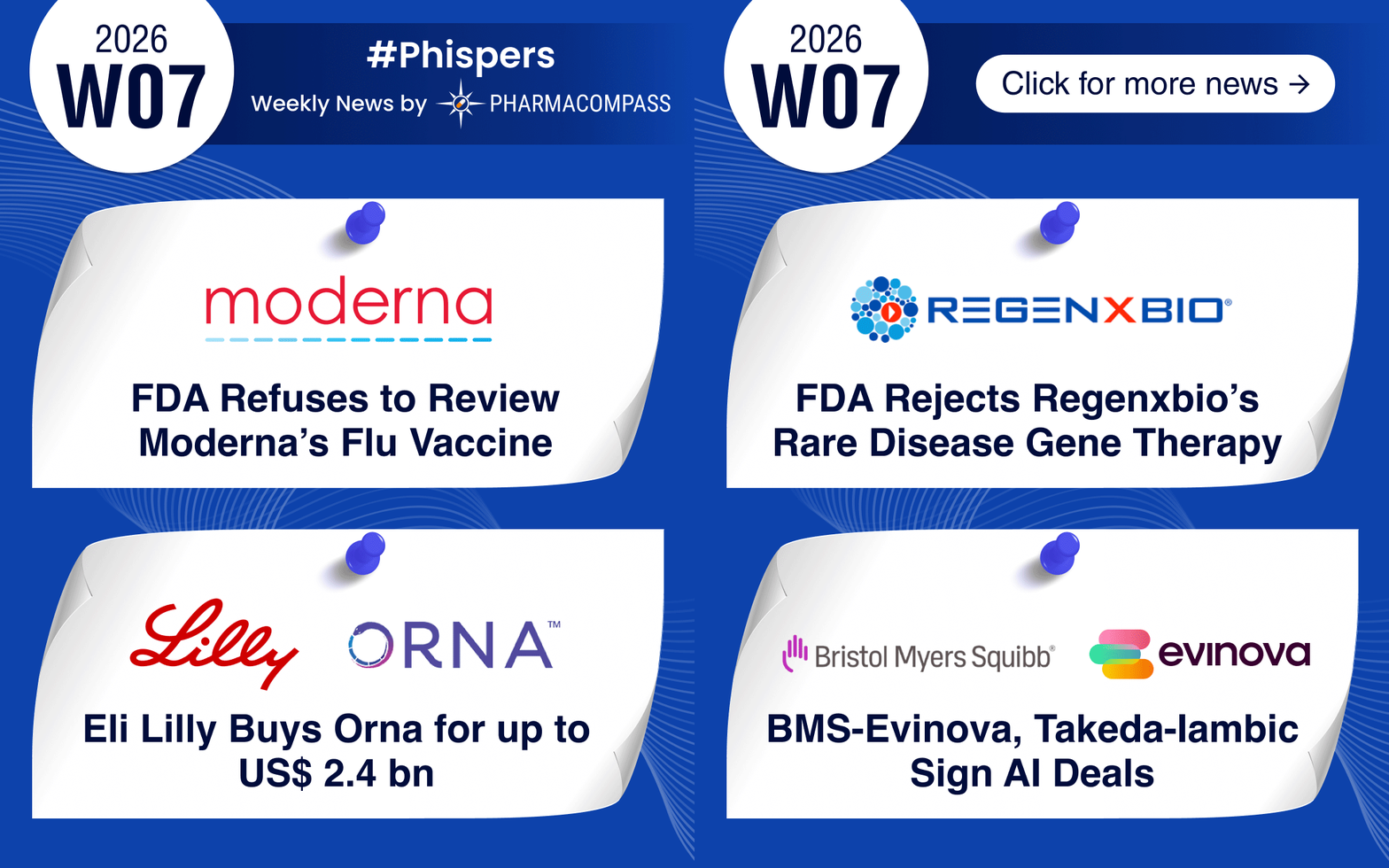
The US Food and Drug Administration (FDA) has said it will not review Moderna’s application for its experimental influenza vaccine — mRNA-1010 — as its control arm did not “reflect the best-available standard of care” in the US.
In deals, Eli Lilly has agreed to acquire Orna Therapeutics for up to US$ 2.4 billion in order to expand into cell therapy portfolio. Lilly also entered into a strategic collaboration with Chinese drugmaker Innovent Biologics to advance novel medicines in oncology and immunology. And Madrigal Pharmaceuticals has expanded its pipeline for liver diseases through an exclusive global license agreement with Suzhou Ribo Life Science and its subsidiary Ribocure Pharmaceuticals.
Drugmakers are also inking artificial intelligence (AI) deals to speed up drug discovery. Japanese drugmaker Takeda Pharmaceutical has entered into a multi-year partnership worth over US$ 1.7 billion with Iambic and Bristol Myers Squibb (BMS) has signed an agreement with Evinova.
After winning dozens of approvals, Merck’s blockbuster cancer drug Keytruda (pembrolizumab) has won its first FDA approval to treat ovarian cancer. The agency rejected Regenxbio’s experimental therapy for Hunter disease (RGX-121).
In clinical trials, Bayer’s experimental blood thinner — asundexian — reduced the risk of recurrent stroke by 26 percent. And Novo Nordisk sued Hims and Hers Health over infringement of patent of its weight loss drug Wegovy.
FDA refuses to review Moderna’s application for its mRNA-based influenza vaccine
FDA has said it will not review Moderna’s application for the approval of its experimental influenza vaccine — mRNA-1010. In its refusal-to-file (RTF) letter, FDA has said the Center for Biologics Evaluation and Research (CBER) does not consider the application to contain an “adequate and well-controlled” trial. This is because “your control arm does not reflect the best-available standard of care in the United States at the time of the study,” it said.
Moderna’s CEO Stephane Bancel has said the letter “did not identify any safety or efficacy concerns”. Last year, Moderna had said mRNA-1010 vaccine was 26.6 percent more effective than an approved annual flu shot from GSK in a late-stage trial.
Lilly buys Orna, strikes immunology deal with Innovent worth up to US$ 8.8 bn
Eli Lilly has announced the acquisition of Orna Therapeutics for up to US$ 2.4 billion in cash. This buyout will give Lilly access to a new class of therapeutics (known as circular RNA) that allows patients’ own cells to generate therapies (to treat underlying diseases) inside the body, without the need to extract them.Its lead drug candidate, ORN-252, is a chimeric antigen receptor T-cell (CAR-T) therapy. Lilly plans to explore CAR-Ts for autoimmune disorders.
Lilly has also entered into a strategic collaboration with Chinese drugmaker Innovent Biologics to advance novel medicines in oncology and immunology. This is the seventh collaboration between the two companies. Under the deal, Lilly will pay US$ 350 million upfront and as much as US$ 8.5 billion more to Innovent if certain milestones are met. Additionally, Innovent will be eligible for tiered royalties on net sales of each product outside of Greater China.
AI deals: Takeda inks deal with Iambic; BMS ties up with Evinova
Takeda and BMS are the latest drugmakers to turn to AI technologies to speed up drug discovery and cut costs. Takeda Pharmaceutical has entered into a multi-year partnership that could be worth over US$ 1.7 billion with San Diego-headquartered Iambic to use AI for designing small-molecule drugs targeting cancer and gastrointestinal diseases. The partnership will utilize Iambic’s broad suite of AI drug discovery technologies and wet lab capabilities.
BMS-Evinova deal: BMS has signed an agreement with Evinova to optimize clinical trials using Evinova’s AI-native clinical development platform. Under the terms of the agreement, BMS will deploy the “cost optimizer” module of Evinova’s study designer solution across the company’s global portfolio. Evinova was launched by AstraZeneca in 2023 to advance digital health solutions.
FDA rejects Regenxbio’s gene therapy for Hunter syndrome over trial design
After putting Regenxbio’s experimental therapy for Hunter syndrome on clinical hold, FDA has declined to approve RGX-121 (clemidsogene lanparvovec). Hunter syndrome is an ultra-rare genetic disorder. In its complete response letter, FDA has said Regenxbio’s biologics license application for RGX-121 was turned down due to uncertainty regarding the trial design.
Keytruda approved to treat ovarian cancer: Blockbuster cancer drug Keytruda (pembrolizumab) has been approved to treat ovarian cancer. According to the FDA, Merck’s Keytruda and Keytruda Qlex (pembrolizumab and berahyaluronidase alfa-pmph) in combination with paclitaxel, with or without bevacizumab, have been approved for treating adult patients with platinum-resistant epithelial ovarian, fallopian tube, or primary peritoneal carcinoma whose tumors express PD-L1 as determined by an FDA-authorized test, and who have received one or two prior systemic treatment regimens. This is Keytruda’s first FDA approval for ovarian cancer
Madrigal inks pact with Suzhou Ribo to expand its MASH pipeline
After bagging an FDA approval in 2024 for Rezdiffra (resmetirom) — the first approved drug to treat metabolic dysfunction–associated steatohepatitis (MASH) — Madrigal Pharmaceuticals has now expanded its MASH pipeline. It has entered into an exclusive global license agreement with Suzhou Ribo Life Science and its subsidiary Ribocure Pharmaceuticals for six preclinical small interfering RNA (siRNA) programs (a precision approach to gene silencing in MASH). Madrigal said it will pay US$ 60 million upfront to Suzhou Ribo Life Science for access to the six siRNA candidates, and another US$ 4.4 billion in milestone payments.
Bayer’s experimental blood thinner reduces risk of stroke by 26%
In a phase 3 trial, Bayer’s experimental blood thinner — asundexian — reduced the risk of recurrence of stroke by 26 percent. The study compared a combination of standard anti-platelet therapy and Bayer's asundexian with anti-platelet therapy alone in patients who had suffered a stroke or had a blocked blood vessels in the brain. The study involved 12,327 patients.
Novo sues Hims & Hers over patent infringement; plans to launch Wegovy in vials
Novo Nordisk has sued Hims and Hers Health over patent infringement after the latter, an American telehealth firm, launched, then cancelled, a US$ 49 copy of its weight-loss drug Wegovy (semaglutide). Novo is also seeking to recover damages from Hims and Hers.
Meanwhile, Novo has said it plans to launch Wegovy in vials. Its competitor Eli Lilly has been selling two lowest doses of its obesity drug Zepbound (tirzepatide) in vials since 2024.
The PharmaCompass Newsletter – Sign Up, Stay Ahead
Feedback, help us to improve. Click here
Image Credit : Phispers Infographic by PharmaCompass license under CC BY 2.0
“ The article is based on the information available in public and which the author believes to be true. The author is not disseminating any information, which the author believes or knows, is confidential or in conflict with the privacy of any person. The views expressed or information supplied through this article is mere opinion and observation of the author. The author does not intend to defame, insult or, cause loss or damage to anyone, in any manner, through this article.”