



NEWS
- Pharma & Biotech News #PharmaBuzz
- Weekly News Recap #Phispers
- Recent Product Approvals #GreenLight
- Quality Compliance Alerts #Warning!
- All News #Library
DRUGS & DEVELOPMENTS
MARKET INTEL by PharmaCompass

Create content with us, ask us

Phispers On Air
Click & Listen
By PharmaCompass
2026-06-18
Impressions: 1,125 Article || 3 Video || 1 Listen
This week’s Phispers is loaded with news from the US Food and Drug Administration (FDA). The agency appears to be revisiting its earlier decisions. First, it gave a go-ahead to uniQure to pursue an accelerated approval for its gene therapy for Huntington’s disease. Earlier this year, FDA had asked for data from another trial for this therapy. Second, FDA’s Vaccines and Related Biological Products Advisory Committee will soon discuss Moderna’s seasonal flu vaccine, after raising concerns in February over its trial design.
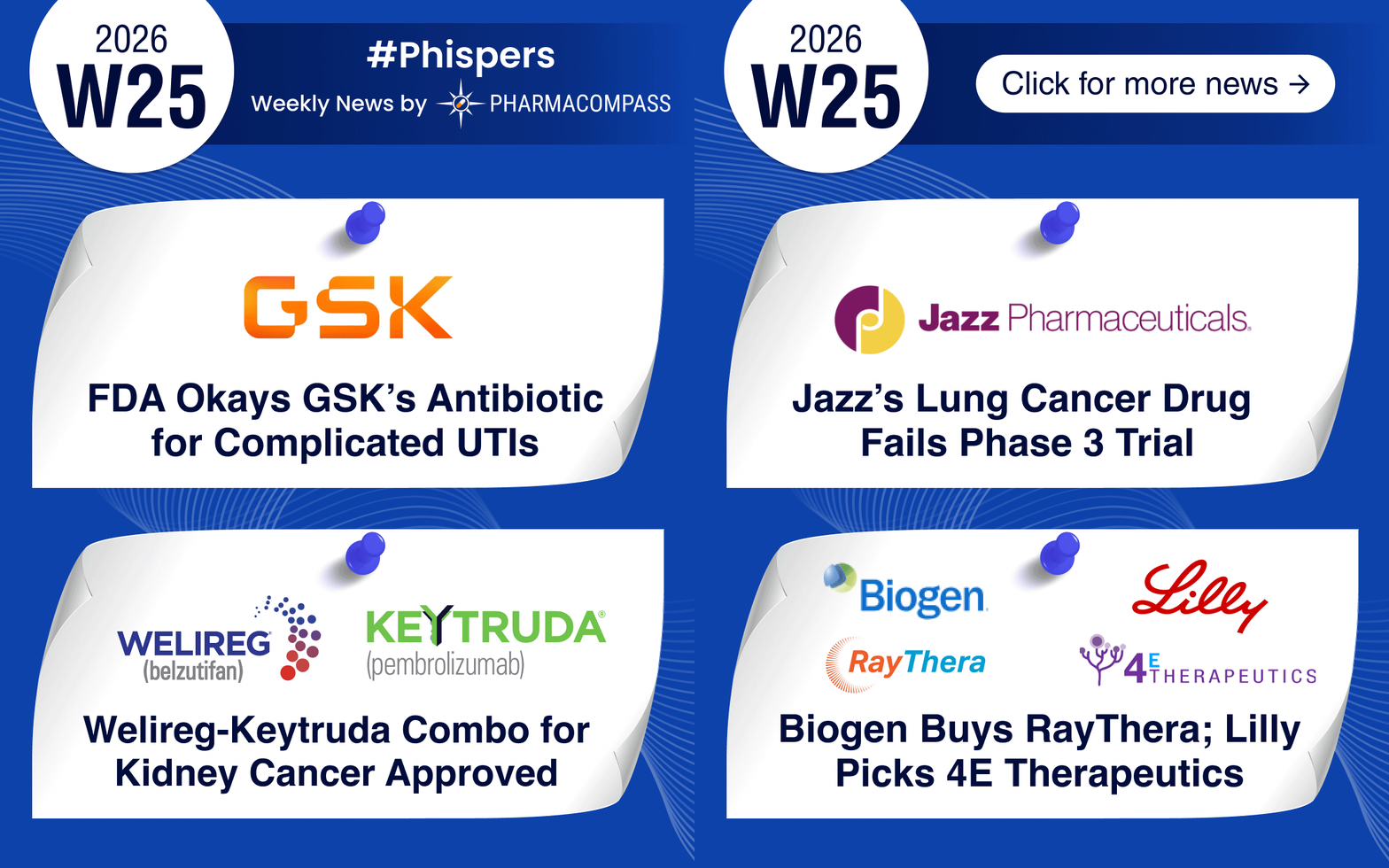
Meanwhile, the agency approved GSK and Spero Therapeutics’ first and only oral carbapenem antibiotic for complicated urinary tract infections (cUTIs). It also approved AstraZeneca’s Truqap (capivasertib) in combination with abiraterone and prednisone as the first and only targeted treatment for adults with a type of prostate cancer.
FDA expanded the label of Sanofi’s Tzield (teplizumab-mzwv). It has now received accelerated approval for use in children aged eight to 17 years who were recently diagnosed with stage 3 type 1 diabetes. FDA also approved Merck’s Keytruda (pembrolizumab) and Keytruda Qlex (pembrolizumab and berahyaluronidase alfa-pmph), each in combination with Merck’s Welireg (belzutifan), for adjuvant treatment of adult patients with a type of kidney cancer.
In deals, Biogen acquired private biotechnology company RayThera for up to US$ 1 billion in a bid to expand its immunology pipeline. And Eli Lilly acquired an Austin-based neuroscience company — 4E Therapeutics — that has a pipeline of early-stage, oral, non-opioid therapies that address the underlying neurological mechanisms that cause pain. And Merck signed a collaboration and license agreement with AI drug design specialist Protillion Biosciences.
In trials, Jazz Pharmaceuticals’ lung cancer drug — Zepzelca (lurbinectedin) — failed to meet the primary goal of improving overall survival in a phase 3 study. The drugmaker also signed a partnership with AbCellera to discover and develop T-cell-engaging (TCE) antibodies for hard-to-treat cancers.
FDA clears path for uniQure’s Huntington’s filing; panel to review Moderna’s flu shot
The FDA appears to be revisiting its earlier decisions. For instance, it has given a go-ahead to uniQure to pursue an accelerated approval for its gene therapy for Huntington’s disease. This marks a shift in its stance in March, when the agency had asked for data from another trial and called it a failed product.
Separately, FDA’s Vaccines and Related Biological Products Advisory Committee will meet on June 18 to discuss Moderna’s seasonal flu vaccine — mFlusiva (mRNA-1010) — after raising concerns in February over its trial design. At that time, FDA had issued a refusal-to-file letter to Moderna for the flu shot.
FDA approves GSK-Spero’s oral antibiotic for complicated UTIs
FDA has approved Utebzi (tebipenem pivoxil) — developed by Spero Therapeutics and licensed to GSK — as the first and only oral carbapenem antibiotic for adults with complicated urinary tract infections (cUTIs), including pyelonephritis (a type of kidney inflammation). Carbapenem is a class of antibiotics which is widely used for the treatment of drug-resistant bacterial infections.
Okays Astra’s drug combo for prostate cancer: FDA has approved AstraZeneca’s Truqap (capivasertib), in combination with abiraterone and prednisone, as the first and only targeted treatment for adults with PTEN-deficient metastatic androgen pathway modulation-naïve or sensitive (mAPMN/S) prostate cancer, a genetically distinct, highly aggressive form of the disease, as detected by an FDA-authorized test. The approval was based on positive results from a phase 3 trial.
Approves Merck’s Welireg-Keytruda combo: FDA has approved Merck’s Keytruda (pembrolizumab) and Keytruda Qlex (pembrolizumab and berahyaluronidase alfa-pmph), each in combination with Merck’s Welireg (belzutifan) for adjuvant treatment of a type of kidney cancer in adults, known as renal cell carcinoma with a clear cell component (ccRCC) at intermediate-high or high risk of recurrence following nephrectomy, or following nephrectomy and resection of metastatic lesions.
FDA grants accelerated approval to Sanofi’s Tzield in kids with type 1 diabetes
FDA has granted accelerated approval to Tzield (teplizumab-mzwv) to delay the decline in endogenous insulin production in children aged eight to 17 years who were recently diagnosed with stage 3 type 1 diabetes. The accelerated approval expands the label of Tzield.
Tzield is a monoclonal antibody that was first approved in November 2022 by FDA to delay the onset of stage 3 type 1 diabetes in those with stage 2 disease.
Biogen expands immunology pipeline through up to US$ 1 bn RayThera acquisition
Biogen has announced the acquisition of private biotechnology company RayThera for up to US$ 1 billion in a bid to expand its immunology pipeline. RayThera’s portfolio includes multiple anti-inflammatory assets that could treat immune-mediated conditions across a range of indications. Its lead candidate is expected to enter phase 1 development in the third quarter of 2026.
Lilly buys 4E Therapeutics: Eli Lilly has acquired 4E Therapeutics, an Austin-based neuroscience company that develops next-generation treatments for chronic pain. The company has a pipeline of early-stage, oral, non-opioid therapies that address the underlying neurological mechanisms that cause pain.
Merck ties up with AI firm: Merck has signed a collaboration and license agreement worth up to US$ 510 million with AI drug design specialist Protillion Biosciences. Protillion will receive an undisclosed upfront payment, with the potential to earn more through research, development and commercial milestones. The deal centers around Protillion’s Prot-MaP technology.
Jazz Pharma’s small cell lung cancer drug fails phase 3 trial
Jazz Pharmaceuticals’ lung cancer drug — Zepzelca (lurbinectedin) — has failed to meet the primary goal of improving overall survival in a phase 3 study. Zepzelca was being evaluated in patients with relapsed (second-line) metastatic small cell lung cancer (SCLC). It had been granted accelerated approval by the FDA. The trial was testing Zepzelca as a monotherapy or in combination with irinotecan. Zepzelca is an approved FDA drug that is used in combination with atezolizumab as first-line maintenance treatment for patients with extensive-stage SCLC.
Signs oncology deal with AbCellera: Jazz Pharma has signed a partnership with AbCellera to discover and develop T-cell-engaging (TCE) antibodies for hard-to-treat cancers. The deal involves an upfront payment of US$ 56 million, and US$ 792 million in other potential payments.
Neumora to cut 35 percent staff: Neumora Therapeutics is abandoning the development of its experimental depression drug — navacaprant — after multiple trial failures. The company also plans to cut 35 percent of its workforce. This will help Neumora save approximately US$ 10 million annually. Navacaprant recently failed two late-stage trials. It had failed another late-stage trial (for major depressive disorder) roughly 18 months ago.
The PharmaCompass Newsletter – Sign Up, Stay Ahead
Feedback, help us to improve. Click here
Image Credit : Phispers Infographic by PharmaCompass license under CC BY 2.0
“ The article is based on the information available in public and which the author believes to be true. The author is not disseminating any information, which the author believes or knows, is confidential or in conflict with the privacy of any person. The views expressed or information supplied through this article is mere opinion and observation of the author. The author does not intend to defame, insult or, cause loss or damage to anyone, in any manner, through this article.”