


NEWS
- Pharma & Biotech News #PharmaBuzz
- Weekly News Recap #Phispers
- Recent Product Approvals #GreenLight
- Quality Compliance Alerts #Warning!
- All News #Library
DRUGS & DEVELOPMENTS
MARKET INTEL by PharmaCompass

Create content with us, ask us
By PharmaCompass
2021-08-19
Impressions: 1,798 Article
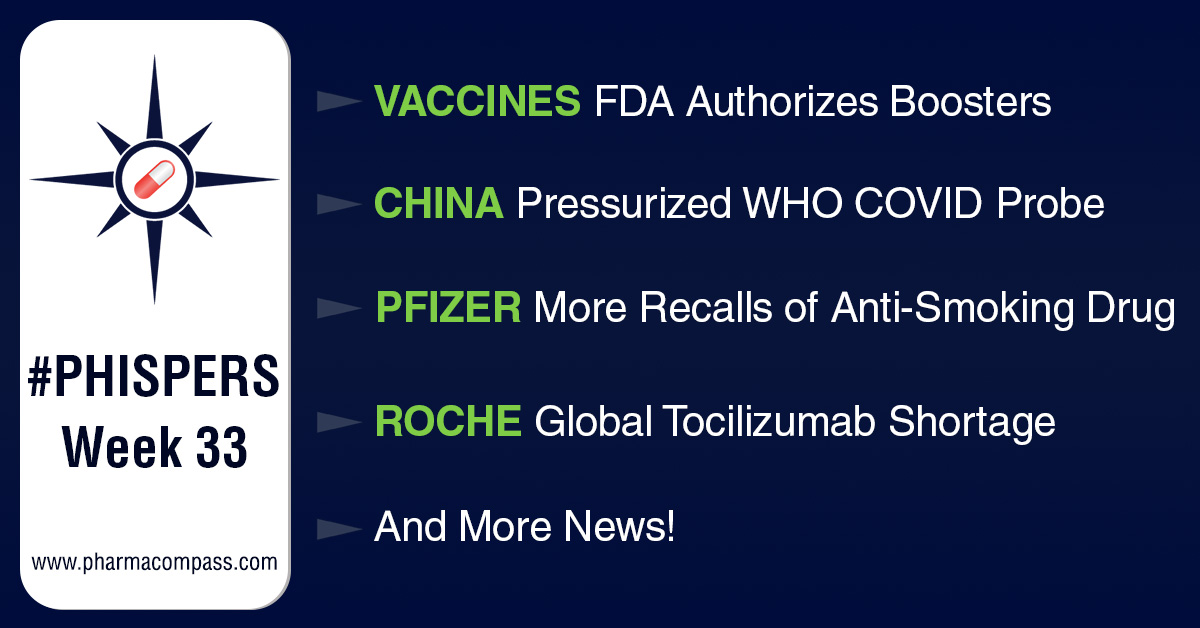
This week, the Biden Administration recommended that all eligible Americans who have received the messenger RNA Covid-19 vaccines from Moderna and Pfizer should get a booster shot eight months after getting the second dose. The recommendation came despite the WHO’s call for a moratorium on booster shots until September-end in order to bridge the vaccine disparities between wealthy and poor countries. Pfizer-BioNTech and Moderna are expected to rake in over US$ 6 billion each from their booster shots in 2023, say news reports.
In other Covid news, a scientist who led the WHO mission to study the origins of Covid-19 in China said the Chinese scientists (who comprised half the mission) had put pressure on others and even refused to discuss the lab leak scenario unless the final report dismissed any need for further investigation. Meanwhile, Roche’s Genentech has warned of a global shortage of Actemra, its arthritis drug being used to treat severely ill Covid-19 patients, due to an unprecedented surge in demand driven by the highly infectious delta variant.
In other news, Pfizer recalled more lots of its anti-smoking drug — Chantix — due to the detection of nitrosamine impurities. The FDA, on its part, approved Par Pharmaceutical’s generic version of the drug to fill in the shortage. And the US Securities and Exchange Commission levied insider trading charges on a former executive of Medivation. The executive allegedly used information on the merger of Medivation with Pfizer in August 2016 to make illicit profits.
FDA authorizes third dose of mRNA vaccines to all Americans from September 20
Over the last few weeks, there has been a lot of focus on Covid-19 booster shots, with the World Health Organization (WHO) reiterating that the current data does not indicate that Covid-19 booster shots are needed. The agency has repeatedly stressed on the need to vaccinate people in the underdeveloped world in order to bring about vaccine parity.




Despite this view, the Biden administration on Wednesday formally introduced recommendations that all eligible Americans who received the Moderna and Pfizer vaccines should get a third booster shot eight months after receiving their second dose.
Covid-related deaths have spiked in the US, hitting over 1,000 on Tuesday, as the Delta variant of the virus (first found in India) continues to spread in parts with low vaccination rates.
The Biden administration will begin offering coronavirus booster shots from September 20, with
officials stressing that the decision was driven by data showing a decline over time in the vaccines’ ability to protect against less serious disease and evidence that boosters work.
According to the Centers for Disease Control and Prevention (CDC), the delta variant of the coronavirus now accounts for 98.8 percent of new infections in the US. In just three months, this highly transmissible variant has outcompeted all the other strains of the virus.
An advisory panel to the CDC voted to recommend the additional shot. Last week, the FDA authorized a third dose of vaccines by Pfizer-BioNTech and Moderna for people with compromised immune systems.
“We also anticipate booster shots will likely be needed for people who received the Johnson & Johnson (J&J) vaccine. Administration of the J&J vaccine did not begin in the US until March 2021, and we expect more data on J&J in the next few weeks,” a CDC statement said.
CDC estimates that over 1 million Americans have gotten an unauthorized third shot of either Pfizer-BioNTech or Moderna’s vaccine. Other countries, such as France, Germany and Israel, have started offering boosters to vulnerable populations. Over one million Israelis have received the third-dose booster shot as the government tries to control the spread of the delta variant through another vaccination drive.
Earlier, Pfizer’s CEO Albert Bourla had tweeted that the company has submitted initial data that suggests a third dose of its vaccine needs to be administered within “six to 12 months after the primary vaccine schedule” in order to “help maintain a high level of protection against the disease.”
Pfizer, Moderna to generate over US$ 6 billion each from boosters in 2023: Pfizer-BioNTech and Moderna are expected to rake in billions of dollars from their Covid-19 booster shots.
Pfizer, along with its German partner BioNTech, and Moderna have generated an order book of over US$ 60 billion in sales of their vaccines just in 2021 and 2022. The agreements include supply of the initial two doses of their vaccines as well as billions of dollars in potential boosters for the rich nations.
Going forward, analysts have forecasted a revenue of over US$ 6.6 billion for the Pfizer-BioNTech shot and US$ 7.6 billion for Moderna in 2023, mostly from booster sales. They eventually see the annual market settling at around US$ 5 billion or higher, with additional players in the fray.
WHO mission on origins of Covid-19 had faced pressure from China, says scientist
In February, a World Health Organization (WHO) mission to study Covid-19’s origins in China, had announced that the possibility that the virus had escaped from a laboratory needed no further investigation. The mission was put under pressure by Chinese scientists who made up half the team to reach that conclusion, Peter Ben Embarek, the scientist who led the WHO mission to Wuhan said in a Danish television documentary, broadcasted last week.
According to Ben Embarek, the Chinese scientists refused to even discuss the lab leak scenario unless the final report dismissed any need for further investigation, an article in The BMJ said. After discussions, Ben Embarek’s Chinese counterpart agreed to discuss the lab leak theory in the report “on the condition we didn’t recommend any specific studies to further that hypothesis,” the scientist said.
Discussing the team’s findings before leaving China, Ben Embarek told reporters that a lab leak was “extremely unlikely.” Asked by Denmark’s TV if that wording was a Chinese requirement, he said: “It was the category we chose to put it in at the end, yes…This did not mean it was not impossible.”
“A lab employee infected in the field while collecting samples in a bat cave—such a scenario belongs both as a lab leak hypothesis and as our first hypothesis of direct infection from bat to human. We’ve seen that hypothesis as a likely hypothesis,” Ben Embarek said.
The WHO’s scientist team had to be approved by China and accompanied by an equal number of Chinese scientists, under conditions China set before allowing them entry. The Chinese scientists had to approve the report before its release.
But the swift dismissal of a lab leak scenario drew widespread criticism, including that from the WHO’s director general, Tedros Adhanom Ghebreyesus, who has since called the finding “premature,” says The BMJ, a global healthcare knowledge provider.
Meanwhile, former FDA commissioner Scott Gottlieb said in a tweet: “The WHO “investigation” was not independent, as it was portrayed. It was ALWAYS a joint investigation between WHO and Chinese Government; each side had equal influence. Why the WHO side let their own conclusions be suppressed in final report is a question history will need to ask.”
Pfizer recalls more lots of its anti-smoking drug due to impurities; FDA expedites generic availability
In June, Pfizer had paused distribution of certain lots of its anti-smoking drug — Chantix — due to the presence of a nitrosamine — N-nitroso-varenicline — above the Pfizer-established ‘acceptable daily intake’ (ADI) level. “Long-term ingestion of N-nitroso-varenicline may be associated with a theoretical potential increased cancer risk in humans, but there is no immediate risk to patients taking this medication,” the FDA had said in a statement.
Last week, Pfizer said it is recalling four additional lots of its anti-smoking treatment, Chantix, after finding elevated levels of nitrosamines in the pills. With these additional recalls, Pfizer has paused distribution of 16 lots of the drug. The lots were distributed to wholesalers in the US and Puerto Rico from June 2019 to June 2021.
Pfizer said so far it has not received any reports of adverse events related to these recalls. Trying to fill the shortage of Chantix, the FDA has approved Par Pharmaceutical’s generic version of the drug — varenicline — “well ahead” of its expected review date. The expedited approval was expected as Chantix had lost its main patent in November last year.
Chantix was approved by the FDA in 2006 as a prescription medication used for a duration of 12 to 24 weeks that helps adults aged 18 and above quit smoking. The drug had generated US$ 1.1 billion in global sales in 2019. However, during the pandemic, its sales fell by 17 percent as several clinics were shut. With the approval of Par Pharmaceutical’s copycat drug, Chantix’s glory days are over, though it is unclear when Endo, which owns Par, will start rolling out the generic.
SEC levies insider trading charges on Medivation’s former head of business
This week, the US Securities and Exchange Commission (SEC) said it is levying an insider trading charge on a former senior executive of California-based, oncology-focused firm Medivation, that was acquired by Pfizer for US$ 14 billion in 2016.
According to the SEC complaint, filed in a district court, Matthew Panuwat, the then-head of business development at Medivation, purchased short-term, out-of-the-money stock options in Incyte Corporation, another mid-cap oncology-focused biopharmaceutical company, just days before the August 22, 2016 announcement that Pfizer would acquire Medivation at a significant premium. Panuwat allegedly purchased the options within minutes of learning highly confidential information concerning the merger.
Following the merger announcement, Incyte’s stock price increased by around 8 percent, and Panuwat raked in US$ 107,066 in “illicit profits,” the SEC said.
The complaint alleges that Panuwat knew investment bankers had flagged Incyte as a similar company and expected the Pfizer deal to fuel an increase in Incyte’s stock price. Medivation’s insider trading policy “expressly forbade” Panuwat from using confidential information to trade in securities of other public companies, the SEC’s complaint says.
Panuwat is being charged with violating antifraud provisions of the federal securities laws. The SEC’s complaint seeks a permanent injunction, civil penalty and an officer and director bar.
Roche’s Genentech warns of global shortage of Actemra due to rise of Delta variant
Roche’s Genentech has said it is confronting an unprecedented surge in demand for its arthritis drug Actemra (tocilizumab), used to treat severely ill Covid-19 patients. This has led to a global shortage that could last months if the pandemic continues to show its current rage.
Actemra was granted emergency use authorization (EUA) by the FDA in June this year for Covid-19, despite some mixed data. However, an 11,000-patient analysis soon showed it cut the risk of death. Less than two months after that analysis, the drug is in short supply.
Actemra’s EUA is for hospitalized adults and pediatric patients (two years of age and older) who are receiving systemic corticosteroids and require supplemental oxygen, non-invasive or invasive mechanical ventilation, or extracorporeal membrane oxygenation (ECMO).
Tocilizumab has also been included in the WHO Therapeutics and Covid-19 living guideline, based on the body of evidence that has been generated throughout the last 18 months.
The latest wave of infections and hospitalizations, driven by the highly infectious delta variant first found in India, has catapulted Actemra’s demand “well over” 400 percent compared with pre-Covid levels in the last two weeks alone, Roche’s Genentech said in a statement.
That has spurred a global shortage of the drug, which could worsen in the coming weeks if the pandemic continues to rage on. As of Monday, Genentech didn’t have any 200 mg and 400 mg Actemra vials available, and it expects the same fate for its 80 mg supply by the end of the week. There will be a global shortage for “ at least the next several weeks,” Roche said in a statement. Replenishment is expected by the end of August.
The PharmaCompass Newsletter – Sign Up, Stay Ahead
Feedback, help us to improve. Click here
Image Credit : Phisper Infographic by SCORR MARKETING & PharmaCompass is licensed under CC BY 2.0
“ The article is based on the information available in public and which the author believes to be true. The author is not disseminating any information, which the author believes or knows, is confidential or in conflict with the privacy of any person. The views expressed or information supplied through this article is mere opinion and observation of the author. The author does not intend to defame, insult or, cause loss or damage to anyone, in any manner, through this article.”