


NEWS
- Pharma & Biotech News #PharmaBuzz
- Weekly News Recap #Phispers
- Recent Product Approvals #GreenLight
- Quality Compliance Alerts #Warning!
- All News #Library
DRUGS & DEVELOPMENTS
MARKET INTEL by PharmaCompass

Create content with us, ask us
By PharmaCompass
2019-02-21
Impressions: 90 Article
Following Eli Lilly’s US$ 8 billion acquisition of Loxo Oncology last month, Bayer has exercised its right to gain exclusive licensing rights for the global development and commercialization of Loxo Oncology’s TRK inhibitors — Vitrakvi and BAY 2731964 (Loxo-195).
Both Vitrakvi and BAY 2731954 are being developed globally for the treatment of adult and pediatric patients with advanced solid tumors harboring neurotrophic receptor tyrosine kinase (NTRK) gene fusions.
Bayer has exercised this option under a change-in-control clause in the collaboration agreement with Loxo to obtain the exclusive licensing rights for the global development and commercialization of these two drugs.
In November 2017, Bayer and Loxo Oncology entered into a global collaboration for the joint development and commercialization of Vitrakvi and BAY 2731954. Following the change of control, Bayer will be solely responsible for the global development and commercialization of both Vitrakvi and BAY 2731954.
As a result of this exercise, the joint co-promotion agreement in the US between Bayer and Loxo Oncology is being converted to full commercialization in the US by Bayer.
Bayer and Loxo gained accelerated FDA approval for Vitrakvi last November as a “tumor-agnostic” therapy to treat patients with tumors with NTRK gene fusion. LOXO-195 is designed as a follow-on therapy for patients who’ve grown resistant to Vitrakvi or any other initial TRK therapy.
Meanwhile, according to Leerink Partners, the projected peak sales for Vitrakvi is US$ 700 million, whereas for Loxo-195 it is US$ 375 million.
Bayer-Orion announce promising results on prostate cancer collaboration: Bayer and partner Orion have released numbers that show their drug — darolutamide — cut the risk of metastasis or death by 59 percent in a late-stage trial in patients with non-metastatic castration-resistant prostate cancer (nmCRPC).
The companies first reported the drug had met the main goal in the ARAMIS trial last October. The trial tested darolutamide against a placebo in more than 1,500 patients with nmCRPC that were already on standard-of-care androgen deprivation therapy and were at high risk of the disease spreading.
The PharmaCompass Newsletter – Sign Up, Stay Ahead
Feedback, help us to improve. Click here
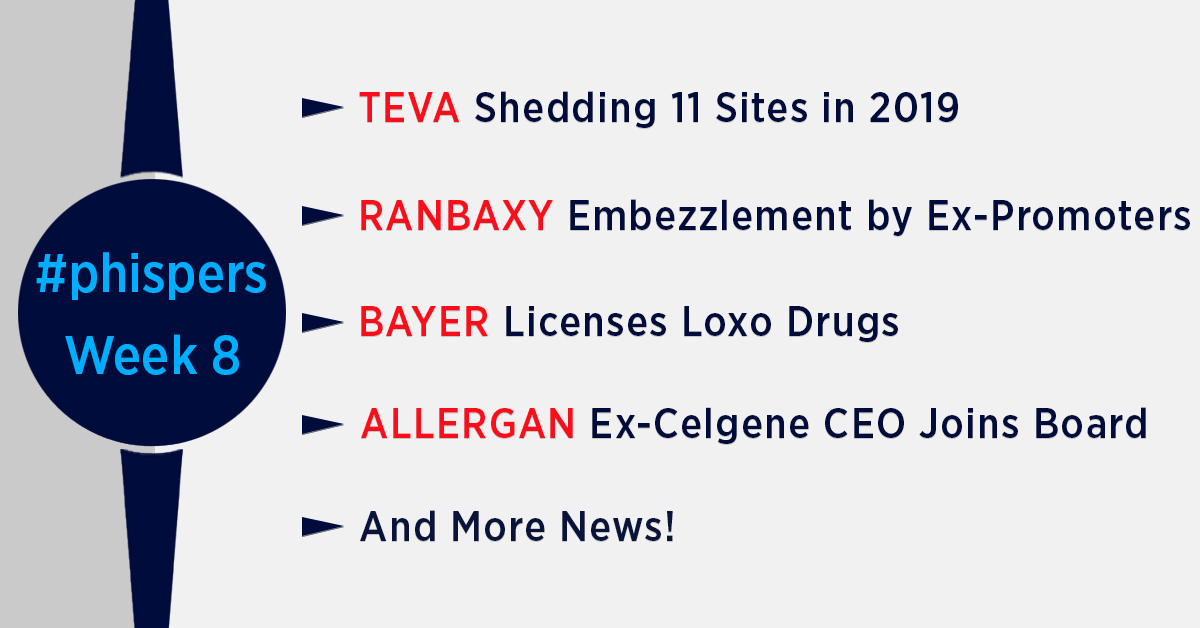
Image Credit : #Phisper Infographic by SCORR MARKETING & PharmaCompass is licensed under CC BY 2.0
“ The article is based on the information available in public and which the author believes to be true. The author is not disseminating any information, which the author believes or knows, is confidential or in conflict with the privacy of any person. The views expressed or information supplied through this article is mere opinion and observation of the author. The author does not intend to defame, insult or, cause loss or damage to anyone, in any manner, through this article.”