


NEWS
- Pharma & Biotech News #PharmaBuzz
- Weekly News Recap #Phispers
- Recent Product Approvals #GreenLight
- Quality Compliance Alerts #Warning!
- All News #Library
DRUGS & DEVELOPMENTS
MARKET INTEL by PharmaCompass

Create content with us, ask us
By PharmaCompass
2021-08-12
Impressions: 2,165 Article
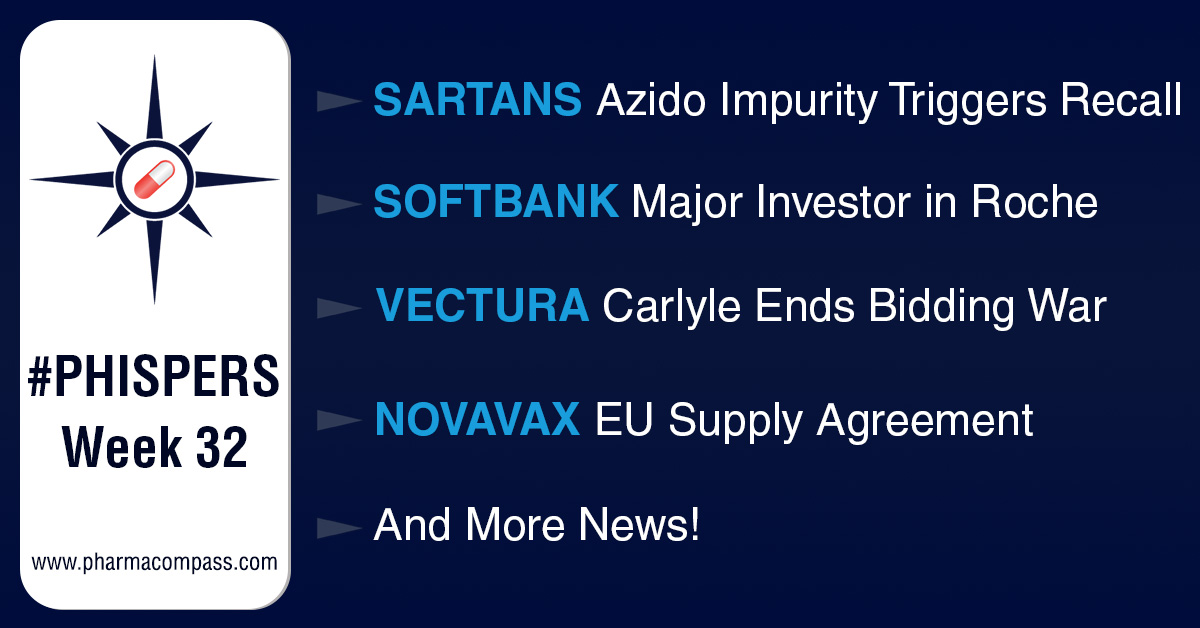
This week, Phispers brings you diverse news on vaccines, acquisitions and drug impurities. After nitrosamine impurities, azido impurities are triggering recalls, with South Korea and the UK recalling a clutch of hypertension drugs.
There would be no takeover battle for inhaled treatments maker Vectura as private equity firm Carlyle stepped back from a bidding war with Philip Morris and declared a final bid at US$ 1.3 billion. The tobacco company’s bid is higher — at US$ 1.45 billion. However, Carlyle has urged shareholders to support its bid due to the potential impact on “wider stakeholders” of selling Vectura to a tobacco group.
SoftBank is now one of the largest investor in Roche, having quietly increased its stake to US$ 5 billion. According to news reports, the Japanese multinational is placing its bet on Roche’s strategy of using data to develop drugs.
Even though Novavax has once again delayed seeking US Food and Drug Administration’s emergency authorization for its two-dose Covid vaccine, the company says it plans to supply 200 million Covid-19 jabs to Europe.
Moderna, on the other hand, has signed an agreement with the Canadian government to start producing its mRNA Covid-19 vaccines there. However, it has failed to meet its vaccine shipment commitments in South Korea, where the health minister had to apologise for vaccine shortages.
And Sanofi’s treatment for muscle disorder (Pompe disease) — Nexviazyme — received the US Food and Drug Administration’s nod last week.
After nitrosamines, azido impurity triggers recall of three BP drugs in Korea
The concerns pertaining to impurities in drugs continue to rattle the industry. After repeated incidents of sartans, ranitidine and metformin being found to be contaminated with nitrosamine impurities over the last few years, a clutch of blood pressure drugs in Asia and the UK are being recalled by French drugmaker Sanofi for a new impurity known to be mutagenic.




According to the Korea Biomedical Review, Sanofi-Aventis is recalling three brands of hypertension tablets in Korea that contain irbesartan —Aprovel, CoAprovel and Rovelito. The recalls have been linked to the detection of azido impurities. According to Sanofi, the recall in Korea is being undertaken as a preventive measure.
During the first half of this year, the three hypertension drugs posted sales worth US$ 14.7 million (16.9 billion won) in South Korea. The recall is likely to impact second-half sales of the manufacturers of the three drugs — Handok and Hanmi Pharmaceutical. Sanofi-Aventis Korea handles domestic sales and marketing of the three drugs.
Azido impurity is a potentially carcinogenic substance. On April 29, the European Directorate for the Quality of Medicines & HealthCare (EDQM) had termed the impurity as a “new mutagenic substance”.
“Our company is managing azido impurity in finished products manufactured after January 2021 below the tolerated level,” an official at Sanofi-Aventis Korea said. “We have yet to derive results for azido impurity in finished goods manufactured before January 2021.”
Meanwhile, the UK’s Medicines and Healthcare Products Regulatory Agency (MHRA) issued its own azido recall notice this week for certain batches of Sanofi’s Aprovel and CoAprovel, and film-coated irbesartan tablets made by Zentiva.
In June this year, MHRA had issued a recall for 31 batches of irbesartan-containing drugs and two batches of losartan-containing medicines made by Bristol Laboratories, Teva UK and Brown & Burk due to contamination with azido-tetrazole. In May, a similar recall notice covering irbesartan, losartan and valsartan had been issued by Health Canada.
Carlyle steps back from bidding war with Philip Morris for Vectura; declares final bid at US$ 1.3 billion
Until early this week, it seemed like there would be a takeover battle between tobacco giant Philip Morris International and private equity firm Carlyle for British inhaled treatments maker Vectura.
However, Carlyle has stepped back from a bidding war with Philip Morris for Vectura after refusing to raise its offer. On Tuesday, Carlyle said its most recent offer of 155 pence a share was “full and fair” and final. Philip Morris had bid at 165 pence-a-share. The tobacco maker had put US$ 1.45 billion on the table for Vectura. Carlyle’s offer is at about US$ 1.33 billion.
As a result, a planned five-day auction that was to be overseen by the UK’s takeover regulator is being called off.
Carlyle also urged shareholders to back its bid due to the potential impact on “wider stakeholders” of selling Vectura to a tobacco group. Vectura has also voiced its support for the Carlyle offer, saying it would be better positioned under the ownership of the private equity firm. It also noted that uncertainties could arise for its stakeholders as a result of it being owned by a cigarette-maker known for its Marlboro brand. Medical bodies and anti-smoking groups have also expressed their opposition to Philip Morris buying Vectura.
Philip Morris has pledged to become more of a life sciences company and to one day stop selling cigarettes. It’s “Beyond Nicotine” strategy looks at branching out from cigarettes into fields such as respiratory drug delivery and “self-care wellness.” It is hoping this strategy will deliver at least US$ 1 billion in net revenues by 2025, CEO Jacek Olczak had recently said in a statement.
Earlier this week, Britain’s takeover regulator had intervened in the battle, saying it would enter a rare head-to-head auction here if the bidders do not make final bids by Tuesday, August 10.
SoftBank builds US$ 5 billion stake in Roche; bets on its strategy to use data to develop drugs
SoftBank Group Corp has built a US$ 5 billion stake in Roche Holding AG, placing its bets on the drug behemoth’s strategy of using data to develop medicines, a Bloomberg Quint report said.
The Minato-headquartered Japanese multinational is now one of Roche’s largest investors. Roche’s sales have recently been boosted by its Covid-19 testing business. The company’s diagnostics unit has been quick in responding to the pandemic, and SoftBank believes Roche’s Genentech division, which focuses on data-based drug discovery and development, is highly undervalued.
SoftBank has been increasing its focus on biotech and healthcare. It has invested in Pacific Biosciences, AbCellera Biologics and Sana Biotechnology. In February, Bloomberg News had reported that SoftBank was planning to spend billions investing in public biotech companies, through its asset management arm — SB Northstar.
Novavax to supply 200 million Covid-19 jabs to EU; delays filing EUA with FDA yet again
Novavax has finally been able to iron out its production problems and has said it will supply 200 million Covid-19 jabs to the European Union. However, the company has delayed filing an emergency use authorization with the US Food and Drug Administration (FDA).
Last week, Novavax once again delayed its timeline for seeking US authorization for its two-dose Covid-19 vaccine. It had previously said it would seek EUA from the FDA in the third quarter of 2021, but now expects to file it in the fourth quarter.
Novavax has received about US$ 1.75 billion in funding from the US government for the development and manufacturing of a Covid vaccine. It was one of the six recipients of such funding under Operation Warp Speed.
In an SEC filing last week, Novavax said the government had “recently instructed the company to prioritize alignment with the (FDA) ... before conducting additional manufacturing and further indicated that the US government will not fund additional US manufacturing until such agreement has been made.”
Last month, the European Commission said it approved a deal to purchase 200 million doses of the Maryland-based biotech’s protein-based vaccine. As per the contract, Novavax is to provide 100 million vaccine doses, with an option for another 100 million, by 2023-end. The company said it is working to complete the rolling submission to the European Medicines Agency (EMA) in the third quarter of this year.
With this move, Europe will be able to diversify its vaccine stock. After dealing with supply problems and safety concerns with AstraZeneca and Johnson & Johnson, the EU had announced it would not renew contracts with the two companies, leaving it heavily dependent on shots from Pfizer and Moderna.
“Our new agreement with Novavax expands our vaccine portfolio to include one more protein-based vaccine, a platform showing promise in clinical trials,” EU Health Commissioner Stella Kyriakides said in a statement.
Moderna defaults on vaccine shipments to Korea; to start producing jabs in Canada
It was a mixed week for Moderna Inc. On the one hand, the company said it had signed an agreement with the Canadian government to start domestic production of mRNA vaccines for Covid-19, on the other hand, it got brickbats in South Korea where the country’s health minister had to apologise for vaccine shortages since the American drugmaker delivered less than half its planned shipment this month due to production issues.
South Korea has a contract to buy 40 million doses from Moderna, and only around 2.4 million have been delivered so far, according to the Korea Disease Control and Prevention Agency (KDCA). Health Minister Kwon Deok-cheol said Moderna had informed South Korea that it would only be able to deliver less than half the 8.5 million doses it was supposed to ship in August. “I once again apologize for causing concerns among the people because of Moderna’s vaccine supply problems,” Kwon said. Moderna had already missed its late-July shipment, as some manufacturing partners were facing delays due to laboratory testing operations.
South Korea is reportedly going through a fourth wave of infections and has posted record numbers of new cases in recent weeks. Meanwhile, its inoculation campaign has slowed down due to vaccine shortages and shipment delays. The country aims to immunize over 70 percent of the population by September.
Moderna to set up vaccine plant in Canada: Moderna has signed a memorandum of understanding with the Canadian government to set up an mRNA vaccine manufacturing facility in the country and also give access to its mRNA development engine. The Moderna vaccine is already being administered in Canada.
The manufacturing facility is expected to be set up on an urgent basis to support the country with direct access to rapid pandemic response capabilities. Moderna has said it is in talks with other governments as well about potential collaborations.
Last week, Moderna said its Covid vaccine was about 93 percent effective six months after the second dose. In the original clinical trial, the vaccine had reported 94 percent efficacy.
Meanwhile, Moderna is planning to double the size of an ongoing trial of its vaccine in children aged six months to less than 12 years. The study will now enroll around 13,275 participants, nearly double the earlier target of 6,975 participants.
Korea strives to become top five vaccine manufacturing bases: South Korea plans to invest US$ 1.9 billion (2.2 trillion won) to become one of the world’s five largest Covid-19 vaccine manufacturing bases by 2025, its President Moon Jae-in said last week.
Moon said he would designate Covid vaccines as one of the three national strategic technologies, along with semiconductors and batteries. He plans to ramp up investment in these areas by giving tax breaks and incentives to help firms localize materials, parts and equipment. “We will strive to take a leap forward to become one of the top five global vaccine producers by 2025,” he said.
Sanofi’s buyout of Translate Bio may not ease pressure on CEO
French drugmaker Sanofi had announced last week that it plans to buy Translate Bio for US$ 3.2 billion in order to increase its focus on the messenger RNA technology. According to a Reuters report, while the deal is being seen as a positive, Sanofi continues to remain under pressure to launch new drugs and overcome setbacks in the Covid-19 vaccine race.
Analysts have cautioned that the acquisition won’t be enough to ease pressure on CEO Paul Hudson to revive the company’s drug pipeline with a blockbuster product. Martial Descoutures, an analyst with Oddo BFH, said: “(But) we do need more visibility in the longer term. Right now, the pipeline is the main issue.”
The two companies have been partnering since 2018 and are developing a Covid-19 mRNA shot together that has entered clinical trials, as well as an influenza vaccine.
Sanofi’s drug bags FDA nod: The US Food and Drug Administration (FDA) has approved Sanofi’s drug Nexviazyme for the treatment of patients one year of age and older with late-onset Pompe disease, a progressive and debilitating muscle disorder that impairs a person’s ability to move and breathe. Nexviazyme is an enzyme replacement therapy. Pompe disease affects an estimated 3,500 people in the United States and can present as infantile-onset Pompe disease (IOPD), the most severe form of Pompe disease with rapid onset in infancy, and late-onset Pompe disease (LOPD), which progressively damages muscles over time.
The PharmaCompass Newsletter – Sign Up, Stay Ahead
Feedback, help us to improve. Click here
Image Credit : Phisper Infographic by SCORR MARKETING & PharmaCompass is licensed under CC BY 2.0
“ The article is based on the information available in public and which the author believes to be true. The author is not disseminating any information, which the author believes or knows, is confidential or in conflict with the privacy of any person. The views expressed or information supplied through this article is mere opinion and observation of the author. The author does not intend to defame, insult or, cause loss or damage to anyone, in any manner, through this article.”