

BLOG
MARKET INTEL by PharmaCompass
CONTENT by Suppliers
- Interview #SpeakPharma
- Video #SupplierSpotlight
- Vlog #PharmaReel
- Company Bio #AboutSupplier
- Services Bio #AboutCapabilities
News

Create content with us, ask us
Microsoft
founder Bill Gates, through the Bill & Melinda Gates Foundation, has done
some exemplary work in poor countries, pertaining to infectious diseases such
as AIDS, malaria and polio.
Perhaps that’s also the closest Microsoft has ever got to the world of healthcare and pharmaceuticals (besides some software and health information-related investments).
But all that can soon change.
Microsoft's US $ 26.2 billion acquisition of LinkedIn – the world’s largest professional social networking platform – has the potential to completely disrupt the pharmaceutical industry the way we know it.
This week, PharmaCompass shares its thoughts on the ways in which this acquisition, executed in the right manner, can transform the pharmaceutical industry forever.
Bridging the academia and industry divide
Not all research is about developing new drugs to address new therapeutic areas. A lot of research also revolves around making patients’ lives more convenient.For instance, any breakthrough that reduces the daily intake of tablets, or reduces pain (such as doing away with the need for an injection) is likely to be lapped up by patients worldwide.
At present, the potential to improve collaboration between industry and academia is enormous, since most work continues to be done in independent silos.
For instance, academia may not share their research – funded by a philanthropic foundation – with large pharma companies. Large companies, in turn, are focused on clinical trials and commercialization of products, and may not even be aware of the kind of research being undertaken at universities.
In the new scenario, the pharmaceutical industry could use LinkedIn as a platform to post a technical problem on which research is being undertaken by one or multiple academic research groups. These research groups, in turn, could use Microsoft Office Online and/or Skype (which got acquired by Microsoft in 2011) to collaborate and compare results with other groups around the world.
This way, the Microsoft-LinkedIn combine can help overcome one of the biggest challenges of research publications – lack of reproducibility.
Of course, one of the biggest assumptions being made by PharmaCompass is that the pharmaceutical industry will migrate to a more open-sourced, collaborative approach to research like the information technology industry, and give up its obsession with intellectual property and data secrecy. After all, lawyers still form a significant cost center for most major pharmaceutical companies.
The acquisition of LinkedIn by Microsoft opens up the possibility of unprecedented peer-review, by publishing results on LinkedIn, thereby changing the landscape of how results are published by academia and pharma companies.
Developing an intelligent -B2B connection platform
How often have you received an email that sends you an invite for a meeting tomorrow – with the word ‘tomorrow’ underlined so you can add the meeting to your calendar, which in turn is also synced to your phone? Next morning, a reminder pops up on your mobile phone.
Whether we like to it or not, the digital revolution continues to invade our privacy, even as it makes life a lot easier.
Applications created by Microsoft are getting smarter each day. These applications have a deep understanding of the content in your emails.
The day is not far when you could identify a supplier of Paracetamol in China in a matter of seconds. A search on Bing, with a secondary search on LinkedIn, could connect you to the sales and marketing contacts of the relevant supplier in China in a matter of seconds.
Creating a marketplace for pharmaceutical freelancers
While it’s easy to find freelancers in fields like journalism, graphic designing and application development, finding freelancers is still not commonplace in the pharmaceutical industry, considering the industry is highly dependent on researchers, regulatory consultants and other specialized service providers.
The dependence is highlighted by the quantum of contract work being undertaken by the pharmaceutical industry having grown manifolds – the size of contract services grew from US $ 21 billion in 2000 to US $ 72 billion in 2012.
Using LinkedIn's recommendation platform, pharma companies can look for specialized service providers.
LinkedIn earns most of its revenues from job postings. Therefore, the creation of a freelancer connection platform could disrupt LinkedIn’s own revenue generation model of being a job site. After all, if companies engage professionals for a specific work, why would they employ them full-time?
At the same time, the LinkedIn acquisition has the potential to open up opportunities for professionals who want to freelance in the pharmaceutical industry, rather than be in a full-time job.
This promises to be a win-win situation for professionals and pharmaceutical companies, provided both parties have proper non-disclosure agreements in place.
Making organizations smarter with LinkedIn groups and Lynda
With periodic introduction of new compliance guidelines in different geographies, the global pharmaceutical industry is becoming increasingly complex. Given this scenario, how do companies stay informed about the latest developments and ensure that their organizations are trained on the relevant skills?
LinkedIn is a good way of staying well-informed. Groups on LinkedIn constantly provide relevant newsfeeds and increase awareness about the latest industry activities.
In addition, LinkedIn’s US $1.5 billion acquisition of Lynda – an online education company that offers thousands of video courses in software, creative and business skills – provides an opportunity where Lynda could provide training content and become the YouTube-equivalent for professional skill development.
Integration of these capabilities into Edge, Microsoft’s browser with a digital assistant – Cortana – will provide on-demand learning to organizations, thereby increasing their level of competitiveness.
Our view
The acquisition of LinkedIn puts Microsoft in a unique position. The amalgamation of the world’s largest professional cloud services company with the world’s largest computing conglomerate does create endless opportunities for industries.
There is certainly some competition in the works. For instance, Facebook is said to be undertaking a closed beta for ‘Facebook at Work (FaW)’ – a platform that enables in-office communication. Facebook is likely to launch the free version of this interoffice network sometime end of this year.
However, tech giants like Facebook and Amazon lack the productivity tools that Microsoft offers to engage effectively with the professional community.
While Google and Apple have some productivity tools in their portfolio, they don’t have the ‘professionals only’ network that LinkedIn offers.
However, Microsoft has a rather dismal track record of integrating acquisitions into its existing businesses. While the opportunities before Microsoft are truly transformational, it remains to be seen how well the acquisitions actually get executed.
The PharmaCompass Newsletter – Sign Up, Stay Ahead
Feedback, help us to improve. Click here
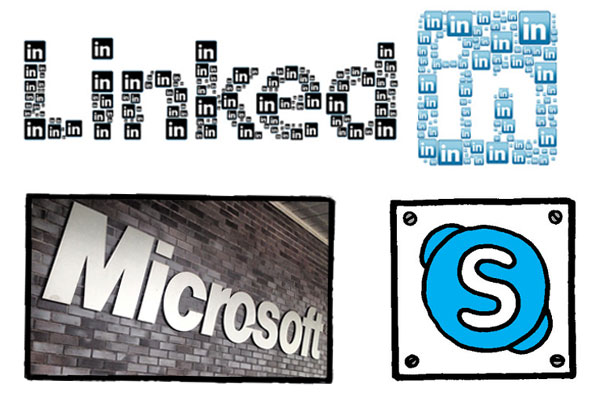
Image Credit : collage of microsoft by Martin Abegglen with linkedin logo by Esther Vargas and Skype icon by Jurgen Appelo is licensed under CC BY 2.0
“ The article is based on the information available in public and which the author believes to be true. The author is not disseminating any information, which the author believes or knows, is confidential or in conflict with the privacy of any person. The views expressed or information supplied through this article is mere opinion and observation of the author. The author does not intend to defame, insult or, cause loss or damage to anyone, in any manner, through this article.”