Find Azithromycin manufacturers, exporters & distributors on PharmaCompass

PharmaCompass

Synopsis

Related ProductsRelated Products

Chemistry

Click the arrow to open the dropdown
read-moreClick the button for full data set
Also known as: Zithromax, 83905-01-5, Sumamed, Hemomycin, Azasite, Zitromax
Molecular Formula
C38H72N2O12
Molecular Weight
749.0  g/mol
InChI Key
MQTOSJVFKKJCRP-BICOPXKESA-N
FDA UNII
J2KLZ20U1M

Azithromycin
A semi-synthetic macrolide antibiotic structurally related to ERYTHROMYCIN. It has been used in the treatment of Mycobacterium avium intracellulare infections, toxoplasmosis, and cryptosporidiosis.
Azithromycin anhydrous is a Macrolide Antimicrobial.
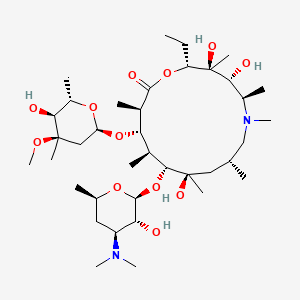
1 2D Structure

Azithromycin

2 Identification
2.1 Computed Descriptors
2.1.1 IUPAC Name
(2R,3S,4R,5R,8R,10R,11R,12S,13S,14R)-11-[(2S,3R,4S,6R)-4-(dimethylamino)-3-hydroxy-6-methyloxan-2-yl]oxy-2-ethyl-3,4,10-trihydroxy-13-[(2R,4R,5S,6S)-5-hydroxy-4-methoxy-4,6-dimethyloxan-2-yl]oxy-3,5,6,8,10,12,14-heptamethyl-1-oxa-6-azacyclopentadecan-15-one
2.1.2 InChI
InChI=1S/C38H72N2O12/c1-15-27-38(10,46)31(42)24(6)40(13)19-20(2)17-36(8,45)33(52-35-29(41)26(39(11)12)16-21(3)48-35)22(4)30(23(5)34(44)50-27)51-28-18-37(9,47-14)32(43)25(7)49-28/h20-33,35,41-43,45-46H,15-19H2,1-14H3/t20-,21-,22+,23-,24-,25+,26+,27-,28+,29-,30+,31-,32+,33-,35+,36-,37-,38-/m1/s1
2.1.3 InChI Key
MQTOSJVFKKJCRP-BICOPXKESA-N
2.1.4 Canonical SMILES
CCC1C(C(C(N(CC(CC(C(C(C(C(C(=O)O1)C)OC2CC(C(C(O2)C)O)(C)OC)C)OC3C(C(CC(O3)C)N(C)C)O)(C)O)C)C)C)O)(C)O
2.1.5 Isomeric SMILES
CC[C@@H]1[C@@]([C@@H]([C@H](N(C[C@@H](C[C@@]([C@@H]([C@H]([C@@H]([C@H](C(=O)O1)C)O[C@H]2C[C@@]([C@H]([C@@H](O2)C)O)(C)OC)C)O[C@H]3[C@@H]([C@H](C[C@H](O3)C)N(C)C)O)(C)O)C)C)C)O)(C)O
2.2 Other Identifiers
2.2.1 UNII
J2KLZ20U1M
2.3 Synonyms
2.3.1 MeSH Synonyms

1. Azadose

2. Azithromycin Dihydrate

3. Azithromycin Monohydrate

4. Azitrocin

5. Azythromycin

6. Cp 62993

7. Cp-62993

8. Cp62993

9. Dihydrate, Azithromycin

10. Goxal

11. Monohydrate, Azithromycin

12. Sumamed

13. Toraseptol

14. Ultreon

15. Vinzam

16. Zentavion

17. Zithromax

18. Zitromax

2.3.2 Depositor-Supplied Synonyms

1. Zithromax

2. 83905-01-5

3. Sumamed

4. Hemomycin

5. Azasite

6. Zitromax

7. Zmax

8. Azithromycine

9. Azithromycinum

10. Azenil

11. Aziromycin

12. Zithromac

13. Azithromycine [french]

14. Azithromycinum [latin]

15. Azithromycin Dihydrate

16. Cp 62993

17. Cp-62993

18. Azitromax

19. Misultina

20. Tromix

21. Azithromycin Anhydrous

22. Azithrocin

23. Aruzilina

24. Macrozit

25. Trozocina

26. Xithrone

27. Zythromax

28. Aziwin

29. Durasite

30. Xz-450

31. Toraseptol

32. Anhydrous Azithromycin

33. 9-deoxo-9a-aza-9a-methyl-9a-homoerythromycin A

34. J2klz20u1m

35. Chebi:2955

36. (2r,3s,4r,5r,8r,10r,11r,12s,13s,14r)-11-(((2s,3r,4s,6r)-4-(dimethylamino)-3-hydroxy-6-methyltetrahydro-2h-pyran-2-yl)oxy)-2-ethyl-3,4,10-trihydroxy-13-(((2r,4r,5s,6s)-5-hydroxy-4-methoxy-4,6-dimethyltetrahydro-2h-pyran-2-yl)oxy)-3,5,6,8,10,12,14-heptamethyl-1-oxa-6-azacyclopentadecan-15-one

37. Azitrocin

38. Xz 405

39. Xz 450

40. Nsc-758625

41. (2r,3s,4r,5r,8r,10r,11r,12s,13s,14r)-11-[(2s,3r,4s,6r)-4-(dimethylamino)-3-hydroxy-6-methyloxan-2-yl]oxy-2-ethyl-3,4,10-trihydroxy-13-[(2r,4r,5s,6s)-5-hydroxy-4-methoxy-4,6-dimethyloxan-2-yl]oxy-3,5,6,8,10,12,14-heptamethyl-1-oxa-6-azacyclopentadecan-15-one

42. Ncgc00090753-01

43. Aritromicina

44. Mixoterin

45. Zithrax

46. Zitrotek

47. Aziwok

48. Aztrin

49. Setron

50. Zitrim

51. Tobil

52. Zifin

53. Cp-62,993

54. Zeto

55. Zmas

56. Zithromax Iv

57. Dsstox_cid_10760

58. Dsstox_rid_78858

59. Dsstox_gsid_30760

60. (2r,3s,4r,5r,8r,10r,11r,12s,13s,14r)-2-ethyl-3,4,10-trihydroxy-3,5,6,8,10,12,14-heptamethyl-15-oxo-11-{[3,4,6-trideoxy-3-(dimethylamino)-beta-d-xylo-hexopyranosyl]oxy}-1-oxa-6-azacyclopentadecan-13-yl 2,6-dideoxy-3-c-methyl-3-o-methyl-alpha-l-ribo-hexopyranoside

61. Z-pak

62. C38h72n2o12

63. Aritromicina [spanish]

64. Azitromicine

65. Azithromycin (as Dihydrate)

66. Trulimax

67. Zentavion

68. Drg-0104

69. (2r,3s,4r,5r,8r,10r,11r,12s,13s,14r)-11-{[(2s,3r,4s,6r)-4-(dimethylamino)-3-hydroxy-6-methyloxan-2-yl]oxy}-2-ethyl-3,4,10-trihydroxy-13-{[(2r,4r,5s,6s)-5-hydroxy-4-methoxy-4,6-dimethyloxan-2-yl]oxy}-3,5,6,8,10,12,14-heptamethyl-1-oxa-6-azacyclopentadecan-15-one

70. 13-[(2,6-dideoxy-3-c-methyl-3-o-methyl-?-l-ribo-hexopyranosyl)oxy]-2-ethyl-3,4,10-trihydroxy-3,5,6,8,10,12,14-heptamethyl-11-[[3,4,6-trideoxy-3-(dimethylamino)-?-d-xylo-hexopyranosyl]oxy]-1-oxa-6-azacyclopentadecan-15-one

71. Azm

72. Smr000471864

73. Zit

74. Azithromycin (zithromax)

75. Cas-83905-01-5

76. Ccris 1961

77. Azithromycin [inn]

78. Hsdb 7205

79. Z-pak (azithromycin)

80. Azithromycin (anhydrous)

81. Sr-05000002067

82. Azithromycin, Antibiotic For Culture Media Use Only

83. Unii-j2klz20u1m

84. Brn 5387583

85. Azithramycine

86. Azitromicina

87. Zithromycin

88. Azifast

89. Azigram

90. Azimakrol

91. Azitromin

92. Azyter

93. Azithromycin [usan:inn:ban]

94. Nsc643732

95. Azithromycin (aids Initiative)

96. Azithromycin,(s)

97. Zmax Sr

98. (2r,3s,4r,5r,8r,10r,11r,12s,13s,14r)-11-[(2s,3r,4s,6r)-4-(dimethylamino)-3-hydroxy-6-methyloxan-2-yl]oxy-2-ethyl-3,4,10-trihydroxy-13-[(2r,4r,5s,6s)-5-hydroxy-4-methoxy-4,6-dimethyloxan-2-yl]oxy-3,5,6

99. (2r,3s,4r,5r,8r,10r,11r,12s,13s,14r)-2-ethyl-3,4,10-trihydroxy-3,5,6,8,10,12,14-heptamethyl-15-oxo-11-{[3,4,6-trideoxy-3-(dimethylamino)-b-d-xylo-hexopyranosyl]oxy}-1-oxa-6-azacyclopentadecan-13-yl 2,6-dideoxy-3-c-methyl-3-o-methyl-a-l-ribo-hexopyranoside

100. Zitromax Avium 600

101. Azitromicina [spanish]

102. Spectrum_000307

103. Azithromycin, Unspecified

104. Dch3

105. Spectrum2_001582

106. Spectrum3_000653

107. Spectrum4_000186

108. Spectrum5_001867

109. Azithromycin [mi]

110. Chembl529

111. Azithromycin [hsdb]

112. Ec 617-500-5

113. Schembl23481

114. Bspbio_002285

115. Kbiogr_000731

116. Kbioss_000787

117. (2r,3s,4r,5r,8r,10r,11r,12s,13s,14r)-13-((2,6-dideoxy-3-c-methyl-3-o-methyl-alpha-l-ribo-hexopyranosyl)oxy)-2-ethyl-3,4,10-trihydroxy-3,5,6,8,10,12,14-heptamethyl-11-((3,4,6-trideoxy-3-(dimethylamino)-beta-d-xylo-hexopyranosyl)oxy)-1-oxa-6-azacyclopentadecan-15-one

118. 1-oxa-6-azacyclopentadecan-15-one, 13-((2,6-dideoxy-3-c-methyl-3-o-methyl-alpha-l-ribo-hexopyranosyl)oxy)-2-ethyl-3,4,10-trihydroxy-3,5,6,8,10,12,14-heptamethyl-11-((3,4,6-trideoxy-3-(dimethylamino)-beta-d-xylo-hexopyranosyl)oxy)-, (2r-(2r*,3s*,4r*,5r*,8r*,10r*,11r*,12s*,13s*,14r*))-

119. Mls001055353

120. Mls001066331

121. Mls001201763

122. Mls001304005

123. Mls001332499

124. Mls001332500

125. Azithromycin [who-dd]

126. Azithromycin, Unspecified Form

127. Bidd:gt0792

128. Divk1c_000233

129. Spectrum1503679

130. N-methyl-11-aza-10-deoxo-10-dihydroerythromycin A

131. Spbio_001544

132. Gtpl6510

133. Dtxsid8030760

134. Azithromycin, Analytical Standard

135. Hms500l15

136. Kbio1_000233

137. Kbio2_000787

138. Kbio2_003355

139. Kbio2_005923

140. Kbio3_001505

141. Ninds_000233

142. Hms1922g12

143. Hms2094m11

144. Hms2232m10

145. Hms3259d10

146. Act03224

147. Azithromycin [usp Monograph]

148. Tox21_111008

149. Tox21_201011

150. Bdbm50373918

151. Ccg-39360

152. Mfcd00873574

153. Zinc85537026

154. Akos015895044

155. Db00207

156. Nc00712

157. Nsc 758625

158. Azithromycin 100 Microg/ml In Methanol

159. Idi1_000233

160. Ncgc00090753-02

161. Ncgc00090753-03

162. Ncgc00090753-04

163. Ncgc00090753-06

164. Ncgc00258564-01

165. Ac-16014

166. Cp62,993

167. Hy-17506

168. Sbi-0206706.p001

169. Cp-62993-3

170. A-9940

171. A-9941

172. N46072

173. Ab00698251-10

174. Ab00698251_11

175. 905a015

176. A905251

177. Q165399

178. Sr-05000002067-1

179. Sr-05000002067-2

180. Brd-k74501079-001-18-1

181. Z1563146014

182. Azithromycin, European Pharmacopoeia (ep) Reference Standard

183. Azithromycin Identity, United States Pharmacopeia (usp) Reference Standard

184. (2r,3s,4r,5r,8r,10r,11r,12s,13s,14r)-11-((2s,3r,4s,6r)-

185. Azithromycin For Peak Identification, European Pharmacopoeia (ep) Reference Standard

186. Azithromycin For System Suitability, European Pharmacopoeia (ep) Reference Standard

187. (2r,3s,4r,5r,8r,10r,11r,12s,13s,14r)-11-((2s,3r,4s,6r)-4-(dimethylamino)-3-hydroxy-6-methyltetrahydro-2h-pyran-2-yloxy)-2-ethyl-3,4,10-trihydroxy-13-((2r,4r,5s,6s)-5-hydroxy-4-methoxy-4,6-dimethyltetrahydro-2h-pyran-2-yloxy)-3,5,6,8,10,12,14-heptamethy...

188. (2r,3s,4r,5r,8r,10r,11r,12s,13s,14r)-11-[(2s,3r,4s,6r)-4-(dimethylamino)-3-hydroxy-6-methyl-tetrahydropyran-2-yl]oxy-2-ethyl-3,4,10-trihydroxy-13-[(2r,4r,5s,6s)-5-hydroxy-4-methoxy-4,6-dimethyl-tetrahydropyran-2-yl]oxy-3,5,6,8,10,12,14-heptamethyl-1-oxa-6-azacyclopentadecan-15-one

189. (2r,3s,4r,5r,8r,10r,11r,12s,13s,14r)-11-[(2s,3r,4s,6r)-4-dimethylamino-3-hydroxy-6-methyloxan-2-yl]oxy-2-ethyl-3,4,10-trihydroxy-13-[(2r,4r,5s,6s)-5-hydroxy-4-methoxy-4,6-dimethyloxan-2-yl]oxy-3,5,6,8,10,12,14-heptamethyl-1-oxa-6-azacyclopentadecan-15-one

190. (2r,3s,4r,5r,8r,10r,11r,12s,13s,14r)13-((2,6-dideoxy-3-c-methyl-3-o-methyl-alpha-l-ribo-hexopyranosyl)oxy)-2-ethyl-3,4,10-trihydroxy-3,5,6,8,10,12,14-heptamethyl-11-((3,4,6-trideoxy-3-(dimethylamino)-beta-d-xylo-hexopyranosyl)oxy)-1-oxa-6-azacyclopentadecan-15-one

191. [2r-(2r*,3s*,4r*,5r*,8r*,10r*,11r*,12s*,13s*,14r*)]-13-[(2,6-dideoxy-3-c-methyl-3-o-methyl-.alpha.-l-ribo-hexopyranosyl)oxy]-2-ethyl-3,4,10-trihydroxy-3,5,6,8,10,12,14-heptamethyl-11-[[3,4,6-

192. 13-[(2,6-dideoxy-3-c-methyl-3-o-methyl-alpha-l-ribo-hexopyranosyl)oxy]-2-ethyl-3,4,10-trihydroxy-3,5,6,8,10,12,14-heptamethyl-11-[[3,4,6-trideoxy-3-(dimethylamino)-beta-d-xylo-hexopyranosyl]oxy]-1-oxa-6-azacyclopentadecan-15-one

2.4 Create Date
2005-06-24
3 Chemical and Physical Properties
Molecular Weight 749.0 g/mol
Molecular Formula C38H72N2O12
XLogP34
Hydrogen Bond Donor Count5
Hydrogen Bond Acceptor Count14
Rotatable Bond Count7
Exact Mass748.50852574 g/mol
Monoisotopic Mass748.50852574 g/mol
Topological Polar Surface Area180 Ų
Heavy Atom Count52
Formal Charge0
Complexity1150
Isotope Atom Count0
Defined Atom Stereocenter Count18
Undefined Atom Stereocenter Count0
Defined Bond Stereocenter Count0
Undefined Bond Stereocenter Count0
Covalently Bonded Unit Count1
4 Drug and Medication Information
4.1 Drug Information
1 of 8  
Drug NameAzasite
Drug LabelAzaSite (azithromycin ophthalmic solution) is a 1% sterile aqueous topical ophthalmic solution of azithromycin formulated in DuraSite (polycarbophil, edetate disodium, sodium chloride). AzaSite is an off-white, viscous liquid with an osmolality of...
Active IngredientAzithromycin
Dosage FormSolution/drops
RouteOphthalmic
Strength1%
Market StatusPrescription
CompanyOak Pharms Akorn

2 of 8  
Drug NameAzithromycin
PubMed HealthAzithromycin (Into the eye)
Drug ClassesAntibiotic
Drug LabelAzithromycin tablets and azithromycin for oral suspension contain the active ingredient azithromycin, an azalide, a subclass of macrolide antibiotics, for oral administration. Azithromycin has the chemical name (2R,3S,4R,5R,8R, 10R,11R,12S,13S,14R)-1...
Active IngredientAzithromycin
Dosage FormInjectable; Tablet; Solution; For suspension
Routeophthalmic; Injection; Oral
Strength1%; eq 600mg base; eq 500mg base; eq 500mg base/vial; eq 100mg base/5ml; eq 250mg base; eq 200mg base/5ml
Market StatusTentative Approval; Prescription
CompanyWockhardt; Sagent Strides; Teva Pharms; Fresenius Kabi Usa; Hospira; Gland Pharma; Teva; Apotex; Sun Pharm Inds; Pliva; Sandoz; Mylan

3 of 8  
Drug NameZithromax
PubMed HealthAzithromycin (By mouth)
Drug ClassesAntibiotic
Drug LabelZITHROMAX (azithromycin tablets and azithromycin for oral suspension) contain the active ingredient azithromycin, an azalide, a subclass of macrolide antibiotics, for oral administration. Azithromycin has the chemical name (2R,3S,4R,5R,8R, 10R,11R,12...
Active IngredientAzithromycin
Dosage FormTablet; Injectable; For suspension
RouteInjection; Oral
Strengtheq 500mg base; eq 100mg base/5ml; eq 250mg base; eq 1gm base/packet; eq 200mg base/5ml; eq 600mg base; eq 500mg base/vial
Market StatusPrescription
CompanyPfizer

4 of 8  
Drug NameZmax
PubMed HealthAzithromycin
Drug ClassesAntibiotic
Drug LabelZmax (azithromycin extended release) for oral suspension contains the active ingredient azithromycin (as azithromycin dihydrate), an azalide, a subclass of macrolide antibiotics. Azithromycin has the chemical name (2R,3S,4R,5R,8R,10R,11R,12S,13S,14R)...
Active IngredientAzithromycin
Dosage FormFor suspension, extended release
RouteOral
Strengtheq 2gm base/bot
Market StatusPrescription
CompanyPf Prism Cv

5 of 8  
Drug NameAzasite
Drug LabelAzaSite (azithromycin ophthalmic solution) is a 1% sterile aqueous topical ophthalmic solution of azithromycin formulated in DuraSite (polycarbophil, edetate disodium, sodium chloride). AzaSite is an off-white, viscous liquid with an osmolality of...
Active IngredientAzithromycin
Dosage FormSolution/drops
RouteOphthalmic
Strength1%
Market StatusPrescription
CompanyOak Pharms Akorn

6 of 8  
Drug NameAzithromycin
PubMed HealthAzithromycin (Into the eye)
Drug ClassesAntibiotic
Drug LabelAzithromycin tablets and azithromycin for oral suspension contain the active ingredient azithromycin, an azalide, a subclass of macrolide antibiotics, for oral administration. Azithromycin has the chemical name (2R,3S,4R,5R,8R, 10R,11R,12S,13S,14R)-1...
Active IngredientAzithromycin
Dosage FormInjectable; Tablet; Solution; For suspension
Routeophthalmic; Injection; Oral
Strength1%; eq 600mg base; eq 500mg base; eq 500mg base/vial; eq 100mg base/5ml; eq 250mg base; eq 200mg base/5ml
Market StatusTentative Approval; Prescription
CompanyWockhardt; Sagent Strides; Teva Pharms; Fresenius Kabi Usa; Hospira; Gland Pharma; Teva; Apotex; Sun Pharm Inds; Pliva; Sandoz; Mylan

7 of 8  
Drug NameZithromax
PubMed HealthAzithromycin (By mouth)
Drug ClassesAntibiotic
Drug LabelZITHROMAX (azithromycin tablets and azithromycin for oral suspension) contain the active ingredient azithromycin, an azalide, a subclass of macrolide antibiotics, for oral administration. Azithromycin has the chemical name (2R,3S,4R,5R,8R, 10R,11R,12...
Active IngredientAzithromycin
Dosage FormTablet; Injectable; For suspension
RouteInjection; Oral
Strengtheq 500mg base; eq 100mg base/5ml; eq 250mg base; eq 1gm base/packet; eq 200mg base/5ml; eq 600mg base; eq 500mg base/vial
Market StatusPrescription
CompanyPfizer

8 of 8  
Drug NameZmax
PubMed HealthAzithromycin
Drug ClassesAntibiotic
Drug LabelZmax (azithromycin extended release) for oral suspension contains the active ingredient azithromycin (as azithromycin dihydrate), an azalide, a subclass of macrolide antibiotics. Azithromycin has the chemical name (2R,3S,4R,5R,8R,10R,11R,12S,13S,14R)...
Active IngredientAzithromycin
Dosage FormFor suspension, extended release
RouteOral
Strengtheq 2gm base/bot
Market StatusPrescription
CompanyPf Prism Cv

4.2 Therapeutic Uses

Anti-Bacterial Agents

National Library of Medicine's Medical Subject Headings online file (MeSH, 2012)


Azithromycin is used orally in children for the treatment of acute otitis media (AOM) caused by Haemophilus influenzae, M. catarrhalis, or S. pneumoniae. /Included in US product labeling/

American Society of Health-System Pharmacists 2012; Drug Information 2012. Bethesda, MD. 2012, p. 225


Azithromycin is used orally for the treatment of pharyngitis and tonsillitis caused by Streptococcus pyogenes (group A beta-hemolytic streptococci) in adults and children when first-line therapy (penicillins) cannot be used. /Included in US product labeling/

American Society of Health-System Pharmacists 2012; Drug Information 2012. Bethesda, MD. 2012, p. 225


Although further study is needed, azithromycin has been used in conjunction with an antimalarial agent (e.g., chloroquine, quinine, artesunate [not commercially available in the US]) for the treatment of uncomplicated malaria caused by Plasmodium falciparum, including multidrug-resistant strains. Azithromycin should not be used alone as monotherapy for the treatment of malaria. /NOT included in US product labeling/

American Society of Health-System Pharmacists 2012; Drug Information 2012. Bethesda, MD. 2012, p. 229


For more Therapeutic Uses (Complete) data for AZITHROMYCIN (52 total), please visit the HSDB record page.


4.3 Drug Warning

Prolonged cardiac repolarization and QT interval, imparting a risk of developing cardiac arrhythmia and torsades de pointes, have been seen in treatment with macrolides, including azithromycin. Cases of torsades de pointes have been spontaneously reported during postmarketing surveillance in patients receiving azithromycin. Providers should consider the risk of QT prolongation which can be fatal when weighing the risks and benefits of azithromycin for at-risk groups including: patients with known prolongation of the QT interval, a history of torsades de pointes, congenital long QT syndrome, bradyarrhythmias or uncompensated heart failure; patients on drugs known to prolong the QT interval; or patients with ongoing proarrhythmic conditions such as uncorrected hypokalemia or hypomagnesemia, clinically significant bradycardia, and in patients receiving Class IA (quinidine, procainamide) or Class III (dofetilide, aminodarone, sotalol) antiarrhythmic agents. Elderly patients may be more susceptible to drug-associated effects on the QT interval.

US FDA; Label Information for ZITHROMAX (azithromycin tablets) and (azithromycin for oral suspension) (Last updated January 2013). Available from, as of March 15, 2013: https://www.accessdata.fda.gov/drugsatfda_docs/label/2013/050710s039,050711s036,050784s023lbl.pdf


Pregnancy risk category: B /NO EVIDENCE OF RISK IN HUMANS. Adequate, well controlled studies in pregnant women have not shown increased risk of fetal abnormalities despite adverse findings in animals, or, in the absents of adequate human studies, animal studies show no fetal risk. The chance of fetal harm is remote but remains a possibility./

Physicians Desk Reference. 58th ed. Thomson PDR. Montvale, NJ 2004., p. 2684


The most frequent adverse effects of azithromycin involve the GI tract (i.e., diarrhea/loose stools, nausea, abdominal pain). While these adverse effects generally are mild to moderate in severity and occur less frequently than with oral erythromycin, adverse GI effects are the most frequent reason for discontinuing azithromycin therapy. Administration of conventional azithromycin tablets or oral suspension with food may improve GI tolerability.

American Society of Health-System Pharmacists 2012; Drug Information 2012. Bethesda, MD. 2012, p. 234


Azithromycin has been detected in human milk. The drug should be used with caution in nursing women.

American Society of Health-System Pharmacists 2012; Drug Information 2012. Bethesda, MD. 2012, p. 237


For more Drug Warnings (Complete) data for AZITHROMYCIN (30 total), please visit the HSDB record page.


4.4 Drug Indication

Azithromycin should be used only to treat or prevent infections that are proven or strongly suspected to be caused by susceptible bacteria in order to prevent the development antimicrobial resistance and maintain the efficacy of azithromycin. Azithromycin is indicated for the treatment of patients with mild to moderate infections caused by susceptible strains of the microorganisms listed in the specific conditions below. Recommended dosages, duration of therapy and considerations for various patient populations may vary among these infections. Refer to the FDA label and "Indications" section of this drug entry for detailed information. **Adults**: Acute bacterial exacerbations of chronic obstructive pulmonary disease due to _Haemophilus influenzae_, _Moraxella catarrhalis_ or _Streptococcus pneumoniae_ Acute bacterial sinusitis due to _Haemophilus influenzae_, _Moraxella catarrhalis_ or _Streptococcus pneumoniae_ Community-acquired pneumonia due to _Chlamydophila pneumoniae_, _Haemophilus influenzae_, _Mycoplasma pneumoniae_ or _Streptococcus pneumoniae_ in patients appropriate for oral therapy Pharyngitis/tonsillitis caused by _Streptococcus pyogenes_ as an alternative to first-line therapy in individuals who cannot use first-line therapy. Uncomplicated skin and skin structure infections due to _Staphylococcus aureus_, _Streptococcus pyogenes_, or _Streptococcus agalactiae_. Abscesses usually require surgical drainage. Urethritis and cervicitis due to _Chlamydia trachomatis_ or _Neisseria gonorrhoeae_. Genital ulcer disease in men due to _Haemophilus ducreyi_ (chancroid). Due to the small number of women included in clinical trials, the efficacy of azithromycin in the treatment of chancroid in women has not been established. **Pediatric Patients** Acute otitis media caused by _Haemophilus influenzae_, _Moraxella catarrhalis_ or _Streptococcus pneumoniae_ Community-acquired pneumonia due to _Chlamydophila pneumoniae_, _Haemophilus influenzae_, _Mycoplasma pneumoniae_ or _Streptococcus pneumoniae_ in patients appropriate for oral therapy. Pharyngitis/tonsillitis caused by _Streptococcus pyogenes_ as an alternative to first-line therapy in individuals who cannot use first-line therapy.


Treatment of bacterial conjunctivitis


Prevention of bronchopulmonary dysplasia


5 Pharmacology and Biochemistry
5.1 Pharmacology

Macrolides stop bacterial growth by inhibiting protein synthesis and translation, treating bacterial infections. Azithromycin has additional immunomodulatory effects and has been used in chronic respiratory inflammatory diseases for this purpose.


5.2 MeSH Pharmacological Classification

Anti-Bacterial Agents

Substances that inhibit the growth or reproduction of BACTERIA. (See all compounds classified as Anti-Bacterial Agents.)


5.3 FDA Pharmacological Classification
5.3.1 Active Moiety
AZITHROMYCIN ANHYDROUS
5.3.2 FDA UNII
J2KLZ20U1M
5.3.3 Pharmacological Classes
Macrolides [CS]; Macrolide Antimicrobial [EPC]
5.4 ATC Code

J01FA10

S76 | LUXPHARMA | Pharmaceuticals Marketed in Luxembourg | Pharmaceuticals marketed in Luxembourg, as published by d'Gesondheetskeess (CNS, la caisse nationale de sante, www.cns.lu), mapped by name to structures using CompTox by R. Singh et al. (in prep.). List downloaded from https://cns.public.lu/en/legislations/textes-coordonnes/liste-med-comm.html. Dataset DOI:10.5281/zenodo.4587355


J - Antiinfectives for systemic use

J01 - Antibacterials for systemic use

J01F - Macrolides, lincosamides and streptogramins

J01FA - Macrolides

J01FA10 - Azithromycin


S - Sensory organs

S01 - Ophthalmologicals

S01A - Antiinfectives

S01AA - Antibiotics

S01AA26 - Azithromycin


5.5 Absorption, Distribution and Excretion

Absorption

Bioavailability of azithromycin is 37% following oral administration. Absorption is not affected by food. Macrolide absorption in the intestines is believed to be mediated by P-glycoprotein (ABCB1) efflux transporters, which are known to be encoded by the _ABCB1_ gene.


Route of Elimination

Biliary excretion of azithromycin, primarily as unchanged drug, is a major route of elimination. Over a 1 week period, approximately 6% of the administered dose is found as unchanged drug in urine.


Volume of Distribution

After oral administration, azithromycin is widely distributed in tissues with an apparent steady-state volume of distribution of 31.1 L/kg. Significantly greater azithromycin concentrations have been measured in the tissues rather than in plasma or serum,. The lung, tonsils and prostate are organs have shown a particularly high rate of azithromycin uptake. This drug is concentrated within macrophages and polymorphonucleocytes, allowing for effective activity against Chlamydia trachomatis. In addition, azithromycin is found to be concentrated in phagocytes and fibroblasts, shown by in vitro incubation techniques. In vivo studies demonstrate that concentration in phagocytes may contribute to azithromycin distribution to inflamed tissues.


Clearance

Mean apparent plasma cl=630 mL/min (following single 500 mg oral and i.v. dose)


Biliary excretion of azithromycin, predominantly as unchanged drug is a major route of elimination following oral administration.

American Society of Health-System Pharmacists 2012; Drug Information 2012. Bethesda, MD. 2012, p. 241


Azithromycin is rapidly absorbed from the GI tract after oral administration; absorption of the drug is incomplete but exceeds that of erythromycin. The absolute oral bioavailability of azithromycin is reported to be approximately 34-52% with single doses of 500 mg to 1.2 g administered as various oral dosage forms. Limited evidence indicates that the low bioavailability of zithromycin results from incomplete GI absorption rather acid degradation of the drug or extensive first-pss metabolism.

American Society of Health-System Pharmacists 2012; Drug Information 2012. Bethesda, MD. 2012, p. 240


Azithromycin appears to be distributed into most body tissues and fluids after oral or IV administration. The extensive tissue uptake of azithromycin has been attributed to cellular uptake of this basic antibiotic into relatively acidic lysosomes as a result of iron trapping and to an energy-dependent pathway associated with the nucleoside transport system.

American Society of Health-System Pharmacists 2012; Drug Information 2012. Bethesda, MD. 2012, p. 240


Because of rapid distribution into tissues and high intracellular concentrations of azithromycin, tissue concentrations of the drug generally exceed plasma concentrations by 10- to 100-fold following single dose administration; with multiple dosing, the tissue-to-plasma ratio increases.

American Society of Health-System Pharmacists 2012; Drug Information 2012. Bethesda, MD. 2012, p. 241


For more Absorption, Distribution and Excretion (Complete) data for AZITHROMYCIN (10 total), please visit the HSDB record page.


5.6 Metabolism/Metabolites

In vitro and in vivo studies to assess the metabolism of azithromycin have not been performed, however, this drug is eliminated by the liver,.


The principal route of biotransformation involves N-demethylation of the desosamine sugar or at the 9a position on the macrolide ring. Other metabolic pathways include O-demethylation and hydrolysis and/or hydroxylation of the cladinose and desosamine sugar moieties and the macrolide ring. Up to 10 metabolites of azithromycin have been identified, and all are microbiologically inactive. While short-term administration of azithromycin produces hepatic accumulation of the drug and increases azithromycin demethylase activity, current evidence indicates that hepatic cytochrome p450 induction of inactivation via cytochrome-metabolite complex formation does not occur. In contrast to erythromycin, azithromycin does not inhibit its own metabolism via this pathway.

American Society of Health-System Pharmacists 2012; Drug Information 2012. Bethesda, MD. 2012, p. 241


5.7 Biological Half-Life

Terminal elimination half-life: 68 hours


An elimination half-life of 54.5 hours has been reported in children 4 months to 15 years of age receiving single or multiple oral doses of azithromycin.

American Society of Health-System Pharmacists 2012; Drug Information 2012. Bethesda, MD. 2012, p. 241


Plasma azithromycin concentrations following a single 500-mg oral or IV dose decline in a polyphasic manner with a terminal elimination half-life averaging 68 hours. The high values for apparent steady-state volume of distribution (31.3-33.3 L/kg) and plasma clearance (630 mL/minute, 10.18 mL/minute per kg) of azithromycin suggest that the prolonged half-life is related to extensive uptake and subsequent release of the drug from tissues. The average tissue half-life of azithromycin is estimated to be 1-4 days. The half-life of the drug in peripheral leukocytes ranges from 34-57 hours.

American Society of Health-System Pharmacists 2012; Drug Information 2012. Bethesda, MD. 2012, p. 241


5.8 Mechanism of Action

In order to replicate, bacteria require a specific process of protein synthesis, enabled by ribosomal proteins. Azithromycin binds to the 23S rRNA of the bacterial 50S ribosomal subunit. It stops bacterial protein synthesis by inhibiting the transpeptidation/translocation step of protein synthesis and by inhibiting the assembly of the 50S ribosomal subunit,. This results in the control of various bacterial infections,. The strong affinity of macrolides, including azithromycin, for bacterial ribosomes, is consistent with their broadspectrum antibacterial activities. Azithromycin is highly stable at a low pH, giving it a longer serum half-life and increasing its concentrations in tissues compared to erythromycin.


Azithromycin usually is bacteriostatic, although the drug may be bactericidal in high concentrations against selected organisms. Bactericidal activity has been observed in vitro against Streptococcus pyogenes, S. pneumoniae, and Haemophilus influenzae. Azithromycin inhibits protein synthesis in susceptible organisms by penetrating the cell wall and binding to 50S ribosomal subunits, thereby inhibiting translocation of aminoacyl transfer-RNA and inhibiting polypeptide synthesis. The site of action of azithromycin appears to be the same as that of the macrolides (i.e., erythromycin, clarithromycin), clindamycin, lincomycin, and chloramphenicol. The antimicrobial activity of azithromycin is reduced at low pH. Azithromycin concentrates in phagocytes, including polymorphonuclear leukocytes, monocytes, macrophages, and fibroblasts. Penetration of the drug into phagocytic cells is necessary for activity against intracellular pathogens (e.g., Staphylococcus aureus, Legionella pneumophila, Chlamydia trachomatis, Salmonella typhi).

American Society of Health-System Pharmacists 2012; Drug Information 2012. Bethesda, MD. 2012, p. 238


DRUG PRODUCT COMPOSITIONS

Do you need Business Intel? Ask us

DOSAGE - FOR SUSPENSION;ORAL - EQ 1GM BASE/PA...DOSAGE - FOR SUSPENSION;ORAL - EQ 1GM BASE/PACKET

USFDA APPLICATION NUMBER - 50693

read-more

DOSAGE - FOR SUSPENSION;ORAL - EQ 100MG BASE/...DOSAGE - FOR SUSPENSION;ORAL - EQ 100MG BASE/5ML

USFDA APPLICATION NUMBER - 50710

read-more

DOSAGE - FOR SUSPENSION;ORAL - EQ 200MG BASE/...DOSAGE - FOR SUSPENSION;ORAL - EQ 200MG BASE/5ML

USFDA APPLICATION NUMBER - 50710

read-more

DOSAGE - TABLET;ORAL - EQ 250MG BASE

USFDA APPLICATION NUMBER - 50711

read-more

DOSAGE - TABLET;ORAL - EQ 600MG BASE **Federa...DOSAGE - TABLET;ORAL - EQ 600MG BASE **Federal Register determination that product was not discontinued or withdrawn for safety or effectiveness reasons**

USFDA APPLICATION NUMBER - 50730

read-more

DOSAGE - INJECTABLE;INJECTION - EQ 500MG BASE...DOSAGE - INJECTABLE;INJECTION - EQ 500MG BASE/VIAL

USFDA APPLICATION NUMBER - 50733

read-more

DOSAGE - TABLET;ORAL - EQ 500MG BASE

USFDA APPLICATION NUMBER - 50784

read-more

DOSAGE - FOR SUSPENSION, EXTENDED RELEASE;ORA...DOSAGE - FOR SUSPENSION, EXTENDED RELEASE;ORAL - EQ 2GM BASE/BOT

USFDA APPLICATION NUMBER - 50797

read-more

Related Excipient Companies

Upload your portfolio for free, ask us

Excipients by Applications

Click here to find the perfect excipient manufacturers by their capabilities

Fillers, Diluents & Binders

read-more
read-more

Coating Systems & Additives

read-more
read-more

Direct Compression

read-more
read-more

Thickeners and Stabilizers

read-more
read-more

Disintegrants & Superdisintegrants

read-more
read-more

Taste Masking

read-more
read-more

Controlled & Modified Release

read-more
read-more

Granulation

read-more
read-more

Chewable & Orodispersible Aids

read-more
read-more

Parenteral

read-more
read-more

Lubricants & Glidants

read-more
read-more

Solubilizers

read-more
read-more

Topical

read-more
read-more

Film Formers & Plasticizers

read-more
read-more

Co-Processed Excipients

read-more
read-more

API Stability Enhancers

read-more
read-more

Emulsifying Agents

read-more
read-more

Empty Capsules

read-more
read-more

Vegetarian Capsules

read-more
read-more

Rheology Modifiers

read-more
read-more

Surfactant & Foaming Agents

read-more
read-more

Coloring Agents

read-more
read-more

Digital Content read-more

Create Content with PharmaCompass, ask us

DATA COMPILATION #PharmaFlow

read-more
read-more

NEWS #PharmaBuzz

read-more
read-more

Global Sales Information

Do you need Business Intel? Ask us

Market Place

Do you need sourcing support? Ask us

Patents & EXCLUSIVITIES

Check the patents & exclusivity for this product

REF. STANDARDS & IMPURITIES

Upload your portfolio for free, ask us

ANALYTICAL

Upload your methods for free, ask us

ABOUT THIS PAGE

Looking for 83905-01-5 / Azithromycin API manufacturers, exporters & distributors?

Azithromycin manufacturers, exporters & distributors 1

11

PharmaCompass offers a list of Azithromycin API manufacturers, exporters & distributors, which can be sorted by GMP, USDMF, JDMF, KDMF, CEP (COS), WC, Price,and more, enabling you to easily find the right Azithromycin manufacturer or Azithromycin supplier for your needs.

Send us enquiries for free, and we will assist you in establishing a direct connection with your preferred Azithromycin manufacturer or Azithromycin supplier.

PharmaCompass also assists you with knowing the Azithromycin API Price utilized in the formulation of products. Azithromycin API Price is not always fixed or binding as the Azithromycin Price is obtained through a variety of data sources. The Azithromycin Price can also vary due to multiple factors, including market conditions, regulatory modifications, or negotiated pricing deals.

API | Excipient name

Azithromycin

Synonyms

Zithromax, 83905-01-5, Sumamed, Hemomycin, Azasite, Zitromax

Cas Number

83905-01-5

Unique Ingredient Identifier (UNII)

J2KLZ20U1M

About Azithromycin

A semi-synthetic macrolide antibiotic structurally related to ERYTHROMYCIN. It has been used in the treatment of Mycobacterium avium intracellulare infections, toxoplasmosis, and cryptosporidiosis.

C38H72N2O12 Manufacturers

A C38H72N2O12 manufacturer is defined as any person or entity involved in the manufacture, preparation, processing, compounding or propagation of C38H72N2O12, including repackagers and relabelers. The FDA regulates C38H72N2O12 manufacturers to ensure that their products comply with relevant laws and regulations and are safe and effective to use. C38H72N2O12 API Manufacturers are required to adhere to Good Manufacturing Practices (GMP) to ensure that their products are consistently manufactured to meet established quality criteria.

click here to find a list of C38H72N2O12 manufacturers with USDMF, JDMF, KDMF, CEP, GMP, COA and API Price related information on PhamaCompass.

C38H72N2O12 Suppliers

A C38H72N2O12 supplier is an individual or a company that provides C38H72N2O12 active pharmaceutical ingredient (API) or C38H72N2O12 finished formulations upon request. The C38H72N2O12 suppliers may include C38H72N2O12 API manufacturers, exporters, distributors and traders.

click here to find a list of C38H72N2O12 suppliers with USDMF, JDMF, KDMF, CEP, GMP, COA and API Price related information on PharmaCompass.

C38H72N2O12 USDMF

A C38H72N2O12 DMF (Drug Master File) is a document detailing the whole manufacturing process of C38H72N2O12 active pharmaceutical ingredient (API) in detail. Different forms of C38H72N2O12 DMFs exist exist since differing nations have different regulations, such as C38H72N2O12 USDMF, ASMF (EDMF), JDMF, CDMF, etc.

A C38H72N2O12 DMF submitted to regulatory agencies in the US is known as a USDMF. C38H72N2O12 USDMF includes data on C38H72N2O12's chemical properties, information on the facilities and procedures used, and details about packaging and storage. The C38H72N2O12 USDMF is kept confidential to protect the manufacturer’s intellectual property.

click here to find a list of C38H72N2O12 suppliers with USDMF on PharmaCompass.

C38H72N2O12 JDMF

The Pharmaceuticals and Medical Devices Agency (PMDA) established the Japan Drug Master File (JDMF), also known as the Master File (MF), to permit Japanese and foreign manufacturers of drug substances, intermediates, excipients, raw materials, and packaging materials (‘Products’) to voluntarily register confidential information about the production and management of their products in Japan.

The C38H72N2O12 Drug Master File in Japan (C38H72N2O12 JDMF) empowers C38H72N2O12 API manufacturers to present comprehensive information (e.g., production methods, data, etc.) to the review authority, i.e., PMDA (Pharmaceuticals & Medical Devices Agency).

PMDA reviews the C38H72N2O12 JDMF during the approval evaluation for pharmaceutical products. At the time of C38H72N2O12 JDMF registration, PMDA checks if the format is accurate, if the necessary items have been included (application), and if data has been attached.

click here to find a list of C38H72N2O12 suppliers with JDMF on PharmaCompass.

C38H72N2O12 KDMF

In Korea, the Ministry of Food and Drug Safety (MFDS) is in charge of regulating pharmaceutical products and services.

Pharmaceutical companies submit a C38H72N2O12 Drug Master File in Korea (C38H72N2O12 KDMF) to the MFDS, which includes comprehensive information about the production, processing, facilities, materials, packaging, and testing of C38H72N2O12. The MFDS reviews the C38H72N2O12 KDMF as part of the drug registration process and uses the information provided in the C38H72N2O12 KDMF to evaluate the safety and efficacy of the drug.

After submitting a C38H72N2O12 KDMF to the MFDS, the registered manufacturer can provide importers or distributors with the registration number without revealing confidential information to Korean business partners. Applicants seeking to register their C38H72N2O12 API can apply through the Korea Drug Master File (KDMF).

click here to find a list of C38H72N2O12 suppliers with KDMF on PharmaCompass.

C38H72N2O12 CEP

A C38H72N2O12 CEP of the European Pharmacopoeia monograph is often referred to as a C38H72N2O12 Certificate of Suitability (COS). The purpose of a C38H72N2O12 CEP is to show that the European Pharmacopoeia monograph adequately controls the purity of C38H72N2O12 EP produced by a given manufacturer. Suppliers of raw materials can prove the suitability of C38H72N2O12 to their clients by showing that a C38H72N2O12 CEP has been issued for it. The manufacturer submits a C38H72N2O12 CEP (COS) as part of the market authorization procedure, and it takes on the role of a C38H72N2O12 CEP holder for the record. Additionally, the data presented in the C38H72N2O12 CEP (COS) is managed confidentially and offers a centralized system acknowledged by numerous nations, exactly like the C38H72N2O12 DMF.

A C38H72N2O12 CEP (COS) is recognised by all 36 nations that make up the European Pharmacopoeia Convention. C38H72N2O12 CEPs may be accepted in nations that are not members of the Ph. Eur. at the discretion of the authorities there.

click here to find a list of C38H72N2O12 suppliers with CEP (COS) on PharmaCompass.

C38H72N2O12 WC

A C38H72N2O12 written confirmation (C38H72N2O12 WC) is an official document issued by a regulatory agency to a C38H72N2O12 manufacturer, verifying that the manufacturing facility of a C38H72N2O12 active pharmaceutical ingredient (API) adheres to the Good Manufacturing Practices (GMP) regulations of the importing country. When exporting C38H72N2O12 APIs or C38H72N2O12 finished pharmaceutical products to another nation, regulatory agencies frequently require a C38H72N2O12 WC (written confirmation) as part of the regulatory process.

click here to find a list of C38H72N2O12 suppliers with Written Confirmation (WC) on PharmaCompass.

C38H72N2O12 NDC

National Drug Code is a comprehensive database maintained by the FDA that contains information on all drugs marketed in the US. This directory includes information about finished drug products, unfinished drug products, and compounded drug products, including those containing C38H72N2O12 as an active pharmaceutical ingredient (API).

Finished drug products

The FDA updates the NDC directory daily. The NDC numbers for C38H72N2O12 API and other APIs are published in this directory by the FDA.

Unfinished drugs

The NDC unfinished drugs database includes product listing information submitted for all unfinished drugs, such as active pharmaceutical ingredients (APIs), drugs intended for further processing and bulk drug substances for compounding.

Pharmaceutical companies that manufacture C38H72N2O12 as an active pharmaceutical ingredient (API) must furnish the FDA with an updated record of all drugs that they produce, prepare, propagate, compound, or process for commercial distribution in the US at their facilities.

Compounded drug products

The NDC directory also contains data on finished compounded human drug products that contain C38H72N2O12 and are produced by outsourcing facilities. While these outsourcing facilities are not mandated to assign a C38H72N2O12 NDC to their finished compounded human drug products, they may choose to do so.

click here to find a list of C38H72N2O12 suppliers with NDC on PharmaCompass.

C38H72N2O12 GMP

C38H72N2O12 Active pharmaceutical ingredient (API) is produced in GMP-certified manufacturing facility.

GMP stands for Good Manufacturing Practices, which is a system used in the pharmaceutical industry to make sure that goods are regularly produced and monitored in accordance with quality standards. The FDA’s current Good Manufacturing Practices requirements are referred to as cGMP or current GMP which indicates that the company follows the most recent GMP specifications. The World Health Organization (WHO) has its own set of GMP guidelines, called the WHO GMP. Different countries can also set their own guidelines for GMP like China (Chinese GMP) or the EU (EU GMP).

PharmaCompass offers a list of C38H72N2O12 GMP manufacturers, exporters & distributors, which can be sorted by USDMF, JDMF, KDMF, CEP (COS), WC, API price, and more, enabling you to easily find the right C38H72N2O12 GMP manufacturer or C38H72N2O12 GMP API supplier for your needs.

C38H72N2O12 CoA

A C38H72N2O12 CoA (Certificate of Analysis) is a formal document that attests to C38H72N2O12's compliance with C38H72N2O12 specifications and serves as a tool for batch-level quality control.

C38H72N2O12 CoA mostly includes findings from lab analyses of a specific batch. For each C38H72N2O12 CoA document that a company creates, the USFDA specifies specific requirements, such as supplier information, material identification, transportation data, evidence of conformity and signature data.

C38H72N2O12 may be tested according to a variety of international standards, such as European Pharmacopoeia (C38H72N2O12 EP), C38H72N2O12 JP (Japanese Pharmacopeia) and the US Pharmacopoeia (C38H72N2O12 USP).


Inform the supplier about your product requirements, specifying if you need a product with particular monograph like EP (Ph. Eur.), USP, JP, BP, or any other quality. In addition, clarify whether you need hydrochloride (HCl), anhydricum, base, micronisatum or a specific level of purity. To find reputable suppliers, utilize the filters and select those certified by GMP, FDA, or any other certification as per your requirement.
For your convenience, we have listed synonyms and CAS numbers to help you find the best supplier. The use of synonyms and CAS numbers can be helpful in identifying potential suppliers, but it is crucial to note that they might not always indicate the exact same product. It is important to confirm the product details with the supplier before making a purchase to ensure that it meets your requirements.
Ask Us for Pharmaceutical Supplier and Partner
Ask Us, Find A Supplier / Partner
No Commissions, No Strings Attached, Get Connected for FREE

What are you looking for?

How can we help you?

The request can't be empty

Please read our Privacy Policy carefully

You must agree to the privacy policy

The name can't be empty
The company can't be empty.
The email can't be empty Please enter a valid email.
The mobile can't be empty